
Trusted by 50K+ Pharmacy StudentsHigh Quality Notes, MCQs, Mock Tests & Study ResourcesGo Premium (Ads Free)
Pharmacy Freak

Mechanism of Action of Leuprolide (Lupron)
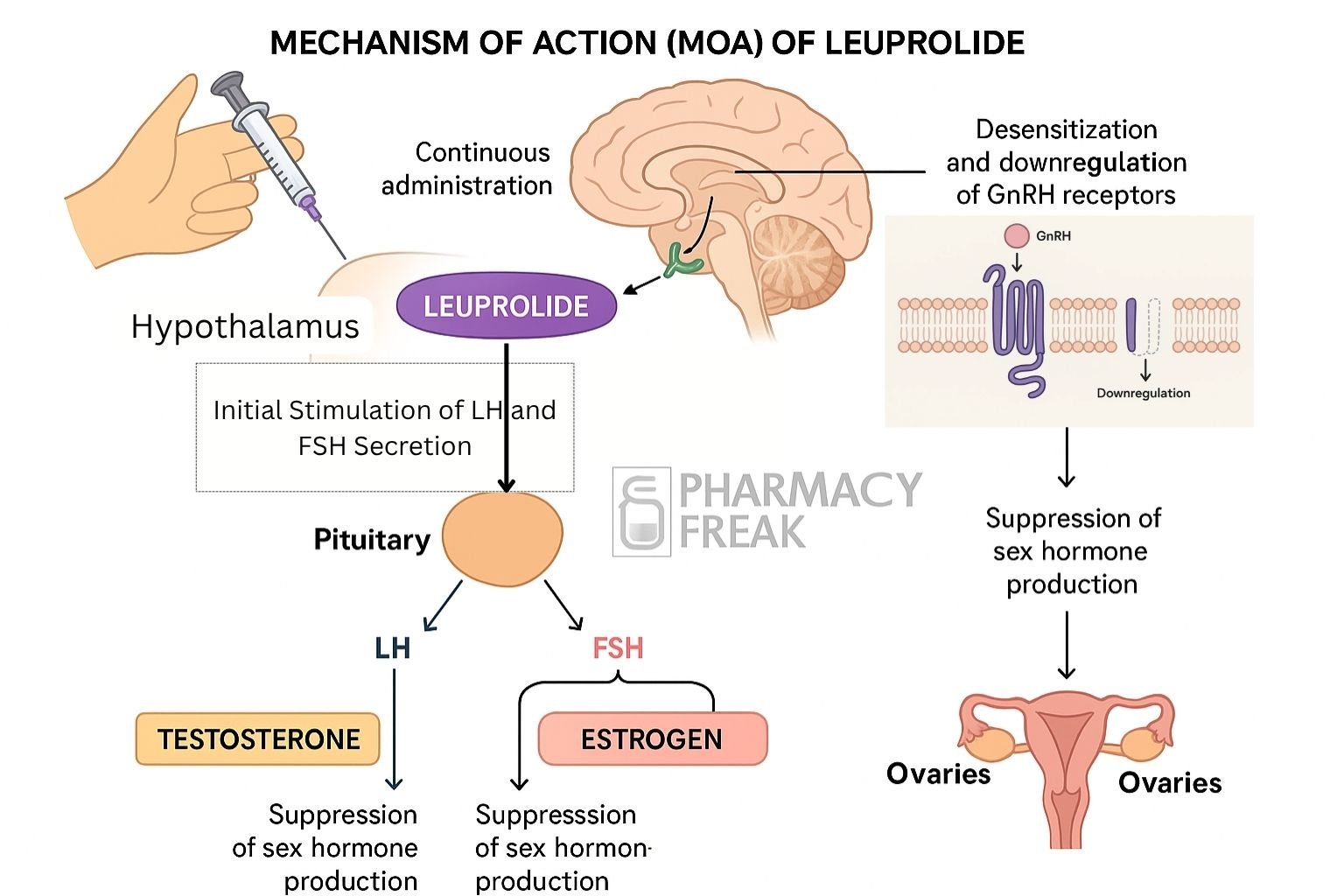
Mechanism of action of Leuprolide

Introduction Leuprolide is a synthetic gonadotropin-releasing hormone (GnRH) agonist used in conditions like prostate cancer, endometriosis, uterine fibroids, and central precocious puberty. Initially, it stimulates the pituitary gland, but with continuous use, it leads to receptor desensitization, suppressing gonadotropins and resulting in decreased sex hormone levels. Step-by-Step Mechanism of Action Pharmacokinetic Parameters Parameter Value Route … Read more

Mechanism of Action of Guanfacine

Mechanism of action of Guanfacine

Introduction Guanfacine is a selective α₂A‑adrenergic receptor agonist used in treating ADHD and for managing hypertension. It enhances prefrontal cortex functioning by activating postsynaptic α₂A receptors, resulting in improved attention, impulse control, and reduced sympathetic tone. Step-by-Step Mechanism of Action Pharmacokinetic Parameters Parameter Value Bioavailability ~70–80% (oral) Time to Peak (Tₘₐₓ) ~1–4 hours Half‑Life ~17 … Read more

Mechanism of Action of Cyclosporine

Mechanism of action of Cyclosporine

Introduction Cyclosporine is a calcineurin inhibitor used primarily to prevent organ transplant rejection and to treat select autoimmune disorders. It binds to cyclophilin, forming a complex that inhibits calcineurin, thereby blocking T‑cell activation and interleukin‑2 (IL‑2) production. This selective immunosuppression reduces T‑lymphocyte–mediated damage. Step-by-Step Mechanism of Action Pharmacokinetic Parameters Parameter Value Bioavailability ~30% (range 10–90%) … Read more

Mechanism of Action of Eliquis (Apixaban)

Mechanism of action of Eliquis

Introduction Eliquis (apixaban) is an oral direct Factor Xa inhibitor used to prevent stroke in nonvalvular atrial fibrillation and to treat or prevent deep vein thrombosis (DVT) and pulmonary embolism (PE). It binds selectively and reversibly to both free and clot-bound Factor Xa, blocking thrombin generation and fibrin clot formation without needing antithrombin III. Step-by-Step … Read more

Mechanism of Action of Naltrexone

Mechanism of action of Naltrexone

Introduction Naltrexone is a pure opioid antagonist primarily used to prevent relapse in opioid use disorder and reduce alcohol craving in alcohol dependence. It competitively blocks μ-opioid receptors and to a lesser extent κ and δ receptors, thereby diminishing the rewarding effects of opioids and alcohol without inducing any agonist activity. Step-by-Step Mechanism of Action … Read more

Mechanism of Action of Mirabegron

Mechanism of action of Mirabegron

Introduction Mirabegron is a β₃‑adrenergic receptor agonist used to treat overactive bladder (OAB). By selectively activating β₃‑receptors in the detrusor muscle of the bladder, it enhances urine storage and reduces urinary urgency and frequency without significantly affecting cardiovascular β₁ or β₂ receptors. Step-by-Step Mechanism of Action Pharmacokinetic Parameters Parameter Value Bioavailability ~29% (fasting) Peak Plasma … Read more

Mechanism of Action of Aripiprazole

Mechanism of action of Aripiprazole

Introduction Aripiprazole is a third-generation atypical antipsychotic approved for treating schizophrenia, bipolar disorder, depression (as an adjunct), Tourette’s syndrome, and irritability in autism. It is pharmacologically unique for its role as a partial agonist at dopamine D₂ and serotonin 5‑HT₁A receptors, and as an antagonist at serotonin 5‑HT₂A receptors, allowing it to modulate neurotransmission rather … Read more

Mechanism of Action of Ticagrelor

Mechanism of action of Ticagrelor

Introduction Ticagrelor is an oral antiplatelet agent used in the management of acute coronary syndrome (ACS) and for secondary prevention of thrombotic events. It directly and reversibly inhibits the P2Y₁₂ receptor on platelets, thereby preventing ADP-induced platelet aggregation. Unlike thienopyridines like clopidogrel, it does not require metabolic activation, leading to a faster and more predictable … Read more

Mechanism of Action of Vyvanse (Lisdexamfetamine)

Mechanism of action of Vyvanse

Introduction Vyvanse (lisdexamfetamine) is a central nervous system stimulant used to treat ADHD and binge-eating disorder. It is a prodrug, meaning it becomes active only after enzymatic conversion in the body. This mechanism provides a smoother onset, extended action, and lower risk of misuse. Its active metabolite, dextroamphetamine, boosts dopamine and norepinephrine in the brain—improving … Read more

Mechanism of Action of Dexmedetomidine

Mechanism of action of Dexmedetomidine

Introduction Dexmedetomidine is a highly selective alpha-2 adrenergic receptor agonist used for sedation in intensive care settings and during surgical procedures. It provides sedation without significant respiratory depression, distinguishing it from other sedatives like benzodiazepines and propofol. Its analgesic-sparing and sympatholytic effects further enhance its clinical utility. Step-by-Step Mechanism of Action Pharmacokinetic Parameters Parameter Value … Read more

PRO
Ad-Free Access
$3.99 / month
  • No Interruptions
  • Faster Page Loads
  • Support Content Creators