
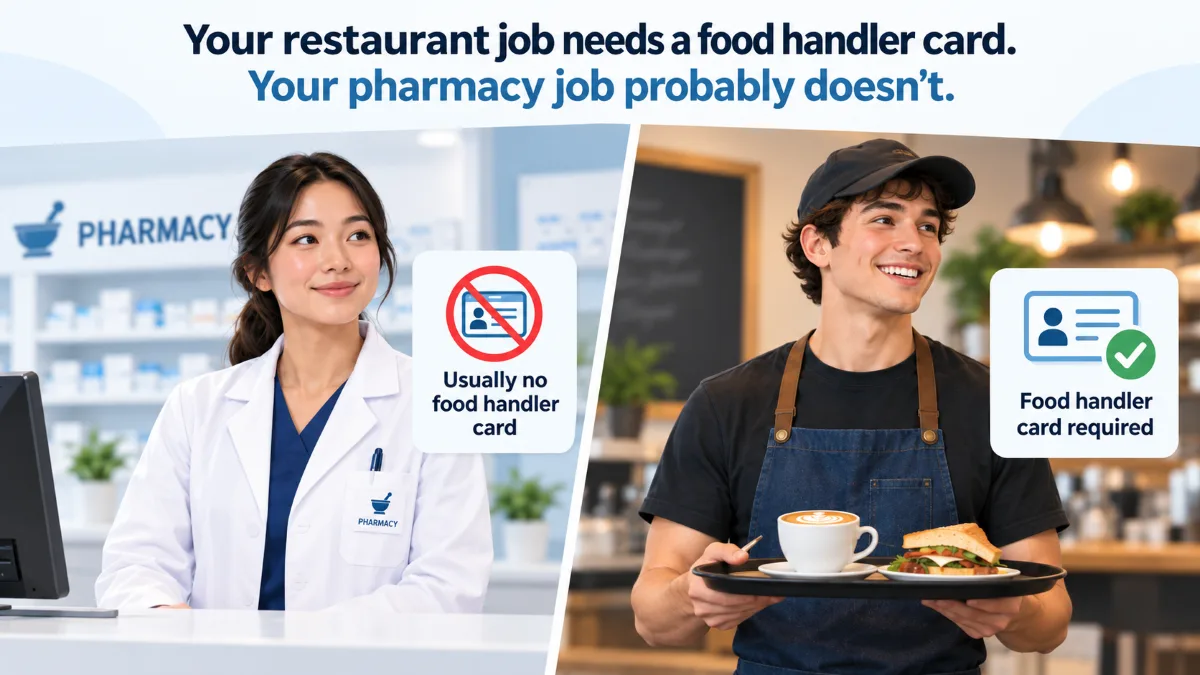
Plenty of pharmacy students work a second job, and a fair number of those jobs involve food. The food handler card question catches people out because the answer changes depending on which of your two jobs you are asking about. The guidance online is also wrong often enough that checking it costs you nothing and trusting it can cost you a month of working uncertified.
Short version. Behind the pharmacy counter, you almost certainly do not need a card. On the shifts you pick up at a restaurant, café, deli or bar, you probably do, and the clock started on your hire date rather than on your first shift.
Why the pharmacy job is usually exempt
Most states build their rule on the FDA Food Code definition of a food employee: someone working with unpackaged food, food equipment or utensils, or food-contact surfaces. Texas DSHS uses that definition directly. Counting tablets, labelling vials and running a register touch none of it, so in most states the question never arises.
California goes further and writes the exemption into the statute. Its Food Handler Card Law lists exempt categories that include grocery stores and convenience stores, licensed health care facilities, school cafeterias, and retail stores where the majority of sales come from a pharmacy. If you work at a CVS or a Walgreens in California, that last clause is about you.
There is a catch worth knowing if you work in a supermarket. The grocery store exemption covers the store’s own employees, but a separately owned food facility inside that store does not inherit it. The coffee kiosk near the entrance is often a different business on a different permit, and its staff need cards even though the people at the deli counter twenty feet away do not.
The restaurant job is a different question
Food employee covers more roles than people assume. Bussers, hosts who handle clean utensils, barbacks and dishwashers all work with food-contact surfaces, so a job that never involves cooking still falls inside the definition.
This is where the deadline matters, and where the internet will actively mislead you.
Texas says 30 days. Most course sellers say 60.
The Texas Department of State Health Services states on its own site that food service employees must complete an accredited food handler training course within 30 days of getting a job. Its FAQ page cites Texas Food Establishment Rules §228.31 for the same 30-day figure.
Search for Texas food handler requirements and you will mostly find 60 days, cited to §228.33, published by the companies selling the courses. At least one of them says plainly that the deadline used to be 60 days, that Texas shortened it, and that a lot of published guidance has not caught up.
Thirty days against sixty is not a trivia question. If you started a serving job on the first of the month and believed the vendor page, you would spend your fifth week working without a certificate you were legally required to hold.
The lesson generalises. Course sellers have no obligation to keep their marketing pages current, they copy each other freely, and once a wrong figure has been repeated across enough sites it starts to look like consensus rather than a single error propagating, which is roughly how the internet came to agree on a Texas deadline the state itself stopped using. Health departments publish the rule they enforce.
California, if that is where you are
The card is due within 30 days of hire and stays valid for three years. Training must come from a programme accredited by ANSI, and ServSafe is one of several accredited providers.
Three counties run their own systems. Cards issued in San Bernardino, Riverside and San Diego are not accepted outside those counties unless they carry an ANSI-accredited stamp, which matters if you move for a rotation.
Your employer is required to keep records showing every food handler on staff holds a valid card, and to produce them at inspection. If nobody has asked you for yours, that is not evidence you do not need one.
Checking your own state without wasting an afternoon
Start with your county health department rather than your state. County rules are often stricter, and in states such as Arizona and Nevada the county is where the requirement actually lives. Search the county name with food handler card requirement and look for a .gov result.
If the county has nothing, go to the state health department. Ignore the course vendors entirely at this stage. Read them later, once you know what the rule is and only want to compare prices.
Then ask your manager which provider the business accepts. Some employers run their own approved in-house training, and in Texas a single entity can train its own staff under SB 1089 without the course being separately accredited, though that certificate does not travel with you to another employer.
The exam itself is not the hard part
Food handler assessments are short, multiple choice, and usually taken online straight after a two-hour course. Compared with anything on the PTCB or NAPLEX track, the content volume is trivial.
People still fail, and mostly on details rather than concepts. The temperature danger zone is 41°F to 135°F under the current FDA Food Code, and a surprising amount of study material still prints the older 40°F to 140°F figures. Sesame became the ninth major allergen in 2023, so any list showing eight is out of date.
Working through a set of practice questions before you sit it is worth the twenty minutes. There are free ServSafe Food Handler practice tests that cover the same ground the assessment does, organised by topic so you can see which part you are actually weak on rather than collecting percentages.
What this does not tell you
State rules change, county rules change more often, and nothing above substitutes for the requirement your own employer or health department gives you in writing. The Texas and California positions here were checked against those states’ own published guidance, and both states have amended their rules in the past few years, which is precisely why the second-hand versions circulating online are unreliable.
If your employer tells you that you need a card, get one. The argument about whether the statute technically requires it is not one you want to have during an inspection.
Common questions
Does working in a hospital pharmacy change the answer?
Licensed health care facilities appear on California’s exemption list, so a hospital-based role is exempt there on two separate grounds. In states following the FDA Food Code definition, dispensing medication still does not make you a food employee. If your role crosses into patient meal service, ask, because that is a genuine grey area rather than a settled one.
I only work one shift a week. Does that matter?
No. The requirement attaches to the role rather than the hours, and part-time and temporary staff are covered in the same way as full-time employees.
My food handler card is from another state. Can I use it?
Sometimes. An ANSI-accredited card is portable in many states, but several run their own systems and will not accept an outside card. Washington issues its food worker card through local health departments rather than through third-party providers, and three California counties issue cards that are not valid elsewhere without an ANSI stamp. Check before you assume.
Do I need a food handler card or a food manager certification?
Almost certainly the food handler card, which is the entry-level credential. The manager certification is a longer, proctored exam for people with responsibility for a food safety system. In California, holding a valid food protection manager certificate exempts you from needing the food handler card at all.
Is the card the same thing as ServSafe?
No. ServSafe is one accredited training provider among several. The card is the credential your state recognises, and it can come from any provider your state accepts. Check which providers your county approves before paying for a course, then use something like ServSafePractice.com to rehearse the questions once you know which assessment you are sitting.
