Table of Contents
Introduction
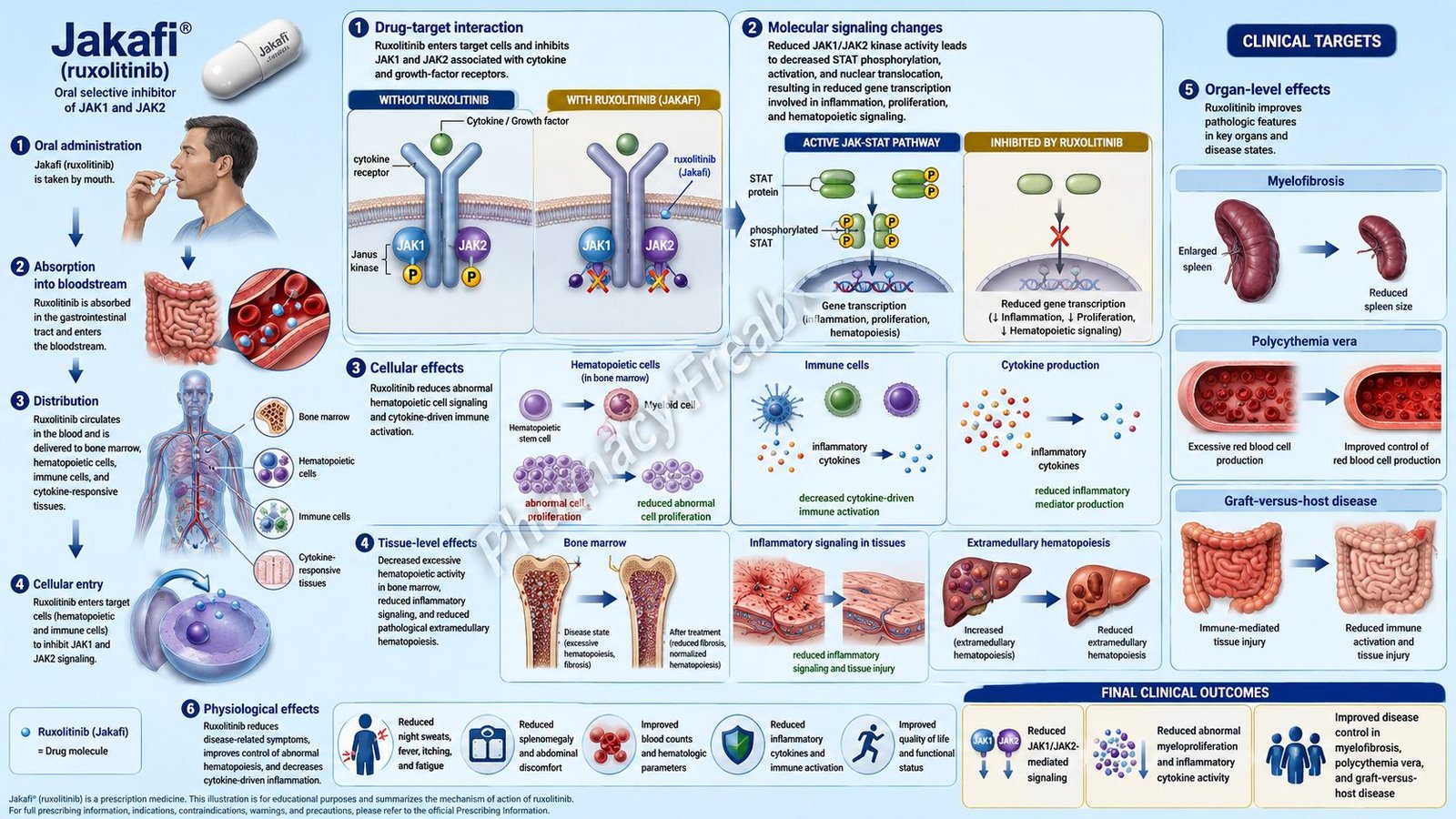
Jakafi is the brand name of ruxolitinib, an oral small-molecule kinase inhibitor that primarily inhibits Janus-associated kinase 1 (JAK1) and Janus-associated kinase 2 (JAK2).
JAK1 and JAK2 are intracellular tyrosine kinases that transmit signals from numerous cytokine and growth-factor receptors to the nucleus. These signals are important for hematopoiesis, inflammation, and immune function. Ruxolitinib interrupts this signaling by inhibiting JAK1 and JAK2.
The JAK-STAT pathway is particularly important in myelofibrosis (MF) and polycythemia vera (PV). These myeloproliferative neoplasms are associated with dysregulated JAK1/JAK2 signaling. Importantly, Jakafi does not require a patient to have the JAK2 V617F mutation to exert JAK1/JAK2 inhibition; the pathway can be abnormally activated through different molecular mechanisms.
JAK-STAT signaling also contributes to the development, proliferation, and activation of immune cells involved in graft-versus-host disease (GVHD). This explains why ruxolitinib is effective not only in myeloproliferative disorders but also in selected forms of acute and chronic GVHD.
As of the current 2026 U.S. labeling, Jakafi/Jakafi XR is indicated for intermediate- or high-risk myelofibrosis, polycythemia vera after inadequate response or intolerance to hydroxyurea, steroid-refractory acute GVHD, and chronic GVHD after failure of one or two lines of systemic therapy.
For exam revision:
Jakafi (ruxolitinib) → inhibits JAK1 + JAK2 → ↓ STAT activation → ↓ abnormal cytokine/growth-factor signaling → ↓ inflammatory signaling and abnormal hematopoietic activity.
Mechanism of Action (Step-wise)
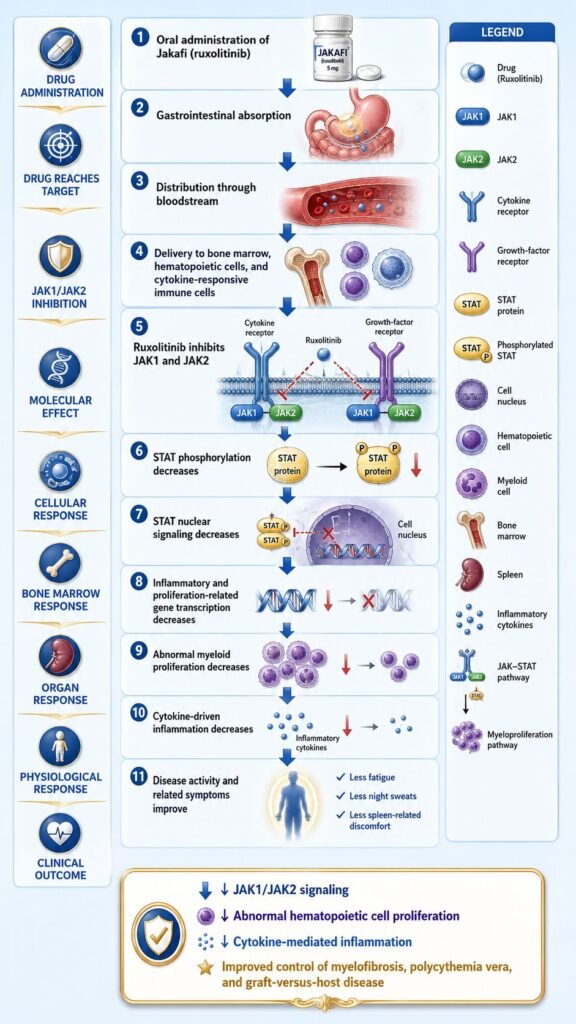
Step 1: Cytokines and growth factors bind their receptors
Many cytokines and growth factors involved in blood-cell production and immune regulation bind receptors located on the cell membrane.
Unlike receptor tyrosine kinases such as EGFR, many of these cytokine receptors do not possess their own intrinsic kinase activity.
Instead, they depend on associated Janus kinases, including JAK1 and JAK2, to transmit their signals.
Step 2: JAK proteins become activated
When a cytokine or growth factor activates its receptor, receptor-associated JAK proteins become activated.
JAKs then phosphorylate intracellular components of the receptor-signaling complex.
Step 3: STAT proteins are recruited
Activated JAK signaling recruits proteins known as:
STATs = Signal Transducers and Activators of Transcription
STAT proteins are important intracellular messengers connecting cytokine receptors with gene transcription inside the nucleus.
Step 4: STAT proteins become activated
JAK-mediated phosphorylation activates STAT proteins.
The activated STAT molecules subsequently move toward the nucleus.
Step 5: STATs enter the nucleus
Activated STAT proteins localize to the nucleus, where they influence transcription of genes regulating:
- Cell proliferation
- Cell survival
- Hematopoiesis
- Immune-cell activation
- Cytokine responses
- Inflammation
This sequence forms the JAK-STAT signaling pathway.
Step 6: JAK signaling becomes dysregulated in myeloproliferative neoplasms
Myelofibrosis and polycythemia vera are associated with dysregulated JAK1 and JAK2 signaling.
Abnormal activation of this pathway contributes to pathological hematopoietic signaling and excessive inflammatory cytokine activity.
Step 7: JAK2 V617F can cause constitutive JAK signaling
A particularly important molecular abnormality in myeloproliferative neoplasms is the JAK2 V617F mutation.
This mutation can promote persistent JAK2 signaling even without normal physiologic stimulation.
However, abnormal JAK-STAT activation can occur through other mutations and signaling abnormalities as well.
Step 8: Ruxolitinib enters cells
Ruxolitinib is a small-molecule drug administered orally.
Unlike monoclonal antibodies that act mainly on extracellular targets, ruxolitinib enters cells and inhibits intracellular kinase signaling.
Step 9: Ruxolitinib inhibits JAK1 and JAK2
Ruxolitinib directly inhibits JAK1 and JAK2 kinase activity.
This is the central pharmacological mechanism of Jakafi.
Step 10: STAT activation decreases
When JAK1/JAK2 activity is inhibited, cytokine-induced STAT phosphorylation decreases.
The current prescribing information reports that Jakafi inhibits cytokine-induced STAT3 phosphorylation in whole blood from patients with MF and PV. Maximum inhibition occurred about 2 hours after dosing and approached baseline by approximately 10 hours.
Step 11: Nuclear gene signaling decreases
With less STAT activation, fewer activated STAT molecules reach the nucleus.
This reduces transcriptional signaling driven by cytokines and growth factors dependent on JAK1/JAK2.
Step 12: Inflammatory cytokine signaling decreases
Abnormal JAK signaling contributes to elevated inflammatory cytokine activity in myelofibrosis.
In a JAK2 V617F-positive mouse model, ruxolitinib decreased circulating inflammatory cytokines including TNF-α and IL-6.
Reduced inflammatory signaling helps explain improvement in constitutional symptoms such as:
- Night sweats
- Fever
- Pruritus
- Fatigue
- Weight-related symptoms
Step 13: Splenomegaly decreases
Myelofibrosis frequently causes marked splenomegaly due partly to extramedullary hematopoiesis.
In the JAK2 V617F-positive experimental model, ruxolitinib prevented splenomegaly and preferentially decreased JAK2 V617F mutant cells in the spleen.
Clinically, reduction of spleen volume is one of the major benefits of ruxolitinib in myelofibrosis.
Step 14: Abnormal erythropoietic signaling is reduced in PV
Polycythemia vera is characterized by excessive production of blood cells, particularly erythrocytes, and is strongly associated with abnormal JAK2 signaling.
Inhibiting JAK2 reduces pathological hematopoietic signaling and helps control hematocrit and disease manifestations.
Step 15: JAK-STAT immune signaling decreases in GVHD
The JAK-STAT pathway regulates the development, proliferation, and activation of multiple immune-cell populations involved in GVHD.
By inhibiting JAK1/JAK2, ruxolitinib suppresses cytokine-driven immune activation.
In an acute GVHD mouse model, ruxolitinib was associated with decreased inflammatory cytokine expression and reduced immune-cell infiltration in the colon.
Step 16: Final therapeutic effect
The final therapeutic outcome depends on the disease:
Myelofibrosis → ↓ pathological JAK signaling + ↓ inflammatory cytokines → ↓ splenomegaly and constitutional symptoms
Polycythemia vera → ↓ dysregulated hematopoietic signaling → improved hematocrit and disease control
GVHD → ↓ cytokine-driven immune-cell activation → ↓ inflammatory tissue injury
Pharmacokinetics
Jakafi is administered orally and can be taken with or without food. A newer extended-release formulation, Jakafi XR, is also included in the current U.S. prescribing information.
The dose depends substantially on the indication, platelet count, organ function, and interacting medications.
For myelofibrosis, current Jakafi starting doses are based on baseline platelet count:
- 200 × 10⁹/L → 20 mg twice daily
- 100–200 × 10⁹/L → 15 mg twice daily
- 50–<100 × 10⁹/L → 5 mg twice daily
For polycythemia vera, the recommended Jakafi starting dose is 10 mg twice daily.
For steroid-refractory acute GVHD, the starting dose is 5 mg twice daily.
For chronic GVHD, the starting dose is 10 mg twice daily.
Ruxolitinib exposure increases approximately dose-proportionally over the evaluated dose range.
Ruxolitinib is metabolized predominantly by CYP3A4 and to a lesser extent by CYP2C9.
Strong CYP3A4 inhibitors can increase ruxolitinib exposure. Fluconazole can also increase exposure, and the current label recommends dose modification with fluconazole doses up to 200 mg while avoiding doses above 200 mg in this setting.
Following radiolabeled ruxolitinib administration, approximately 74% of radioactivity was recovered in urine and 22% in feces. Less than 1% of excreted radioactivity represented unchanged ruxolitinib.
Renal impairment increases exposure to ruxolitinib and its active metabolites, so dosage modifications may be necessary. Ruxolitinib itself is not effectively removed by dialysis.
Clinical Uses
Jakafi/Jakafi XR is currently indicated for intermediate- or high-risk myelofibrosis in adults, including:
- Primary myelofibrosis
- Post-polycythemia vera myelofibrosis
- Post-essential thrombocythemia myelofibrosis
Myelofibrosis can produce severe splenomegaly and constitutional symptoms. JAK inhibition can substantially reduce spleen size and symptom burden.
Jakafi/Jakafi XR is also approved for polycythemia vera in adults who have had an inadequate response to or are intolerant of hydroxyurea.
Another major use is steroid-refractory acute graft-versus-host disease in adults and pediatric patients 12 years and older.
It is also indicated for chronic GVHD after failure of one or two lines of systemic therapy in adults and pediatric patients aged 12 years and older.
Jakafi is therefore pharmacologically unusual because the same JAK1/JAK2 pathway is therapeutically targeted in both myeloproliferative neoplasms and immune-mediated GVHD.
Adverse Effects
One of the most important toxicities of ruxolitinib is myelosuppression.
Because JAK2 participates in normal hematopoietic growth-factor signaling, inhibiting it can suppress normal blood-cell production.
Important hematologic adverse effects include:
- Thrombocytopenia
- Anemia
- Neutropenia
Complete blood counts should therefore be monitored, and dose reduction, interruption, or transfusion may be necessary depending on severity.
Serious infections can occur because JAK signaling is important for immune function. The current label recommends assessing patients for infection and ensuring serious infections have resolved before starting treatment.
Reported infectious risks include bacterial, mycobacterial, fungal, and viral infections. Tuberculosis, herpes zoster, and hepatitis B reactivation are clinically important considerations.
Another distinctive warning involves symptom exacerbation after interruption or discontinuation. After stopping Jakafi, symptoms of myeloproliferative neoplasms may return over approximately one week, and severe events have occasionally occurred. Unless treatment must be stopped urgently because of a potentially life-threatening toxicity, gradual tapering may be considered.
Non-melanoma skin cancers have occurred during treatment. Periodic skin examinations are recommended.
Ruxolitinib can increase lipid parameters, including total cholesterol, LDL cholesterol, and triglycerides. Lipid levels should be assessed approximately 8–12 weeks after beginning treatment and managed appropriately.
The current label also includes warnings concerning major adverse cardiovascular events (MACE), thrombosis, and secondary malignancies, reflecting safety concerns observed across the JAK-inhibitor class and relevant patient populations.
Comparative Analysis
Jakafi is commonly compared with fedratinib, pacritinib, momelotinib, hydroxyurea, and other JAK inhibitors.
Compared with fedratinib, both drugs inhibit JAK signaling in myelofibrosis. Fedratinib is more selective for JAK2, whereas ruxolitinib inhibits both JAK1 and JAK2.
Compared with pacritinib, ruxolitinib has a different kinase profile and dosing strategy. Pacritinib has an important role in myelofibrosis patients with severe thrombocytopenia.
Compared with momelotinib, both inhibit JAK1/JAK2 signaling, but momelotinib also inhibits activin A receptor type 1 (ACVR1), an effect relevant to anemia biology in myelofibrosis.
Compared with hydroxyurea, ruxolitinib directly targets JAK signaling. Hydroxyurea is a cytoreductive antimetabolite that inhibits ribonucleotide reductase and decreases DNA synthesis.
Compared with tofacitinib, both are JAK inhibitors, but their kinase selectivity and approved indications differ. Ruxolitinib prominently inhibits JAK1/JAK2 and is used in MF, PV, and GVHD, whereas tofacitinib is used primarily for selected immune-mediated inflammatory diseases.
A useful exam distinction is:
Ruxolitinib → JAK1 + JAK2
Fedratinib → predominantly JAK2
Pacritinib → JAK2 + IRAK1
Momelotinib → JAK1 + JAK2 + ACVR1
MCQs
- Jakafi contains which active drug?
a) Fedratinib
b) Ruxolitinib
c) Tofacitinib
d) Pacritinib
Answer: b) Ruxolitinib
- Ruxolitinib primarily inhibits:
a) JAK1 and JAK2
b) EGFR and HER2
c) BRAF and MEK
d) CD20 and CD38
Answer: a) JAK1 and JAK2
- JAK proteins primarily participate in:
a) Cytokine and growth-factor signaling
b) Bacterial cell-wall synthesis
c) Gastric acid secretion
d) DNA cross-linking
Answer: a) Cytokine and growth-factor signaling
- Which proteins are recruited and activated during JAK signaling?
a) STAT proteins
b) GABA receptors
c) Integrins only
d) Cyclooxygenases
Answer: a) STAT proteins
- Activated STAT proteins ultimately:
a) Enter the nucleus and regulate gene expression
b) Destroy extracellular antibodies
c) Block renal sodium transport
d) Synthesize bacterial DNA
Answer: a) Enter the nucleus and regulate gene expression
- A mutation strongly associated with myeloproliferative neoplasms is:
a) JAK2 V617F
b) CFTR ΔF508
c) Factor V Leiden only
d) HLA-B27
Answer: a) JAK2 V617F
- Jakafi inhibits cytokine-induced phosphorylation of:
a) STAT3
b) Troponin
c) Albumin
d) Hemoglobin
Answer: a) STAT3
- Which disease is an approved indication for Jakafi?
a) Myelofibrosis
b) Parkinson disease
c) Alzheimer disease
d) Acute bacterial meningitis
Answer: a) Myelofibrosis
- Jakafi is used in polycythemia vera particularly when patients:
a) Have inadequate response or intolerance to hydroxyurea
b) Have never received any therapy
c) Have iron deficiency alone
d) Have isolated thrombocytopenia
Answer: a) Have inadequate response or intolerance to hydroxyurea
- Jakafi is approved for steroid-refractory acute GVHD in patients aged:
a) 12 years and older
b) Only 65 years and older
c) Only neonates
d) 2 years and older
Answer: a) 12 years and older
- Which hematologic toxicity is associated with ruxolitinib?
a) Thrombocytopenia
b) Polycythemia in every patient
c) Thrombocytosis exclusively
d) Eosinophilia only
Answer: a) Thrombocytopenia
- Ruxolitinib is metabolized primarily by:
a) CYP3A4
b) CYP2D6 only
c) MAO-B
d) COMT
Answer: a) CYP3A4
- Why can Jakafi increase infection risk?
a) JAK signaling contributes to normal immune function
b) It destroys all antibodies directly
c) It permanently removes the spleen
d) It blocks bacterial ribosomes
Answer: a) JAK signaling contributes to normal immune function
- Which statement correctly compares ruxolitinib and hydroxyurea?
a) Ruxolitinib inhibits JAK1/JAK2, while hydroxyurea is a cytoreductive antimetabolite
b) Both are monoclonal antibodies
c) Both exclusively inhibit JAK2 V617F mutant protein
d) Hydroxyurea inhibits JAK1/JAK2 more selectively
Answer: a) Ruxolitinib inhibits JAK1/JAK2, while hydroxyurea is a cytoreductive antimetabolite
- Which statement best describes the mechanism of Jakafi?
a) It inhibits JAK1/JAK2 and reduces downstream STAT-mediated cytokine and growth-factor signaling
b) It blocks TNF-α directly with a monoclonal antibody
c) It inhibits IL-17A extracellularly
d) It depletes CD20-positive B lymphocytes
Answer: a) It inhibits JAK1/JAK2 and reduces downstream STAT-mediated cytokine and growth-factor signaling
FAQs
What is the mechanism of action of Jakafi?
Jakafi contains ruxolitinib, a kinase inhibitor that inhibits JAK1 and JAK2. These enzymes transmit cytokine and growth-factor signals through STAT proteins. JAK1/JAK2 inhibition reduces STAT activation and downstream gene signaling involved in hematopoiesis, inflammation, and immune-cell activity.
What is the generic name of Jakafi?
The generic name of Jakafi is ruxolitinib.
Is Jakafi a JAK inhibitor?
Yes. Ruxolitinib is primarily a JAK1/JAK2 inhibitor.
Does Jakafi work only in patients with the JAK2 V617F mutation?
No. JAK2 V617F is an important driver mutation in myeloproliferative neoplasms, but Jakafi inhibits JAK1/JAK2 signaling rather than selectively targeting only the mutant JAK2 V617F protein.
What is Jakafi used for?
Current U.S. indications include intermediate- or high-risk myelofibrosis, polycythemia vera after inadequate response or intolerance to hydroxyurea, steroid-refractory acute GVHD, and chronic GVHD after failure of one or two systemic therapies.
Why does Jakafi reduce spleen size in myelofibrosis?
Myelofibrosis is associated with abnormal JAK signaling, inflammatory cytokines, and extramedullary hematopoiesis. JAK1/JAK2 inhibition reduces pathological signaling and can substantially reduce splenomegaly.
Why can Jakafi cause anemia and thrombocytopenia?
JAK2 is involved in normal hematopoietic growth-factor signaling. Inhibiting JAK2 can therefore suppress normal production of blood cells, producing anemia, thrombocytopenia, and sometimes neutropenia.
Can Jakafi be stopped suddenly?
Abrupt interruption can lead to rapid return or worsening of myeloproliferative-neoplasm symptoms. When discontinuation is not required for a potentially life-threatening toxicity, the current label recommends gradual tapering; one example is reducing Jakafi by 5 mg twice daily each week.
References
Goodman & Gilman’s The Pharmacological Basis of Therapeutics
Katzung Basic & Clinical Pharmacology