Table of Contents
Introduction
Humira is the brand name of adalimumab, a biologic immunomodulatory medicine that belongs to the tumor necrosis factor blocker class. More specifically, adalimumab is a recombinant human IgG1 monoclonal antibody directed against tumor necrosis factor-alpha, commonly abbreviated as TNF-α.
TNF-α is a pro-inflammatory cytokine with an important role in normal immune defense. When produced excessively or inappropriately, however, it contributes to chronic inflammation, leukocyte recruitment, endothelial activation, cytokine release, tissue destruction, and immune-mediated disease.
High TNF concentrations are found in the inflamed joints of patients with rheumatoid arthritis, juvenile idiopathic arthritis, psoriatic arthritis, and ankylosing spondylitis. TNF also contributes to inflammatory pathways in psoriasis, inflammatory bowel disease, hidradenitis suppurativa, and non-infectious uveitis.
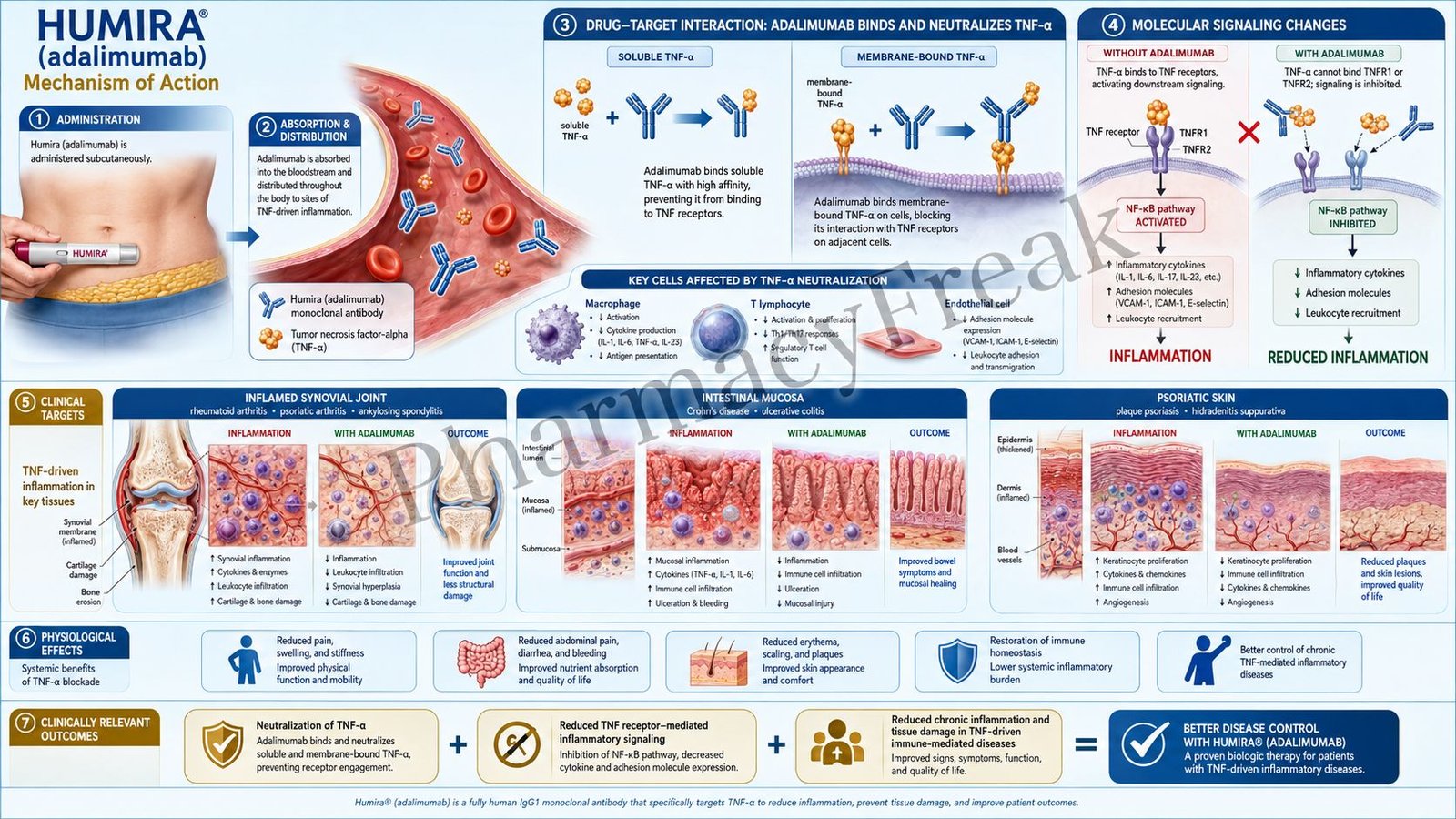
Adalimumab binds specifically to TNF-α and prevents TNF-α from interacting with its two principal cell-surface receptors, p55 or TNFR1 and p75 or TNFR2. The drug can also lyse cells expressing surface TNF in vitro when complement is present. It does not bind or inactivate lymphotoxin, also called TNF-β.
Blocking TNF reduces several downstream inflammatory responses, including expression of endothelial adhesion molecules involved in leukocyte migration. Treatment is also associated with reductions in inflammatory biomarkers such as C-reactive protein, erythrocyte sedimentation rate, IL-6, and certain matrix metalloproteinases.
Humira is currently indicated for several immune-mediated inflammatory diseases, including rheumatoid arthritis, polyarticular juvenile idiopathic arthritis, psoriatic arthritis, ankylosing spondylitis, Crohn’s disease, ulcerative colitis, plaque psoriasis, hidradenitis suppurativa, and non-infectious intermediate, posterior, and panuveitis in specified adult or pediatric populations.
For exam revision, the essential mechanism is:
TNF-α → binds TNFR1/TNFR2 → inflammatory signaling → cytokine production + leukocyte recruitment + tissue inflammation
Humira → binds TNF-α → prevents TNFR activation → decreases inflammatory signaling → reduces immune-mediated tissue injury.
Mechanism of Action (Step-wise)
Step 1: TNF-α is produced during immune activation
TNF-α is produced mainly by activated macrophages and monocytes, although T lymphocytes and several other immune and tissue cells can also release it.
Under normal conditions, TNF-α contributes to host defense and coordinates inflammatory responses. Persistent TNF activity, however, can become pathogenic.
Step 2: TNF-α binds TNF receptors
TNF-α produces many of its cellular effects by binding to two cell-surface receptors:
TNFR1, also called p55
TNFR2, also called p75
Humira’s prescribing information specifically identifies inhibition of TNF interaction with both p55 and p75 receptors as a central part of adalimumab’s mechanism.
Step 3: TNF receptor signaling promotes inflammation
Activation of TNF receptors triggers intracellular signaling that can influence pathways such as NF-κB and mitogen-activated protein kinases.
These signals can promote expression of inflammatory cytokines, chemokines, adhesion molecules, and enzymes involved in tissue remodeling.
Step 4: Leukocyte recruitment increases
TNF promotes endothelial activation and increases expression of adhesion molecules that allow circulating leukocytes to adhere to vascular endothelium and migrate into inflamed tissues.
Relevant molecules affected by TNF include ELAM-1, VCAM-1, and ICAM-1. Adalimumab modulates TNF-regulated changes in these adhesion molecules.
Step 5: Chronic TNF activity damages tissues
Persistent TNF signaling can maintain a cycle of immune-cell recruitment and inflammatory mediator release.
In rheumatoid arthritis, this contributes to synovitis, cartilage damage, bone erosion, swelling, pain, and loss of joint function.
In inflammatory bowel disease, TNF contributes to intestinal immune activation and mucosal inflammation.
In psoriasis, TNF participates in inflammatory signaling associated with epidermal thickening and inflammatory-cell infiltration.
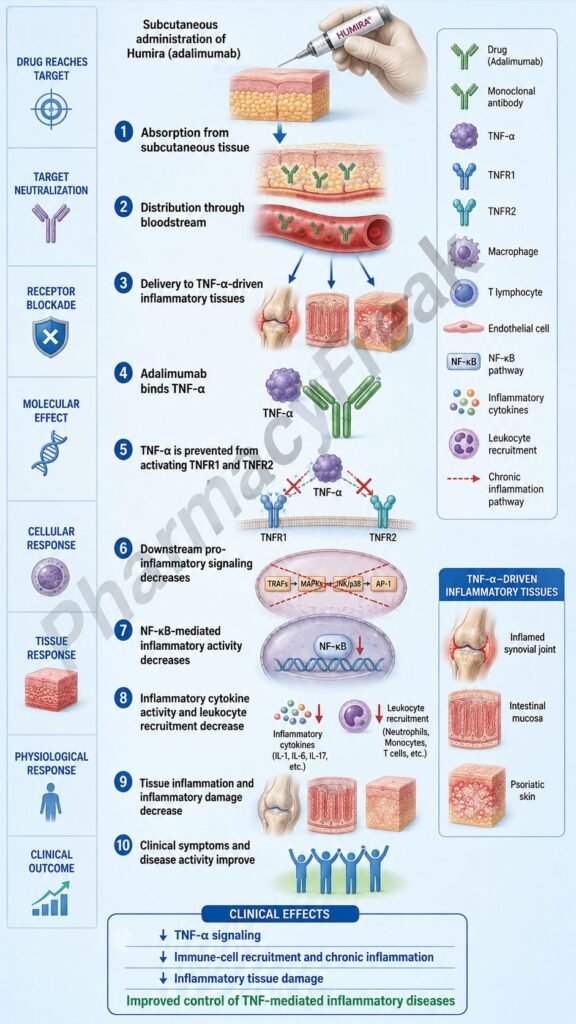
Step 6: Adalimumab binds TNF-α
Adalimumab is a monoclonal antibody with high specificity for TNF-α.
After subcutaneous administration and systemic distribution, it binds available TNF-α and forms antibody-cytokine complexes.
Step 7: TNF-α can no longer efficiently activate TNFR1 and TNFR2
Once TNF-α is bound by adalimumab, interaction with p55 and p75 TNF receptors is blocked.
This prevents a major upstream inflammatory signal from reaching susceptible cells.
Step 8: Downstream inflammatory signaling decreases
With reduced TNF receptor activation, downstream inflammatory pathways are suppressed.
This decreases the transcription and release of multiple mediators involved in chronic inflammation.
Step 9: Endothelial activation decreases
Reduced TNF signaling lowers expression of adhesion molecules involved in leukocyte trafficking.
Fewer inflammatory cells are therefore recruited into affected tissues.
Step 10: Pro-inflammatory cytokine activity decreases
TNF sits high in several inflammatory signaling networks. Blocking TNF can indirectly alter other inflammatory mediators.
In rheumatoid arthritis, Humira treatment has been associated with reductions in IL-6 as well as acute-phase inflammatory markers.
Step 11: CRP and ESR decrease
C-reactive protein and erythrocyte sedimentation rate are commonly used markers of systemic inflammation.
Humira treatment has been associated with reductions in CRP and ESR in rheumatoid arthritis. Reduced CRP has also been observed in Crohn’s disease, ulcerative colitis, and hidradenitis suppurativa.
Step 12: Matrix metalloproteinase activity decreases
Matrix metalloproteinases can contribute to cartilage and tissue remodeling.
After Humira treatment, reductions in serum MMP-1 and MMP-3 have been observed. These enzymes are involved in tissue remodeling associated with cartilage destruction.
Step 13: Surface TNF-expressing cells may undergo complement-mediated lysis
Adalimumab can lyse cells expressing surface TNF in vitro when complement is present.
This is an additional demonstrated pharmacological property, although the extent to which this effect contributes to clinical efficacy in each disease is not fully defined.
Step 14: Adalimumab does not block TNF-β
A useful exam distinction is that adalimumab does not bind or inactivate lymphotoxin, also known as TNF-β. Its principal cytokine target is TNF-α.
Step 15: Tissue inflammation decreases
The consequences differ somewhat by disease:
In rheumatoid and psoriatic arthritis, synovial inflammation and structural damage are reduced.
In Crohn’s disease and ulcerative colitis, intestinal inflammation decreases.
In plaque psoriasis, epidermal inflammation and inflammatory-cell infiltration decrease.
In hidradenitis suppurativa, chronic inflammatory lesions can improve.
In uveitis, inflammatory activity inside the eye is reduced.
Step 16: Final therapeutic outcome
The overall therapeutic effect is suppression of excessive TNF-α-mediated inflammation.
Humira does not cure the underlying autoimmune or inflammatory disease. Instead, it reduces an important inflammatory pathway that contributes to disease activity and tissue injury.
Pharmacokinetics
Humira is administered by subcutaneous injection. The exact dosing regimen depends heavily on the indication, patient age or body weight, and whether induction dosing is required.
A common adult regimen in rheumatoid arthritis, psoriatic arthritis, and ankylosing spondylitis is 40 mg subcutaneously every other week. In some patients with rheumatoid arthritis who are not receiving methotrexate, dosing may be increased according to the prescribing information.
Diseases such as Crohn’s disease, ulcerative colitis, hidradenitis suppurativa, and plaque psoriasis use indication-specific loading and maintenance schedules, so Humira should not be thought of as having one universal dosing schedule.
Following a single 40 mg subcutaneous dose in healthy adults, the mean absolute bioavailability of adalimumab is approximately 64%. Peak concentrations occur gradually rather than immediately because monoclonal antibodies are absorbed slowly from subcutaneous tissue.
Adalimumab has a long elimination half-life, approximately two weeks on average, which supports weekly or every-other-week dosing depending on the indication and regimen.
Like other monoclonal antibodies, adalimumab is not primarily eliminated through CYP450 metabolism. It is expected to undergo normal protein catabolism into smaller peptides and amino acids.
Concomitant methotrexate reduces the apparent clearance of adalimumab in patients with rheumatoid arthritis, which can increase adalimumab exposure.
Because Humira suppresses TNF signaling rather than inhibiting a conventional hepatic enzyme, its important interactions are mainly pharmacodynamic, particularly with other potent immunosuppressive biologic therapies.
Combining TNF blockers with certain biologic DMARDs can produce excessive immunosuppression and increase serious infection risk. Concurrent use with agents such as anakinra or abatacept is generally avoided.
Patients should be evaluated for tuberculosis before starting treatment. Screening for hepatitis B infection is also clinically important because reactivation may occur in carriers receiving TNF blockers.
Clinical Uses
Humira is indicated for moderately to severely active rheumatoid arthritis in adults. It can reduce symptoms, improve physical function, induce major clinical responses, and inhibit progression of structural joint damage. It may be used alone or with methotrexate or other non-biologic DMARDs.
Humira is used for moderately to severely active polyarticular juvenile idiopathic arthritis in patients 2 years of age and older. It may be used alone or with methotrexate.
It is also approved for active psoriatic arthritis in adults, where it reduces signs and symptoms, improves function, and inhibits progression of structural joint damage.
Humira is used for active ankylosing spondylitis in adults to reduce signs and symptoms of inflammatory axial disease.
For inflammatory bowel disease, Humira is approved for moderately to severely active Crohn’s disease in adults and pediatric patients 6 years and older. It is also approved for moderately to severely active ulcerative colitis in adults and pediatric patients 5 years and older.
Humira is used for moderate to severe chronic plaque psoriasis in adults who are candidates for systemic therapy or phototherapy and when other systemic approaches are medically less appropriate.
Another important indication is moderate to severe hidradenitis suppurativa in patients 12 years of age and older.
Humira is also approved for non-infectious intermediate, posterior, and panuveitis in adults and pediatric patients 2 years of age and older.
Humira is not a corticosteroid, NSAID, JAK inhibitor, IL-6 inhibitor, IL-17 inhibitor, or conventional cytotoxic immunosuppressant.
It is a targeted biologic that neutralizes TNF-α.
Adverse Effects
Humira carries a boxed warning for serious infections and malignancy. These are among the most important exam and clinical safety points.
Serious infections can lead to hospitalization or death. Reported infections include tuberculosis, bacterial sepsis, invasive fungal infections such as histoplasmosis, and infections caused by other opportunistic pathogens.
Patients should be tested for latent tuberculosis before treatment. If latent TB is identified, appropriate treatment should be started before Humira. Patients should continue to be monitored for active TB during therapy even when the initial test was negative.
Humira should be discontinued if a patient develops a serious infection or sepsis.
Malignancy is another boxed-warning concern. Lymphoma and other malignancies, some fatal, have occurred in children and adolescents receiving TNF blockers.
Hepatosplenic T-cell lymphoma is a rare but particularly important warning. Postmarketing cases have occurred primarily in adolescent and young adult patients with inflammatory bowel disease treated with TNF blockers. Many reported patients had also received azathioprine or 6-mercaptopurine.
Hepatitis B virus reactivation may occur in carriers receiving TNF blockers. In some cases, HBV reactivation has been fatal.
TNF blockers can also cause or worsen demyelinating disorders. New neurologic symptoms such as visual changes, weakness, numbness, or other signs of demyelination require evaluation.
New-onset or worsening congestive heart failure has been reported with TNF blockers. Humira should therefore be used cautiously in patients with heart failure.
Hematologic reactions can occur, including pancytopenia, aplastic anemia, leukopenia, and thrombocytopenia, although these are uncommon.
TNF blockers can trigger autoimmune phenomena. Development of autoantibodies and, rarely, a lupus-like syndrome may occur. The Humira prescribing information was updated in 2025 in the autoimmunity warning section.
Live vaccines should generally be avoided during Humira therapy because TNF blockade alters immune responses.
Common adverse effects include injection-site reactions and infections, particularly upper respiratory tract infections.
Other clinically relevant effects include headache, rash, and laboratory abnormalities depending on the disease population and concomitant therapies.
Comparative Analysis
Humira is commonly compared with infliximab, etanercept, certolizumab pegol, golimumab, methotrexate, JAK inhibitors, IL-6 inhibitors, IL-17 inhibitors, and IL-23 inhibitors.
Compared with infliximab, both drugs inhibit TNF-α. Humira is a fully human monoclonal antibody administered subcutaneously, whereas infliximab is a chimeric monoclonal antibody administered intravenously.
Compared with etanercept, Humira is a monoclonal antibody. Etanercept is a soluble TNF receptor fusion protein that acts as a decoy receptor for TNF.
Compared with certolizumab pegol, Humira contains a complete IgG1 antibody with an Fc region. Certolizumab is a pegylated Fab′ fragment and lacks an Fc region.
Compared with golimumab, both are human monoclonal antibodies against TNF-α, but they differ in dosing, approved indications, formulations, and pharmacokinetic profiles.
Compared with methotrexate, Humira targets a specific cytokine. Methotrexate is a conventional synthetic DMARD with broader anti-inflammatory actions. In rheumatoid arthritis, Humira may be used with methotrexate, and the combination can improve disease control in appropriate patients.
Compared with tofacitinib or upadacitinib, Humira acts outside cells by neutralizing TNF-α. JAK inhibitors are small oral molecules that block intracellular cytokine-signaling enzymes.
Compared with sarilumab or tocilizumab, Humira targets TNF-α rather than the IL-6 receptor.
Compared with secukinumab or ixekizumab, Humira targets TNF-α rather than IL-17A.
Compared with guselkumab or risankizumab, Humira does not target IL-23. It acts higher in a different inflammatory cytokine pathway by neutralizing TNF-α.
A useful exam comparison is:
Humira → TNF-α monoclonal antibody
Etanercept → soluble TNF receptor fusion protein
Infliximab → chimeric anti-TNF monoclonal antibody
Certolizumab → PEGylated anti-TNF Fab′ fragment
Golimumab → human anti-TNF monoclonal antibody.
MCQs
- Humira contains which active drug?
a) Infliximab
b) Etanercept
c) Adalimumab
d) Golimumab
Answer: c) Adalimumab
- Adalimumab belongs to which pharmacological class?
a) TNF blocker
b) JAK inhibitor
c) IL-17 inhibitor
d) IL-6 receptor agonist
Answer: a) TNF blocker
- Humira primarily targets:
a) IL-1
b) TNF-α
c) IL-17A
d) CD20
Answer: b) TNF-α
- Adalimumab prevents TNF-α from interacting with:
a) EGFR and HER2
b) CD80 and CD86
c) IL-6R and gp130
d) p55 and p75 TNF receptors
Answer: d) p55 and p75 TNF receptors
- Adalimumab does NOT bind or inactivate:
a) TNF-β
b) TNF-α
c) Surface TNF
d) Soluble TNF-α
Answer: a) TNF-β
- Which inflammatory marker commonly decreases after Humira therapy?
a) Troponin only
b) CRP
c) Thyroxine only
d) Creatinine kinase only
Answer: b) CRP
- Which adhesion molecules are influenced by TNF blockade with adalimumab?
a) ELAM-1, VCAM-1, and ICAM-1
b) Only P-selectin
c) CD20 and CD38
d) HER2 and MET
Answer: a) ELAM-1, VCAM-1, and ICAM-1
- Humira is administered primarily by:
a) Oral tablet
b) Intravenous infusion only
c) Subcutaneous injection
d) Inhalation
Answer: c) Subcutaneous injection
- Which disease is an approved use of Humira?
a) Parkinson disease
b) Rheumatoid arthritis
c) Acute bacterial meningitis
d) Epilepsy
Answer: b) Rheumatoid arthritis
- Before starting Humira, patients should be screened particularly for:
a) Latent tuberculosis
b) Cataracts only
c) Hyperthyroidism only
d) Nephrolithiasis only
Answer: a) Latent tuberculosis
- The boxed warning for Humira includes:
a) Thyroid tumors and pancreatitis
b) Severe hypoglycemia and arrhythmia
c) Serious infections and malignancy
d) Ototoxicity and nephrotoxicity
Answer: c) Serious infections and malignancy
- Which rare malignancy is especially associated with the TNF-blocker warning in young patients with inflammatory bowel disease?
a) Glioblastoma
b) Hepatosplenic T-cell lymphoma
c) Retinoblastoma
d) Osteosarcoma
Answer: b) Hepatosplenic T-cell lymphoma
- Humira differs from etanercept because adalimumab is:
a) A monoclonal antibody
b) A JAK inhibitor
c) A soluble IL-6 receptor
d) An oral kinase inhibitor
Answer: a) A monoclonal antibody
- Live vaccines during Humira treatment are generally:
a) Required monthly
b) Preferred over all other vaccines
c) Used to increase TNF blockade
d) Avoided
Answer: d) Avoided
- Which statement best describes the mechanism of Humira?
a) It inhibits intracellular JAK enzymes
b) It binds TNF-α and prevents activation of p55 and p75 TNF receptors
c) It blocks IL-17A exclusively
d) It depletes CD20-positive B cells
Answer: b) It binds TNF-α and prevents activation of p55 and p75 TNF receptors
FAQs
What is the mechanism of action of Humira?
Humira contains adalimumab, a monoclonal antibody that binds specifically to TNF-α. This prevents TNF-α from interacting with the p55 and p75 TNF receptors and reduces downstream inflammatory signaling.
What is the generic name of Humira?
The generic name of Humira is adalimumab.
Is Humira a biologic?
Yes. Humira is a recombinant human monoclonal antibody and therefore a biologic medicine.
What is Humira used for?
Humira is approved for several inflammatory disorders, including rheumatoid arthritis, juvenile idiopathic arthritis, psoriatic arthritis, ankylosing spondylitis, Crohn’s disease, ulcerative colitis, plaque psoriasis, hidradenitis suppurativa, and certain forms of non-infectious uveitis. Age restrictions and dosing differ by indication.
Does Humira block TNF-α or TNF-β?
Humira specifically binds TNF-α. It does not bind or inactivate lymphotoxin, also called TNF-β.
Why does Humira increase infection risk?
TNF-α is important for normal immune defense, particularly against intracellular and opportunistic pathogens. Blocking TNF can impair these defenses and increase the risk of serious bacterial, fungal, mycobacterial, and opportunistic infections.
Why is tuberculosis screening required before Humira?
TNF signaling is important for containing Mycobacterium tuberculosis. TNF blockade can reactivate latent TB, so patients should be tested before treatment and monitored during therapy.
What are the major warnings for Humira?
The boxed warning covers serious infections and malignancy. Other important concerns include tuberculosis, invasive fungal infection, hepatitis B reactivation, demyelinating disease, heart failure, hematologic abnormalities, autoimmune reactions, and hypersensitivity.
References
Goodman & Gilman’s The Pharmacological Basis of Therapeutics
Katzung Basic & Clinical Pharmacology