Table of Contents
Introduction
Dimethyl fumarate is an oral disease-modifying therapy used for relapsing forms of multiple sclerosis. It is marketed under the brand name Tecfidera and is available in delayed-release capsules.
Multiple sclerosis, commonly abbreviated as MS, is a chronic immune-mediated disease of the central nervous system. In MS, inflammatory immune activity damages myelin, oligodendrocytes, and eventually axons within the brain and spinal cord. This produces neurologic symptoms that can include visual disturbances, weakness, sensory changes, impaired coordination, fatigue, and cognitive problems.
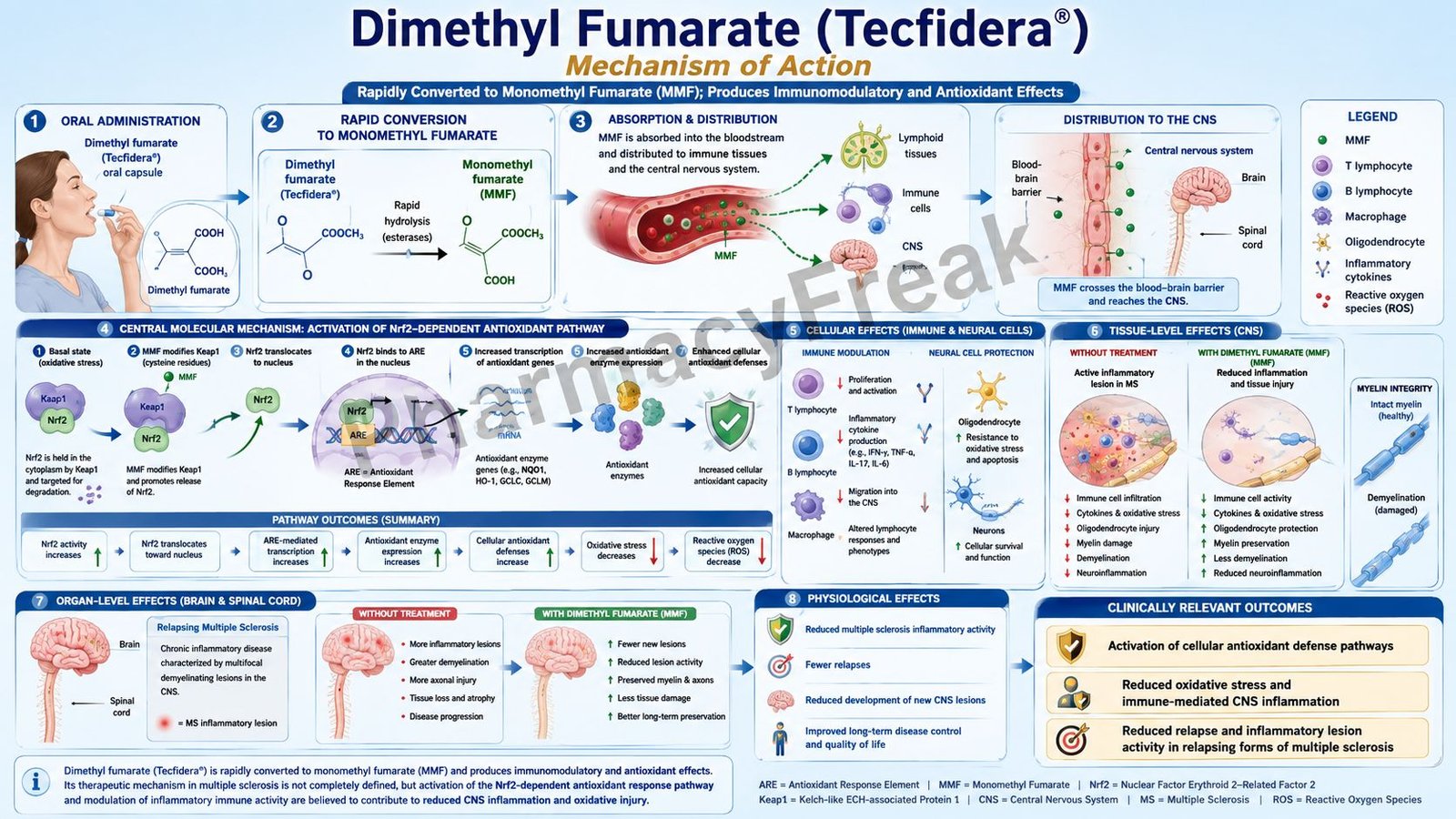
Dimethyl fumarate has both immunomodulatory and cytoprotective pharmacological effects, but its exact therapeutic mechanism in multiple sclerosis has not been fully established. According to the prescribing information, dimethyl fumarate and its active metabolite monomethyl fumarate, or MMF, activate the nuclear factor erythroid 2-related factor 2 pathway, commonly called the Nrf2 pathway. Nrf2 is involved in cellular defenses against oxidative stress.
After oral administration, dimethyl fumarate is rapidly hydrolyzed by esterases to monomethyl fumarate. Parent dimethyl fumarate is generally not measurable in plasma, so much of its systemic pharmacology is attributed to MMF.
MMF has also been identified as a nicotinic acid receptor agonist in vitro. However, the clinical contribution of this activity to the therapeutic effect in MS is not fully established.
For exam purposes, the most important concept is:
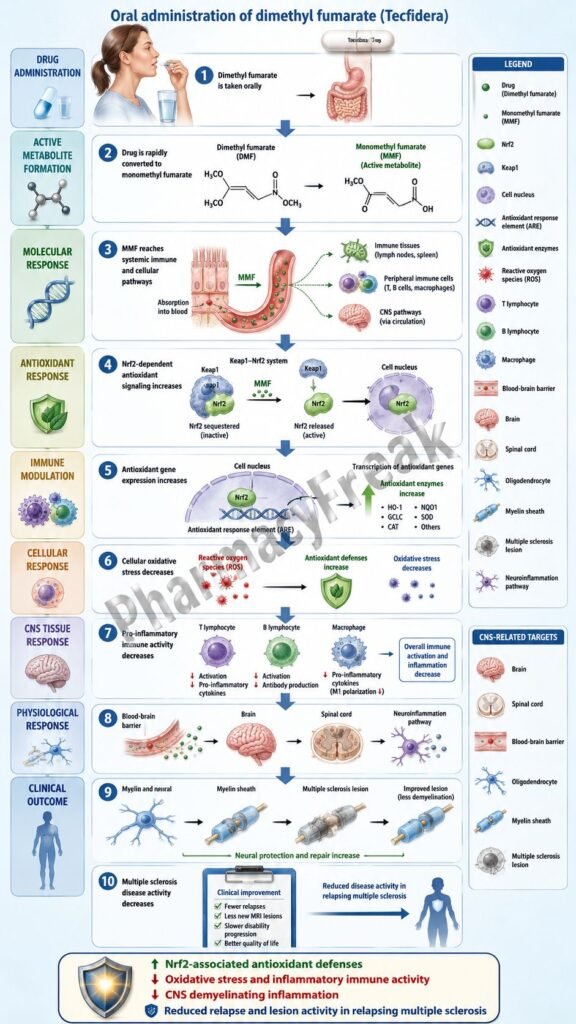
Dimethyl fumarate → converted to monomethyl fumarate → activates Nrf2-related cellular antioxidant defenses + alters inflammatory immune activity → reduces oxidative and inflammatory injury in the CNS → decreases MS disease activity.
Mechanism of Action (Step-wise)
Step 1: Multiple sclerosis involves immune-mediated CNS injury
In multiple sclerosis, immune cells cross the blood-brain barrier and participate in inflammatory attacks against structures within the central nervous system.
Activated T lymphocytes, B lymphocytes, macrophages, cytokines, oxidative stress, and other inflammatory mediators contribute to demyelination and neuronal injury.
Step 2: Oxidative stress contributes to tissue damage
Inflammatory cells can generate reactive oxygen species and other highly reactive molecules.
When antioxidant defenses are inadequate, oxidative stress can damage lipids, proteins, mitochondria, myelin, oligodendrocytes, and neurons.
Step 3: Dimethyl fumarate is taken orally
Dimethyl fumarate is administered as a delayed-release oral capsule.
The delayed-release formulation helps deliver the drug beyond the stomach before substantial release.
Step 4: Dimethyl fumarate is rapidly converted to MMF
After oral administration, dimethyl fumarate undergoes rapid presystemic hydrolysis by esterases.
The main active systemic metabolite is monomethyl fumarate. Parent dimethyl fumarate is not quantifiable in plasma after oral Tecfidera administration.
Step 5: DMF and MMF activate the Nrf2 pathway
Both dimethyl fumarate and MMF have been shown to activate the Nrf2 pathway in experimental systems and in humans.
The official label identifies this as an established pharmacological action while also making clear that the exact mechanism responsible for clinical benefit in MS remains unknown.
Step 6: Nrf2 regulates cellular defense against oxidative stress
Nrf2 is a transcription factor that helps cells respond to oxidative and electrophilic stress.
When activated, Nrf2 can increase transcription of genes involved in antioxidant defense, cellular detoxification, redox balance, and protection against oxidative injury.
Step 7: Antioxidant defense mechanisms increase
Nrf2 activation can increase expression of several protective enzymes and proteins involved in maintaining intracellular redox balance.
This may make CNS and immune cells more resistant to oxidative injury generated during chronic inflammation.
Step 8: Oxidative cellular damage may decrease
With stronger antioxidant responses, reactive oxygen species are less likely to produce uncontrolled injury to cellular structures.
This cytoprotective effect is considered an important proposed component of dimethyl fumarate pharmacology.
Step 9: Inflammatory immune activity is also modified
Dimethyl fumarate has broader immunomodulatory effects beyond antioxidant signaling.
Treatment changes immune-cell populations and inflammatory signaling. In clinical use, a reduction in circulating lymphocyte counts is frequently observed, demonstrating a meaningful effect on immune biology.
Step 10: Pro-inflammatory immune responses may decrease
Experimental studies suggest fumarates can shift immune activity away from strongly pro-inflammatory responses and reduce production or signaling of some inflammatory mediators.
These effects may reduce the intensity of immune-mediated attacks against CNS tissue.
Step 11: Lymphocyte trafficking and inflammatory activity are reduced
A lower pool of activated inflammatory lymphocytes may mean fewer immune cells capable of participating in CNS inflammatory lesions.
However, excessive or prolonged lymphopenia is not simply a therapeutic effect; it is also an important safety concern because it can increase susceptibility to opportunistic infections.
Step 12: Myelin and neural tissue experience less inflammatory stress
When inflammatory and oxidative injury is reduced, there may be less ongoing damage to myelin, oligodendrocytes, and axons.
This helps explain why dimethyl fumarate can reduce new inflammatory MS lesions and relapse activity.
Step 13: MMF also has nicotinic acid receptor activity
Monomethyl fumarate has been identified as a nicotinic acid receptor agonist in vitro.
This activity is particularly relevant to understanding flushing, although its exact contribution to the therapeutic effect in multiple sclerosis remains uncertain.
Step 14: MS inflammatory disease activity decreases
By combining immunomodulatory effects with activation of cellular stress-response pathways, dimethyl fumarate reduces the biological processes associated with relapsing inflammatory MS.
Step 15: Final therapeutic outcome
The clinical outcome is a reduction in MS disease activity, including fewer relapses and reduced development of new inflammatory CNS lesions in responsive patients.
The key caution is that the exact therapeutic mechanism remains unknown. Nrf2 activation, antioxidant defense, and immunomodulation are important known and proposed pharmacological actions rather than a complete explanation of how dimethyl fumarate works in every patient.
Pharmacokinetics
Dimethyl fumarate is administered orally as delayed-release capsules. Tecfidera is available in 120 mg and 240 mg strengths.
The recommended starting dose is 120 mg orally twice daily for the first 7 days. After 7 days, the recommended maintenance dosage is 240 mg orally twice daily.
Tecfidera may be taken with or without food. Taking it with food can improve tolerability in some patients, particularly flushing and gastrointestinal symptoms.
After oral administration, dimethyl fumarate undergoes rapid presystemic hydrolysis by esterases and is converted to MMF. Because parent dimethyl fumarate is not measurable in plasma, pharmacokinetic measurements are based primarily on MMF concentrations.
The median time to peak plasma concentration of MMF is approximately 2 to 2.5 hours. Exposure increases approximately proportionally across the studied dose range.
A high-fat, high-calorie meal does not meaningfully change overall MMF exposure measured by AUC, but it lowers peak concentration by approximately 40% and delays Tmax. In clinical pharmacology studies, food also reduced the incidence of flushing.
The apparent volume of distribution of MMF is approximately 53 to 73 L. Plasma protein binding is relatively modest, around 27% to 45%.
MMF is further metabolized through the tricarboxylic acid cycle. Metabolism does not primarily depend on CYP450 enzymes, which limits the potential for many conventional CYP-mediated drug interactions.
Carbon dioxide is a major route of elimination of fumarate-derived carbon and is exhaled through the lungs. Smaller proportions are eliminated through urine and feces.
The terminal half-life of MMF is short, approximately 1 hour, and significant accumulation is not expected with twice-daily dosing.
Clinical Uses
Dimethyl fumarate is used for the treatment of relapsing forms of multiple sclerosis in adults.
These relapsing forms include clinically isolated syndrome, relapsing-remitting multiple sclerosis, and active secondary progressive multiple sclerosis.
Clinically isolated syndrome refers to a first neurologic episode caused by inflammatory demyelination that may represent the earliest clinical stage of multiple sclerosis.
Relapsing-remitting multiple sclerosis is characterized by episodes of new or worsening neurologic symptoms followed by periods of partial or complete recovery.
Active secondary progressive multiple sclerosis refers to progressive disease that continues to show inflammatory activity, such as clinical relapses or new MRI lesions.
Dimethyl fumarate is a disease-modifying therapy. It does not provide immediate symptomatic relief for an acute MS relapse.
It is not a corticosteroid. Corticosteroids such as intravenous methylprednisolone may be used to shorten severe acute MS relapses, whereas dimethyl fumarate is used chronically to reduce future disease activity.
It is also not a monoclonal antibody, sphingosine-1-phosphate receptor modulator, interferon preparation, or anti-CD20 therapy.
Adverse Effects
Flushing is one of the most characteristic adverse effects of dimethyl fumarate.
Patients may experience warmth, redness, itching, or a burning sensation. Flushing is often most prominent early in therapy and may decrease with continued treatment.
Taking Tecfidera with food may improve flushing. The prescribing information also notes that administration of non-enteric-coated aspirin before Tecfidera may reduce the incidence or severity of flushing in selected patients, although routine aspirin use should be individualized.
Gastrointestinal adverse effects are also common. These include abdominal pain, diarrhea, nausea, vomiting, and dyspepsia.
Lymphopenia is one of the most important laboratory abnormalities. Dimethyl fumarate can reduce circulating lymphocyte counts, sometimes substantially.
A complete blood count including lymphocyte count should be obtained before treatment and monitored during therapy according to prescribing recommendations.
Progressive multifocal leukoencephalopathy, or PML, is a rare but serious opportunistic infection associated with John Cunningham virus. Cases have occurred in patients receiving dimethyl fumarate, particularly in the setting of prolonged lymphopenia.
PML can cause progressive weakness, visual changes, impaired coordination, cognitive or personality changes, and other neurologic abnormalities. Suspected PML requires immediate clinical evaluation and withholding of dimethyl fumarate.
Serious opportunistic infections have also been reported, including viral, fungal, and bacterial infections. These may occur with or without severe lymphopenia.
Herpes zoster can occur during treatment and may occasionally be serious or disseminated.
Liver injury is another important warning. Clinically significant elevations in serum aminotransferases and bilirubin have been reported. Liver function tests should be obtained before therapy and repeated when clinically indicated.
Anaphylaxis and angioedema can occur, including after the first dose or at any time during treatment. Symptoms such as difficulty breathing, swelling of the face, lips, tongue, or throat require immediate medical attention.
The most common adverse reactions associated with dimethyl fumarate are flushing, abdominal pain, diarrhea, and nausea.
Comparative Analysis
Dimethyl fumarate is commonly compared with diroximel fumarate, monomethyl fumarate, interferon beta, glatiramer acetate, teriflunomide, fingolimod, ozanimod, siponimod, natalizumab, ocrelizumab, and other disease-modifying MS therapies.
Compared with diroximel fumarate, dimethyl fumarate ultimately produces the same major active metabolite, MMF. Diroximel fumarate was developed with a different chemical structure and is often associated with improved gastrointestinal tolerability in some patients.
Compared with monomethyl fumarate, dimethyl fumarate is essentially an upstream fumarate formulation that is rapidly converted to MMF after oral administration. Monomethyl fumarate formulations deliver the active fumarate more directly.
Compared with interferon beta, dimethyl fumarate is an oral therapy. Interferon beta is administered by injection and modifies immune signaling through interferon receptors.
Compared with glatiramer acetate, dimethyl fumarate has a distinct mechanism. Glatiramer acetate is a synthetic polypeptide mixture believed to modify antigen-specific immune responses, whereas dimethyl fumarate is associated particularly with Nrf2 activation and fumarate-mediated immunomodulation.
Compared with teriflunomide, dimethyl fumarate does not inhibit dihydroorotate dehydrogenase. Teriflunomide reduces de novo pyrimidine synthesis in rapidly dividing lymphocytes, while dimethyl fumarate has a different immunomodulatory and oxidative-stress-related mechanism.
Compared with fingolimod, ozanimod, and siponimod, dimethyl fumarate does not act primarily through sphingosine-1-phosphate receptors. S1P modulators retain lymphocytes within lymphoid tissues, whereas dimethyl fumarate alters immune-cell biology through different pathways.
Compared with natalizumab, dimethyl fumarate does not block alpha-4 integrin. Natalizumab reduces leukocyte migration across the blood-brain barrier, while dimethyl fumarate has broader immunomodulatory and cytoprotective actions.
Compared with ocrelizumab, dimethyl fumarate does not selectively deplete CD20-positive B cells. Ocrelizumab is an anti-CD20 monoclonal antibody, while dimethyl fumarate is an oral small-molecule fumarate therapy.
MCQs
- Dimethyl fumarate is marketed for multiple sclerosis under which well-known brand name?
a) Gilenya
b) Tecfidera
c) Aubagio
d) Tysabri
Answer: b) Tecfidera
- The exact therapeutic mechanism of dimethyl fumarate in multiple sclerosis is:
a) Unknown
b) Completely explained by CD20 depletion
c) Due only to sodium-channel blockade
d) Due to direct dopamine receptor antagonism
Answer: a) Unknown
- Dimethyl fumarate is rapidly converted to:
a) Diroximel fumarate
b) Fumaric acid only
c) Monomethyl fumarate
d) Teriflunomide
Answer: c) Monomethyl fumarate
- Dimethyl fumarate and MMF have been shown to activate which pathway?
a) JAK2-V617F pathway
b) Nrf2 pathway
c) Renin-angiotensin pathway
d) HMG-CoA reductase pathway
Answer: b) Nrf2 pathway
- The Nrf2 pathway is importantly involved in:
a) Cellular response to oxidative stress
b) Gastric acid secretion
c) Platelet ADP signaling
d) Dopamine synthesis
Answer: a) Cellular response to oxidative stress
- MMF has also been identified in vitro as an agonist at the:
a) Nicotinic acid receptor
b) Dopamine D2 receptor
c) NMDA receptor
d) Beta-1 adrenergic receptor
Answer: a) Nicotinic acid receptor
- The recommended initial Tecfidera dose is:
a) 120 mg twice daily for 7 days
b) 240 mg three times daily immediately
c) 10 mg once weekly
d) 500 mg once monthly
Answer: a) 120 mg twice daily for 7 days
- The usual maintenance dose of Tecfidera is:
a) 120 mg once daily
b) 240 mg once weekly
c) 480 mg once monthly
d) 240 mg twice daily
Answer: d) 240 mg twice daily
- Which adverse effect is especially characteristic of dimethyl fumarate?
a) Flushing
b) Severe bradycardia in every patient
c) Gingival hyperplasia
d) Ototoxicity
Answer: a) Flushing
- Which hematologic abnormality is an important safety concern with dimethyl fumarate?
a) Polycythemia
b) Lymphopenia
c) Thrombocytosis
d) Eosinophilia in every patient
Answer: b) Lymphopenia
- Prolonged lymphopenia during dimethyl fumarate therapy raises concern for:
a) Progressive multifocal leukoencephalopathy
b) Parkinson disease
c) Acute gout
d) Hyperthyroidism
Answer: a) Progressive multifocal leukoencephalopathy
- Which virus is associated with PML?
a) JC virus
b) Influenza virus
c) Hepatitis A virus
d) Rabies virus
Answer: a) JC virus
- Dimethyl fumarate is used for:
a) Relapsing forms of multiple sclerosis
b) Bacterial meningitis
c) Parkinson disease
d) Myasthenic crisis
Answer: a) Relapsing forms of multiple sclerosis
- Dimethyl fumarate differs from ocrelizumab because ocrelizumab:
a) Activates Nrf2
b) Is an anti-CD20 monoclonal antibody
c) Is an oral fumarate ester
d) Is converted to MMF
Answer: b) Is an anti-CD20 monoclonal antibody
- Which statement best describes dimethyl fumarate?
a) It is an oral MS disease-modifying therapy whose exact mechanism is unknown but which is associated with Nrf2 activation and immunomodulation
b) It is a monoclonal antibody that blocks TNF-α
c) It is a dopamine agonist for Parkinson disease
d) It is a sodium-channel blocker used for epilepsy
Answer: a) It is an oral MS disease-modifying therapy whose exact mechanism is unknown but which is associated with Nrf2 activation and immunomodulation
FAQs
What is the mechanism of action of dimethyl fumarate?
The exact therapeutic mechanism of dimethyl fumarate in multiple sclerosis is unknown. Dimethyl fumarate and its active metabolite monomethyl fumarate activate the Nrf2 pathway, which participates in the cellular response to oxidative stress. The treatment also has immunomodulatory effects that contribute to reduced inflammatory MS activity.
What is the brand name of dimethyl fumarate?
The best-known brand name of dimethyl fumarate for multiple sclerosis is Tecfidera.
What is dimethyl fumarate used for?
Dimethyl fumarate is used in adults with relapsing forms of multiple sclerosis, including clinically isolated syndrome, relapsing-remitting disease, and active secondary progressive disease.
What is the active metabolite of dimethyl fumarate?
Dimethyl fumarate is rapidly hydrolyzed to monomethyl fumarate, or MMF. Parent dimethyl fumarate is generally not measurable in plasma after oral administration.
Why does dimethyl fumarate cause flushing?
Flushing is related to fumarate pharmacology, including activity of MMF at the nicotinic acid receptor. Patients may experience warmth, redness, itching, or burning sensations, especially early in therapy.
Why are lymphocyte counts monitored with dimethyl fumarate?
Dimethyl fumarate can cause lymphopenia. Persistent reductions in lymphocyte counts can increase susceptibility to serious opportunistic infections, including PML.
What is PML?
Progressive multifocal leukoencephalopathy is a rare but potentially fatal demyelinating brain infection caused by JC virus. It is an important safety concern in patients receiving immunomodulatory therapies, particularly when significant lymphopenia persists.
Can dimethyl fumarate be taken with food?
Yes. It may be taken with or without food. Food does not meaningfully reduce overall MMF exposure and may reduce flushing and improve gastrointestinal tolerability.
References
Goodman & Gilman’s The Pharmacological Basis of Therapeutics
Katzung Basic & Clinical Pharmacology
K.D. Tripathi Essentials of Medical Pharmacology
Harrison’s Principles of Internal Medicine