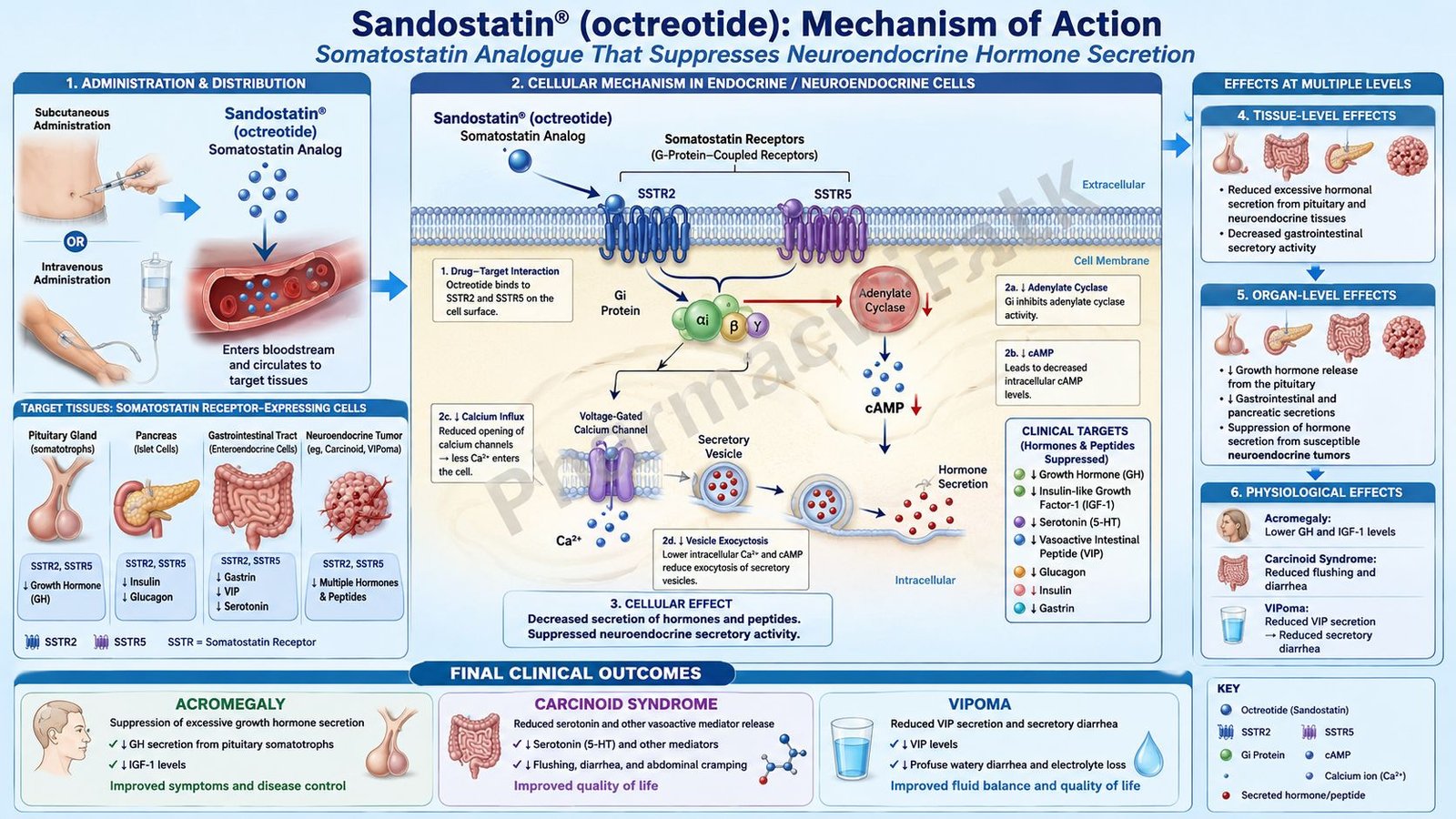
Table of Contents
Introduction
Sandostatin is the brand name of octreotide, a synthetic somatostatin analogue. It is a cyclic octapeptide designed to reproduce many of the inhibitory actions of the natural hormone somatostatin while having a much longer duration of action.
Somatostatin is an endogenous peptide hormone that suppresses the secretion of several hormones and gastrointestinal mediators. Octreotide has particularly strong inhibitory effects on growth hormone (GH), glucagon, and insulin. It also suppresses the release of serotonin, gastrin, vasoactive intestinal peptide (VIP), secretin, motilin, and pancreatic polypeptide, reduces the luteinizing hormone response to gonadotropin-releasing hormone, and decreases splanchnic blood flow.
These actions explain the major approved uses of Sandostatin. Sandostatin Injection is indicated for selected patients with acromegaly, symptomatic metastatic carcinoid tumors, and VIP-secreting tumors called VIPomas. Sandostatin LAR Depot provides prolonged octreotide exposure for patients who have responded to and tolerated the immediate-release formulation.
For exam purposes, the key concept is:
Sandostatin (octreotide) → somatostatin analogue → inhibits hormone and peptide secretion → ↓ GH and IGF-1 in acromegaly + ↓ serotonin in carcinoid syndrome + ↓ VIP in VIPoma → improvement of hormone-mediated symptoms.
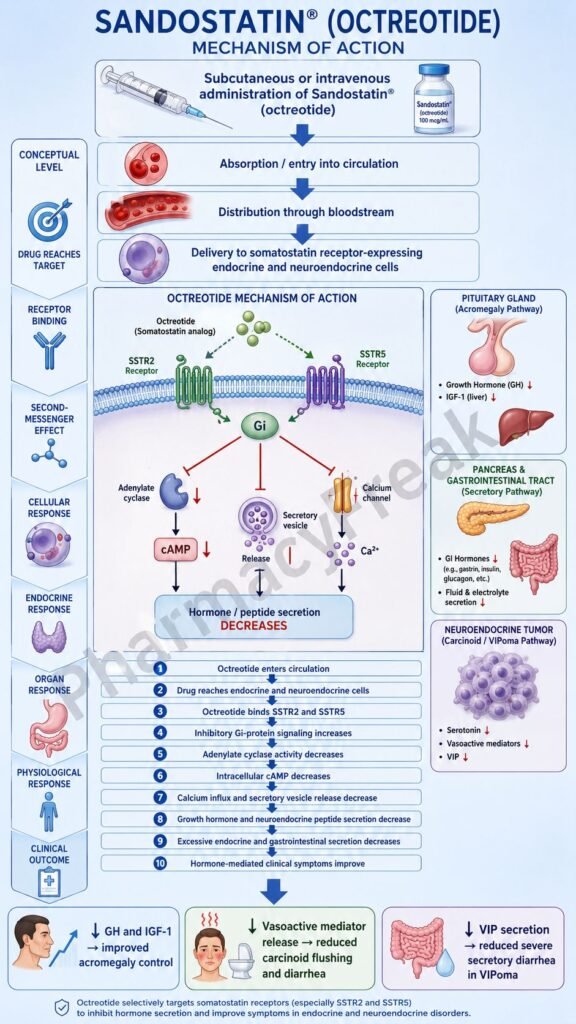
Mechanism of Action (Step-wise)
Step 1: Octreotide mimics endogenous somatostatin
Octreotide is structurally related to natural somatostatin and reproduces many of its inhibitory endocrine and gastrointestinal effects.
Unlike endogenous somatostatin, which is rapidly degraded, octreotide has a much longer duration of action. The plasma half-life of immediate-release octreotide is approximately 1.7 to 1.9 hours, compared with only about 1 to 3 minutes for natural somatostatin.
Step 2: Octreotide activates somatostatin receptors
Octreotide acts as an agonist at somatostatin receptors, particularly receptor subtypes involved in inhibition of hormone secretion.
Somatostatin receptors are G-protein-coupled receptors. Their activation generally suppresses intracellular signaling involved in secretion, including reduction of adenylyl cyclase activity, changes in ion-channel activity, reduced calcium-dependent exocytosis, and inhibition of secretory processes.
Step 3: Intracellular cyclic AMP signaling decreases
Somatostatin receptor activation is coupled mainly to inhibitory G proteins.
This reduces adenylyl cyclase activity and decreases intracellular cyclic AMP. The result is reduced activation of secretory pathways within endocrine and neuroendocrine cells.
Step 4: Calcium-dependent hormone release is reduced
Hormone secretion from endocrine cells depends partly on calcium entry and exocytosis of secretory granules.
Somatostatin receptor activation can reduce calcium influx and make secretory cells less likely to release stored hormones.
Step 5: Growth hormone secretion decreases
Octreotide is a potent inhibitor of growth hormone secretion.
This is the central pharmacological action responsible for its use in acromegaly. The current prescribing information notes that octreotide substantially reduces GH and IGF-1 concentrations in patients with acromegaly.
Step 6: IGF-1 concentrations decrease
Growth hormone stimulates hepatic production of insulin-like growth factor-1, or IGF-1.
When octreotide suppresses GH secretion, circulating IGF-1 concentrations also decline. Lower GH and IGF-1 activity can improve manifestations of acromegaly such as soft-tissue enlargement, excessive sweating, headache, and other hormone-related features.
Step 7: Serotonin and other carcinoid mediators are suppressed
Neuroendocrine carcinoid tumors can release serotonin and other vasoactive substances.
Excess mediator release contributes to characteristic symptoms such as flushing and severe diarrhea.
Octreotide suppresses the release of serotonin and other gastrointestinal peptides, helping control these symptoms.
Step 8: VIP secretion is suppressed
VIPomas are neuroendocrine tumors that secrete excessive amounts of vasoactive intestinal peptide.
VIP stimulates intestinal electrolyte and water secretion, producing profuse watery diarrhea.
Octreotide inhibits VIP release, which can markedly reduce secretory diarrhea in affected patients.
Step 9: Insulin and glucagon secretion decrease
Octreotide inhibits both insulin and glucagon secretion.
Because insulin lowers glucose while glucagon raises glucose, suppressing both hormones can disturb normal glucose regulation. Depending on the patient, hyperglycemia or hypoglycemia may occur during therapy.
Step 10: Gastrointestinal peptide secretion decreases
Octreotide inhibits several gastrointestinal hormones and peptides, including gastrin, secretin, motilin, and pancreatic polypeptide.
These effects contribute to its antisecretory actions but also explain some gastrointestinal adverse effects.
Step 11: Splanchnic blood flow decreases
Octreotide decreases blood flow through the splanchnic circulation.
This vascular effect is another important pharmacological property of somatostatin analogues.
Step 12: Gallbladder contraction and bile secretion decrease
Octreotide inhibits gallbladder contractility and decreases bile secretion.
Although this is not the desired therapeutic mechanism, it explains the clinically important risk of biliary sludge, gallstones, cholecystitis, and other biliary complications during prolonged therapy.
Step 13: TSH secretion can also decrease
Octreotide can suppress thyroid-stimulating hormone secretion.
Long-term therapy may therefore contribute to thyroid-function abnormalities, including hypothyroidism, which is why periodic thyroid monitoring is recommended.
Step 14: Different diseases benefit from different inhibitory actions
In acromegaly, the clinically important effect is suppression of GH and IGF-1.
In carcinoid syndrome, suppression of serotonin and other vasoactive mediators reduces diarrhea and flushing.
In VIPoma, suppression of VIP reduces severe watery diarrhea.
Step 15: Final therapeutic outcome
The final effect of Sandostatin is suppression of excessive hormone and peptide secretion.
It does not work through one disease-specific pathway. Instead, it mimics somatostatin and suppresses multiple endocrine and gastrointestinal secretory pathways, making it useful in disorders characterized by pathological hormone hypersecretion.
Pharmacokinetics
Sandostatin is available in immediate-release and long-acting formulations.
Sandostatin Injection contains octreotide acetate for subcutaneous or intravenous administration. Current labeled strengths include 50 mcg/mL, 100 mcg/mL, and 500 mcg/mL. For acromegaly, the current label gives an initial dose of 50 mcg three times daily, followed by individualized maintenance dosing. Doses for carcinoid tumors and VIPomas are also individualized according to symptom control.
After subcutaneous administration, octreotide is rapidly and essentially completely absorbed. Following a 100-mcg dose in healthy subjects, peak concentration was reached at about 0.4 hour. In acromegaly, peak concentration after the same dose occurred at approximately 0.7 hour.
In healthy volunteers, the steady-state volume of distribution was estimated at approximately 13.6 L, and total body clearance ranged from roughly 7 to 10 L/hour. About 65% of octreotide was plasma protein bound.
The apparent elimination half-life of immediate-release octreotide is approximately 1.7 to 1.9 hours. About 32% of a dose is excreted unchanged in urine.
Renal and hepatic dysfunction can prolong exposure. In severe renal failure requiring dialysis, clearance is reduced substantially. Cirrhosis also prolongs the half-life and reduces clearance, so maintenance dosing may require adjustment.
Sandostatin LAR Depot is a long-acting intramuscular formulation in biodegradable microspheres. The microspheres gradually release octreotide as the polymer matrix breaks down, allowing administration once every four weeks. It is available in 10 mg, 20 mg, and 30 mg strengths.
Clinical Uses
Sandostatin Injection is approved for acromegaly in patients who have had an inadequate response to, or cannot be treated with, surgical resection, pituitary irradiation, and maximally tolerated bromocriptine therapy. Its purpose is to reduce GH and IGF-1 concentrations.
It is also approved for symptomatic treatment of metastatic carcinoid tumors, particularly for suppression of severe diarrhea and flushing episodes caused by secretion of vasoactive mediators.
A third major labeled indication is treatment of profuse watery diarrhea associated with VIP-secreting tumors, or VIPomas. By suppressing VIP secretion, octreotide reduces intestinal fluid and electrolyte secretion.
Sandostatin LAR Depot is used in patients with acromegaly, carcinoid syndrome, or VIPoma who have responded to and tolerated subcutaneous Sandostatin Injection. The long-acting formulation reduces the need for frequent injections by providing sustained drug release over approximately four weeks.
An important exam distinction is that Sandostatin is mainly controlling hormone excess and the symptoms caused by that excess. The immediate-release label notes that the clinical studies did not establish reduction in tumor size or tumor growth rate.
Adverse Effects
Gallbladder and biliary abnormalities are among the most important adverse effects of octreotide. Reduced gallbladder contractility and reduced bile secretion can cause biliary sludge and gallstones. Complications such as acute cholecystitis, ascending cholangitis, biliary obstruction, cholestatic hepatitis, and pancreatitis have also been reported.
Glucose abnormalities are another major exam point. Because octreotide suppresses insulin, glucagon, and GH, either hyperglycemia or hypoglycemia can develop. Patients with diabetes may need changes in insulin or other glucose-lowering therapy.
Cardiac effects include sinus bradycardia, conduction abnormalities, arrhythmias, and, particularly with intravenous administration, higher-degree atrioventricular block. Cardiac monitoring should be considered when Sandostatin is administered intravenously to patients at risk.
Thyroid abnormalities can occur because octreotide suppresses TSH. Periodic monitoring of thyroid function is recommended during prolonged treatment.
A more recently emphasized safety issue is steatorrhea and malabsorption of dietary fat. Patients may develop loose or discolored stools, abdominal bloating, steatorrhea, and weight loss. New or worsening symptoms should prompt evaluation for pancreatic exocrine insufficiency.
Octreotide may also reduce vitamin B12 concentrations in some patients, so monitoring may be appropriate during chronic therapy.
Common adverse reactions in patients with acromegaly include gallbladder abnormalities, sinus bradycardia, diarrhea, loose stools, nausea, abdominal discomfort, hyperglycemia, and hypothyroidism.
Sandostatin is contraindicated in patients with hypersensitivity to octreotide or any component of the formulation.
Comparative Analysis
Sandostatin is most commonly compared with other somatostatin analogues such as lanreotide and pasireotide.
Octreotide and lanreotide both mimic somatostatin and are used in disorders involving excessive hormone secretion. Both can suppress GH and are important in acromegaly. Their formulations and administration differ: Sandostatin LAR is given intramuscularly, while long-acting lanreotide is administered by deep subcutaneous injection.
Pasireotide is also a somatostatin analogue but has a broader somatostatin receptor-binding profile. It can be useful in selected endocrine disorders but is particularly associated with clinically significant hyperglycemia.
Compared with bromocriptine or cabergoline, octreotide acts through somatostatin receptors rather than dopamine D2 receptors. Dopamine agonists can reduce GH secretion in some patients with acromegaly, whereas octreotide directly mimics somatostatin-mediated inhibitory signaling.
Compared with pegvisomant, octreotide works upstream by reducing GH secretion. Pegvisomant blocks peripheral GH receptors and therefore reduces GH-mediated production of IGF-1 without directly suppressing pituitary GH release.
For carcinoid syndrome and VIPoma, Sandostatin is especially useful because it suppresses secretion of multiple gastrointestinal and vasoactive peptides rather than blocking a single downstream receptor.
MCQs
- Sandostatin contains which active drug?
a) Lanreotide
b) Octreotide
c) Pasireotide
d) Pegvisomant
Answer: b) Octreotide
- Octreotide belongs to which pharmacological class?
a) Dopamine antagonist
b) Growth hormone receptor antagonist
c) Somatostatin analogue
d) Proton pump inhibitor
Answer: c) Somatostatin analogue
- In acromegaly, Sandostatin primarily reduces:
a) GH and IGF-1
b) Cortisol and aldosterone
c) Prolactin only
d) ACTH only
Answer: a) GH and IGF-1
- Which mediator is especially important in the diarrhea and flushing of carcinoid syndrome?
a) Acetylcholine only
b) Histamine only
c) Dopamine only
d) Serotonin and other vasoactive mediators
Answer: d) Serotonin and other vasoactive mediators
- Sandostatin improves watery diarrhea in VIPoma mainly by reducing secretion of:
a) Insulin
b) VIP
c) Aldosterone
d) Thyroxine
Answer: b) VIP
- Octreotide is more prolonged in action than natural somatostatin because:
a) Natural somatostatin has a very short plasma half-life
b) Octreotide is stored permanently in bone
c) Octreotide cannot be eliminated
d) Somatostatin is orally absorbed better
Answer: a) Natural somatostatin has a very short plasma half-life
- Which adverse effect is strongly associated with chronic octreotide therapy?
a) Pulmonary fibrosis
b) Gingival hyperplasia
c) Gallstones and biliary sludge
d) Ototoxicity
Answer: c) Gallstones and biliary sludge
- Octreotide can cause both hyperglycemia and hypoglycemia because it alters secretion of:
a) Thyroxine and calcitonin only
b) Insulin, glucagon, and growth hormone
c) Aldosterone only
d) Erythropoietin only
Answer: b) Insulin, glucagon, and growth hormone
- Sandostatin LAR Depot is normally administered by:
a) Oral route
b) Intravenous infusion every day
c) Deep subcutaneous injection every hour
d) Intragluteal intramuscular injection
Answer: d) Intragluteal intramuscular injection
- Which statement best describes Sandostatin?
a) It mimics somatostatin and suppresses secretion of multiple hormones and gastrointestinal peptides
b) It stimulates growth hormone release
c) It directly blocks GH receptors like pegvisomant
d) It irreversibly inhibits dopamine receptors
Answer: a) It mimics somatostatin and suppresses secretion of multiple hormones and gastrointestinal peptides
- Which cardiac effect may occur with Sandostatin?
a) Mandatory tachycardia
b) Sinus bradycardia
c) Permanent atrial fibrillation in every patient
d) QT shortening only
Answer: b) Sinus bradycardia
- Octreotide may suppress which pituitary hormone?
a) TSH
b) FSH exclusively
c) ACTH in every patient
d) Prolactin completely
Answer: a) TSH
- Sandostatin Injection can be administered:
a) Only orally
b) Only intramuscularly
c) Subcutaneously or intravenously
d) Only by inhalation
Answer: c) Subcutaneously or intravenously
- Which drug works differently from octreotide by blocking the growth hormone receptor?
a) Lanreotide
b) Pasireotide
c) Bromocriptine
d) Pegvisomant
Answer: d) Pegvisomant
- A patient develops oily stools, bloating, and weight loss during prolonged octreotide therapy. An important possibility is:
a) Pancreatic exocrine insufficiency with fat malabsorption
b) Hyperthyroidism only
c) Iron overload
d) Serotonin syndrome
Answer: a) Pancreatic exocrine insufficiency with fat malabsorption
FAQs
What is the mechanism of action of Sandostatin?
Sandostatin contains octreotide, a synthetic somatostatin analogue. It activates somatostatin receptors and suppresses the secretion of several hormones and peptides, including GH, glucagon, insulin, serotonin, gastrin, VIP, secretin, motilin, and pancreatic polypeptide.
What is the generic name of Sandostatin?
The generic name of Sandostatin is octreotide.
What is Sandostatin used for?
Sandostatin Injection is used for selected patients with acromegaly, severe diarrhea and flushing caused by metastatic carcinoid tumors, and profuse watery diarrhea associated with VIPomas.
How does Sandostatin work in acromegaly?
Octreotide suppresses excessive GH secretion. Reduced GH then lowers IGF-1 production, helping control the biochemical abnormalities and symptoms of acromegaly.
How does Sandostatin work in carcinoid syndrome?
It suppresses the release of serotonin and other vasoactive gastrointestinal mediators. This reduces severe diarrhea and flushing caused by metastatic carcinoid tumors.
Why can Sandostatin cause gallstones?
Octreotide reduces gallbladder contractility and bile secretion. Prolonged biliary stasis can promote sludge and gallstone formation.
Can Sandostatin affect blood glucose?
Yes. Octreotide inhibits insulin, glucagon, and GH, so either hyperglycemia or hypoglycemia can occur. Blood glucose should be monitored when clinically appropriate.
What is the difference between Sandostatin Injection and Sandostatin LAR?
Sandostatin Injection is the immediate-release form and can be administered subcutaneously or intravenously. Sandostatin LAR Depot contains octreotide in biodegradable microspheres that release the drug slowly and is administered intramuscularly once every four weeks.
References
Goodman & Gilman’s The Pharmacological Basis of Therapeutics
Katzung Basic & Clinical Pharmacology