Table of Contents
Introduction
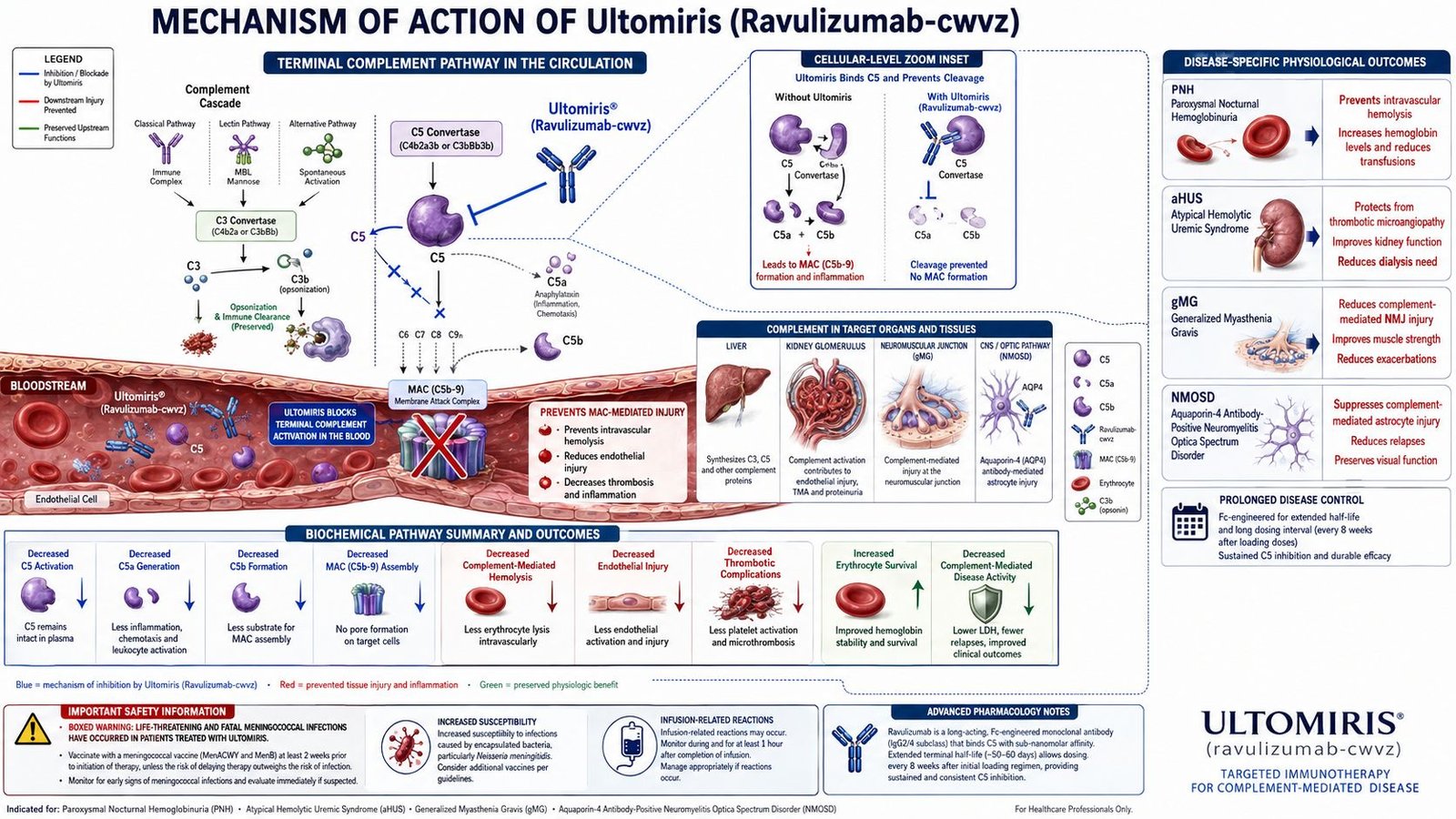
Ultomiris is the brand name of ravulizumab-cwvz, a long-acting complement inhibitor. Pharmacologically, ravulizumab is a humanized monoclonal antibody that binds complement protein C5 and prevents terminal complement activation.
The complement system is part of innate immunity. It helps destroy pathogens and damaged cells through inflammatory mediators and formation of the membrane attack complex, also called MAC or C5b-9. However, excessive or uncontrolled complement activation can damage host tissues and contribute to serious diseases.
Ultomiris is indicated for paroxysmal nocturnal hemoglobinuria in adult and pediatric patients 1 month of age and older, atypical hemolytic uremic syndrome in adult and pediatric patients 1 month of age and older, anti-acetylcholine receptor antibody-positive generalized myasthenia gravis in adults, and anti-aquaporin-4 antibody-positive neuromyelitis optica spectrum disorder in adults. It is not indicated for Shiga toxin E. coli-related hemolytic uremic syndrome.
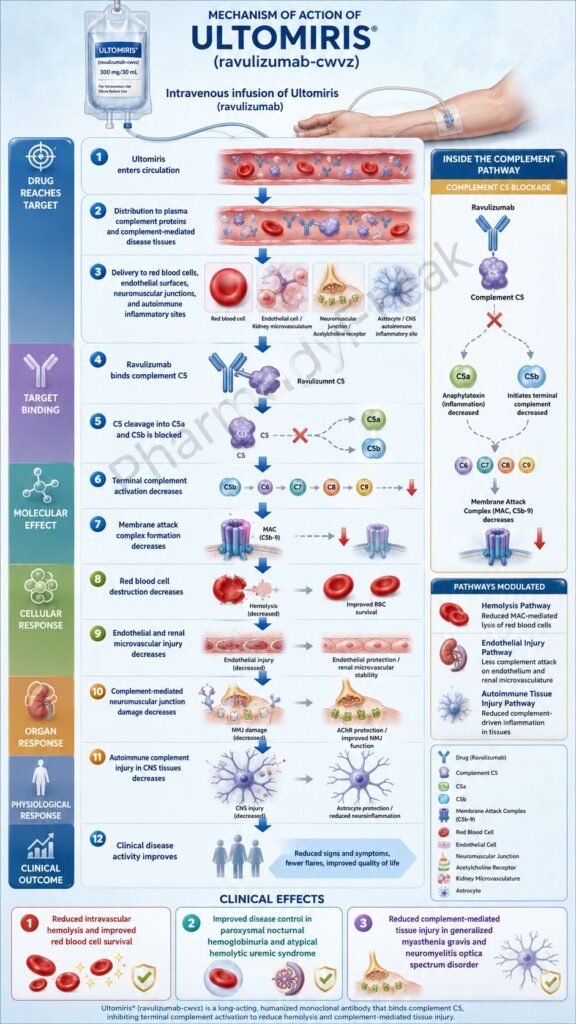
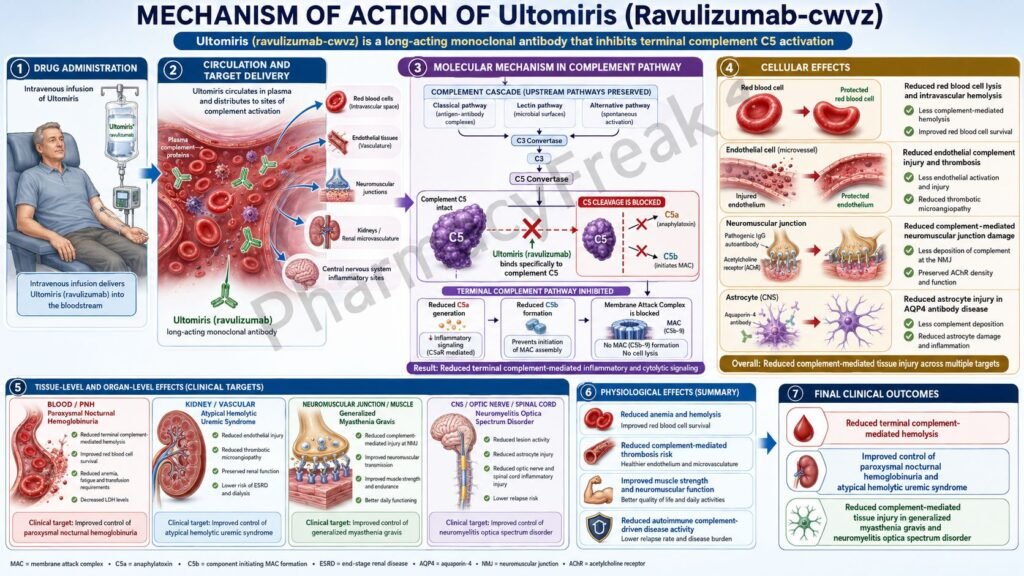
Ravulizumab works by binding C5 with high affinity. This prevents C5 cleavage into C5a and C5b. C5a is a pro-inflammatory anaphylatoxin, and C5b begins formation of the membrane attack complex. By blocking this step, Ultomiris prevents MAC formation and reduces terminal complement-mediated injury.
For exam purposes, Ultomiris should be remembered as a long-acting anti-C5 monoclonal antibody that prevents C5a generation and C5b-9 membrane attack complex formation. It is mechanistically related to eculizumab but has a longer dosing interval.
Mechanism of Action (Step-wise)
Step 1: Complement activation normally helps immune defense
The complement system can be activated through the classical, lectin, or alternative pathway. These pathways converge at C3 activation and eventually lead to C5 cleavage.
Step 2: C5 is cleaved into C5a and C5b
When complement activation reaches the terminal pathway, C5 convertase cleaves complement protein C5 into C5a and C5b. This is a key step in terminal complement activation.
Step 3: C5a promotes inflammation
C5a is a powerful anaphylatoxin. It promotes inflammation, leukocyte recruitment, vascular activation, chemotaxis, and immune-cell activation. Excess C5a can worsen tissue injury in complement-mediated diseases.
Step 4: C5b initiates membrane attack complex formation
C5b binds other complement proteins, including C6, C7, C8, and C9. This leads to formation of the terminal complement complex C5b-9, also called the membrane attack complex.
Step 5: MAC can damage host cells
The membrane attack complex can insert into cell membranes and cause cell injury or lysis. In uncontrolled complement activation, host cells may be damaged along with pathogens.
Step 6: In PNH, red blood cells are vulnerable to complement
Paroxysmal nocturnal hemoglobinuria is caused by a clonal defect that leaves blood cells deficient in complement-protective proteins such as CD55 and CD59. Without adequate protection, red blood cells are destroyed by terminal complement activation, leading to intravascular hemolysis.
Step 7: In aHUS, complement activation causes TMA
Atypical hemolytic uremic syndrome involves dysregulated complement activation that damages endothelial cells and causes thrombotic microangiopathy. This can produce thrombocytopenia, hemolytic anemia, kidney injury, hypertension, seizures, and other organ complications.
Step 8: In gMG, complement damages the neuromuscular junction
In anti-AChR antibody-positive generalized myasthenia gravis, antibodies bind acetylcholine receptors at the neuromuscular junction. Complement activation contributes to postsynaptic membrane injury and impaired neuromuscular transmission.
Step 9: In NMOSD, AQP4 antibodies trigger complement injury
In anti-aquaporin-4 antibody-positive neuromyelitis optica spectrum disorder, antibodies target aquaporin-4 on astrocytes. Complement activation contributes to astrocyte injury, inflammation, optic neuritis, transverse myelitis, and neurological disability.
Step 10: Ultomiris binds complement protein C5
Ravulizumab-cwvz specifically binds complement protein C5 with high affinity. This is the central molecular action of Ultomiris.
Step 11: C5 cleavage is inhibited
When ravulizumab binds C5, C5 cannot be efficiently cleaved into C5a and C5b. This blocks terminal complement activation at a critical point.
Step 12: C5a generation decreases
Because C5 cleavage is blocked, less C5a is produced. This reduces complement-mediated inflammatory amplification and immune-cell recruitment.
Step 13: C5b-9 membrane attack complex formation decreases
Because C5b generation is blocked, the C5b-9 membrane attack complex cannot form effectively. This reduces terminal complement-mediated cell damage.
Step 14: Disease-specific tissue injury decreases
In PNH, inhibition of terminal complement reduces intravascular hemolysis. In aHUS, it reduces complement-mediated thrombotic microangiopathy. In gMG, the precise mechanism is not fully known but is presumed to involve reduced C5b-9 deposition at the neuromuscular junction. In NMOSD, the precise mechanism is also not fully known but is presumed to involve inhibition of aquaporin-4 antibody-induced terminal complement C5b-9 deposition.
Step 15: Final therapeutic outcome
The final therapeutic effect of Ultomiris is sustained terminal complement blockade. This reduces hemolysis in PNH, complement-mediated TMA in aHUS, neuromuscular junction injury in anti-AChR-positive gMG, and complement-mediated astrocyte injury in anti-AQP4-positive NMOSD.
Pharmacokinetics
Ultomiris is administered only as an intravenous infusion. The recommended loading and maintenance doses are weight-based. Maintenance dosing begins 2 weeks after the loading dose and is given every 4 or 8 weeks depending on body weight and indication.
Ultomiris must be diluted before administration and given through a 0.2 or 0.22 micron filter. It should be administered under healthcare supervision as an IV infusion, not as an oral medicine or intramuscular injection.
Ravulizumab is a monoclonal antibody and is not primarily metabolized by hepatic CYP450 enzymes. Like other therapeutic antibodies, it is expected to undergo protein catabolism into peptides and amino acids.
The long duration of action allows less frequent maintenance dosing compared with eculizumab. This is one of the major practical differences between Ultomiris and Soliris.
Ravulizumab shows dose-proportional pharmacokinetics over the studied dose range. The label reports pharmacokinetic parameters across PNH, aHUS, gMG, and NMOSD populations, with terminal complement inhibition sustained during treatment in most studied patients.
Complete inhibition of serum free C5 was observed by the end of the first infusion and sustained throughout the 26-week treatment period in adult and pediatric PNH patients, in most aHUS patients, in all adult gMG patients, and in most adult NMOSD patients.
Concomitant plasma exchange, plasmapheresis, or intravenous immunoglobulin can reduce serum ravulizumab concentrations and requires supplemental dosing. Neonatal Fc receptor blockers may also reduce ravulizumab concentrations by interfering with monoclonal antibody recycling.
Clinical Uses
Ultomiris is used in paroxysmal nocturnal hemoglobinuria in adult and pediatric patients 1 month of age and older. In PNH, terminal complement inhibition reduces intravascular hemolysis, improves hemolysis-related symptoms, and lowers complement-mediated red-cell destruction.
Ultomiris is used in atypical hemolytic uremic syndrome in adult and pediatric patients 1 month of age and older to inhibit complement-mediated thrombotic microangiopathy. It is not used for Shiga toxin E. coli-related hemolytic uremic syndrome.
Ultomiris is used in adult patients with generalized myasthenia gravis who are anti-acetylcholine receptor antibody-positive. In this setting, it helps reduce complement-mediated neuromuscular junction injury.
Ultomiris is used in adult patients with neuromyelitis optica spectrum disorder who are anti-aquaporin-4 antibody-positive. In NMOSD, complement inhibition helps reduce antibody-mediated astrocyte and CNS injury.
Ultomiris is not a corticosteroid, cytotoxic chemotherapy drug, anticoagulant, acetylcholinesterase inhibitor, or broad immunosuppressant. It is a targeted terminal complement inhibitor.
Ultomiris does not replace supportive management. Patients may still require disease-specific monitoring, vaccination, infection surveillance, anticoagulation decisions, renal monitoring, neurology follow-up, or other supportive care depending on the disease.
Adverse Effects
The most important adverse effect of Ultomiris is serious meningococcal infection. Because terminal complement is essential for defense against Neisseria meningitidis, blocking C5 greatly increases susceptibility to meningococcal meningitis or septicemia. Life-threatening and fatal infections have occurred in patients treated with complement inhibitors.
Patients should complete or update meningococcal vaccination against serogroups A, C, W, Y, and B at least 2 weeks before the first Ultomiris dose whenever possible. If urgent therapy is needed before vaccination is up to date, antibacterial prophylaxis should be provided and vaccines should be administered as soon as possible.
Vaccination reduces but does not eliminate meningococcal infection risk. Patients must be monitored for early symptoms such as fever, headache with nausea or vomiting, stiff neck, confusion, rash, muscle aches with flu-like symptoms, and light sensitivity.
Ultomiris is available only through a restricted REMS program called the Ultomiris and Soliris REMS because of the risk of serious meningococcal infections. Prescribers must enroll, counsel patients, assess vaccination status, and provide required safety materials.
Other infections are also important. Terminal complement blockade can increase susceptibility to encapsulated bacteria such as Streptococcus pneumoniae and Haemophilus influenzae, and to Neisseria gonorrhoeae. Children may be at increased risk of serious infections due to Streptococcus pneumoniae and Haemophilus influenzae type b.
Infusion-related reactions may occur. Reported reactions include lower back pain, abdominal pain, muscle spasms, blood pressure changes, rigors, limb discomfort, hypersensitivity, and dysgeusia. If cardiovascular instability or respiratory compromise occurs, the infusion should be interrupted and supportive care provided.
Common adverse reactions vary by indication. In PNH, common adverse reactions include upper respiratory tract infection and headache. In aHUS, common reactions include upper respiratory tract infection, diarrhea, nausea, vomiting, headache, hypertension, and pyrexia. In gMG, common reactions include diarrhea and upper respiratory tract infection. In NMOSD, common reactions include COVID-19, headache, back pain, arthralgia, and urinary tract infection.
Discontinuation requires monitoring. After stopping Ultomiris in PNH, patients should be monitored for at least 16 weeks for hemolysis. After stopping in aHUS, patients should be monitored for at least 12 months for thrombotic microangiopathy complications.
Comparative Analysis
Ultomiris is commonly compared with eculizumab, pegcetacoplan, sutimlimab, zilucoplan, efgartigimod, rituximab, corticosteroids, and other disease-specific therapies.
Compared with eculizumab, Ultomiris has the same broad terminal complement target because both inhibit C5. The major practical difference is dosing interval. Eculizumab is usually given more frequently, while ravulizumab is engineered for longer-acting C5 inhibition and less frequent maintenance dosing.
Compared with pegcetacoplan, Ultomiris acts later in the complement cascade. Pegcetacoplan inhibits C3, affecting upstream complement activation, while Ultomiris blocks terminal C5 activation.
Compared with sutimlimab, Ultomiris blocks C5 in the terminal pathway, while sutimlimab inhibits C1s in the classical pathway. Therefore, their complement targets and approved disease settings differ.
Compared with zilucoplan, both affect C5 biology, but zilucoplan is a small peptide C5 inhibitor used subcutaneously in generalized myasthenia gravis, while Ultomiris is an intravenous monoclonal antibody used across several complement-mediated diseases.
Compared with efgartigimod in myasthenia gravis, Ultomiris reduces complement-mediated injury at the neuromuscular junction, while efgartigimod lowers pathogenic IgG levels by blocking neonatal Fc receptor recycling.
Compared with rituximab, Ultomiris does not deplete B cells. Rituximab targets CD20-positive B cells, while Ultomiris blocks terminal complement activation downstream of antibody binding.
Compared with corticosteroids, Ultomiris is more targeted. Corticosteroids broadly suppress inflammation and immunity, while Ultomiris specifically prevents C5 cleavage and MAC formation.
Compared with anticoagulants in PNH, Ultomiris addresses complement-mediated hemolysis and complement-related thrombotic risk, while anticoagulants act on the coagulation cascade. The Ultomiris label states that treatment should not alter anticoagulant management because the effect of withdrawing anticoagulant therapy has not been established.
MCQs
- Ultomiris contains which active drug?
a) Eculizumab
b) Ravulizumab-cwvz
c) Pegcetacoplan
d) Sutimlimab
Answer: b) Ravulizumab-cwvz
- Ultomiris belongs to which pharmacological class?
a) Terminal complement inhibitor
b) TNF-alpha inhibitor
c) CD20 monoclonal antibody
d) JAK inhibitor
Answer: a) Terminal complement inhibitor
- The main molecular target of ravulizumab is:
a) C5
b) CD20
c) IL-6 receptor
d) VEGFR-2
Answer: a) C5
- Ultomiris prevents cleavage of C5 into:
a) C5a and C5b
b) C3a and C3b
c) Factor VIII and thrombin
d) IgG and IgM
Answer: a) C5a and C5b
- C5b normally initiates formation of:
a) Membrane attack complex
b) Dopamine transporter
c) Acetylcholine receptor
d) Thrombopoietin receptor
Answer: a) Membrane attack complex
- The membrane attack complex is also called:
a) C5b-9
b) CD20-CD19
c) IL-12/23
d) PD-1/PD-L1
Answer: a) C5b-9
- In PNH, Ultomiris reduces:
a) Terminal complement-mediated intravascular hemolysis
b) Dopamine receptor blockade
c) Estrogen receptor signaling
d) Gastric acid secretion
Answer: a) Terminal complement-mediated intravascular hemolysis
- In aHUS, Ultomiris is used to inhibit:
a) Complement-mediated thrombotic microangiopathy
b) HER2 receptor signaling
c) Histamine release only
d) Bacterial DNA gyrase
Answer: a) Complement-mediated thrombotic microangiopathy
- Ultomiris is approved for adult gMG patients who are:
a) Anti-AChR antibody-positive
b) EGFR mutation-positive
c) HER2-positive
d) HLA-B27-positive only
Answer: a) Anti-AChR antibody-positive
- Ultomiris is approved for adult NMOSD patients who are:
a) Anti-AQP4 antibody-positive
b) Anti-TPO antibody-positive
c) Anti-CCP antibody-positive
d) Anti-dsDNA-negative only
Answer: a) Anti-AQP4 antibody-positive
- Ultomiris is administered by which route?
a) Intravenous infusion
b) Oral tablet
c) Inhalation
d) Topical application
Answer: a) Intravenous infusion
- The boxed warning of Ultomiris is mainly for:
a) Serious meningococcal infections
b) Severe hypoglycemia
c) Thyroid C-cell tumors
d) Ototoxicity
Answer: a) Serious meningococcal infections
- Before starting Ultomiris, patients should receive vaccination against:
a) Meningococcal serogroups A, C, W, Y, and B
b) Only influenza A
c) Only hepatitis A
d) Only rabies virus
Answer: a) Meningococcal serogroups A, C, W, Y, and B
- Ultomiris is available through which restricted program?
a) Ultomiris and Soliris REMS
b) iPLEDGE only
c) Clozapine REMS only
d) Opioid REMS only
Answer: a) Ultomiris and Soliris REMS
- Which statement best describes Ultomiris?
a) It binds C5, prevents C5a and C5b generation, and blocks membrane attack complex formation
b) It depletes CD20-positive B cells through complement-mediated lysis
c) It inhibits TNF-alpha and reduces granuloma formation
d) It blocks dopamine D2 receptors in the basal ganglia
Answer: a) It binds C5, prevents C5a and C5b generation, and blocks membrane attack complex formation
FAQs
What is the mechanism of action of Ultomiris?
Ultomiris, or ravulizumab-cwvz, binds complement protein C5 and prevents its cleavage into C5a and C5b. This blocks terminal complement activation and prevents formation of the C5b-9 membrane attack complex.
What is the generic name of Ultomiris?
The generic name of Ultomiris is ravulizumab-cwvz.
What is Ultomiris used for?
Ultomiris is used for paroxysmal nocturnal hemoglobinuria, atypical hemolytic uremic syndrome, anti-AChR antibody-positive generalized myasthenia gravis in adults, and anti-AQP4 antibody-positive neuromyelitis optica spectrum disorder in adults.
Is Ultomiris the same as Soliris?
No. Ultomiris contains ravulizumab, while Soliris contains eculizumab. Both inhibit complement C5, but Ultomiris is longer acting and is given less frequently as maintenance therapy.
Why does Ultomiris increase meningococcal infection risk?
Ultomiris blocks terminal complement activation, which is important for immune defense against Neisseria meningitidis. This increases the risk of serious and potentially fatal meningococcal infection.
Why is meningococcal vaccination needed before Ultomiris?
Meningococcal vaccination reduces the risk of serious meningococcal infection. Patients should be vaccinated against serogroups A, C, W, Y, and B at least 2 weeks before treatment whenever possible.
Does vaccination completely remove the meningococcal risk?
No. Vaccination reduces but does not eliminate the risk. Patients must still be monitored for symptoms of meningococcal infection and seek urgent medical care if symptoms occur.
Is Ultomiris chemotherapy?
No. Ultomiris is not chemotherapy. It is a monoclonal antibody complement inhibitor that blocks terminal complement activation.
References
Goodman & Gilman’s The Pharmacological Basis of Therapeutics
Katzung Basic & Clinical Pharmacology