
Table of Contents
Introduction
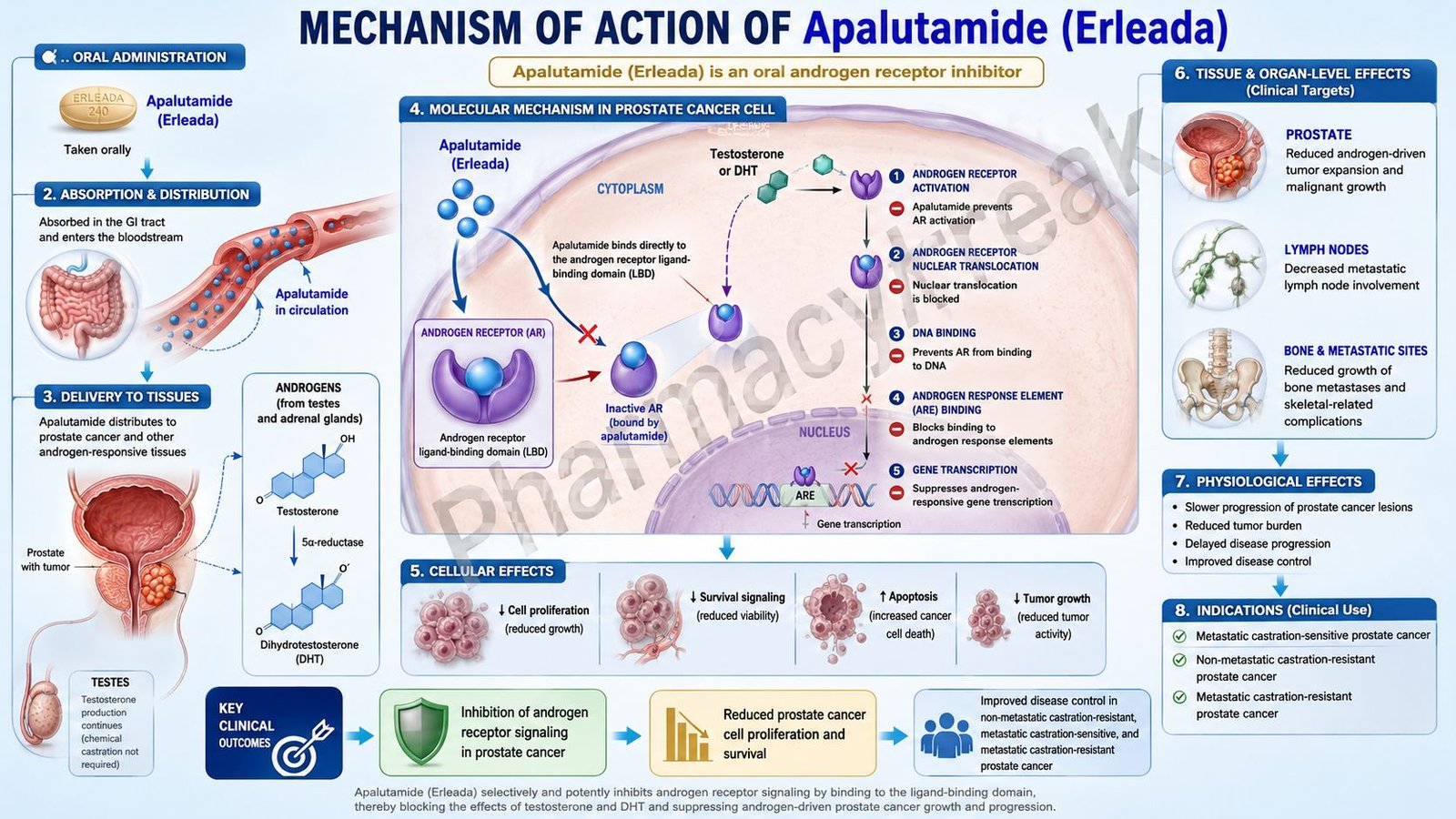
Apalutamide is an oral targeted anticancer drug marketed under the brand name Erleada. Pharmacologically, apalutamide is an androgen receptor inhibitor used in prostate cancer.
Prostate cancer growth is often driven by androgen signaling. Androgens such as testosterone and dihydrotestosterone bind to androgen receptors inside prostate cancer cells. Once activated, androgen receptors move into the nucleus, bind DNA, and stimulate transcription of genes that promote prostate cancer cell growth, survival, and proliferation.
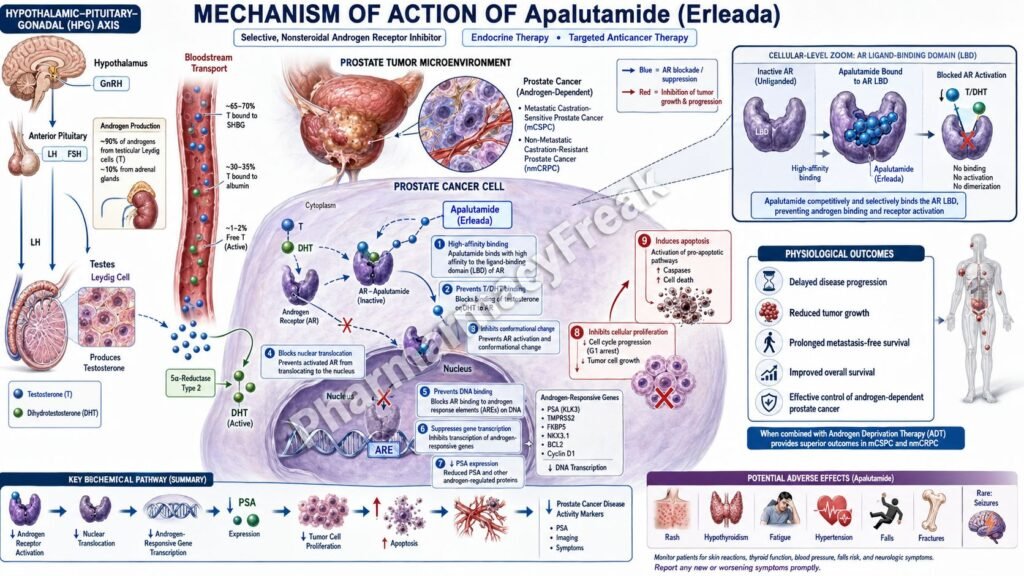
Apalutamide works by directly inhibiting the androgen receptor. It binds to the ligand-binding domain of the androgen receptor, prevents androgen receptor nuclear translocation, blocks DNA binding, and reduces androgen receptor-mediated transcription. This decreases prostate cancer cell proliferation and increases apoptosis in androgen receptor-dependent prostate cancer cells. The current Erleada label identifies apalutamide as an androgen receptor inhibitor and states that it inhibits AR nuclear translocation, DNA binding, and AR-mediated transcription.
Apalutamide is indicated for metastatic castration-sensitive prostate cancer and non-metastatic castration-resistant prostate cancer. Patients should also receive a GnRH analog concurrently or should have had bilateral orchiectomy.
For exam purposes, apalutamide should be remembered as an oral androgen receptor inhibitor that blocks androgen receptor signaling downstream of testosterone production. It is different from GnRH analogs because it does not primarily reduce testosterone synthesis; instead, it blocks the receptor-level action of androgens.
Mechanism of Action (Step-wise)
Step 1: Androgens drive prostate cancer growth
Testosterone and dihydrotestosterone are key androgens involved in prostate cell biology. In androgen-sensitive prostate cancer, these hormones stimulate cancer-cell survival and proliferation through androgen receptor activation.
Step 2: Androgens bind androgen receptors
Androgen receptors are intracellular nuclear hormone receptors. When testosterone or dihydrotestosterone binds to the androgen receptor, the receptor changes shape and becomes activated.
Step 3: Activated androgen receptors move into the nucleus
After androgen binding, the androgen receptor translocates into the nucleus. This nuclear movement is required for the receptor to regulate gene transcription.
Step 4: Androgen receptors bind DNA
Inside the nucleus, activated androgen receptors bind to androgen response elements on DNA. This triggers transcription of androgen-regulated genes involved in cell growth, survival, and prostate cancer progression.
Step 5: Androgen receptor transcription promotes tumor growth
When androgen receptor-mediated transcription continues, prostate cancer cells receive signals that support proliferation, survival, invasion, and disease progression.
Step 6: Castration-sensitive prostate cancer still depends on androgen signaling
In metastatic castration-sensitive prostate cancer, tumor growth remains strongly influenced by androgen signaling. Androgen deprivation therapy reduces testosterone, but adding androgen receptor inhibition can further block the pathway.
Step 7: Castration-resistant prostate cancer may still use androgen receptor signaling
In non-metastatic castration-resistant prostate cancer, testosterone is already suppressed to castrate levels, but cancer cells can continue using androgen receptor signaling through receptor overexpression, hypersensitivity, intratumoral androgen production, or other adaptations.
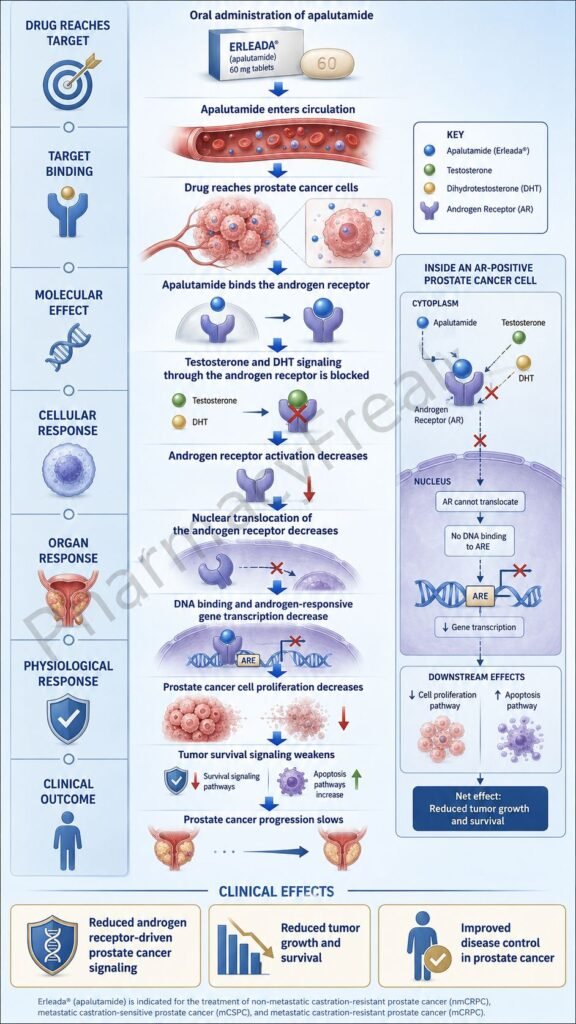
Step 8: Apalutamide binds directly to androgen receptors
Apalutamide binds to the ligand-binding domain of the androgen receptor. This prevents normal androgen-driven receptor activation. This is the central molecular mechanism of apalutamide.
Step 9: Androgen receptor nuclear translocation is inhibited
When apalutamide blocks the androgen receptor, the receptor is less able to move into the nucleus. This prevents a key step required for androgen receptor-mediated gene regulation.
Step 10: Androgen receptor DNA binding decreases
Apalutamide also inhibits androgen receptor binding to DNA. Without effective DNA binding, androgen-responsive genes are not activated normally.
Step 11: AR-mediated transcription decreases
Because nuclear translocation and DNA binding are blocked, androgen receptor-mediated transcription decreases. This reduces expression of genes that promote prostate cancer cell proliferation and survival.
Step 12: Tumor cell proliferation decreases
In prostate cancer models, apalutamide decreased tumor cell proliferation. This means fewer cancer cells progress through growth and division pathways.
Step 13: Apoptosis increases
Apalutamide administration increased apoptosis in prostate cancer xenograft models. Apoptosis means programmed cell death, which helps reduce tumor cell burden.
Step 14: Active metabolite contributes to activity
Apalutamide has a major active metabolite called N-desmethyl apalutamide. This metabolite is a less potent androgen receptor inhibitor but likely contributes to clinical activity because of its exposure and pharmacological properties.
Step 15: Final therapeutic outcome
The final therapeutic effect of apalutamide is suppression of androgen receptor signaling. This helps delay prostate cancer progression, reduce PSA activity, and improve disease control in appropriate patients with metastatic castration-sensitive prostate cancer or non-metastatic castration-resistant prostate cancer.
Pharmacokinetics
Apalutamide is administered orally as Erleada tablets. The recommended dosage is 240 mg orally once daily, with or without food. The tablets are available as 60 mg and 240 mg strengths. Patients receiving Erleada should also receive a GnRH analog unless they have had bilateral orchiectomy.
Apalutamide tablets should usually be swallowed whole. For patients who cannot swallow tablets whole, the label provides alternate administration instructions using non-carbonated water followed by orange juice, applesauce, or additional water.
Apalutamide has approximately 100% absolute oral bioavailability. The median time to maximum plasma concentration is about 2 hours. Food does not produce clinically significant changes in apalutamide peak concentration or overall exposure, although it may delay the time to peak concentration.
Steady state is achieved after about 4 weeks of once-daily dosing. Apalutamide shows approximately 5-fold accumulation at steady state. Its major active metabolite, N-desmethyl apalutamide, also reaches clinically relevant exposure and contributes to therapeutic activity.
Apalutamide is highly protein bound, about 96%, while N-desmethyl apalutamide is about 95% protein bound. The apparent volume of distribution is approximately 276 L, suggesting extensive tissue distribution.
Apalutamide has a half-life of approximately 3 days. It is mainly metabolized by CYP2C8 and CYP3A4 to form the active metabolite N-desmethyl apalutamide. At steady state, both CYP2C8 and CYP3A4 contribute meaningfully to its metabolism.
Drug interactions are important. Apalutamide is a strong inducer of CYP3A4 and CYP2C19, a weak inducer of CYP2C9, and an inducer of P-gp, BCRP, and OATP1B1. This can reduce exposure and effectiveness of drugs that are substrates of these enzymes or transporters.
In severe hepatic impairment, the recommended Erleada dose is reduced to 120 mg orally once daily. No dosage adjustment is recommended for mild or moderate hepatic impairment.
Clinical Uses
Apalutamide is used for metastatic castration-sensitive prostate cancer. In this setting, prostate cancer has spread beyond the prostate and remains responsive to androgen deprivation therapy. Apalutamide is used with ongoing medical or surgical castration to provide deeper blockade of androgen receptor signaling.
Apalutamide is also used for non-metastatic castration-resistant prostate cancer. In this condition, prostate cancer progresses biochemically despite castrate testosterone levels, but no distant metastases are detected on conventional imaging. Apalutamide helps delay progression by blocking androgen receptor signaling.
Apalutamide is not chemotherapy. It does not directly damage DNA like platinum drugs or alkylating agents. It is not a GnRH agonist, GnRH antagonist, or androgen synthesis inhibitor. It is a receptor-level androgen signaling blocker.
Apalutamide is usually used with androgen deprivation therapy. Patients should receive a GnRH analog concurrently unless they have undergone bilateral orchiectomy. This combination reduces androgen production and blocks androgen receptor signaling at the same time.
Apalutamide is not approved for pediatric patients. The label states that safety and effectiveness in pediatric patients have not been established.
Adverse Effects
The adverse effects of apalutamide are mainly related to androgen receptor blockade, central nervous system effects, skin reactions, metabolic effects, cardiovascular risk, and drug interactions.
Common adverse reactions include fatigue, arthralgia, rash, decreased appetite, falls, weight loss, hypertension, hot flushes, diarrhea, and fractures. These were the most common adverse reactions reported more frequently with Erleada than placebo in randomized clinical trials.
Cerebrovascular and ischemic cardiovascular events are important warnings. Patients should be monitored for symptoms of stroke, transient ischemic attack, myocardial infarction, chest pain, shortness of breath, weakness, speech difficulty, or sudden neurological changes.
Fractures can occur with apalutamide. This is clinically relevant because prostate cancer patients receiving androgen deprivation therapy are already at risk of bone loss. Bone health evaluation, fall prevention, calcium and vitamin D optimization, and bone-targeted therapy may be considered according to clinical judgment.
Falls are also important, especially in older patients. The label notes that falls occurred with increased incidence in elderly patients receiving Erleada. Fall-risk assessment is recommended.
Seizure is a serious adverse effect. Seizure occurred in 0.4% of patients receiving Erleada in clinical studies. Apalutamide should be permanently discontinued in patients who develop a seizure during treatment.
Severe cutaneous adverse reactions can occur, including Stevens-Johnson syndrome, toxic epidermal necrolysis, and DRESS. If signs or symptoms of severe cutaneous adverse reactions develop, Erleada should be interrupted, and if confirmed, it should be permanently discontinued.
Interstitial lung disease or pneumonitis is an important updated warning. Fatal and life-threatening cases have occurred. Patients should be monitored for new or worsening dyspnea, cough, or fever. Erleada should be withheld if ILD or pneumonitis is suspected and permanently discontinued in severe cases or when no other cause is identified.
Hypothyroidism can occur. In combined clinical trial data, hypothyroidism was reported more often in patients treated with Erleada than placebo, and elevated TSH was also more frequent. Thyroid replacement therapy may be started or adjusted when clinically indicated.
Embryo-fetal toxicity is important. Based on mechanism and animal data, apalutamide can cause fetal harm and pregnancy loss. Male patients with female partners of reproductive potential should use effective contraception during treatment and for 3 months after the last dose.
Apalutamide can interfere with certain digoxin immunoassays, causing falsely elevated digoxin plasma concentration results. Laboratories should use an appropriate method when measuring digoxin in patients receiving Erleada.
Comparative Analysis
Apalutamide is commonly compared with enzalutamide, darolutamide, abiraterone, bicalutamide, flutamide, nilutamide, docetaxel, and GnRH analogs.
Compared with enzalutamide, apalutamide has a similar broad mechanism because both are androgen receptor inhibitors. Both inhibit androgen receptor signaling and are used in prostate cancer. They differ in pharmacokinetics, dosing, approved settings, adverse-effect profile, interaction patterns, and clinical trial evidence.
Compared with darolutamide, apalutamide also blocks androgen receptor signaling. Darolutamide is often discussed as having lower blood-brain barrier penetration, which may influence CNS adverse effects such as seizure risk, although patient-specific risk still matters.
Compared with abiraterone, apalutamide works at the androgen receptor level. Abiraterone inhibits CYP17 and reduces androgen synthesis from the testes, adrenal glands, and tumor tissue. Apalutamide does not primarily lower androgen production; it prevents androgens from activating the receptor.
Compared with bicalutamide, apalutamide is a newer-generation androgen receptor inhibitor with stronger receptor pathway blockade. Bicalutamide is an older first-generation antiandrogen that may have partial agonist properties in some resistant disease settings.
Compared with GnRH agonists such as leuprolide or goserelin, apalutamide has a different endocrine target. GnRH agonists suppress testicular testosterone production through pituitary downregulation, while apalutamide blocks androgen receptor signaling downstream.
Compared with GnRH antagonists such as degarelix or relugolix, apalutamide again differs by target. GnRH antagonists lower testosterone by directly blocking pituitary GnRH receptors, while apalutamide blocks androgen receptor activation in prostate cancer cells.
Compared with docetaxel, apalutamide is not cytotoxic chemotherapy. Docetaxel disrupts microtubule function and cell division, while apalutamide targets androgen receptor-mediated transcription.
MCQs
- Apalutamide is marketed under which brand name?
a) Xtandi
b) Erleada
c) Zytiga
d) Nubeqa
Answer: b) Erleada
- Apalutamide belongs to which pharmacological class?
a) Androgen receptor inhibitor
b) GnRH agonist
c) CYP17 inhibitor
d) Taxane chemotherapy
Answer: a) Androgen receptor inhibitor
- Apalutamide directly binds to which receptor?
a) Androgen receptor
b) Estrogen receptor
c) Dopamine D2 receptor
d) VEGF receptor
Answer: a) Androgen receptor
- Apalutamide binds mainly to which part of the androgen receptor?
a) Ligand-binding domain
b) Mitochondrial membrane
c) Ion channel pore
d) Fc receptor domain
Answer: a) Ligand-binding domain
- Apalutamide inhibits androgen receptor:
a) Nuclear translocation, DNA binding, and transcription
b) Insulin secretion only
c) Bacterial ribosome activity
d) Acetylcholine breakdown
Answer: a) Nuclear translocation, DNA binding, and transcription
- Apalutamide is used in:
a) Metastatic castration-sensitive prostate cancer
b) Acute bacterial prostatitis
c) Benign prostatic hyperplasia only
d) Testicular torsion
Answer: a) Metastatic castration-sensitive prostate cancer
- Apalutamide is also indicated for:
a) Non-metastatic castration-resistant prostate cancer
b) HER2-positive breast cancer
c) Acute myeloid leukemia
d) Type 2 diabetes mellitus
Answer: a) Non-metastatic castration-resistant prostate cancer
- Patients receiving Erleada should also receive:
a) GnRH analog or have had bilateral orchiectomy
b) Insulin in every case
c) Antibiotics lifelong
d) Dopamine agonist therapy
Answer: a) GnRH analog or have had bilateral orchiectomy
- The recommended usual dose of Erleada is:
a) 240 mg orally once daily
b) 5 mg orally twice daily
c) 600 mg intravenously every 6 months
d) 40 mg subcutaneously weekly
Answer: a) 240 mg orally once daily
- The major active metabolite of apalutamide is:
a) N-desmethyl apalutamide
b) SN-38
c) R406
d) Morphine-6-glucuronide
Answer: a) N-desmethyl apalutamide
- Apalutamide is mainly metabolized by:
a) CYP2C8 and CYP3A4
b) Acetylcholinesterase
c) DPP-4
d) Renal filtration unchanged only
Answer: a) CYP2C8 and CYP3A4
- Which adverse effect is important with apalutamide?
a) Seizure
b) Severe hypoglycemia in every patient
c) Ototoxicity
d) Gingival hyperplasia
Answer: a) Seizure
- Which skin reaction is an important warning with apalutamide?
a) Stevens-Johnson syndrome/toxic epidermal necrolysis
b) Acne only
c) Vitiligo in every patient
d) Alopecia universalis in every patient
Answer: a) Stevens-Johnson syndrome/toxic epidermal necrolysis
- Apalutamide may decrease effectiveness of other drugs because it is:
a) A strong inducer of CYP3A4 and CYP2C19
b) A direct insulin receptor agonist
c) A pure renal transporter blocker only
d) A monoclonal antibody
Answer: a) A strong inducer of CYP3A4 and CYP2C19
- Which statement best describes apalutamide?
a) It inhibits androgen receptor signaling by blocking nuclear translocation, DNA binding, and AR-mediated transcription
b) It lowers testosterone by blocking pituitary GnRH receptors
c) It inhibits CYP17 to block androgen synthesis
d) It disrupts microtubules like taxane chemotherapy
Answer: a) It inhibits androgen receptor signaling by blocking nuclear translocation, DNA binding, and AR-mediated transcription
FAQs
What is the mechanism of action of apalutamide?
Apalutamide directly inhibits the androgen receptor. It binds to the ligand-binding domain of the receptor, inhibits androgen receptor nuclear translocation, blocks DNA binding, and reduces androgen receptor-mediated transcription.
What is the brand name of apalutamide?
The brand name of apalutamide is Erleada.
What is apalutamide used for?
Apalutamide is used for metastatic castration-sensitive prostate cancer and non-metastatic castration-resistant prostate cancer.
Is apalutamide chemotherapy?
No. Apalutamide is not traditional chemotherapy. It is an oral targeted androgen receptor inhibitor used in prostate cancer.
Does apalutamide lower testosterone?
Apalutamide does not primarily lower testosterone production. It blocks androgen receptor signaling. Patients usually continue GnRH analog therapy or should have had bilateral orchiectomy to maintain castrate testosterone levels.
How is apalutamide different from abiraterone?
Apalutamide blocks androgen receptors. Abiraterone inhibits CYP17 and reduces androgen synthesis. Both affect androgen signaling, but they act at different points in the pathway.
What are common adverse effects of apalutamide?
Common adverse effects include fatigue, joint pain, rash, decreased appetite, falls, weight loss, hypertension, hot flushes, diarrhea, and fractures.
What serious warnings are associated with apalutamide?
Important warnings include cardiovascular and cerebrovascular events, fractures, falls, seizure, severe cutaneous adverse reactions, interstitial lung disease or pneumonitis, embryo-fetal toxicity, and drug interactions.
References
Goodman & Gilman’s The Pharmacological Basis of Therapeutics
Katzung Basic & Clinical Pharmacology
K.D. Tripathi Essentials of Medical Pharmacology
Harrison’s Principles of Internal Medicine

