Table of Contents
Introduction
Tenapanor is an oral, locally acting gastrointestinal drug marketed under two important brand names: Ibsrela and Xphozah. Pharmacologically, tenapanor is a sodium/hydrogen exchanger 3 inhibitor, commonly written as an NHE3 inhibitor.
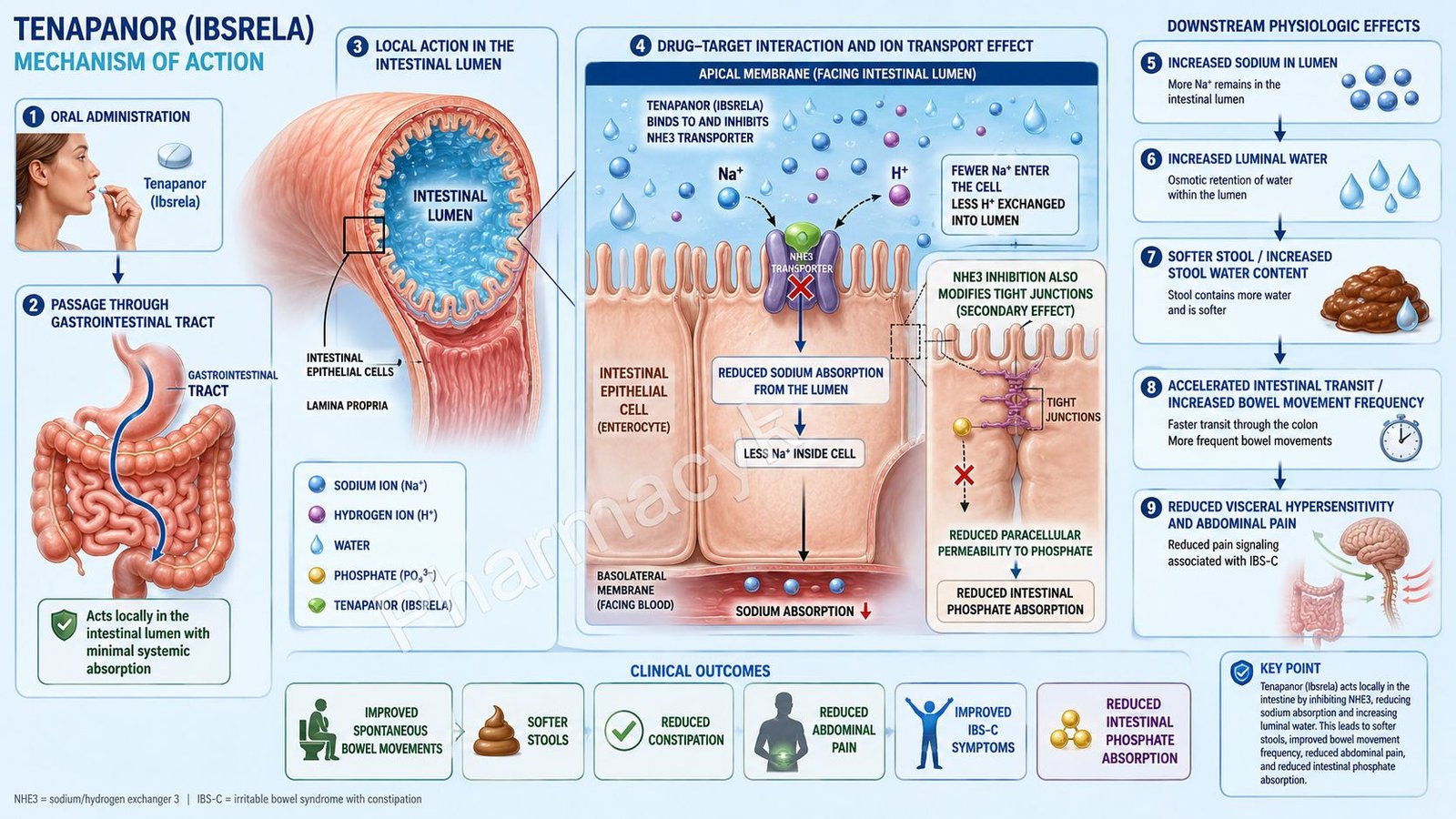
NHE3 is an antiporter located on the apical surface of intestinal epithelial cells in the small intestine and colon. It plays an important role in intestinal sodium absorption. By inhibiting NHE3, tenapanor reduces sodium absorption from the gut. This increases water retention in the intestinal lumen, softens stool, and accelerates intestinal transit.
Tenapanor is used as Ibsrela for the treatment of irritable bowel syndrome with constipation, or IBS-C, in adults. The official Ibsrela label describes tenapanor as a locally acting NHE3 inhibitor and states that it reduces sodium absorption from the small intestine and colon, resulting in increased water secretion into the intestinal lumen, accelerated intestinal transit, and softer stool consistency.
Tenapanor is also used as Xphozah to reduce serum phosphorus in adults with chronic kidney disease on dialysis as add-on therapy when response to phosphate binders is inadequate or when patients are intolerant of any dose of phosphate binder therapy. The Xphozah label states that NHE3 inhibition reduces sodium absorption and decreases phosphate absorption by reducing phosphate permeability through the paracellular pathway.
For exam purposes, tenapanor should be remembered as a minimally absorbed, locally acting NHE3 inhibitor. In IBS-C, it increases intestinal water content and improves bowel movement. In CKD patients on dialysis with hyperphosphatemia, it reduces intestinal phosphate absorption through effects on paracellular phosphate transport.
Mechanism of Action (Step-wise)
Step 1: NHE3 is present on intestinal epithelial cells
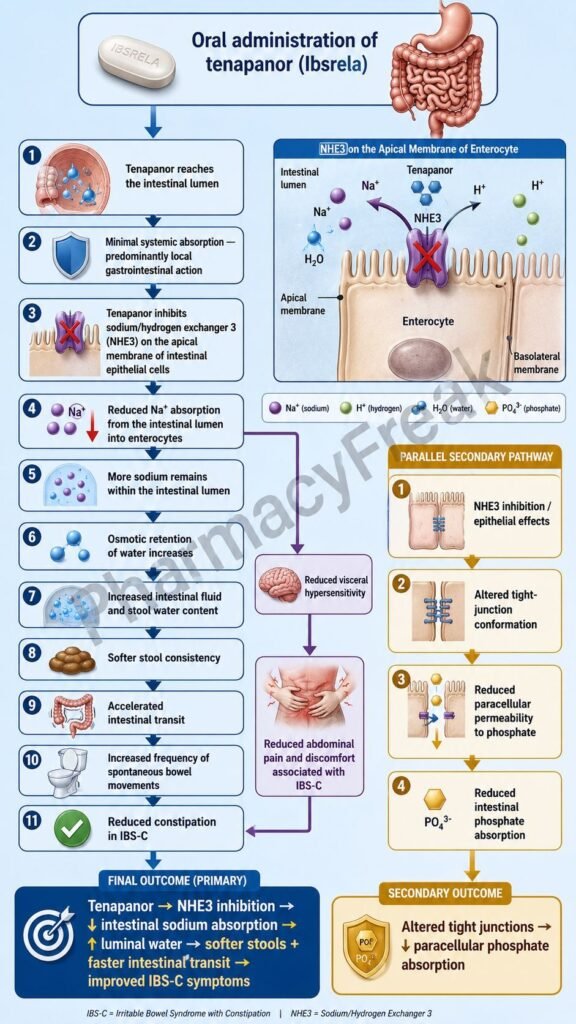
NHE3, or sodium/hydrogen exchanger 3, is located on the apical surface of enterocytes in the small intestine and colon. It exchanges luminal sodium for intracellular hydrogen ions and helps absorb dietary sodium from the intestinal lumen.
Step 2: Sodium absorption promotes water absorption
When sodium is absorbed from the intestinal lumen, water tends to follow. This reduces luminal water content and contributes to firmer stool.
Step 3: Constipation involves reduced stool water and slow transit
In IBS-C, patients experience constipation, abdominal pain, bloating, straining, and altered bowel habits. Reduced intestinal fluid content and slower transit can contribute to harder stools and difficult defecation.
Step 4: Tenapanor inhibits NHE3 locally
Tenapanor acts locally inside the gastrointestinal tract and inhibits NHE3 on intestinal epithelial cells. It is minimally absorbed, so its main action occurs in the gut rather than through systemic circulation.
Step 5: Sodium absorption decreases
By blocking NHE3, tenapanor reduces sodium absorption from the small intestine and colon. Less sodium moves from the intestinal lumen into enterocytes.
Step 6: Water retention in the lumen increases
When sodium remains in the intestinal lumen, water also remains in the lumen. This increases intestinal fluid content.
Step 7: Stool becomes softer
Increased luminal water softens stool. Softer stool is easier to pass and helps relieve constipation symptoms.
Step 8: Intestinal transit accelerates
The Ibsrela label states that tenapanor increases water secretion into the intestinal lumen, accelerates intestinal transit time, and results in softer stool consistency.
Step 9: Bowel movement frequency may improve
By increasing intestinal fluid and transit, tenapanor can improve bowel movement frequency in adults with IBS-C.
Step 10: Abdominal pain may improve through additional gut effects
Tenapanor has also been shown in animal models to reduce abdominal pain by decreasing visceral hypersensitivity and intestinal permeability. In a rat model of colonic hypersensitivity, it reduced visceral hyperalgesia and normalized colonic sensory neuronal excitability.
Step 11: Tenapanor can also reduce phosphate absorption
In CKD patients on dialysis, phosphate control is important because kidney failure reduces phosphate excretion. Tenapanor reduces phosphate absorption in the intestine.
Step 12: Paracellular phosphate permeability decreases
The Xphozah label states that inhibition of NHE3 by tenapanor decreases phosphate absorption by reducing phosphate permeability through the paracellular pathway.
Step 13: Fecal phosphorus excretion increases
When Xphozah is taken before meals, stool phosphorus excretion increases compared with fed or fasting conditions. This supports its use before the first and last meals of the day.
Step 14: Serum phosphorus decreases in CKD patients on dialysis
By reducing intestinal phosphate absorption, tenapanor can lower serum phosphorus in adults with CKD on dialysis when used as add-on therapy or when phosphate binders are not tolerated.
Step 15: Final therapeutic outcome
The final therapeutic effect depends on the indication. In IBS-C, tenapanor increases intestinal water content, softens stool, accelerates transit, and improves constipation symptoms. In CKD-related hyperphosphatemia on dialysis, tenapanor reduces intestinal phosphate absorption and helps lower serum phosphorus.
Pharmacokinetics
Tenapanor is administered orally. As Ibsrela, the recommended adult dose is 50 mg orally twice daily, taken immediately before breakfast or the first meal of the day and immediately before dinner. Ibsrela tablets contain 50 mg tenapanor.
As Xphozah, the recommended dose is 30 mg orally twice daily before the morning and evening meals. Xphozah is available as 10 mg, 20 mg, and 30 mg tablets. Patients should not take Xphozah right before a hemodialysis session; instead, they should take it before the next meal following dialysis.
Tenapanor is minimally absorbed after repeated oral administration. Plasma concentrations are below the limit of quantitation in most samples, so standard systemic pharmacokinetic parameters such as AUC, Cmax, and half-life generally cannot be determined.
Tenapanor is metabolized primarily by CYP3A4/5, but because systemic absorption is minimal, systemic drug exposure remains very low. Its major metabolite, M1, is present at low plasma concentrations and is pharmacologically inactive against NHE3.
After radiolabeled tenapanor administration, most radioactivity is recovered in feces, mainly as parent drug. A smaller amount is recovered in urine, primarily as metabolites. This supports the concept that tenapanor acts mainly inside the gastrointestinal tract.
Tenapanor and its metabolite do not show clinically significant CYP3A4 inhibition or induction in interaction studies. However, tenapanor can inhibit OATP2B1 and may reduce exposure of some OATP2B1 substrates such as enalapril. Xphozah labeling also recommends separating sodium polystyrene sulfonate by at least 3 hours.
Clinical Uses
Tenapanor as Ibsrela is used for the treatment of irritable bowel syndrome with constipation in adults. It is not approved for pediatric patients, and the Ibsrela label states that safety and effectiveness have not been established in patients younger than 18 years.
In IBS-C, tenapanor improves constipation by increasing intestinal luminal water, softening stool, and accelerating transit. It may also help abdominal pain through effects on visceral hypersensitivity and intestinal permeability, although the clinically dominant mechanism is NHE3 inhibition.
Tenapanor as Xphozah is used to reduce serum phosphorus in adults with CKD on dialysis. It is used as add-on therapy in patients who have inadequate response to phosphate binders or who are intolerant of any dose of phosphate binder therapy.
In hyperphosphatemia of CKD on dialysis, tenapanor is not a classic phosphate binder. Instead of binding phosphate directly like sevelamer, calcium acetate, or lanthanum, it reduces phosphate absorption by decreasing paracellular phosphate permeability.
Tenapanor is not a laxative stimulant like senna or bisacodyl. It does not directly stimulate enteric nerves. It increases luminal sodium and water by inhibiting intestinal NHE3.
Tenapanor is not an osmotic laxative like polyethylene glycol or lactulose, although its final stool-softening effect involves increased water in the intestinal lumen.
Tenapanor is not a systemic immunosuppressant, not an opioid receptor drug, not a 5-HT4 agonist, and not a chloride channel activator. It is a locally acting NHE3 inhibitor.
Adverse Effects
The most important adverse effect of tenapanor is diarrhea. Because tenapanor increases intestinal luminal water, excessive pharmacologic effect can cause loose stools, severe diarrhea, dehydration, and treatment discontinuation.
Ibsrela has a boxed warning for risk of serious dehydration in pediatric patients. It is contraindicated in patients younger than 6 years of age, should be avoided in patients 6 years to less than 12 years of age, and is not established as safe or effective in patients younger than 18 years.
Ibsrela is also contraindicated in patients with known or suspected mechanical gastrointestinal obstruction. This is clinically logical because increasing intestinal fluid and transit can be dangerous or ineffective when bowel obstruction is present.
The most common adverse reactions with Ibsrela include diarrhea, abdominal distension, flatulence, and dizziness.
Xphozah is contraindicated in pediatric patients younger than 6 years and in patients with known or suspected mechanical gastrointestinal obstruction. Severe diarrhea may occur. In combined clinical trials, diarrhea was reported by 43% to 53% of Xphozah-treated patients.
In CKD patients on dialysis, diarrhea can be clinically important because excessive fluid loss can worsen volume status, blood pressure instability, dehydration risk, and dialysis tolerance.
Patients should be counseled to report severe or persistent diarrhea, symptoms of dehydration, dizziness, lightheadedness, reduced urination, or inability to maintain oral fluid intake.
Tenapanor has minimal systemic absorption, so many systemic adverse effects are less expected than with highly absorbed drugs. However, local gastrointestinal adverse effects can be significant.
Comparative Analysis
Tenapanor is commonly compared with linaclotide, plecanatide, lubiprostone, polyethylene glycol, stimulant laxatives, phosphate binders, and dietary phosphate restriction.
Compared with linaclotide, tenapanor has a different target. Linaclotide activates guanylate cyclase-C receptors and increases chloride and bicarbonate secretion through CFTR. Tenapanor inhibits NHE3 and reduces sodium absorption.
Compared with plecanatide, tenapanor again differs by mechanism. Plecanatide is a guanylate cyclase-C agonist, while tenapanor is an NHE3 inhibitor.
Compared with lubiprostone, tenapanor does not activate chloride channels directly. Lubiprostone activates intestinal chloride channels to increase fluid secretion, while tenapanor reduces sodium absorption and secondarily increases water retention.
Compared with polyethylene glycol, tenapanor is not a simple osmotic polymer. Polyethylene glycol retains water in stool by osmotic action, while tenapanor blocks a specific intestinal sodium transporter.
Compared with stimulant laxatives such as senna and bisacodyl, tenapanor does not directly stimulate enteric nerves or colonic contractions. It modifies intestinal electrolyte transport.
Compared with sevelamer, calcium acetate, calcium carbonate, ferric citrate, or lanthanum carbonate, tenapanor is not mainly a phosphate binder. Phosphate binders bind dietary phosphate in the gut, while tenapanor reduces paracellular phosphate absorption.
Compared with sodium zirconium cyclosilicate or patiromer, tenapanor does not bind potassium. Patiromer and sodium zirconium cyclosilicate are potassium-lowering agents, while tenapanor is used for IBS-C and hyperphosphatemia depending on brand and indication.
Compared with dietary phosphate restriction, tenapanor is pharmacologic therapy. Dietary restriction reduces phosphate intake, while tenapanor reduces intestinal phosphate absorption.
MCQs
- Tenapanor is marketed for IBS-C under which brand name?
a) Ibsrela
b) Linzess
c) Amitiza
d) Trulance
Answer: a) Ibsrela
- Tenapanor is marketed for hyperphosphatemia in CKD on dialysis under which brand name?
a) Veltassa
b) Xphozah
c) Lokelma
d) Renvela
Answer: b) Xphozah
- Tenapanor belongs to which pharmacological class?
a) NHE3 inhibitor
b) Chloride channel activator
c) Guanylate cyclase-C agonist
d) Opioid receptor antagonist
Answer: a) NHE3 inhibitor
- NHE3 is mainly involved in intestinal absorption of:
a) Sodium
b) Iron
c) Vitamin B12
d) Bile acids only
Answer: a) Sodium
- Tenapanor acts mainly on the:
a) Apical surface of intestinal epithelial cells
b) Renal glomerulus only
c) Cardiac beta receptor
d) Central dopamine receptor
Answer: a) Apical surface of intestinal epithelial cells
- In IBS-C, tenapanor improves constipation mainly by:
a) Reducing sodium absorption and increasing intestinal water
b) Blocking dopamine receptors
c) Increasing insulin secretion
d) Inhibiting gastric acid secretion
Answer: a) Reducing sodium absorption and increasing intestinal water
- Tenapanor causes softer stool because it:
a) Increases water in the intestinal lumen
b) Reduces pancreatic enzyme secretion
c) Blocks opioid receptors in the brain
d) Increases bile acid synthesis only
Answer: a) Increases water in the intestinal lumen
- In CKD patients on dialysis, tenapanor lowers serum phosphorus by:
a) Reducing phosphate absorption through the paracellular pathway
b) Binding calcium in bone
c) Increasing renal phosphate excretion in functioning nephrons only
d) Stimulating parathyroid hormone release
Answer: a) Reducing phosphate absorption through the paracellular pathway
- Ibsrela is indicated for:
a) IBS-C in adults
b) Ulcerative colitis in children
c) Acute bowel obstruction
d) Infectious diarrhea
Answer: a) IBS-C in adults
- Xphozah is indicated to reduce serum phosphorus in adults with:
a) CKD on dialysis as add-on therapy after inadequate phosphate binder response or intolerance
b) Acute hypophosphatemia
c) Normal kidney function and low phosphate
d) Primary hyperparathyroidism only
Answer: a) CKD on dialysis as add-on therapy after inadequate phosphate binder response or intolerance
- The recommended Ibsrela dose is:
a) 50 mg orally twice daily before meals
b) 30 mg orally once weekly
c) 5 mg orally at bedtime
d) 100 mg intravenously monthly
Answer: a) 50 mg orally twice daily before meals
- The recommended Xphozah dose is:
a) 30 mg orally twice daily before morning and evening meals
b) 50 mg orally once weekly
c) 10 mg intravenously daily
d) 150 mg orally at bedtime only
Answer: a) 30 mg orally twice daily before morning and evening meals
- The most important adverse effect of tenapanor is:
a) Diarrhea
b) Severe hypoglycemia
c) Ototoxicity
d) Retinal detachment
Answer: a) Diarrhea
- Tenapanor is contraindicated in patients with:
a) Known or suspected mechanical gastrointestinal obstruction
b) Mild seasonal allergy only
c) Controlled hypertension
d) Stable myopia
Answer: a) Known or suspected mechanical gastrointestinal obstruction
- Which statement best describes tenapanor?
a) It locally inhibits intestinal NHE3, reducing sodium absorption and modifying intestinal water and phosphate absorption
b) It directly binds phosphate like sevelamer
c) It activates chloride channels like lubiprostone
d) It blocks opioid receptors like methylnaltrexone
Answer: a) It locally inhibits intestinal NHE3, reducing sodium absorption and modifying intestinal water and phosphate absorption
FAQs
What is the mechanism of action of tenapanor?
Tenapanor locally inhibits sodium/hydrogen exchanger 3, or NHE3, on the apical surface of intestinal epithelial cells. This reduces intestinal sodium absorption, increases luminal water, softens stool, accelerates transit, and can reduce phosphate absorption through the paracellular pathway.
What is the brand name of tenapanor?
Tenapanor is marketed as Ibsrela for IBS-C and as Xphozah for hyperphosphatemia in adults with CKD on dialysis.
What is tenapanor used for?
Tenapanor is used as Ibsrela for IBS-C in adults. It is used as Xphozah to reduce serum phosphorus in adults with CKD on dialysis as add-on therapy when phosphate binders are inadequate or not tolerated.
Is tenapanor a phosphate binder?
No. Tenapanor is not primarily a phosphate binder. It reduces phosphate absorption by decreasing paracellular phosphate permeability through NHE3 inhibition.
Is tenapanor systemically absorbed?
Tenapanor is minimally absorbed. Its plasma concentrations are below the limit of quantitation in most samples, so its main action is local within the gastrointestinal tract.
Why does tenapanor cause diarrhea?
Tenapanor reduces sodium absorption in the intestine. This increases water retention in the intestinal lumen, which can soften stool but may also cause diarrhea if the effect is excessive.
Can tenapanor be used in children?
Ibsrela is contraindicated in patients younger than 6 years, should be avoided in patients 6 years to less than 12 years, and is not established as safe or effective in patients younger than 18 years. Xphozah is also contraindicated in pediatric patients younger than 6 years.
How is tenapanor different from linaclotide?
Linaclotide activates guanylate cyclase-C receptors, while tenapanor inhibits intestinal NHE3. Both can increase intestinal fluid, but their molecular targets are different.
References
Goodman & Gilman’s The Pharmacological Basis of Therapeutics
Katzung Basic & Clinical Pharmacology