
Table of Contents
Introduction
Patiromer is an oral potassium-binding drug marketed under the brand name Veltassa. Pharmacologically, patiromer is a non-absorbed cation exchange polymer used for the treatment of hyperkalemia.
Hyperkalemia means increased serum potassium concentration. Potassium is essential for normal nerve conduction, skeletal muscle contraction, and cardiac electrical activity. However, excessive potassium can disturb cardiac conduction and may cause dangerous arrhythmias, muscle weakness, paralysis, or cardiac arrest in severe cases.
Hyperkalemia is commonly seen in patients with chronic kidney disease, heart failure, diabetes mellitus, hypoaldosteronism, and patients receiving renin-angiotensin-aldosterone system inhibitors such as ACE inhibitors, ARBs, mineralocorticoid receptor antagonists, and other potassium-raising drugs.
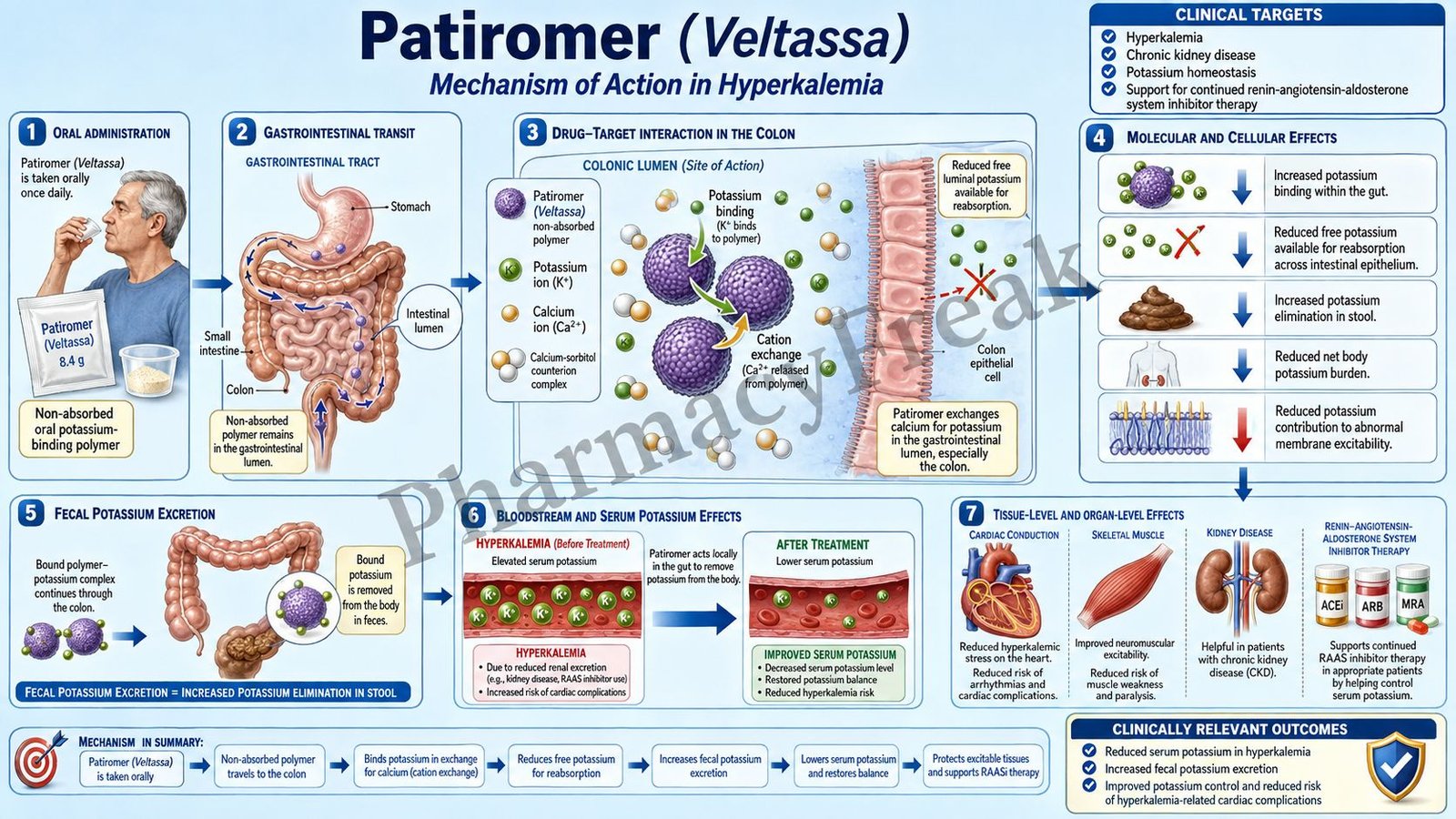
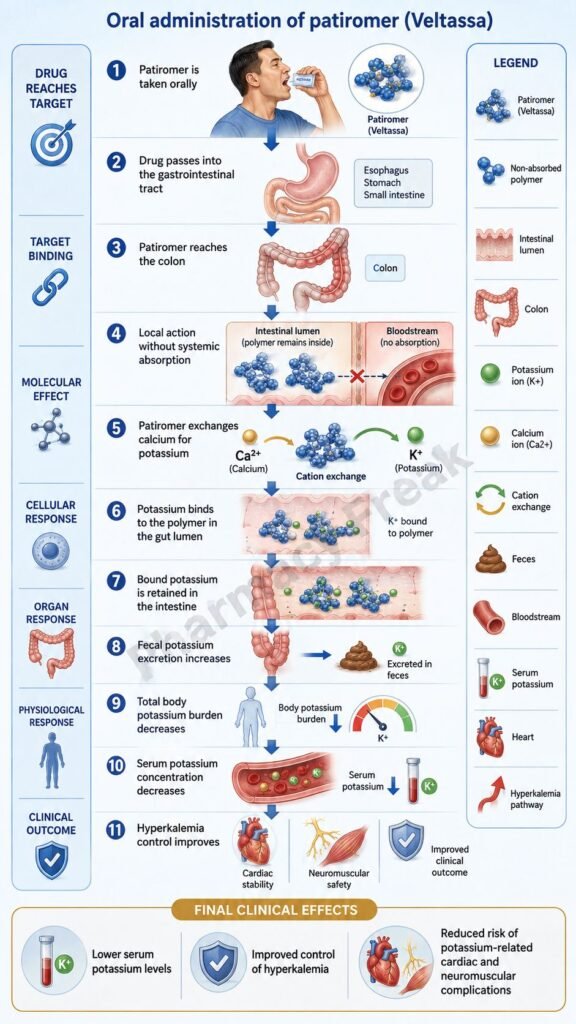
Patiromer works inside the gastrointestinal tract. It is not absorbed systemically. Instead, it binds potassium in the gut lumen and increases fecal potassium excretion. This reduces free potassium in the gastrointestinal tract and gradually lowers serum potassium levels.
The official Veltassa label describes patiromer as a non-absorbed cation exchange polymer containing a calcium-sorbitol counterion. It increases fecal potassium excretion by binding potassium in the gastrointestinal lumen, thereby reducing free potassium in the gut and lowering serum potassium levels.
Veltassa is indicated for the treatment of hyperkalemia in adults and pediatric patients 12 years of age and older. It should not be used as an emergency treatment for life-threatening hyperkalemia because it has a delayed onset of action.
For exam purposes, patiromer should be remembered as an oral, non-absorbed potassium binder that exchanges calcium for potassium in the gastrointestinal tract, increases fecal potassium elimination, and gradually reduces serum potassium.
Mechanism of Action (Step-wise)
Step 1: Hyperkalemia occurs when serum potassium increases
Hyperkalemia develops when potassium intake, potassium release from cells, reduced renal excretion, or medication effects raise serum potassium above the normal range.
Step 2: The kidneys normally maintain potassium balance
Most potassium balance is maintained by renal excretion. In chronic kidney disease or reduced aldosterone activity, potassium excretion falls and serum potassium can rise.
Step 3: RAAS inhibitors can increase potassium
ACE inhibitors, ARBs, mineralocorticoid receptor antagonists, and other RAAS-modifying drugs can reduce aldosterone-mediated potassium excretion. These drugs are useful in kidney and heart disease but can contribute to hyperkalemia.
Step 4: High potassium can affect the heart
Potassium strongly influences cardiac membrane potential. Severe hyperkalemia can cause ECG changes, conduction abnormalities, ventricular arrhythmias, and cardiac arrest.
Step 5: Patiromer is administered orally
Patiromer is taken by mouth as Veltassa powder for oral suspension. It must be mixed with water, other beverages, or soft foods and should not be taken in dry form.
Step 6: Patiromer remains inside the gastrointestinal tract
Patiromer is designed to be non-absorbed. Radiolabeled animal studies showed that patiromer was not systemically absorbed and was excreted in feces.
Step 7: Patiromer acts as a cation exchange polymer
Patiromer contains a calcium-sorbitol counterion and works as a cation exchange polymer. This means it can exchange one positively charged ion for another in the gastrointestinal tract.
Step 8: Patiromer binds potassium in the gut lumen
The key mechanism is potassium binding in the gastrointestinal lumen. Patiromer binds potassium present in the gut, reducing the concentration of free potassium available for absorption.
Step 9: Calcium is exchanged for potassium
During cation exchange, patiromer releases calcium while binding potassium. This allows potassium to be trapped within the polymer complex.
Step 10: Bound potassium is eliminated in feces
After potassium binds to patiromer, the complex remains in the gut and is passed through the gastrointestinal tract. Potassium is then eliminated in stool instead of being absorbed or retained.
Step 11: Fecal potassium excretion increases
The official label states that Veltassa increases fecal potassium excretion through potassium binding in the gastrointestinal tract. Clinical pharmacology studies showed increased fecal potassium excretion during patiromer treatment.
Step 12: Free potassium in the gut decreases
By binding potassium in the intestinal lumen, patiromer lowers free potassium concentration in the gut. This favors net movement and elimination of potassium through the gastrointestinal route.
Step 13: Serum potassium gradually decreases
As potassium is removed through the stool, serum potassium decreases. In an open-label study in hyperkalemic patients with chronic kidney disease, serum potassium reduction was observed at 7 hours after the first dose and continued over 48 hours.
Step 14: Patiromer is not for emergency hyperkalemia
Because potassium lowering is gradual, Veltassa should not be used as emergency treatment for life-threatening hyperkalemia. Emergency hyperkalemia requires rapid measures such as intravenous calcium for membrane stabilization, insulin with glucose, beta-2 agonists, bicarbonate in selected cases, dialysis, and urgent medical monitoring. The Veltassa label specifically warns against emergency use because of delayed onset.
Step 15: Final therapeutic outcome
The final therapeutic effect of patiromer is gradual lowering of serum potassium by increasing fecal potassium elimination. This helps manage chronic or non-emergency hyperkalemia in appropriate adults and pediatric patients 12 years and older.
Pharmacokinetics
Patiromer is administered orally as Veltassa powder for oral suspension. It is available in single-use packets containing 1 gram, 8.4 grams, 16.8 grams, or 25.2 grams of patiromer.
For adults, the recommended starting dose is 8.4 grams patiromer orally once daily. The dose may be adjusted at intervals of at least 1 week in increments of 8.4 grams based on serum potassium and the desired target range.
For pediatric patients 12 years of age and older, the recommended starting dose is 4 grams orally once daily. The dose may be titrated at intervals of at least 1 week in increments of 4 grams. The maximum recommended dosage in adults and pediatric patients older than 12 years is 25.2 grams once daily.
Veltassa can be taken with or without food. In a study of hyperkalemic patients, serum potassium response and mean dose were similar when Veltassa was taken with food or without food.
Patiromer should be prepared immediately before administration. The powder should be mixed with water, other beverages, or soft foods such as applesauce, yogurt, or pudding. It should not be heated, microwaved, added to heated foods or liquids, or taken in dry powder form.
Patiromer is not systemically absorbed. This is important because its action is local within the gastrointestinal tract rather than systemic receptor or enzyme inhibition. Radiolabeled studies in animals showed fecal excretion without detectable systemic tissue distribution.
Because patiromer can bind some oral medications in the gastrointestinal tract, other orally administered drugs should generally be taken at least 3 hours before or 3 hours after Veltassa unless they are specifically shown not to have a clinically important interaction.
The label lists clinically important interactions with drugs such as ciprofloxacin, levothyroxine, metformin, mycophenolate mofetil, quinidine, thiamine, telmisartan, bisoprolol, carvedilol, and nebivolol when taken too close to patiromer. Separation by 3 hours prevents clinically important interaction for tested drugs such as ciprofloxacin, levothyroxine, and metformin.
No special dosage adjustment is needed for renal impairment. In clinical studies, most adult patients receiving Veltassa had chronic kidney disease, and all pediatric patients 12 years and older in the clinical study had chronic kidney disease.
Clinical Uses
Patiromer is used for the treatment of hyperkalemia in adults and pediatric patients 12 years of age and older.
It is especially useful in chronic or recurrent hyperkalemia where gradual potassium lowering is appropriate. Many patients who need potassium binders have chronic kidney disease, heart failure, diabetes, or medication-associated hyperkalemia.
Patiromer may help patients continue important RAAS inhibitor therapy when hyperkalemia limits treatment. This is clinically relevant because RAAS inhibitors are often beneficial in chronic kidney disease, diabetic nephropathy, hypertension, and heart failure, but they can increase serum potassium.
Patiromer is not used for emergency treatment of life-threatening hyperkalemia. It has delayed onset and does not replace urgent potassium-shifting or membrane-stabilizing therapies.
Patiromer is not a diuretic, insulin, beta-2 agonist, bicarbonate, dialysis method, sodium polystyrene sulfonate, or sodium zirconium cyclosilicate. It is an oral, non-absorbed potassium-binding polymer.
Patiromer does not directly shift potassium into cells. Insulin and beta-2 agonists rapidly shift potassium intracellularly; patiromer removes potassium from the body through fecal elimination.
Patiromer does not directly stabilize the cardiac membrane. Intravenous calcium is used in emergency hyperkalemia with ECG changes to stabilize cardiac membranes. Patiromer works more slowly by removing potassium through the gastrointestinal tract.
Adverse Effects
The major adverse effects of patiromer are gastrointestinal adverse reactions, hypomagnesemia, possible hypokalemia, hypersensitivity reactions, and worsening of gastrointestinal motility in susceptible patients.
The most common adverse reactions reported in adults include constipation, hypomagnesemia, diarrhea, nausea, abdominal discomfort, and flatulence. In clinical trials, constipation occurred in 7.2%, hypomagnesemia in 5.3%, diarrhea in 4.8%, nausea in 2.3%, abdominal discomfort in 2.0%, and flatulence in 2.0% of adult patients treated with Veltassa.
Hypomagnesemia is important. Veltassa binds magnesium in the colon, which can lower serum magnesium levels. The label recommends monitoring serum magnesium and considering magnesium supplementation in patients who develop low magnesium during treatment.
Hypokalemia can occur if potassium is lowered too much. In adult clinical trials, approximately 4.7% of patients developed serum potassium below 3.5 mEq/L. Excessive dosing may also result in hypokalemia, and potassium should be restored if hypokalemia occurs.
Worsening gastrointestinal motility is an important warning. Veltassa should be avoided in patients with severe constipation, bowel obstruction, bowel impaction, or abnormal post-operative bowel motility disorders because it may be ineffective and may worsen gastrointestinal conditions.
Patients with a history of bowel obstruction, major gastrointestinal surgery, severe gastrointestinal disorders, or swallowing disorders were not included in Veltassa clinical studies. Therefore, use in such patients requires caution and clinical judgment.
Hypersensitivity reactions can occur. Veltassa is contraindicated in patients with a history of hypersensitivity to Veltassa or any of its components. Mild to moderate hypersensitivity reactions, including lip edema, were reported in clinical trials.
Drug interactions are clinically important. Because patiromer can bind some oral medications and decrease gastrointestinal absorption, many oral drugs should be separated from Veltassa by at least 3 hours unless the label identifies no clinically important interaction.
Comparative Analysis
Patiromer is commonly compared with sodium zirconium cyclosilicate, sodium polystyrene sulfonate, loop diuretics, insulin with glucose, beta-2 agonists, sodium bicarbonate, dialysis, and dietary potassium restriction.
Compared with sodium zirconium cyclosilicate, patiromer is also an oral potassium binder, but the ion-exchange chemistry differs. Patiromer contains a calcium-sorbitol counterion, while sodium zirconium cyclosilicate exchanges mainly sodium and hydrogen for potassium and ammonium. Both increase gastrointestinal potassium removal, but they differ in onset, dosing, sodium load, edema considerations, and interaction profile.
Compared with sodium polystyrene sulfonate, patiromer is a newer potassium binder. Sodium polystyrene sulfonate exchanges sodium for potassium and has older clinical use, but it is associated with gastrointestinal tolerability concerns. Patiromer is a non-absorbed polymer that exchanges calcium for potassium and is used for chronic hyperkalemia management.
Compared with loop diuretics such as furosemide, patiromer does not increase urinary potassium excretion. Loop diuretics increase renal sodium and water excretion and can increase potassium loss through urine if kidney function and urine output are adequate. Patiromer removes potassium through the feces.
Compared with insulin plus glucose, patiromer is slower. Insulin shifts potassium into cells rapidly and is used in emergency hyperkalemia. Patiromer removes potassium from the body through the gastrointestinal tract and is not for emergency treatment.
Compared with beta-2 agonists such as nebulized albuterol, patiromer does not shift potassium intracellularly. Beta-2 agonists rapidly move potassium into cells, while patiromer binds potassium in the gut.
Compared with sodium bicarbonate, patiromer does not correct metabolic acidosis. Bicarbonate may help shift potassium intracellularly in selected acidotic patients, while patiromer increases fecal potassium excretion.
Compared with dialysis, patiromer is much slower and less definitive. Dialysis directly removes potassium from the blood and is used in severe or refractory hyperkalemia, especially in advanced kidney failure.
Compared with dietary potassium restriction, patiromer is a pharmacologic binder. Dietary restriction reduces potassium intake, while patiromer increases potassium elimination through stool. Both may be used together when clinically appropriate.
MCQs
- Patiromer is marketed under which brand name?
a) Lokelma
b) Veltassa
c) Kayexalate
d) Renvela
Answer: b) Veltassa
- Patiromer belongs to which pharmacological class?
a) Oral potassium binder
b) Loop diuretic
c) Aldosterone antagonist
d) Carbonic anhydrase inhibitor
Answer: a) Oral potassium binder
- Patiromer is mainly used for:
a) Hypokalemia
b) Hypernatremia
c) Hyperkalemia
d) Hypocalcemia
Answer: c) Hyperkalemia
- The main site of action of patiromer is:
a) Gastrointestinal tract
b) Cardiac beta receptor
c) Renal collecting duct only
d) Central nervous system
Answer: a) Gastrointestinal tract
- Patiromer lowers serum potassium by:
a) Increasing fecal potassium excretion
b) Increasing insulin secretion
c) Blocking aldosterone receptors
d) Activating sodium channels
Answer: a) Increasing fecal potassium excretion
- Veltassa is best described as:
a) Systemically absorbed enzyme inhibitor
b) Non-absorbed cation exchange polymer
c) Intravenous calcium preparation
d) Beta-2 agonist inhaler
Answer: b) Non-absorbed cation exchange polymer
- The counterion present in patiromer is:
a) Calcium-sorbitol
b) Sodium chloride
c) Potassium phosphate
d) Magnesium sulfate
Answer: a) Calcium-sorbitol
- Veltassa should not be used as emergency treatment for life-threatening hyperkalemia because of:
a) Delayed onset of action
b) Immediate cardiac stimulation
c) Lack of oral formulation
d) Direct potassium infusion
Answer: a) Delayed onset of action
- The recommended adult starting dose of Veltassa is:
a) 1 gram once daily
b) 4 grams twice daily
c) 8.4 grams once daily
d) 25.2 grams twice daily
Answer: c) 8.4 grams once daily
- The recommended starting dose for pediatric patients 12 years and older is:
a) 4 grams once daily
b) 8.4 grams twice daily
c) 16.8 grams three times daily
d) 25.2 grams twice daily
Answer: a) 4 grams once daily
- The maximum recommended dose of Veltassa is:
a) 4 grams once daily
b) 8.4 grams once daily
c) 16.8 grams twice daily
d) 25.2 grams once daily
Answer: d) 25.2 grams once daily
- Other oral medications should generally be separated from Veltassa by:
a) 15 minutes
b) 30 minutes
c) 1 hour
d) 3 hours
Answer: d) 3 hours
- Which adverse effect is important with patiromer?
a) Hypomagnesemia
b) Hyperthyroidism
c) Ototoxicity
d) Retinal detachment
Answer: a) Hypomagnesemia
- Veltassa should be avoided in patients with:
a) Severe constipation or bowel obstruction
b) Mild seasonal allergy only
c) Stable myopia
d) Controlled migraine
Answer: a) Severe constipation or bowel obstruction
- Which statement best describes patiromer?
a) It rapidly shifts potassium into cells during cardiac arrest
b) It binds potassium in the gastrointestinal tract and increases fecal potassium elimination
c) It blocks aldosterone receptors in the kidney
d) It directly stabilizes cardiac membranes
Answer: b) It binds potassium in the gastrointestinal tract and increases fecal potassium elimination
FAQs
What is the mechanism of action of patiromer?
Patiromer is a non-absorbed cation exchange polymer that binds potassium in the gastrointestinal tract. This increases fecal potassium excretion, reduces free potassium in the gut, and gradually lowers serum potassium.
What is the brand name of patiromer?
The brand name of patiromer is Veltassa.
What is patiromer used for?
Patiromer is used for the treatment of hyperkalemia in adults and pediatric patients 12 years of age and older.
Is patiromer used in emergency hyperkalemia?
No. Veltassa should not be used as emergency treatment for life-threatening hyperkalemia because it has a delayed onset of action.
Is patiromer absorbed into the blood?
No. Patiromer is designed to be non-absorbed and works locally inside the gastrointestinal tract.
Why should other oral drugs be separated from patiromer?
Patiromer can bind some oral medications in the gastrointestinal tract and reduce their absorption. Therefore, many oral drugs should be taken at least 3 hours before or 3 hours after Veltassa unless the label states no clinically important interaction.
Why can patiromer cause hypomagnesemia?
Patiromer can bind magnesium in the colon. This may lower serum magnesium, so magnesium levels should be monitored and supplementation considered if hypomagnesemia develops.
What are common adverse effects of patiromer?
Common adverse effects include constipation, hypomagnesemia, diarrhea, nausea, abdominal discomfort, and flatulence. Hypokalemia and hypersensitivity reactions may also occur.
References
Goodman & Gilman’s The Pharmacological Basis of Therapeutics
Katzung Basic & Clinical Pharmacology

