Table of Contents
Introduction
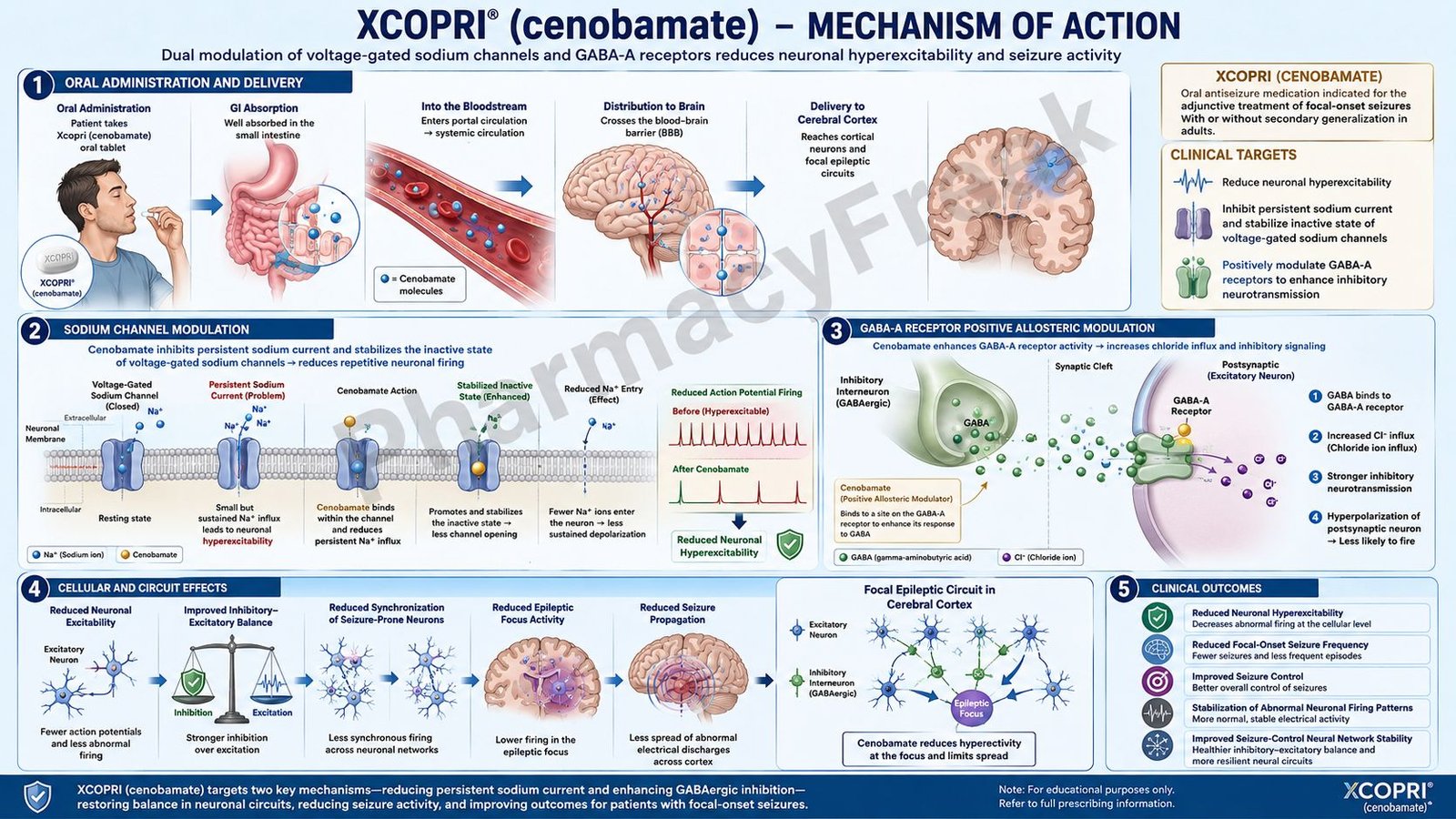
Xcopri is the brand name of cenobamate, an oral antiseizure medication used for the treatment of partial-onset seizures in adults. Pharmacologically, cenobamate is an antiseizure drug with dual actions on neuronal excitability: inhibition of voltage-gated sodium currents and positive allosteric modulation of GABA-A ion channels.
Partial-onset seizures, also called focal seizures, begin in one area or network of the brain. They may remain localized or spread to both hemispheres and become focal to bilateral tonic-clonic seizures. The clinical features depend on the brain region involved and may include abnormal movements, sensory symptoms, impaired awareness, automatisms, emotional changes, or convulsions.
Seizures occur when groups of neurons become excessively synchronized and hyperexcitable. Antiseizure drugs reduce seizures by decreasing abnormal neuronal firing, enhancing inhibitory neurotransmission, reducing excitatory signaling, or modifying ion-channel activity.
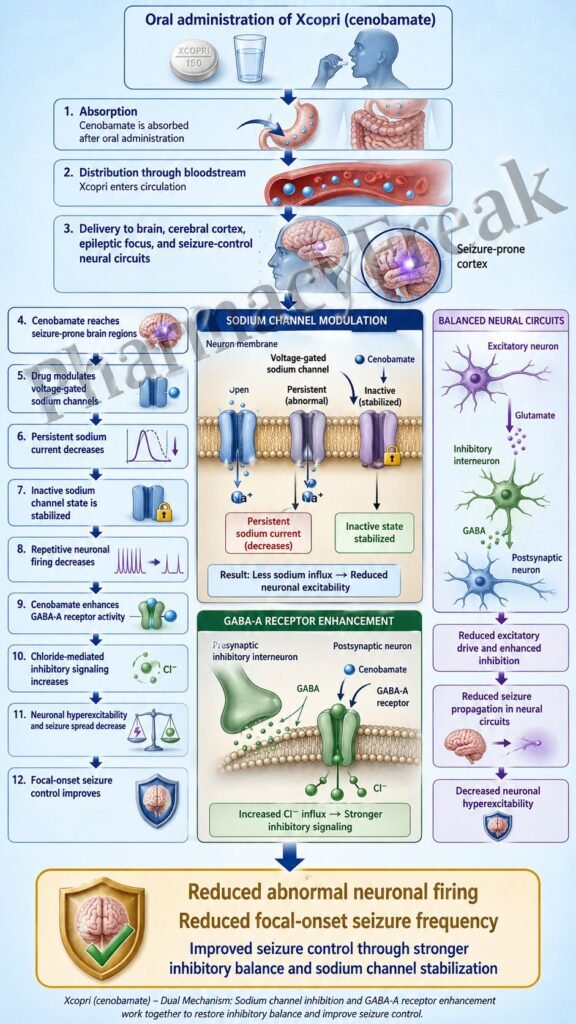
The official Xcopri label states that the precise mechanism by which cenobamate exerts its therapeutic effects in patients with partial-onset seizures is unknown. However, cenobamate has been demonstrated to reduce repetitive neuronal firing by inhibiting voltage-gated sodium currents. It is also a positive allosteric modulator of the gamma-aminobutyric acid type A, or GABA-A, ion channel.
Xcopri is indicated for the treatment of partial-onset seizures in adult patients. It is given orally once daily and is titrated slowly from 12.5 mg once daily to a recommended maintenance dose of 200 mg once daily. The maximum dose is 400 mg once daily when needed based on clinical response and tolerability.
For exam purposes, Xcopri should be remembered as cenobamate, an oral antiseizure drug for adult partial-onset seizures. Its key pharmacology is reduction of repetitive neuronal firing through voltage-gated sodium current inhibition plus enhancement of inhibitory GABA-A channel activity.
Mechanism of Action (Step-wise)
Step 1: Partial-onset seizures begin from a focal brain region
Partial-onset seizures start from a localized neuronal network. This abnormal electrical activity may remain focal or spread to other brain regions.
Step 2: Seizures involve neuronal hyperexcitability
During a seizure, neurons fire excessively and synchronously. This uncontrolled firing can produce abnormal motor, sensory, autonomic, emotional, or consciousness-related symptoms.
Step 3: Sodium channels support action potential generation
Voltage-gated sodium channels are essential for the rapid depolarization phase of neuronal action potentials. When sodium channels open, sodium enters the neuron and allows electrical signals to propagate.
Step 4: Repetitive firing depends on sodium-channel recovery
In epileptic tissue, neurons may fire repeatedly at high frequency. If sodium channels rapidly recover and continue opening, abnormal repetitive firing can persist.
Step 5: Cenobamate inhibits voltage-gated sodium currents
Cenobamate has been shown to reduce repetitive neuronal firing by inhibiting voltage-gated sodium currents. This reduces the ability of hyperexcitable neurons to sustain repetitive action potentials.
Step 6: Abnormal high-frequency firing decreases
By limiting sodium current activity, cenobamate decreases repetitive neuronal firing. This helps suppress seizure initiation and seizure propagation.
Step 7: GABA is the major inhibitory neurotransmitter in the CNS
Gamma-aminobutyric acid, or GABA, is the main inhibitory neurotransmitter in the brain. It helps reduce neuronal excitability and counterbalances excitatory neurotransmission.
Step 8: GABA-A receptors are chloride ion channels
GABA-A receptors are ligand-gated chloride channels. When activated, they allow chloride movement across the neuronal membrane, usually producing inhibitory effects that make neurons less likely to fire.
Step 9: Cenobamate positively modulates GABA-A ion channels
Cenobamate is also a positive allosteric modulator of the GABA-A ion channel. This means it enhances GABA-A receptor function by binding to an allosteric site rather than directly acting as GABA itself.
Step 10: Inhibitory neurotransmission increases
Positive allosteric modulation of GABA-A receptors strengthens inhibitory signaling. This makes neuronal networks less excitable and less likely to generate seizure activity.
Step 11: Excitation-inhibition balance improves
Epileptic seizures often reflect an imbalance between excitatory and inhibitory signaling. Cenobamate helps restore this balance by both reducing excitatory repetitive firing and enhancing inhibitory GABA-A signaling.
Step 12: Seizure propagation is reduced
When abnormal firing is reduced and inhibition is enhanced, seizure activity is less likely to spread through cortical and subcortical networks.
Step 13: Clinical seizure frequency may decrease
In clinical use, the intended result is fewer partial-onset seizures. Xcopri does not cure epilepsy but helps reduce seizure burden in appropriately selected adult patients.
Step 14: The exact complete therapeutic mechanism remains unknown
Although sodium-current inhibition and GABA-A modulation are demonstrated pharmacologic actions, the label clearly states that the precise therapeutic mechanism in partial-onset seizures is unknown.
Step 15: Final therapeutic outcome
The final therapeutic effect of Xcopri is seizure reduction through decreased neuronal hyperexcitability, reduced repetitive firing, and enhanced inhibitory neurotransmission.
Pharmacokinetics
Xcopri is administered orally once daily with or without food. The recommended initial dose is 12.5 mg once daily for weeks 1 and 2. The dose is then increased every 2 weeks: 25 mg once daily during weeks 3 and 4, 50 mg once daily during weeks 5 and 6, 100 mg once daily during weeks 7 and 8, 150 mg once daily during weeks 9 and 10, and 200 mg once daily from week 11 onward. If needed, the dose may be increased above 200 mg in increments of 50 mg once daily every 2 weeks to a maximum of 400 mg once daily.
The titration schedule should not be exceeded because rapid titration has been associated with serious adverse reactions, including DRESS. Xcopri should be started low and titrated slowly.
Xcopri tablets are available in strengths of 12.5 mg, 25 mg, 50 mg, 100 mg, 150 mg, and 200 mg. The tablets may be swallowed whole or crushed. Crushed tablets may be mixed with water and administered by mouth as an oral suspension or through a nasogastric tube according to label instructions.
At least 88% of cenobamate is absorbed after oral administration. Median time to peak plasma concentration ranges from 1 to 4 hours. Crushed tablets mixed in water have similar exposure to whole tablets, with a median Tmax of about 0.5 hours. Food does not produce clinically significant pharmacokinetic differences, so Xcopri may be taken with or without food.
Steady-state plasma concentrations are reached after approximately 2 weeks of once-daily dosing. Cenobamate Cmax increases dose proportionally, while AUC increases more than dose proportionally over a wide studied range.
Cenobamate has an apparent volume of distribution of approximately 40 to 50 L. Plasma protein binding is approximately 60% and is independent of concentration in vitro. It primarily binds to human albumin.
The apparent terminal half-life of cenobamate is approximately 50 to 60 hours. This long half-life supports once-daily dosing. Apparent oral clearance is approximately 0.45 to 0.63 L/hour over the 100 mg/day to 400 mg/day dose range.
Cenobamate is extensively metabolized. The primary metabolic pathways include glucuronidation mainly by UGT2B7 and to a lesser extent UGT2B4, and oxidation by CYP2E1, CYP2A6, CYP2B6, and to a lesser extent CYP2C19 and CYP3A4/5.
After radiolabeled cenobamate administration, approximately 93% of the radioactive dose was recovered, mainly in urine. About 87.8% was recovered in urine and 5.2% in feces.
Drug interactions are clinically important. Xcopri can increase exposure to phenytoin, phenobarbital, and CYP2C19 substrates, so dose reductions may be needed. It can decrease exposure to lamotrigine, carbamazepine, CYP2B6 substrates, and CYP3A substrates, so dose increases may be needed depending on response. Clobazam dosage may also need reduction because sedation can increase due to interaction with its active metabolite.
For mild or moderate hepatic impairment, the maximum recommended dose is 200 mg once daily. Xcopri is not recommended in severe hepatic impairment. In renal impairment, caution is advised, and dose reduction may be considered; use is not recommended in end-stage renal disease undergoing dialysis.
Clinical Uses
Xcopri is indicated for the treatment of partial-onset seizures in adult patients.
Partial-onset seizures are also called focal-onset seizures. They may occur with preserved awareness, impaired awareness, or progression to bilateral tonic-clonic seizures.
Xcopri may be used as monotherapy or adjunctive therapy according to the dosing section of the current label. This means it may be used alone or with other antiseizure medications when clinically appropriate.
Xcopri is not approved for absence seizures, primary generalized tonic-clonic seizures, Lennox-Gastaut syndrome, infantile spasms, migraine prevention, bipolar disorder, anxiety, or neuropathic pain.
Xcopri is not a benzodiazepine, barbiturate, classic sodium-channel blocker only, calcium-channel blocker, AMPA receptor antagonist, SV2A ligand, or carbonic anhydrase inhibitor. It has a distinct antiseizure profile involving sodium-current inhibition and GABA-A positive allosteric modulation.
Xcopri is not used for emergency termination of status epilepticus. Acute seizure emergencies usually require rapid-acting benzodiazepines and emergency medical management.
Xcopri is a Schedule V controlled substance. This means it has recognized medical use but is regulated because of abuse potential. Patients should take it only as prescribed.
Adverse Effects
The most important serious adverse effect of Xcopri is Drug Reaction with Eosinophilia and Systemic Symptoms, also called DRESS or multiorgan hypersensitivity. DRESS has been reported, including one fatality, when Xcopri was titrated rapidly using weekly or faster titration. No cases were reported in an open-label safety study when Xcopri was initiated at 12.5 mg once daily and titrated every 2 weeks, although this does not prove that slow titration completely prevents DRESS.
DRESS may present with fever, rash, lymphadenopathy, facial swelling, hepatitis, nephritis, hematologic abnormalities, myocarditis, myositis, or eosinophilia. Early symptoms such as fever or lymph-node swelling may appear even without rash. If DRESS is suspected and no alternative cause is found, Xcopri should be discontinued and not restarted.
QT shortening is another important warning. Xcopri can shorten the QT interval in a dose-dependent manner. It is contraindicated in patients with familial short QT syndrome because that syndrome is associated with increased risk of sudden death and ventricular arrhythmias. Caution is also needed when Xcopri is used with other drugs that shorten the QT interval.
Suicidal behavior and ideation are class warnings for antiseizure medications. Patients should be monitored for depression, mood changes, suicidal thoughts, or unusual behavioral changes during treatment.
Liver injury is an important warning. Clinically significant liver injury has occurred. Baseline ALT, AST, and total bilirubin should be obtained before starting Xcopri if not recently available. Liver tests should be checked during treatment if clinically indicated. Xcopri should be discontinued if there is evidence of liver injury without another clear cause.
Neurological adverse reactions are common. Xcopri can cause somnolence, fatigue, dizziness, balance problems, gait disturbance, coordination problems, diplopia, and cognitive slowing. Patients should avoid driving or operating hazardous machinery until they know how Xcopri affects them.
Alcohol and other CNS depressants may have additive sedative effects with Xcopri. This is important when patients are taking benzodiazepines, opioids, sedative hypnotics, antipsychotics, muscle relaxants, or other sedating antiseizure drugs.
Abrupt withdrawal of antiseizure medications may increase seizure frequency. If Xcopri is discontinued, the dosage should usually be gradually reduced over at least 2 weeks unless safety concerns require faster discontinuation.
The most common adverse reactions in clinical trials, occurring in at least 10% of Xcopri-treated patients and more frequently than placebo, were somnolence, dizziness, fatigue, diplopia, and headache.
Xcopri is contraindicated in patients with hypersensitivity to cenobamate or any inactive ingredient, and in patients with familial short QT syndrome.
Pregnancy is an important counseling point. Based on animal data, cenobamate may cause fetal harm. Patients who can become pregnant should discuss pregnancy planning, contraception, and seizure-control strategy with their clinician.
Comparative Analysis
Xcopri is commonly compared with carbamazepine, oxcarbazepine, lacosamide, lamotrigine, levetiracetam, brivaracetam, topiramate, valproate, perampanel, clobazam, phenytoin, phenobarbital, and gabapentin.
Compared with carbamazepine, Xcopri has broader described pharmacology. Carbamazepine mainly inhibits voltage-gated sodium channels. Xcopri reduces repetitive neuronal firing through sodium-current inhibition and also positively modulates GABA-A ion channels.
Compared with oxcarbazepine, Xcopri has a different adverse-effect and interaction profile. Oxcarbazepine is associated with hyponatremia and sodium-channel effects, while Xcopri is especially notable for DRESS risk with rapid titration, QT shortening, and CYP-related interactions.
Compared with lacosamide, Xcopri differs by mechanism. Lacosamide enhances slow inactivation of voltage-gated sodium channels. Xcopri inhibits voltage-gated sodium currents and also enhances GABA-A channel activity.
Compared with lamotrigine, Xcopri is not mainly a glutamate-release-reducing sodium-channel agent. Lamotrigine blocks voltage-sensitive sodium channels and reduces excitatory transmitter release, while Xcopri has sodium-current and GABA-A modulatory actions.
Compared with levetiracetam and brivaracetam, Xcopri has a different target. Levetiracetam and brivaracetam bind synaptic vesicle protein 2A, while Xcopri acts through sodium-current inhibition and GABA-A channel modulation.
Compared with topiramate, Xcopri has a narrower set of described pharmacologic mechanisms. Topiramate has multiple actions, including sodium-channel blockade, GABA-A enhancement, AMPA/kainate receptor antagonism, and carbonic anhydrase inhibition. Xcopri’s label emphasizes sodium-current inhibition and GABA-A positive allosteric modulation.
Compared with valproate, Xcopri is used specifically for adult partial-onset seizures in the U.S. label, while valproate has broad-spectrum antiseizure activity but carries major pregnancy and hepatotoxicity concerns.
Compared with perampanel, Xcopri does not primarily block AMPA receptors. Perampanel is an AMPA receptor antagonist, while Xcopri acts through sodium-current inhibition and GABA-A modulation.
Compared with clobazam, Xcopri is not a benzodiazepine. Clobazam enhances GABA-A activity through benzodiazepine-site modulation. Xcopri is a positive allosteric modulator of GABA-A ion channels but is not classified as a benzodiazepine.
Compared with phenytoin, Xcopri has important interaction relevance because Xcopri can increase phenytoin exposure. Phenytoin dose reduction may be needed when used together.
MCQs
- Xcopri contains which active drug?
a) Lacosamide
b) Cenobamate
c) Brivaracetam
d) Perampanel
Answer: b) Cenobamate
- Xcopri is mainly indicated for:
a) Partial-onset seizures in adults
b) Absence seizures in children only
c) Acute migraine attack
d) Parkinson’s disease
Answer: a) Partial-onset seizures in adults
- The exact therapeutic mechanism of cenobamate in partial-onset seizures is:
a) Unknown
b) Fully explained by dopamine blockade
c) Due to irreversible acetylcholinesterase inhibition
d) Due only to calcium replacement
Answer: a) Unknown
- Cenobamate has been shown to reduce repetitive neuronal firing by inhibiting:
a) Voltage-gated sodium currents
b) Proton pumps
c) Dopamine D2 receptors
d) Histamine H1 receptors
Answer: a) Voltage-gated sodium currents
- Cenobamate is also a positive allosteric modulator of:
a) GABA-A ion channels
b) NMDA receptors only
c) Dopamine transporters
d) Beta-1 receptors
Answer: a) GABA-A ion channels
- GABA is primarily a/an:
a) Inhibitory neurotransmitter
b) Excitatory hormone
c) Digestive enzyme
d) Platelet factor
Answer: a) Inhibitory neurotransmitter
- The recommended initial Xcopri dose is:
a) 12.5 mg once daily
b) 200 mg twice daily
c) 400 mg once daily
d) 50 mg four times daily
Answer: a) 12.5 mg once daily
- The recommended maintenance dose of Xcopri is:
a) 200 mg once daily
b) 10 mg once daily
c) 5 mg twice daily
d) 600 mg once weekly
Answer: a) 200 mg once daily
- The maximum Xcopri dose is:
a) 400 mg once daily
b) 50 mg once daily
c) 100 mg once weekly
d) 800 mg twice daily
Answer: a) 400 mg once daily
- Xcopri should be titrated slowly mainly to reduce risk of:
a) DRESS/multiorgan hypersensitivity
b) Severe hypoglycemia
c) Thyroid C-cell tumors
d) Ototoxicity
Answer: a) DRESS/multiorgan hypersensitivity
- Xcopri is contraindicated in patients with:
a) Familial short QT syndrome
b) Mild seasonal allergy only
c) Controlled hypertension
d) Stable myopia
Answer: a) Familial short QT syndrome
- Xcopri can cause which cardiac electrophysiology effect?
a) QT shortening
b) Mandatory QT prolongation in every patient
c) Complete AV block in all patients
d) Permanent tachycardia only
Answer: a) QT shortening
- Which baseline tests are recommended before initiating Xcopri if not recently available?
a) ALT, AST, and total bilirubin
b) Only blood glucose
c) Only serum calcium
d) Only hearing test
Answer: a) ALT, AST, and total bilirubin
- Common adverse reactions of Xcopri include:
a) Somnolence, dizziness, fatigue, diplopia, and headache
b) Severe hypoglycemia and ototoxicity
c) Gingival hyperplasia only
d) Permanent anosmia only
Answer: a) Somnolence, dizziness, fatigue, diplopia, and headache
- Which statement best describes Xcopri?
a) It reduces repetitive neuronal firing through sodium-current inhibition and enhances GABA-A ion-channel activity
b) It blocks dopamine D2 receptors for psychosis
c) It inhibits acetylcholinesterase for dementia
d) It blocks beta receptors for hypertension
Answer: a) It reduces repetitive neuronal firing through sodium-current inhibition and enhances GABA-A ion-channel activity
FAQs
What is the mechanism of action of Xcopri?
Xcopri contains cenobamate. Its exact therapeutic mechanism in partial-onset seizures is unknown, but it reduces repetitive neuronal firing by inhibiting voltage-gated sodium currents and also acts as a positive allosteric modulator of GABA-A ion channels.
What is the generic name of Xcopri?
The generic name of Xcopri is cenobamate.
What is Xcopri used for?
Xcopri is used for the treatment of partial-onset seizures in adult patients.
Is Xcopri a benzodiazepine?
No. Xcopri is not a benzodiazepine. It can positively modulate GABA-A ion channels, but it is not classified as a benzodiazepine.
Is Xcopri a controlled substance?
Yes. Xcopri is a Schedule V controlled substance.
Why is Xcopri titrated slowly?
Xcopri is titrated slowly because serious hypersensitivity reactions, including DRESS, were reported when the drug was titrated rapidly. The recommended schedule starts at 12.5 mg once daily and increases every 2 weeks.
Why is Xcopri contraindicated in familial short QT syndrome?
Xcopri can shorten the QT interval. Familial short QT syndrome is associated with increased risk of sudden death and ventricular arrhythmias, so Xcopri is contraindicated in these patients.
What are important adverse effects of Xcopri?
Important adverse effects include DRESS/multiorgan hypersensitivity, QT shortening, suicidal thoughts or behavior, liver injury, somnolence, dizziness, fatigue, diplopia, headache, coordination problems, and additive CNS depression with alcohol or sedating drugs.
References
Goodman & Gilman’s The Pharmacological Basis of Therapeutics
Katzung Basic & Clinical Pharmacology