Table of Contents
Introduction
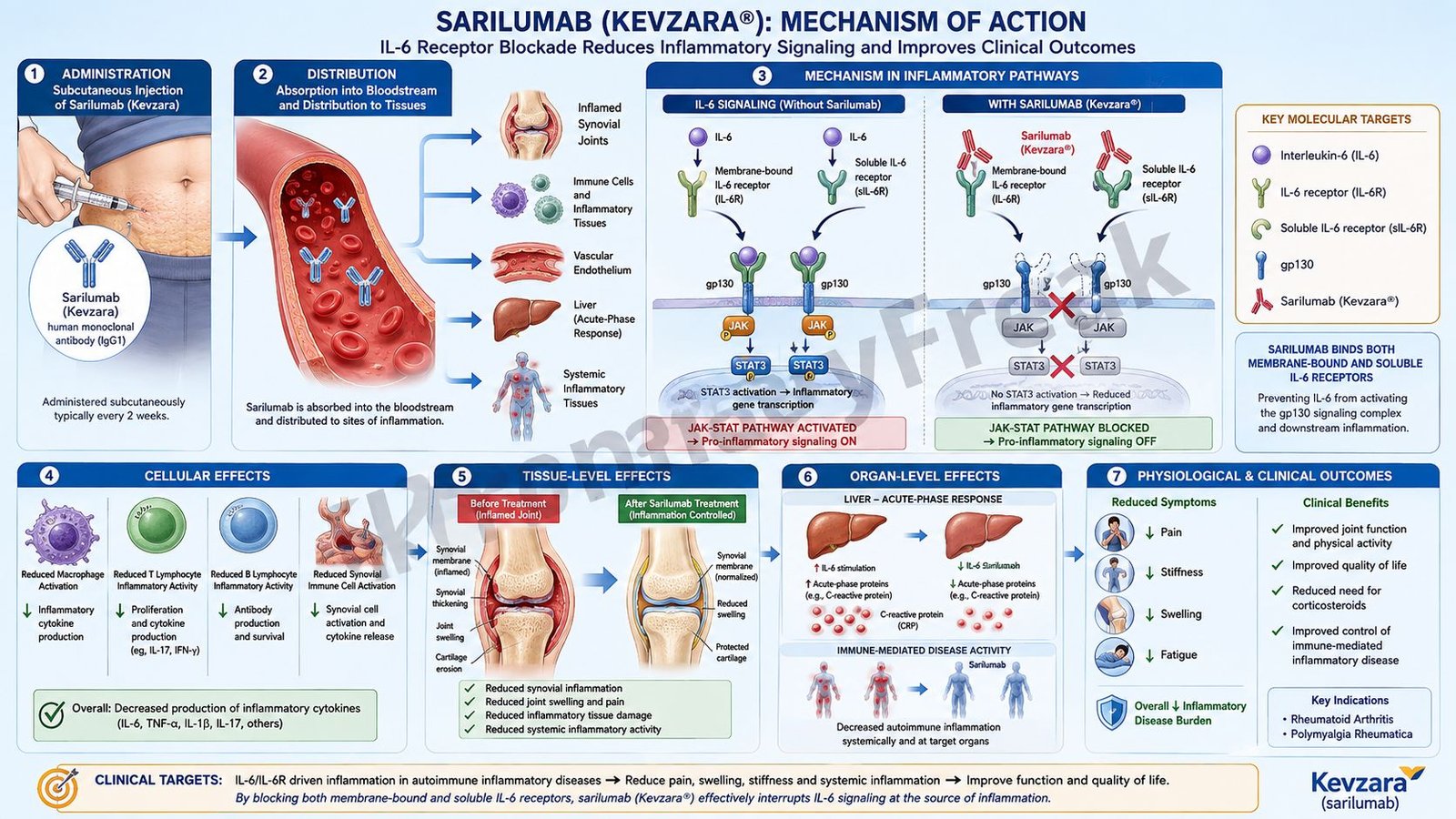
Sarilumab is a biologic immunomodulatory drug marketed under the brand name Kevzara. Pharmacologically, sarilumab is an interleukin-6 receptor antagonist, commonly called an IL-6 receptor blocker.
Interleukin-6, or IL-6, is a pro-inflammatory cytokine involved in immune-cell activation, acute-phase inflammation, antibody production, hepatic acute-phase protein synthesis, hematopoiesis, fever, systemic inflammation, and synovial inflammation. Excessive IL-6 signaling is important in inflammatory diseases such as rheumatoid arthritis, polymyalgia rheumatica, and polyarticular juvenile idiopathic arthritis.
Sarilumab is a human recombinant monoclonal antibody of the IgG1 subclass. The official Kevzara label states that sarilumab binds to both soluble and membrane-bound IL-6 receptors and inhibits IL-6-mediated signaling through these receptors. IL-6 is produced by several cell types, including T cells, B cells, lymphocytes, monocytes, fibroblasts, synovial cells, and endothelial cells.
Kevzara is indicated for adults with moderately to severely active rheumatoid arthritis who have had an inadequate response or intolerance to one or more disease-modifying antirheumatic drugs. It is also indicated for adults with polymyalgia rheumatica who had inadequate response to corticosteroids or cannot tolerate corticosteroid taper, and for active polyarticular juvenile idiopathic arthritis in patients who weigh 63 kg or greater.
For exam purposes, sarilumab should be remembered as a monoclonal antibody that blocks IL-6 receptor signaling, reduces inflammatory cytokine activity, lowers acute-phase reactants such as CRP, and decreases immune-mediated inflammation in RA, PMR, and pJIA.
Mechanism of Action (Step-wise)
Step 1: IL-6 is a pro-inflammatory cytokine
IL-6 is produced by immune cells and stromal cells during inflammation. It participates in T-cell activation, B-cell differentiation, immunoglobulin secretion, hepatic acute-phase protein synthesis, and hematopoietic precursor-cell activity.
Step 2: IL-6 contributes to rheumatoid arthritis inflammation
In rheumatoid arthritis, IL-6 is produced locally by synovial and endothelial cells. This contributes to synovial inflammation, joint swelling, pain, stiffness, fatigue, systemic inflammation, and progressive joint damage.
Step 3: IL-6 signals through IL-6 receptors
IL-6 can signal through membrane-bound IL-6 receptors on cells and soluble IL-6 receptors in circulation. Both receptor forms can participate in inflammatory signaling.
Step 4: IL-6 receptor activation triggers downstream inflammatory pathways
When IL-6 binds its receptor system, downstream signaling activates inflammatory gene expression. This promotes acute-phase proteins, immune-cell activation, inflammatory mediator release, and systemic inflammatory symptoms.
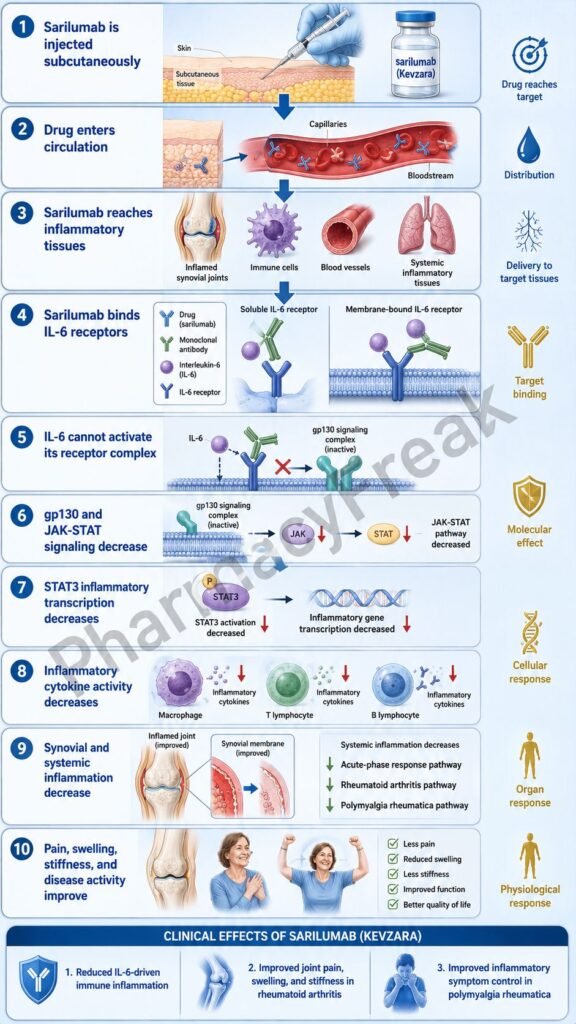
Step 5: Sarilumab binds soluble IL-6 receptors
Sarilumab binds soluble IL-6 receptor, also called sIL-6R. This prevents IL-6 from effectively signaling through soluble receptor-mediated pathways.
Step 6: Sarilumab binds membrane-bound IL-6 receptors
Sarilumab also binds membrane-bound IL-6 receptor, also called mIL-6R. By blocking this receptor form, sarilumab inhibits IL-6 signaling on cells that express membrane IL-6 receptors.
Step 7: IL-6-mediated signaling decreases
The central mechanism is inhibition of IL-6-mediated signaling through both soluble and membrane-bound IL-6 receptors. This reduces the downstream inflammatory effects of IL-6.
Step 8: Acute-phase protein production decreases
IL-6 normally stimulates the liver to produce acute-phase proteins such as C-reactive protein, fibrinogen, and serum amyloid A. Sarilumab treatment rapidly reduces CRP and also decreases fibrinogen and serum amyloid A.
Step 9: CRP levels fall rapidly
After subcutaneous sarilumab administration in RA patients, rapid CRP reduction was observed, and CRP levels were reduced to normal within 2 weeks after treatment initiation.
Step 10: Synovial inflammation decreases
By blocking IL-6 receptor signaling, sarilumab reduces inflammatory signaling in joints. This can reduce synovitis, joint tenderness, swelling, stiffness, and inflammatory pain in responsive RA patients.
Step 11: Systemic inflammatory symptoms decrease
IL-6 contributes to systemic symptoms such as fatigue, malaise, fever, anemia of inflammation, and elevated acute-phase reactants. IL-6 receptor blockade can reduce these systemic inflammatory signals.
Step 12: Hemoglobin and albumin may increase
Sarilumab treatment has been associated with increases in hemoglobin and serum albumin, consistent with reduced inflammatory acute-phase activity.
Step 13: Neutrophil counts may decrease
IL-6 receptor blockade affects neutrophil dynamics. After single-dose sarilumab in RA patients, absolute neutrophil counts decreased to a nadir between 3 and 4 days and then recovered toward baseline.
Step 14: In PMR, inflammatory pain and stiffness may improve
Polymyalgia rheumatica involves inflammatory pain and stiffness, especially around shoulder and hip girdles. By inhibiting IL-6 signaling, sarilumab can reduce inflammatory activity and support corticosteroid tapering in approved patients.
Step 15: In pJIA, systemic inflammation and joint inflammation may decrease
In active polyarticular juvenile idiopathic arthritis, IL-6 contributes to inflammatory joint disease. Sarilumab reduces inflammatory markers such as CRP and ESR in pJIA patients.
Step 16: Final therapeutic outcome
The final therapeutic effect of sarilumab is reduced IL-6 receptor-mediated inflammation. This leads to decreased inflammatory signaling, reduced acute-phase reactants, improved inflammatory symptoms, and better disease control in approved immune-mediated diseases.
Pharmacokinetics
Sarilumab is administered as a subcutaneous injection. Kevzara is supplied as 150 mg/1.14 mL and 200 mg/1.14 mL clear, colorless to pale-yellow solution in single-dose pre-filled syringes and pre-filled pens.
For adult rheumatoid arthritis, the recommended dose of Kevzara is 200 mg once every 2 weeks by subcutaneous injection. It may be used as monotherapy or with methotrexate or other conventional DMARDs.
For polymyalgia rheumatica, the recommended dose is 200 mg once every 2 weeks by subcutaneous injection, given with a tapering course of systemic corticosteroids. Kevzara may be used as monotherapy after corticosteroids are discontinued.
For active polyarticular juvenile idiopathic arthritis, the recommended dose for patients weighing 63 kg or more is 200 mg once every 2 weeks by subcutaneous injection, with a maximum dose of 200 mg. Kevzara is not approved in pediatric patients weighing less than 63 kg because of lack of an appropriate dosage form.
Before treatment, patients should be evaluated for active infection and active or latent tuberculosis. Treatment initiation is not recommended when ANC is below 2000/mm³ or platelet count is below 150,000/mm³. ALT or AST above 1.5 times the upper limit of normal is also a reason treatment initiation is not recommended.
The median time to maximum concentration after subcutaneous administration in RA patients is about 2 to 4 days. Steady state is reached in about 14 to 16 weeks, with approximately 2- to 3-fold accumulation compared with single-dose exposure.
In RA patients, the apparent volume of distribution at steady state is about 7.3 L. Sarilumab is eliminated by both linear proteolytic pathways and nonlinear target-mediated elimination. At steady state, the concentration-dependent half-life is up to 10 days with 200 mg every 2 weeks and up to 8 days with 150 mg every 2 weeks.
Sarilumab is a monoclonal antibody, so its metabolic pathway is not characterized like small-molecule drugs. It is expected to be degraded into small peptides and amino acids through catabolic pathways, similar to endogenous IgG. Monoclonal antibodies such as sarilumab are not eliminated through renal or hepatic pathways.
No dose adjustment is required in mild to moderate renal impairment, but Kevzara has not been studied in severe renal impairment. The safety and efficacy of Kevzara have not been studied in hepatic impairment, including patients with positive HBV or HCV serology.
Sarilumab can affect CYP450 substrate exposure because IL-6 suppresses CYP activity during inflammation. Blocking IL-6 signaling can restore CYP activity and reduce exposure of some CYP substrates. In one RA study, simvastatin exposure decreased after sarilumab administration.
Clinical Uses
Sarilumab is used for adult patients with moderately to severely active rheumatoid arthritis who had inadequate response or intolerance to one or more DMARDs.
In RA, sarilumab can be used as monotherapy or in combination with methotrexate or other conventional DMARDs. However, concurrent use with biologic DMARDs such as TNF antagonists, IL-1 receptor antagonists, anti-CD20 monoclonal antibodies, or selective co-stimulation modulators should be avoided because of increased immunosuppression and infection risk.
Sarilumab is used for adult patients with polymyalgia rheumatica who had inadequate response to corticosteroids or who cannot tolerate corticosteroid taper.
Sarilumab is used for active polyarticular juvenile idiopathic arthritis in patients who weigh 63 kg or greater. It may be used alone or with conventional DMARDs in pJIA.
Sarilumab is not a corticosteroid, not a TNF-alpha inhibitor, not a JAK inhibitor, not a CD20 antibody, not a CTLA-4 fusion protein, and not conventional chemotherapy. It is a monoclonal antibody that blocks IL-6 receptor signaling.
Sarilumab should not be used in patients with active infection. Patients should be tested for latent tuberculosis before treatment and monitored for infections during therapy.
Adverse Effects
Kevzara has a boxed warning for serious infections. Patients treated with Kevzara are at increased risk of serious infections that may lead to hospitalization or death, including tuberculosis, invasive fungal infections, bacterial infections, viral infections, and infections due to opportunistic pathogens.
Serious infections reported with immunosuppressive agents including Kevzara include bacterial, mycobacterial, invasive fungal, viral, and opportunistic infections. In RA patients, the most frequently observed serious infections with Kevzara included pneumonia and cellulitis.
Tuberculosis risk is important. Patients should be evaluated for TB risk and tested for latent infection before starting Kevzara. Latent TB should be treated before initiating therapy, and patients should be monitored for TB symptoms during treatment.
Viral reactivation can occur with immunosuppressive biologic therapies. Herpes zoster cases were observed in Kevzara clinical studies, while the risk of hepatitis B reactivation is unknown because at-risk patients were excluded from studies.
Laboratory abnormalities are important. Kevzara can cause neutropenia, thrombocytopenia, elevated liver enzymes, and lipid abnormalities. Neutrophils, platelets, ALT/AST, and lipid parameters should be monitored according to the label.
GI perforation has been reported, mainly as complications of diverticulitis. Risk may be increased in patients with diverticulitis or when used with NSAIDs or corticosteroids. New abdominal symptoms should be evaluated promptly.
Immunosuppression may increase malignancy risk. The impact of sarilumab on malignancy development is not known, but malignancies were reported in clinical studies.
Hypersensitivity reactions can occur. Kevzara is contraindicated in patients with known hypersensitivity to sarilumab or inactive ingredients. If anaphylaxis or another hypersensitivity reaction occurs, treatment should be stopped immediately.
Kevzara is not recommended in active hepatic disease or hepatic impairment because treatment has been associated with transaminase elevations. Live vaccines should be avoided during treatment, and patients should be brought up to date with immunizations before starting therapy.
The most common adverse reactions in RA include neutropenia, increased ALT, injection-site erythema, upper respiratory infections, and urinary tract infections. In PMR, common adverse reactions include neutropenia, leukopenia, constipation, pruritic rash, myalgia, fatigue, and injection-site pruritus. In pJIA, common adverse reactions include nasopharyngitis, neutropenia, upper respiratory tract infection, and injection-site erythema.
Comparative Analysis
Sarilumab is commonly compared with tocilizumab, TNF inhibitors, JAK inhibitors, abatacept, rituximab, methotrexate, corticosteroids, and NSAIDs.
Compared with tocilizumab, sarilumab belongs to the same broad IL-6 receptor antagonist class. Both block IL-6 receptor signaling, but they differ in structure, dosing, approved indications, formulation options, and product-specific labeling.
Compared with TNF inhibitors such as adalimumab, etanercept, infliximab, golimumab, and certolizumab, sarilumab targets a different cytokine pathway. TNF inhibitors block TNF-alpha signaling, while sarilumab blocks IL-6 receptor signaling.
Compared with JAK inhibitors such as tofacitinib, baricitinib, and upadacitinib, sarilumab acts extracellularly at the cytokine receptor level. JAK inhibitors are oral small molecules that block intracellular cytokine signaling pathways, while sarilumab is a monoclonal antibody given subcutaneously.
Compared with abatacept, sarilumab has a different immune target. Abatacept modulates T-cell co-stimulation through CD80/CD86-CD28 signaling, while sarilumab blocks IL-6 receptor signaling.
Compared with rituximab, sarilumab does not deplete CD20-positive B cells. Rituximab targets CD20 on B cells, while sarilumab targets IL-6 receptors.
Compared with methotrexate, sarilumab is a biologic targeted cytokine-receptor blocker. Methotrexate is a conventional synthetic DMARD with broader anti-inflammatory and immunomodulatory effects.
Compared with corticosteroids, sarilumab is more cytokine-pathway specific. Corticosteroids broadly suppress inflammatory gene expression, while sarilumab specifically blocks IL-6 receptor-mediated signaling.
Compared with NSAIDs, sarilumab modifies inflammatory disease pathways more directly. NSAIDs reduce prostaglandin synthesis through cyclooxygenase inhibition and mainly provide symptomatic pain and inflammation relief, while sarilumab reduces IL-6-mediated immune inflammation.
MCQs
- Sarilumab is marketed under which brand name?
a) Actemra
b) Kevzara
c) Humira
d) Orencia
Answer: b) Kevzara
- Sarilumab belongs to which pharmacological class?
a) IL-6 receptor antagonist
b) TNF-alpha inhibitor
c) JAK inhibitor
d) CD20 monoclonal antibody
Answer: a) IL-6 receptor antagonist
- Sarilumab binds to which receptor forms?
a) Soluble and membrane-bound IL-6 receptors
b) Dopamine D2 and D3 receptors
c) Beta-1 and beta-2 receptors
d) NMDA and AMPA receptors
Answer: a) Soluble and membrane-bound IL-6 receptors
- IL-6 is best described as a:
a) Pro-inflammatory cytokine
b) Gastric acid enzyme
c) Bacterial ribosomal protein
d) Neurotransmitter transporter
Answer: a) Pro-inflammatory cytokine
- Sarilumab inhibits:
a) IL-6-mediated signaling
b) DNA topoisomerase II only
c) Sodium-glucose cotransporter 2
d) Acetylcholinesterase
Answer: a) IL-6-mediated signaling
- Kevzara is indicated for adult rheumatoid arthritis after inadequate response or intolerance to:
a) One or more DMARDs
b) One or more antibiotics
c) Insulin therapy
d) Proton pump inhibitors
Answer: a) One or more DMARDs
- Kevzara is also indicated for polymyalgia rheumatica in adults who had inadequate response to corticosteroids or:
a) Cannot tolerate corticosteroid taper
b) Have acute bacterial meningitis
c) Have acute myocardial infarction
d) Have untreated tuberculosis
Answer: a) Cannot tolerate corticosteroid taper
- Kevzara is approved for active pJIA in patients who weigh:
a) 63 kg or greater
b) 10 kg or greater
c) Less than 20 kg only
d) Exactly 40 kg only
Answer: a) 63 kg or greater
- The recommended adult RA dose of Kevzara is:
a) 200 mg subcutaneously once every 2 weeks
b) 5 mg orally twice daily
c) 300 mg IV every 6 months
d) 40 mg orally once weekly
Answer: a) 200 mg subcutaneously once every 2 weeks
- Sarilumab administration route is:
a) Subcutaneous injection
b) Oral tablet
c) Inhalation
d) Intrathecal injection
Answer: a) Subcutaneous injection
- The boxed warning for Kevzara is:
a) Risk of serious infections
b) Thyroid C-cell tumors
c) Severe hypoglycemia
d) Ototoxicity
Answer: a) Risk of serious infections
- Before starting Kevzara, patients should be tested for:
a) Active and latent tuberculosis
b) Only serum calcium
c) Only blood glucose every hour
d) Only hearing loss
Answer: a) Active and latent tuberculosis
- Which laboratory abnormality may occur with sarilumab?
a) Neutropenia
b) Mandatory hyperkalemia
c) Severe hypoglycemia in every patient
d) Permanent thrombocytosis only
Answer: a) Neutropenia
- Which vaccine type should generally be avoided during Kevzara therapy?
a) Live vaccines
b) Inactivated influenza vaccines only
c) Recombinant vaccines only
d) Toxoid vaccines only
Answer: a) Live vaccines
- Which statement best describes sarilumab?
a) It is a monoclonal antibody that blocks IL-6 receptors and reduces IL-6-mediated inflammatory signaling
b) It is an oral JAK inhibitor that blocks intracellular ATP binding
c) It is a TNF inhibitor that binds TNF-alpha directly
d) It is a corticosteroid that broadly suppresses gene transcription
Answer: a) It is a monoclonal antibody that blocks IL-6 receptors and reduces IL-6-mediated inflammatory signaling
FAQs
What is the mechanism of action of sarilumab?
Sarilumab binds both soluble and membrane-bound IL-6 receptors and inhibits IL-6-mediated signaling. This reduces inflammatory cytokine activity, acute-phase reactant production, and immune-mediated inflammation.
What is the brand name of sarilumab?
The brand name of sarilumab is Kevzara.
What is sarilumab used for?
Sarilumab is used for adults with moderately to severely active rheumatoid arthritis after inadequate response or intolerance to one or more DMARDs. It is also used for adults with polymyalgia rheumatica after inadequate corticosteroid response or inability to tolerate corticosteroid taper, and for active polyarticular juvenile idiopathic arthritis in patients weighing 63 kg or greater.
Is sarilumab a biologic?
Yes. Sarilumab is a biologic monoclonal antibody of the IgG1 subclass.
Is sarilumab a JAK inhibitor?
No. Sarilumab is not a JAK inhibitor. It blocks IL-6 receptors outside the cell, while JAK inhibitors block intracellular cytokine signaling enzymes.
Why does sarilumab reduce CRP?
IL-6 stimulates hepatic acute-phase protein synthesis, including CRP production. By blocking IL-6 receptor signaling, sarilumab reduces CRP levels.
What are important adverse effects of sarilumab?
Important adverse effects include serious infections, tuberculosis, opportunistic infections, neutropenia, thrombocytopenia, elevated liver enzymes, lipid abnormalities, gastrointestinal perforation, hypersensitivity reactions, possible malignancy risk, injection-site reactions, and upper respiratory or urinary tract infections.
Can live vaccines be given with sarilumab?
Live vaccines should be avoided during sarilumab treatment because of possible increased infection risk. Patients should be brought up to date with immunizations before starting therapy.
References
Goodman & Gilman’s The Pharmacological Basis of Therapeutics
Katzung Basic & Clinical Pharmacology