Table of Contents
Introduction
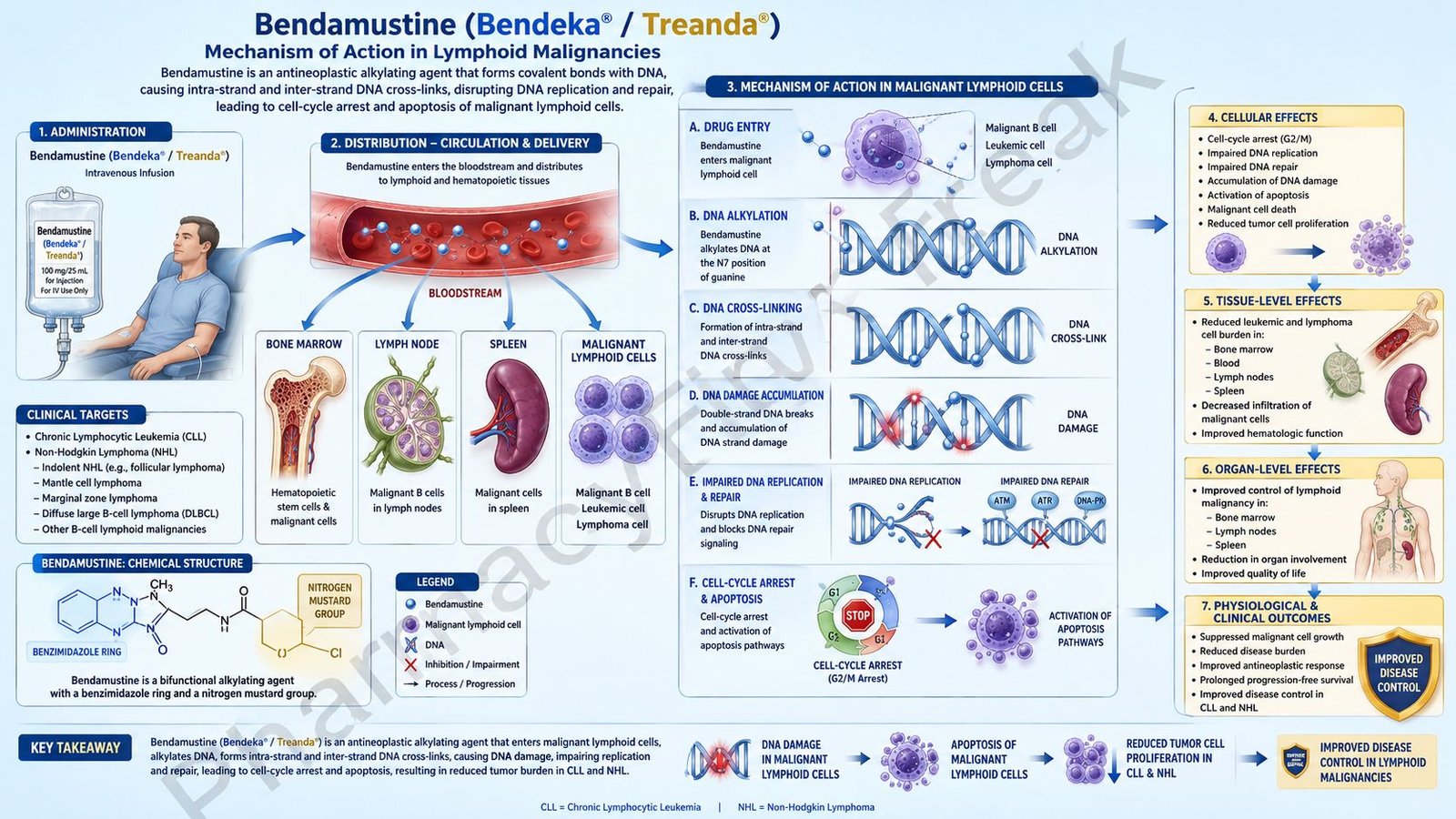
Bendamustine is an anticancer drug used mainly in certain hematologic malignancies. Pharmacologically, bendamustine is an alkylating agent and a bifunctional mechlorethamine derivative.
Bendamustine hydrochloride is given by intravenous infusion. It is used in chronic lymphocytic leukemia, commonly called CLL, and indolent B-cell non-Hodgkin lymphoma, commonly called NHL, that has progressed during or within six months of treatment with rituximab or a rituximab-containing regimen. The official label describes bendamustine hydrochloride as an alkylating drug indicated for these conditions.
Cancer cells divide rapidly and require accurate DNA replication. Alkylating agents damage DNA by forming covalent bonds with DNA bases. This can produce DNA crosslinks, strand damage, replication failure, cell-cycle arrest, and cell death.
Bendamustine is structurally interesting because it contains a mechlorethamine alkylating group and a purine-like benzimidazole ring. This gives it properties that are often described as combining alkylator-like activity with a purine analog-like structural feature. The official label states that bendamustine is a bifunctional mechlorethamine derivative containing a purine-like benzimidazole ring.
The exact mechanism of action of bendamustine remains unknown. However, the key established pharmacological action is formation of electrophilic alkyl groups that form covalent bonds with electron-rich nucleophilic groups, producing interstrand DNA crosslinks and cell death through several pathways. Bendamustine is active against both quiescent and dividing cells.
For exam purposes, bendamustine should be remembered as an alkylating anticancer drug that forms DNA crosslinks, interferes with DNA replication and repair, damages both dividing and non-dividing malignant lymphocytes, and triggers cancer-cell death.
Mechanism of Action (Step-wise)
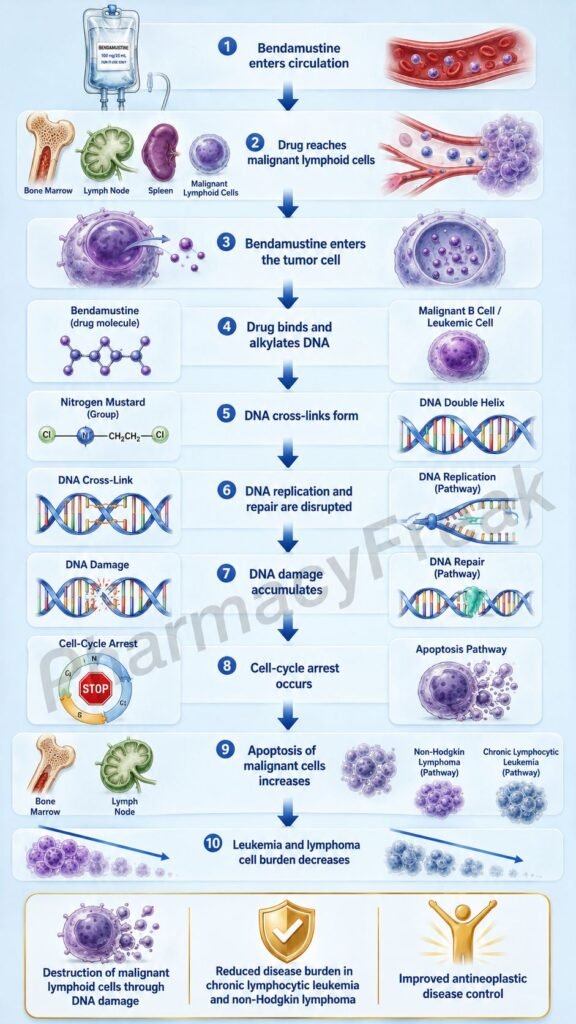
Step 1: Cancer cells require DNA replication and repair
Malignant lymphocytes in CLL and indolent B-cell NHL depend on DNA replication, transcription, repair, and survival signaling. When DNA damage becomes excessive, cancer cells may undergo cell-cycle arrest or apoptosis.
Step 2: Bendamustine enters systemic circulation by IV infusion
Bendamustine hydrochloride is administered intravenously. It is not an oral anticancer tablet. After infusion, it distributes through the body and reaches malignant lymphoid cells.
Step 3: Bendamustine acts as an alkylating agent
Bendamustine belongs to the alkylating drug class. Alkylating drugs work by transferring alkyl groups to cellular macromolecules, especially DNA.
Step 4: Bendamustine contains a mechlorethamine group
The mechlorethamine group is responsible for its alkylating activity. Mechlorethamine derivatives form electrophilic alkyl groups that react with electron-rich nucleophilic sites.
Step 5: Electrophilic intermediates react with DNA
DNA contains nucleophilic sites, especially nitrogen atoms in DNA bases. Alkylating drugs can covalently bind these sites and create chemically damaged DNA.
Step 6: Covalent DNA binding occurs
The official label states that mechlorethamine derivatives form electrophilic alkyl groups, and these groups form covalent bonds with electron-rich nucleophilic moieties.
Step 7: Interstrand DNA crosslinks form
Because bendamustine is bifunctional, it can create covalent linkages between DNA strands. These interstrand DNA crosslinks prevent the two DNA strands from separating properly during replication and transcription.
Step 8: DNA replication is impaired
When DNA strands are crosslinked, replication machinery cannot copy DNA normally. This is especially damaging to rapidly dividing malignant cells.
Step 9: DNA transcription may also be disrupted
DNA crosslinking can interfere with transcription and gene expression. This can reduce production of proteins needed for cancer-cell survival and proliferation.
Step 10: DNA repair pathways are overwhelmed
Cells attempt to repair DNA damage, but extensive crosslinking can exceed repair capacity. If damage is not repaired, checkpoint activation and death pathways may occur.
Step 11: Cell-cycle arrest can occur
DNA damage checkpoints can stop cell-cycle progression. This prevents damaged cells from continuing division and allows either repair or movement toward cell death.
Step 12: Apoptosis and other death pathways are activated
The bifunctional covalent linkage caused by bendamustine can lead to cell death through several pathways. The exact complete mechanism remains unknown, but apoptosis and DNA-damage response pathways are central concepts.
Step 13: Bendamustine can affect dividing and quiescent cells
Unlike drugs that act only during a narrow cell-cycle phase, bendamustine is active against both quiescent and dividing cells. This is important in CLL and indolent NHL, where some malignant cells may divide slowly.
Step 14: Lymphoid tumor burden decreases
As malignant B cells are damaged and eliminated, tumor burden may decrease. In CLL, this may improve lymphocytosis, lymphadenopathy, splenomegaly, and marrow involvement. In indolent NHL, it may reduce lymphoma burden.
Step 15: Final therapeutic outcome
The final therapeutic effect of bendamustine is DNA damage-mediated death of malignant lymphoid cells. It works mainly as an alkylating agent that forms DNA crosslinks, disrupts DNA function, and triggers cancer-cell death.
Pharmacokinetics
Bendamustine hydrochloride is administered by intravenous infusion. For CLL, the recommended dosage of the lyophilized powder formulation is 100 mg/m² infused intravenously over 30 minutes on Days 1 and 2 of a 28-day cycle, for up to 6 cycles. For indolent B-cell NHL, the recommended dosage is 120 mg/m² infused intravenously over 60 minutes on Days 1 and 2 of a 21-day cycle, for up to 8 cycles.
Bendamustine is available in different formulations, including solution and lyophilized powder. These formulations have different concentrations after preparation and should not be mixed or combined. The label specifically notes that the solution concentration and reconstituted lyophilized powder concentration differ.
After IV administration, bendamustine Cmax typically occurs at the end of infusion. The dose proportionality of bendamustine has not been fully studied.
Bendamustine is highly protein bound, approximately 94% to 96%, and this binding is concentration independent over the studied range. The mean steady-state volume of distribution is approximately 20 to 25 L.
After a single 120 mg/m² IV dose infused over 1 hour, the intermediate half-life of the parent bendamustine compound is approximately 40 minutes. Two active metabolites, gamma-hydroxybendamustine, called M3, and N-desmethylbendamustine, called M4, have terminal half-lives of approximately 3 hours and 30 minutes, respectively.
Bendamustine is extensively metabolized through hydrolytic, oxidative, and conjugative pathways. It is mainly metabolized by hydrolysis to monohydroxy-bendamustine and dihydroxy-bendamustine metabolites, which have low cytotoxic activity in vitro. The active minor metabolites M3 and M4 are primarily formed by CYP1A2 in vitro.
After radiolabeled bendamustine hydrochloride infusion, approximately 76% of the administered dose was recovered. About 50% was recovered in urine, with 3.3% unchanged, and about 25% was recovered in feces.
CYP1A2 drug interactions are important. CYP1A2 inhibitors may increase bendamustine exposure and adverse reactions, while CYP1A2 inducers may decrease bendamustine exposure and reduce efficacy. The label recommends considering alternative therapies that are not CYP1A2 inhibitors or inducers during bendamustine treatment.
Bendamustine should not be used in patients with creatinine clearance below 30 mL/min. It should also not be used in certain levels of hepatic impairment, including total bilirubin greater than 3 times the upper limit of normal or combined liver enzyme and bilirubin elevations described in the label.
Clinical Uses
Bendamustine hydrochloride is indicated for treatment of chronic lymphocytic leukemia. The label notes that efficacy relative to first-line therapies other than chlorambucil has not been established.
Bendamustine hydrochloride is also indicated for indolent B-cell non-Hodgkin lymphoma that has progressed during or within six months of treatment with rituximab or a rituximab-containing regimen.
In CLL, bendamustine targets malignant mature B lymphocytes. The therapeutic goal is to reduce leukemic cell burden and improve disease control.
In indolent B-cell NHL, bendamustine is used when disease progresses despite rituximab-based therapy. It may be used in selected regimens depending on disease type, prior treatment, patient fitness, and clinician judgment.
Bendamustine is not a monoclonal antibody, not a BTK inhibitor, not a BCL-2 inhibitor, not a proteasome inhibitor, not an immune checkpoint inhibitor, and not a CAR-T therapy. It is an IV alkylating anticancer drug.
Bendamustine is not used as a targeted receptor blocker. Its main therapeutic action comes from DNA alkylation and DNA crosslink formation.
Bendamustine is not a cell-cycle-specific antimetabolite like methotrexate or 5-fluorouracil. It can damage both quiescent and dividing cells, which is an important feature of its pharmacology.
Adverse Effects
Myelosuppression is one of the most important adverse effects of bendamustine. The label reports severe myelosuppression in NHL studies, and deaths related to myelosuppression-associated complications were reported. Blood counts should be monitored during therapy.
Infections are clinically important. Bendamustine can cause profound immune suppression, and serious and fatal infections may occur. Opportunistic infections are especially relevant in heavily treated hematologic cancer patients.
Progressive multifocal leukoencephalopathy, or PML, is listed as an important warning. PML is a rare but serious JC virus-related demyelinating brain infection that can be fatal.
Anaphylaxis and infusion reactions can occur. Bendamustine is contraindicated in patients with known hypersensitivity to bendamustine, including anaphylactic and anaphylactoid reactions. Patients with severe allergic-type reactions should not be rechallenged.
Tumor lysis syndrome can occur, especially during the first treatment cycle. Without prevention and monitoring, tumor lysis syndrome may lead to acute renal failure and death. Preventive measures include hydration and close monitoring of blood chemistry, especially potassium and uric acid.
Severe skin reactions have been reported, including Stevens-Johnson syndrome, toxic epidermal necrolysis, DRESS, bullous exanthema, and rash. The risk of severe skin toxicity may be increased when bendamustine is given with allopurinol.
Hepatotoxicity can occur. Fatal and serious liver injury has been reported, and liver chemistry tests should be monitored before and during bendamustine therapy.
Secondary malignancies have been reported after bendamustine treatment, including myelodysplastic syndrome, myeloproliferative disorders, acute myeloid leukemia, bronchial carcinoma, and non-melanoma skin cancers.
Extravasation injury is important because bendamustine is given intravenously. Extravasation can cause erythema, swelling, pain, infection, and necrosis. Venous access and infusion-site monitoring are required.
Embryo-fetal toxicity is a major warning. Based on animal studies and mechanism of action, bendamustine can cause fetal harm when administered during pregnancy. Breastfeeding is not recommended during treatment and for 1 week after the last dose.
Bendamustine may impair male fertility based on animal findings. Patients of reproductive potential should receive appropriate counseling before therapy.
Comparative Analysis
Bendamustine is commonly compared with chlorambucil, cyclophosphamide, fludarabine, rituximab-based regimens, BTK inhibitors, venetoclax, and other lymphoma/CLL therapies.
Compared with chlorambucil, bendamustine is also an alkylating agent but is structurally different because it contains both a mechlorethamine group and a purine-like benzimidazole ring. Bendamustine is given intravenously, while chlorambucil is oral.
Compared with cyclophosphamide, bendamustine is not a prodrug requiring the same activation pathway. Cyclophosphamide is metabolically activated to phosphoramide mustard and acrolein. Bendamustine has its own distinct structure and metabolism.
Compared with fludarabine, bendamustine is mainly an alkylating drug rather than a purine nucleoside analog. Fludarabine interferes with DNA synthesis through purine analog mechanisms, while bendamustine forms DNA crosslinks.
Compared with rituximab, bendamustine is chemotherapy, not an antibody. Rituximab targets CD20 on B cells and induces immune-mediated B-cell killing, while bendamustine damages DNA.
Compared with BTK inhibitors such as ibrutinib, acalabrutinib, and zanubrutinib, bendamustine is less targeted. BTK inhibitors block B-cell receptor signaling, while bendamustine produces cytotoxic DNA damage.
Compared with venetoclax, bendamustine has a different cell-death mechanism. Venetoclax inhibits BCL-2 and promotes apoptosis in BCL-2-dependent cells, while bendamustine causes DNA crosslinking and damage.
Compared with CAR-T therapy, bendamustine is not a cellular immunotherapy. CAR-T therapy uses engineered T cells to recognize tumor antigens, while bendamustine is a cytotoxic alkylating agent.
Compared with proteasome inhibitors such as bortezomib, bendamustine does not block proteasome function. Proteasome inhibitors cause accumulation of misfolded proteins and cellular stress, while bendamustine damages DNA.
MCQs
- Bendamustine belongs to which pharmacological class?
a) Alkylating agent
b) EGFR inhibitor
c) Beta-blocker
d) Antimetabolite only
Answer: a) Alkylating agent
- Bendamustine is structurally described as a derivative of:
a) Mechlorethamine
b) Methotrexate
c) Imatinib
d) Rituximab
Answer: a) Mechlorethamine
- Bendamustine contains which ring system?
a) Purine-like benzimidazole ring
b) Beta-lactam ring
c) Steroid nucleus
d) Macrolide ring
Answer: a) Purine-like benzimidazole ring
- The exact mechanism of action of bendamustine is:
a) Unknown
b) Fully explained by beta receptor blockade
c) Only due to VEGF inhibition
d) Only due to CD20 binding
Answer: a) Unknown
- Bendamustine forms electrophilic groups that react with:
a) Electron-rich nucleophilic moieties
b) Beta-2 receptors
c) Sodium channels
d) Dopamine receptors
Answer: a) Electron-rich nucleophilic moieties
- The major DNA lesion associated with bendamustine is:
a) Interstrand DNA crosslink
b) RNA splicing correction
c) Direct mRNA translation enhancement
d) Ribosomal subunit blockade
Answer: a) Interstrand DNA crosslink
- Bendamustine is active against:
a) Both quiescent and dividing cells
b) Only bacteria
c) Only viruses
d) Only mature red blood cells
Answer: a) Both quiescent and dividing cells
- Bendamustine hydrochloride is administered by:
a) Intravenous infusion
b) Oral tablet only
c) Inhalation
d) Topical cream
Answer: a) Intravenous infusion
- Bendamustine is indicated for:
a) Chronic lymphocytic leukemia
b) Hypertension
c) Type 2 diabetes
d) Migraine only
Answer: a) Chronic lymphocytic leukemia
- Bendamustine is also indicated for indolent B-cell NHL that has progressed during or within six months of treatment with:
a) Rituximab or a rituximab-containing regimen
b) Insulin
c) Metformin
d) Albuterol
Answer: a) Rituximab or a rituximab-containing regimen
- A major dose-limiting toxicity of bendamustine is:
a) Myelosuppression
b) Severe hypoglycemia in every patient
c) Permanent deafness
d) Retinal detachment
Answer: a) Myelosuppression
- Which serious syndrome may occur during the first treatment cycle?
a) Tumor lysis syndrome
b) Serotonin syndrome only
c) Neuroleptic malignant syndrome only
d) Cholinergic crisis only
Answer: a) Tumor lysis syndrome
- Which severe skin reaction has been reported with bendamustine?
a) Stevens-Johnson syndrome
b) Acne vulgaris only
c) Mild dandruff only
d) Contact dermatitis only
Answer: a) Stevens-Johnson syndrome
- Bendamustine active minor metabolites M3 and M4 are primarily formed by:
a) CYP1A2
b) CYP3A4 only
c) MAO-B
d) DPP-4
Answer: a) CYP1A2
- Which statement best describes bendamustine?
a) It is a bifunctional alkylating drug that forms DNA crosslinks and causes malignant-cell death
b) It is a monoclonal antibody against CD20
c) It is a BTK inhibitor that blocks B-cell receptor signaling
d) It is a BCL-2 inhibitor that directly mimics BH3 proteins
Answer: a) It is a bifunctional alkylating drug that forms DNA crosslinks and causes malignant-cell death
FAQs
What is the mechanism of action of bendamustine?
Bendamustine is a bifunctional alkylating agent. It forms electrophilic alkyl groups that covalently bind DNA and produce interstrand DNA crosslinks. These crosslinks interfere with DNA replication and repair, leading to cancer-cell death. The exact complete mechanism remains unknown.
What type of drug is bendamustine?
Bendamustine is an alkylating anticancer drug and a bifunctional mechlorethamine derivative with a purine-like benzimidazole ring.
What cancers is bendamustine used for?
Bendamustine hydrochloride is indicated for chronic lymphocytic leukemia and indolent B-cell non-Hodgkin lymphoma that has progressed during or within six months of rituximab or a rituximab-containing regimen.
Is bendamustine chemotherapy?
Yes. Bendamustine is cytotoxic chemotherapy. It damages DNA through alkylation and crosslink formation.
Is bendamustine a targeted therapy?
No. Bendamustine is not a targeted receptor inhibitor or monoclonal antibody. It is a cytotoxic alkylating agent.
Does bendamustine work only on dividing cells?
No. Bendamustine is active against both quiescent and dividing cells, which is important in slowly proliferating lymphoid malignancies.
What are important adverse effects of bendamustine?
Important adverse effects include myelosuppression, infections, progressive multifocal leukoencephalopathy, infusion reactions, anaphylaxis, tumor lysis syndrome, severe skin reactions, hepatotoxicity, secondary malignancies, extravasation injury, embryo-fetal toxicity, and possible infertility.
Why is tumor lysis syndrome important with bendamustine?
Bendamustine can rapidly kill sensitive cancer cells, releasing intracellular contents into the blood. This can cause hyperkalemia, hyperuricemia, hyperphosphatemia, hypocalcemia, acute kidney injury, arrhythmias, seizures, and death if not prevented or managed.
References
Goodman & Gilman’s The Pharmacological Basis of Therapeutics
Katzung Basic & Clinical Pharmacology