Table of Contents
Introduction
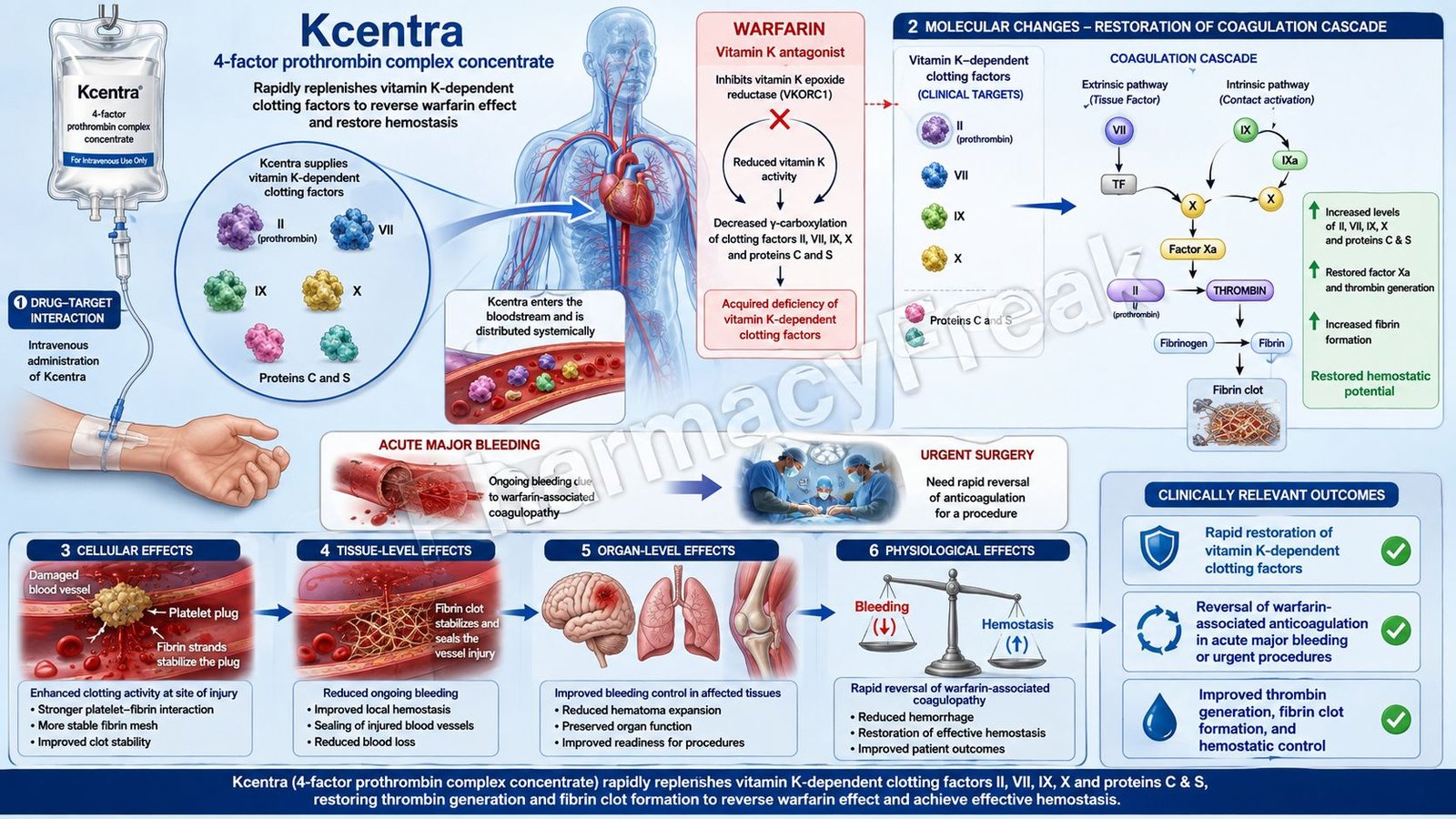
Kcentra is a human plasma-derived blood coagulation factor replacement product. Pharmacologically, Kcentra is a four-factor prothrombin complex concentrate, commonly abbreviated as 4F-PCC.
Kcentra contains vitamin K-dependent coagulation Factors II, VII, IX, and X, together known as the prothrombin complex. It also contains the natural antithrombotic proteins Protein C and Protein S. The product is used to rapidly restore deficient vitamin K-dependent clotting factors in selected patients receiving vitamin K antagonist therapy such as warfarin.
Warfarin and other vitamin K antagonists reduce functional clotting factor activity by blocking vitamin K-dependent gamma-carboxylation during hepatic synthesis. This decreases the activity of Factors II, VII, IX, and X, leading to anticoagulation and an elevated INR.
Kcentra is indicated for urgent reversal of acquired coagulation factor deficiency induced by vitamin K antagonist therapy in adult patients with acute major bleeding or need for urgent surgery or an invasive procedure.
For exam purposes, Kcentra should be remembered as an intravenous 4-factor PCC that rapidly increases plasma levels of Factors II, VII, IX, and X, along with Proteins C and S, to reverse warfarin-induced coagulopathy.
Mechanism of Action (Step-wise)
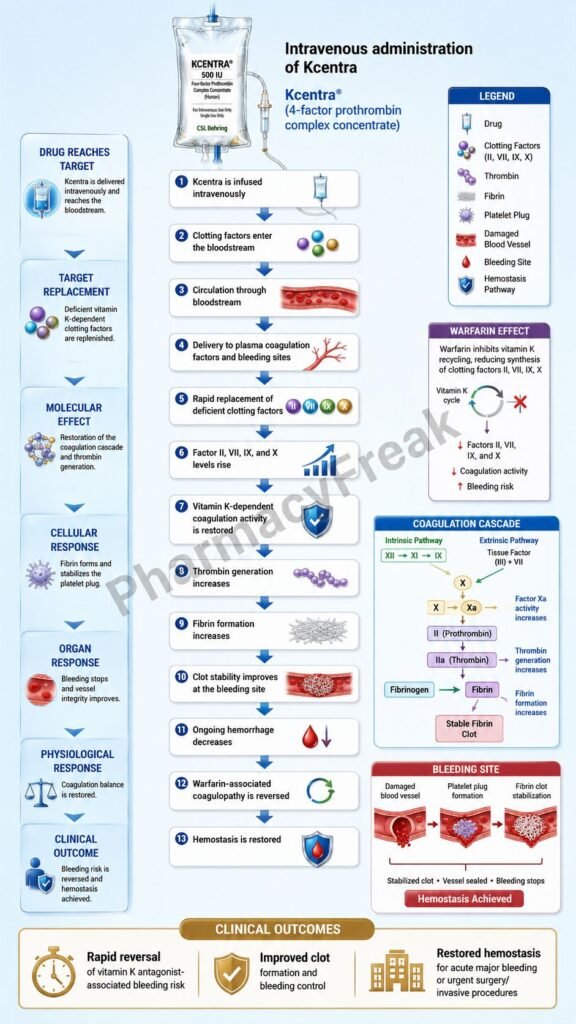
Step 1: Warfarin inhibits vitamin K-dependent clotting factor activation
Vitamin K antagonists such as warfarin block vitamin K-dependent carboxylation of glutamic acid residues during hepatic synthesis of coagulation factors. Without proper carboxylation, vitamin K-dependent factors have reduced function.
Step 2: Functional Factors II, VII, IX, and X decrease
Warfarin reduces the synthesis and functional activity of Factors II, VII, IX, and X. These clotting factors are essential for thrombin generation and fibrin clot formation.
Step 3: INR becomes elevated
Because clotting factor activity is reduced, the prothrombin time and INR increase. A high INR indicates impaired coagulation and increased bleeding risk in patients receiving vitamin K antagonist therapy.
Step 4: Acute bleeding or urgent procedure requires rapid reversal
When a warfarin-treated patient has acute major bleeding or needs urgent surgery, waiting for the body to synthesize new clotting factors may be too slow. Kcentra provides immediate replacement of the deficient factors.
Step 5: Kcentra supplies four vitamin K-dependent coagulation factors
Kcentra contains Factors II, VII, IX, and X. These are collectively called the prothrombin complex. It also contains Protein C and Protein S.
Step 6: Factor VII helps initiate the extrinsic coagulation pathway
Factor VII is converted to activated Factor VIIa. The Factor VIIa-tissue factor complex activates Factor IX and activates Factor X in the presence of phospholipids and calcium ions.
Step 7: Factor IX helps activate Factor X
Factor IX is activated by the Factor VIIa-tissue factor complex and by Factor XIa. Activated Factor IX, together with Factor VIIIa, activates Factor X to Factor Xa.
Step 8: Factor X generates thrombin from prothrombin
Activated Factor X forms a complex with activated Factor V. This prothrombinase complex converts Factor II, also called prothrombin, into thrombin in the presence of phospholipids and calcium ions.
Step 9: Thrombin supports fibrin clot formation
Thrombin converts fibrinogen into fibrin and amplifies coagulation. This helps form a stable hemostatic clot at the bleeding site.
Step 10: Factor II is central to thrombin generation
Factor II, or prothrombin, is the precursor of thrombin. Restoring prothrombin is important because thrombin generation is a key final common step in coagulation.
Step 11: Protein C and Protein S are also replaced
Kcentra contains Protein C and Protein S. Activated Protein C has antithrombotic activity by inactivating Factors Va and VIIIa, and Protein S acts as a cofactor for activated Protein C.
Step 12: Plasma clotting factor levels rise rapidly
Administration of Kcentra rapidly increases plasma levels of vitamin K-dependent Factors II, VII, IX, and X, along with Proteins C and S.
Step 13: INR decreases quickly
In plasma-controlled trials, median INR fell to around 1.20 within 30 minutes after the start of Kcentra infusion in acute major bleeding, while the plasma group had a higher median INR at the same time point.
Step 14: Vitamin K is given concurrently
Kcentra supplies clotting factors rapidly, but its effect decreases as infused factors are cleared. Vitamin K should be given concurrently to maintain vitamin K-dependent clotting factor levels after Kcentra’s effect diminishes.
Step 15: Final therapeutic outcome
The final therapeutic effect of Kcentra is rapid reversal of vitamin K antagonist-induced coagulation factor deficiency. This improves coagulation capacity in adults with acute major bleeding or urgent surgical or invasive procedure needs.
Pharmacokinetics
Kcentra is administered by intravenous infusion after reconstitution. Dosing is individualized according to the patient’s baseline INR and body weight. The labeled doses are 25, 35, or 50 units of Factor IX per kg for pre-treatment INR ranges of 2 to less than 4, 4 to 6, and greater than 6, respectively. Maximum doses are 2500, 3500, and 5000 units of Factor IX for those INR groups.
Kcentra should be given with vitamin K. Repeat dosing has not been established and is not recommended. The reconstituted product is administered at 0.12 mL/kg/min, approximately 3 units/kg/min, up to a maximum rate of 8.4 mL/min or about 210 units/min.
Kcentra is supplied as a lyophilized concentrate in single-dose vials. Potency is defined by Factor IX content. The 500-unit vial contains an actual range of 400 to 620 Factor IX units, and the 1000-unit vial contains an actual range of 800 to 1240 Factor IX units. After reconstitution, the concentration is 20 to 31 units/mL.
In healthy subjects receiving 50 units/kg, a single intravenous Kcentra infusion produced a rapid and sustained increase in plasma concentrations of Factors II, VII, IX, and X, as well as Proteins C and S. Factor II had the longest half-life, about 59.7 hours, while Factor VII had the shortest, about 4.2 hours.
The terminal half-lives reported in the label were approximately 42.4 hours for Factor IX, 60.4 hours for Factor II, 5.0 hours for Factor VII, 31.8 hours for Factor X, 49.6 hours for Protein C, and 50.4 hours for Protein S.
Because Kcentra is a plasma-derived coagulation factor product, its pharmacology is based on replacement of functional proteins rather than receptor binding, enzyme inhibition, or small-molecule metabolism.
Clinical Uses
Kcentra is used for urgent reversal of acquired coagulation factor deficiency caused by vitamin K antagonist therapy, such as warfarin, in adult patients with acute major bleeding.
Kcentra is also used when adults receiving vitamin K antagonist therapy need urgent surgery or an invasive procedure and require rapid reversal of anticoagulation.
Kcentra is not used for routine reversal of direct oral anticoagulants such as apixaban, rivaroxaban, edoxaban, or dabigatran according to its labeled indication. It is specifically indicated for vitamin K antagonist-induced acquired coagulation factor deficiency.
Kcentra is not an anticoagulant. It is a procoagulant factor replacement product. Its purpose is to restore clotting factor activity when anticoagulation from warfarin needs urgent reversal.
Kcentra is not a substitute for vitamin K. Kcentra provides rapid factor replacement, while vitamin K allows the liver to resume production of functional vitamin K-dependent clotting factors. That is why vitamin K should be administered concurrently.
Kcentra is not the same as fresh frozen plasma. Plasma contains many clotting factors in a larger volume, while Kcentra is a concentrated 4-factor prothrombin complex concentrate that can rapidly raise vitamin K-dependent clotting factor levels.
Adverse Effects
Kcentra has a boxed warning for arterial and venous thromboembolic complications. Patients receiving vitamin K antagonist therapy often have underlying conditions that predispose them to thrombosis, so the benefit of urgent reversal must be weighed against thromboembolic risk.
Fatal and non-fatal arterial and venous thromboembolic complications have been reported with Kcentra in clinical trials and postmarketing surveillance. Patients should be monitored for signs and symptoms of thromboembolic events.
Kcentra may not be suitable for patients with recent thromboembolic events, myocardial infarction, disseminated intravascular coagulation, stroke, transient ischemic attack, unstable angina, or severe peripheral vascular disease within the previous 3 months because these patients were not studied in clinical trials.
Kcentra is contraindicated in patients with known anaphylactic or severe systemic reactions to Kcentra or its components, including heparin, Factors II, VII, IX, X, Proteins C and S, antithrombin III, and human albumin. It is also contraindicated in disseminated intravascular coagulation and in patients with known heparin-induced thrombocytopenia because Kcentra contains heparin.
Hypersensitivity reactions may occur and can include flushing, urticaria, tachycardia, anxiety, angioedema, wheezing, nausea, vomiting, hypotension, tachypnea, dyspnea, pulmonary edema, and bronchospasm. Severe allergic or anaphylactic reactions require immediate discontinuation and appropriate treatment.
Because Kcentra is made from human plasma, there is a potential risk of transmitting infectious agents, although manufacturing includes virus reduction steps. The label notes possible transmission risk for viruses, variant Creutzfeldt-Jakob disease agent, and theoretically Creutzfeldt-Jakob disease agent.
The most common adverse reactions reported in subjects receiving Kcentra were headache, nausea or vomiting, hypotension, and anemia. The most serious adverse reactions were thromboembolic events such as stroke, pulmonary embolism, and deep vein thrombosis.
Comparative Analysis
Kcentra is commonly compared with fresh frozen plasma, vitamin K, recombinant factor VIIa, activated prothrombin complex concentrate, idarucizumab, andexanet alfa, and other anticoagulant reversal strategies.
Compared with fresh frozen plasma, Kcentra is more concentrated and provides Factors II, VII, IX, and X in a smaller volume. Plasma replacement may require larger infusion volumes and blood-group compatibility, while Kcentra is a specific 4-factor PCC.
Compared with vitamin K, Kcentra acts faster. Vitamin K helps the liver produce functional clotting factors, but this takes time. Kcentra directly supplies the missing vitamin K-dependent factors, while vitamin K sustains correction after infused factors decline.
Compared with recombinant factor VIIa, Kcentra provides multiple vitamin K-dependent factors rather than only activated Factor VII. This broader factor replacement is why Kcentra is called a four-factor PCC.
Compared with activated prothrombin complex concentrate, Kcentra is described as a non-activated four-factor PCC. Non-activated PCCs primarily replace clotting factor zymogens, while activated products contain activated clotting factors and may carry different thrombosis considerations.
Compared with idarucizumab, Kcentra has a different purpose. Idarucizumab is a specific reversal agent for dabigatran, while Kcentra is labeled for urgent reversal of vitamin K antagonist-induced coagulation factor deficiency.
Compared with andexanet alfa, Kcentra has a different target. Andexanet alfa is designed to reverse factor Xa inhibitors, while Kcentra replaces vitamin K-dependent clotting factors in warfarin-related coagulopathy.
MCQs
- Kcentra belongs to which pharmacological class?
a) Four-factor prothrombin complex concentrate
b) Direct thrombin inhibitor
c) Factor Xa inhibitor
d) Antiplatelet drug
Answer: a) Four-factor prothrombin complex concentrate
- Kcentra is mainly used for urgent reversal of anticoagulation caused by:
a) Vitamin K antagonists
b) Aspirin
c) Clopidogrel
d) Heparin infusion only
Answer: a) Vitamin K antagonists
- Kcentra contains which vitamin K-dependent coagulation factors?
a) II, VII, IX, and X
b) I, V, VIII, and XIII
c) VIII and von Willebrand factor only
d) XII and prekallikrein only
Answer: a) II, VII, IX, and X
- Kcentra also contains which natural antithrombotic proteins?
a) Protein C and Protein S
b) Albumin and fibrinogen only
c) Antiplasmin and plasminogen only
d) Thromboxane and prostacyclin
Answer: a) Protein C and Protein S
- Warfarin causes anticoagulation mainly by blocking:
a) Vitamin K-dependent carboxylation of clotting factors
b) Direct thrombin enzymatic activity
c) Platelet ADP receptors
d) Cyclooxygenase-1 irreversibly
Answer: a) Vitamin K-dependent carboxylation of clotting factors
- Kcentra rapidly increases plasma levels of:
a) Factors II, VII, IX, and X
b) Only Factor VIII
c) Only fibrinogen
d) Only antithrombin
Answer: a) Factors II, VII, IX, and X
- Factor II is also known as:
a) Prothrombin
b) Fibrinogen
c) Christmas factor
d) Stuart-Prower factor
Answer: a) Prothrombin
- Factor X, with Factor Va, converts prothrombin into:
a) Thrombin
b) Plasmin
c) Antithrombin
d) Albumin
Answer: a) Thrombin
- Kcentra dosing is individualized mainly according to:
a) Baseline INR and body weight
b) Blood glucose only
c) Serum sodium only
d) Height only
Answer: a) Baseline INR and body weight
- Kcentra should be administered by:
a) Intravenous infusion after reconstitution
b) Oral tablet
c) Subcutaneous autoinjector
d) Inhalation
Answer: a) Intravenous infusion after reconstitution
- Which drug should be administered concurrently with Kcentra?
a) Vitamin K
b) Aspirin
c) Clopidogrel
d) Warfarin extra dose
Answer: a) Vitamin K
- The boxed warning of Kcentra is for:
a) Arterial and venous thromboembolic complications
b) Thyroid C-cell tumors
c) Severe hypoglycemia
d) Ototoxicity
Answer: a) Arterial and venous thromboembolic complications
- Kcentra is contraindicated in patients with known:
a) Heparin-induced thrombocytopenia
b) Mild seasonal allergy only
c) Controlled hypertension only
d) Stable myopia
Answer: a) Heparin-induced thrombocytopenia
- Kcentra is also contraindicated in patients with:
a) Disseminated intravascular coagulation
b) Mild anemia only
c) Controlled diabetes only
d) Migraine
Answer: a) Disseminated intravascular coagulation
- Which statement best describes Kcentra?
a) It rapidly replaces vitamin K-dependent clotting factors to reverse warfarin-induced coagulopathy
b) It inhibits Factor Xa to prevent clotting
c) It blocks platelet ADP receptors
d) It dissolves fibrin clots directly
Answer: a) It rapidly replaces vitamin K-dependent clotting factors to reverse warfarin-induced coagulopathy
FAQs
What is the mechanism of action of Kcentra?
Kcentra rapidly increases plasma levels of vitamin K-dependent coagulation Factors II, VII, IX, and X, along with Proteins C and S. This reverses the acquired coagulation factor deficiency caused by vitamin K antagonist therapy.
What is Kcentra used for?
Kcentra is used for urgent reversal of acquired coagulation factor deficiency induced by vitamin K antagonist therapy in adults with acute major bleeding or need for urgent surgery or an invasive procedure.
Is Kcentra the same as vitamin K?
No. Kcentra directly supplies clotting factors, while vitamin K helps the liver produce functional clotting factors. Vitamin K is given with Kcentra to maintain factor levels after Kcentra’s effect decreases.
Is Kcentra used for warfarin reversal?
Yes. Kcentra is used for urgent reversal of warfarin-induced acquired coagulation factor deficiency in labeled adult clinical situations.
Is Kcentra a blood product?
Yes. Kcentra is a human plasma-derived blood coagulation factor replacement product.
Why does Kcentra increase thrombosis risk?
Kcentra restores procoagulant clotting factors. Patients receiving warfarin often already have underlying thromboembolic risk. Reversing anticoagulation may therefore increase the risk of arterial or venous thrombosis.
What are important adverse effects of Kcentra?
Important adverse effects include thromboembolic events, hypersensitivity reactions, anaphylaxis, headache, nausea, vomiting, hypotension, anemia, and possible transmission of infectious agents.
Is Kcentra given orally?
No. Kcentra is administered by intravenous infusion after reconstitution.
References
Goodman & Gilman’s The Pharmacological Basis of Therapeutics
Katzung Basic & Clinical Pharmacology