Table of Contents
Introduction
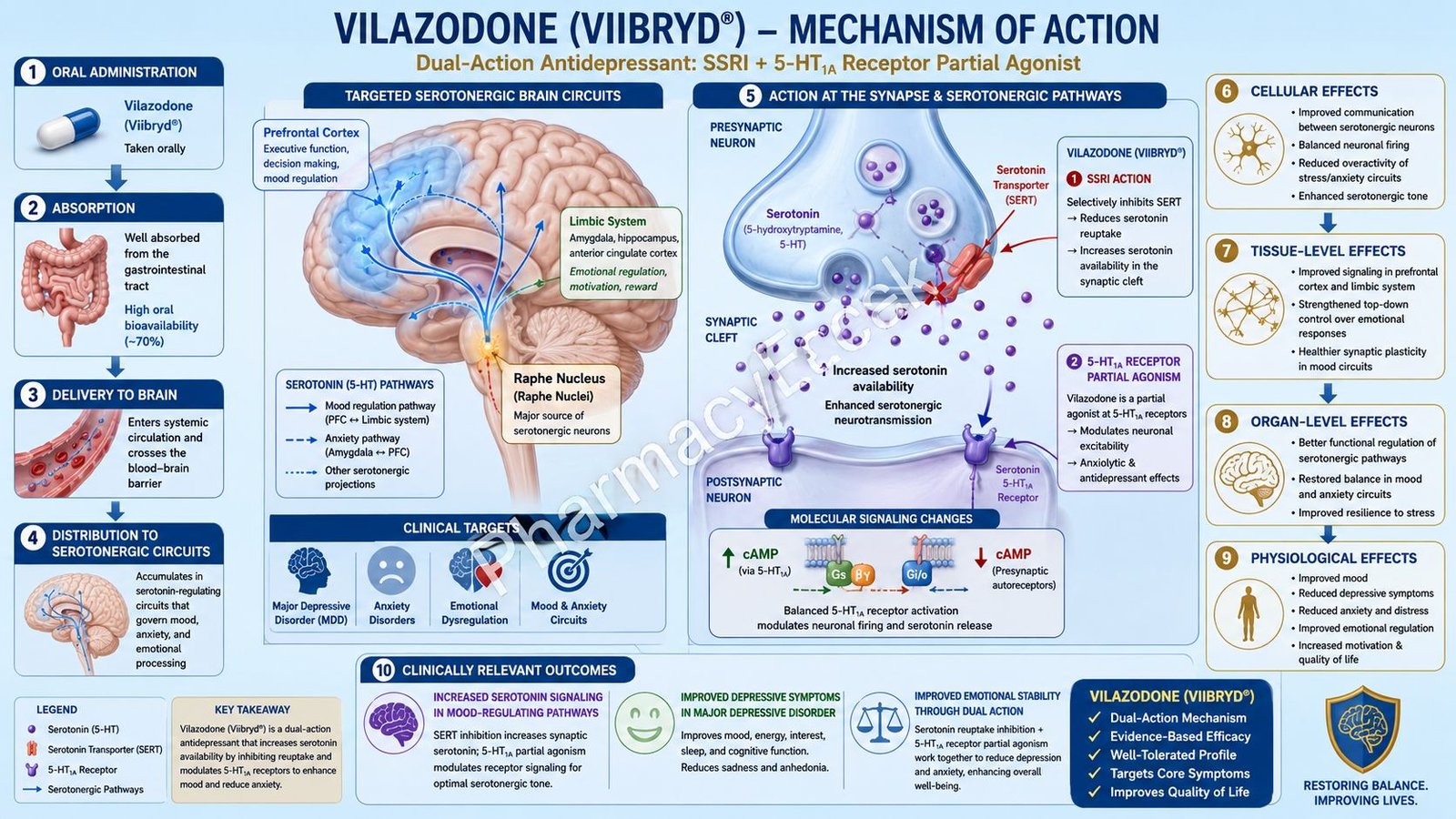
Vilazodone is an oral antidepressant marketed under the brand name Viibryd. Pharmacologically, vilazodone is commonly described as a serotonin reuptake inhibitor and serotonin 5-HT1A receptor partial agonist.
Major depressive disorder, commonly called MDD, is a psychiatric disorder involving persistent low mood, anhedonia, sleep disturbance, appetite changes, fatigue, guilt, impaired concentration, psychomotor changes, and suicidal thoughts in some patients. Neurobiologically, depression involves complex changes in serotonin, norepinephrine, dopamine, glutamate, GABA, neuroplasticity, stress hormones, inflammation, and mood-regulating brain circuits.
Vilazodone mainly enhances serotonergic neurotransmission. The official Viibryd label states that the mechanism of action of vilazodone in major depressive disorder is not fully understood, but it is thought to be related to enhancement of serotonergic activity in the CNS through selective inhibition of serotonin reuptake. Vilazodone is also a partial agonist at serotonergic 5-HT1A receptors, although the net result of this 5-HT1A action and its role in antidepressant effect are unknown.
Viibryd is indicated for the treatment of major depressive disorder in adults. It is not approved for pediatric patients. The recommended target dosage is 20 mg to 40 mg orally once daily with food.
For exam purposes, vilazodone should be remembered as an antidepressant that combines selective serotonin reuptake inhibition with 5-HT1A partial agonist activity. Its exact antidepressant mechanism is not fully understood, but its main pharmacological theme is increased serotonergic signaling in the CNS.
Mechanism of Action (Step-wise)
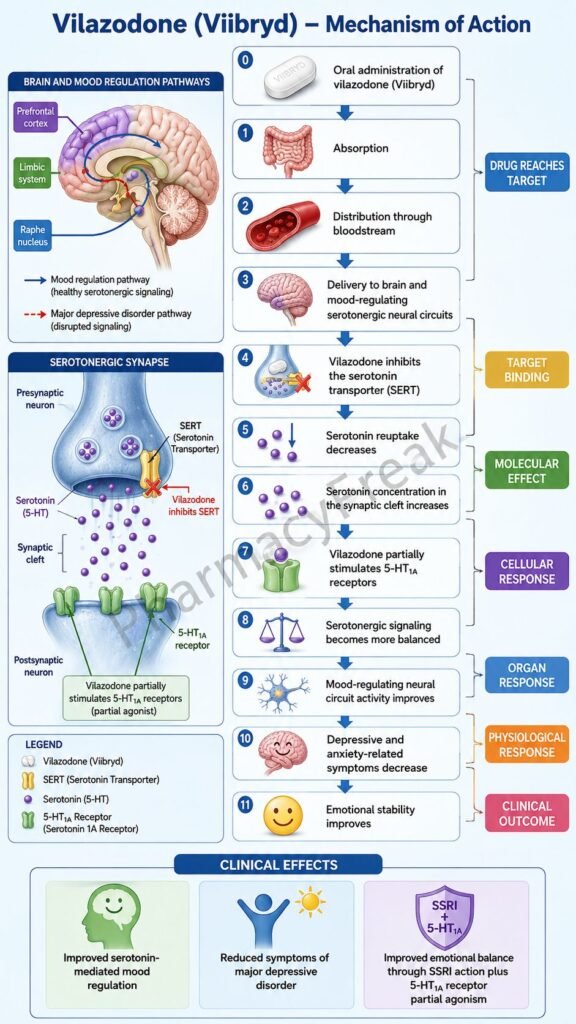
Step 1: Depression involves altered mood-regulating circuits
Major depressive disorder involves abnormal activity in brain circuits controlling mood, reward, motivation, sleep, appetite, cognition, stress response, and emotional regulation.
Step 2: Serotonin is important in mood regulation
Serotonin, also called 5-hydroxytryptamine or 5-HT, is an important neurotransmitter involved in mood, anxiety, sleep, appetite, cognition, pain processing, and emotional regulation.
Step 3: Serotonin is released into the synaptic cleft
Serotonergic neurons release serotonin into the synaptic cleft, where it can bind postsynaptic and presynaptic serotonin receptors.
Step 4: Serotonin is normally cleared by reuptake
After serotonin is released, it is taken back into the presynaptic neuron by the serotonin transporter, commonly abbreviated as SERT. This reuptake process limits the duration and intensity of serotonin signaling.
Step 5: Vilazodone binds the serotonin reuptake site
Vilazodone binds with high affinity to the serotonin reuptake site. The Viibryd label reports a Ki value of 0.1 nM for the serotonin reuptake site and states that vilazodone potently and selectively inhibits serotonin reuptake.
Step 6: Serotonin reuptake decreases
By inhibiting SERT, vilazodone reduces the reuptake of serotonin into presynaptic neurons. This increases serotonin availability in the synaptic cleft.
Step 7: Serotonergic neurotransmission increases
Increased synaptic serotonin can enhance serotonergic signaling in CNS pathways involved in mood and emotional regulation.
Step 8: Vilazodone has limited norepinephrine and dopamine transporter binding
The label states that vilazodone binds with high affinity to the serotonin reuptake site, but not to norepinephrine or dopamine reuptake sites to the same extent. This supports its classification as a serotonergic antidepressant rather than an SNRI or dopamine reuptake inhibitor.
Step 9: Vilazodone also binds 5-HT1A receptors
Vilazodone binds selectively with high affinity to serotonin 5-HT1A receptors and acts as a 5-HT1A receptor partial agonist.
Step 10: 5-HT1A partial agonism may modulate serotonin signaling
A partial agonist activates a receptor but produces less maximal activity than the full natural agonist. At 5-HT1A receptors, partial agonism may influence serotonergic tone, anxiety-related signaling, and mood regulation.
Step 11: Exact 5-HT1A contribution is unknown
Although vilazodone has 5-HT1A partial agonist activity, the official label states that the net result of this action on serotonergic transmission and its role in vilazodone’s antidepressant effect are unknown.
Step 12: Mood-related gene expression may gradually change
Like other serotonergic antidepressants, vilazodone’s clinical antidepressant effect generally depends on downstream adaptive changes in neuronal signaling, receptor sensitivity, neuroplasticity, and mood-circuit function rather than only immediate serotonin elevation.
Step 13: Emotional and cognitive symptoms may improve
With continued treatment, improved serotonergic signaling may help reduce depressed mood, loss of interest, anxiety symptoms, irritability, sleep disturbance, appetite changes, poor concentration, and functional impairment in responsive patients.
Step 14: Vilazodone is not a benzodiazepine or stimulant
Vilazodone does not work by directly enhancing GABA-A receptor activity like benzodiazepines, and it does not directly stimulate dopamine and norepinephrine release like amphetamine stimulants.
Step 15: Final therapeutic outcome
The final therapeutic effect of vilazodone is improvement in depressive symptoms through enhancement of serotonergic neurotransmission, mainly by serotonin reuptake inhibition, with additional 5-HT1A receptor partial agonist activity.
Pharmacokinetics
Vilazodone is administered orally as Viibryd tablets. Tablets are available as 10 mg, 20 mg, and 40 mg strengths. The recommended target dosage is 20 mg to 40 mg once daily with food.
The usual titration schedule is 10 mg once daily with food for 7 days, followed by 20 mg once daily with food. The dose may be increased up to 40 mg once daily with food after a minimum of 7 days between dosage increases.
Vilazodone should be taken with food. The label states that vilazodone AUC and Cmax in the fasted state can be decreased by approximately 50% and 60%, respectively, compared with the fed state. Administration without food can produce inadequate drug concentrations and may reduce effectiveness.
Vilazodone concentrations peak at a median of about 4 to 5 hours after administration. The absolute bioavailability is about 72% with food, and steady state is reached in approximately 3 days.
The terminal half-life of vilazodone is approximately 25 hours. This supports once-daily dosing. Vilazodone pharmacokinetics are dose proportional over the 5 mg to 80 mg range, and its activity is primarily due to the parent drug.
Vilazodone is widely distributed and approximately 96% to 99% protein bound. Because of high protein binding, caution may be needed when considering other highly protein-bound drugs, although the clinical interaction has not been fully evaluated.
Vilazodone is extensively metabolized through CYP and non-CYP pathways. CYP3A4 is the primary CYP enzyme involved, with minor contributions from CYP2C19 and CYP2D6. Only about 1% of the dose is recovered unchanged in urine and about 2% unchanged in feces.
Strong CYP3A4 inhibitors can increase vilazodone exposure. During concomitant use with strong CYP3A4 inhibitors such as itraconazole, clarithromycin, or voriconazole, the Viibryd dose should not exceed 20 mg once daily.
Strong CYP3A4 inducers can decrease vilazodone exposure. If strong CYP3A4 inducers such as carbamazepine, phenytoin, or rifampin are used for more than 14 days, the label recommends considering a dosage increase based on clinical response, up to a maximum of 80 mg once daily.
No dosage adjustment is necessary based on sex, mild to severe renal impairment, or mild to severe hepatic impairment. Viibryd is not a controlled substance.
Clinical Uses
Vilazodone is used for the treatment of major depressive disorder in adults.
In MDD, vilazodone may help improve depressed mood, loss of interest, low energy, sleep disturbance, appetite changes, guilt, cognitive symptoms, anxiety features, and overall functional impairment.
Vilazodone is not approved for pediatric patients. This is important because the boxed warning discusses suicidal thoughts and behaviors in pediatric and young adult patients treated with antidepressants, but Viibryd itself is not approved for pediatric use.
Vilazodone is not approved as a primary treatment for bipolar depression, schizophrenia, generalized anxiety disorder, panic disorder, obsessive-compulsive disorder, insomnia, ADHD, neuropathic pain, or migraine prevention.
Vilazodone is not a classic SSRI only in the simple pharmacology teaching sense, because it also has 5-HT1A partial agonist activity. However, its main antidepressant mechanism is still thought to involve selective inhibition of serotonin reuptake.
Vilazodone is not an SNRI, TCA, MAOI, benzodiazepine, antipsychotic, mood stabilizer, stimulant, or sedative-hypnotic.
Before starting vilazodone, patients should be screened for personal or family history of bipolar disorder, mania, or hypomania because antidepressants may precipitate mania or hypomania in susceptible patients.
Adverse Effects
Viibryd has a boxed warning for suicidal thoughts and behaviors. Antidepressants increased the risk of suicidal thoughts and behaviors in pediatric and young adult patients in short-term studies. All antidepressant-treated patients should be monitored for clinical worsening and emergence of suicidal thoughts and behaviors, especially early in treatment and during dosage changes.
Serotonin syndrome is an important warning. Vilazodone can precipitate serotonin syndrome, especially when used with other serotonergic drugs such as triptans, TCAs, fentanyl, meperidine, methadone, lithium, tramadol, buspirone, amphetamines, St. John’s wort, or MAOIs. Symptoms may include agitation, hallucinations, delirium, coma, tachycardia, blood pressure instability, hyperthermia, tremor, rigidity, myoclonus, hyperreflexia, seizures, nausea, vomiting, and diarrhea.
Vilazodone is contraindicated with MAOIs, including linezolid and intravenous methylene blue, because of serotonin syndrome risk. At least 14 days should elapse between stopping an MAOI and starting vilazodone, and at least 14 days should elapse after stopping vilazodone before starting an MAOI.
Bleeding risk can increase with drugs that interfere with serotonin reuptake, including vilazodone. The risk may be higher with aspirin, NSAIDs, antiplatelet drugs, warfarin, and other anticoagulants. Bleeding events can range from bruising or nosebleeds to serious hemorrhage.
Activation of mania or hypomania may occur. Antidepressant treatment in patients with bipolar disorder can precipitate manic or mixed episodes. Patients should be screened for bipolar disorder risk before treatment.
Discontinuation syndrome can occur if vilazodone is stopped abruptly. Symptoms may include nausea, sweating, dysphoric mood, irritability, agitation, dizziness, sensory disturbances such as electric shock sensations, tremor, anxiety, confusion, headache, lethargy, emotional lability, insomnia, hypomania, tinnitus, and seizures. Gradual tapering is recommended whenever possible.
Seizure caution is important. Viibryd was not systematically evaluated in patients with seizure disorder, and patients with a seizure history were excluded from clinical studies. It should be prescribed with caution in patients with seizure disorder.
Angle-closure glaucoma can occur in susceptible patients because antidepressant-associated pupillary dilation may trigger an angle-closure attack in patients with anatomically narrow angles without a patent iridectomy.
Hyponatremia may occur with serotonergic antidepressants, including vilazodone. It may be due to SIADH and can be serious, with symptoms such as headache, confusion, weakness, unsteadiness, hallucination, syncope, seizure, coma, respiratory arrest, or death in severe cases.
Sexual dysfunction may occur with SSRIs, including vilazodone. In males, this may include ejaculatory delay or failure, decreased libido, and erectile dysfunction. In females, it may include decreased libido and delayed or absent orgasm.
The most common adverse reactions in placebo-controlled MDD studies were diarrhea, nausea, vomiting, and insomnia. Diarrhea and nausea are especially common and exam-relevant adverse effects of vilazodone.
Comparative Analysis
Vilazodone is commonly compared with SSRIs, SNRIs, vortioxetine, buspirone, mirtazapine, bupropion, tricyclic antidepressants, MAO inhibitors, and atypical antipsychotic augmentation.
Compared with SSRIs such as sertraline, fluoxetine, escitalopram, paroxetine, and citalopram, vilazodone also inhibits serotonin reuptake. However, vilazodone additionally acts as a serotonin 5-HT1A receptor partial agonist.
Compared with SNRIs such as venlafaxine, desvenlafaxine, and duloxetine, vilazodone is more serotonergic and does not significantly inhibit norepinephrine reuptake at therapeutic pharmacology levels. SNRIs inhibit serotonin and norepinephrine reuptake.
Compared with vortioxetine, vilazodone has a different serotonin receptor profile. Vortioxetine inhibits serotonin reuptake and modulates multiple serotonin receptors. Vilazodone inhibits serotonin reuptake and partially activates 5-HT1A receptors.
Compared with buspirone, vilazodone has stronger antidepressant SSRI-like activity. Buspirone is a 5-HT1A partial agonist used mainly for anxiety, while vilazodone combines 5-HT1A partial agonism with serotonin reuptake inhibition.
Compared with mirtazapine, vilazodone has a different mechanism. Mirtazapine blocks central alpha-2 adrenergic receptors and certain serotonin receptors and is strongly antihistaminic. Vilazodone primarily enhances serotonin via reuptake inhibition and 5-HT1A partial agonism.
Compared with bupropion, vilazodone is serotonergic. Bupropion inhibits norepinephrine and dopamine reuptake and is often less associated with sexual dysfunction, while vilazodone belongs to the serotonergic antidepressant group and may cause sexual dysfunction.
Compared with tricyclic antidepressants such as amitriptyline, nortriptyline, and imipramine, vilazodone has a more selective serotonin-centered mechanism and generally less anticholinergic, antihistaminic, and cardiac conduction toxicity.
Compared with MAO inhibitors, vilazodone does not inhibit monoamine oxidase. Combining vilazodone with MAOIs is contraindicated because of serotonin syndrome risk.
Compared with atypical antipsychotic augmentation such as aripiprazole, brexpiprazole, or cariprazine, vilazodone is an antidepressant, not an antipsychotic. Antipsychotic augmentation modulates dopamine and serotonin receptors, while vilazodone mainly enhances serotonergic neurotransmission.
MCQs
- Vilazodone is marketed under which brand name?
a) Viibryd
b) Trintellix
c) Cymbalta
d) Remeron
Answer: a) Viibryd
- Vilazodone is mainly indicated for:
a) Major depressive disorder in adults
b) Schizophrenia
c) Epilepsy
d) Parkinson’s disease
Answer: a) Major depressive disorder in adults
- The mechanism of action of vilazodone in MDD is:
a) Not fully understood
b) Fully explained by dopamine D2 blockade
c) Due only to NMDA receptor antagonism
d) Due only to MAO-B inhibition
Answer: a) Not fully understood
- Vilazodone enhances serotonergic activity mainly by:
a) Selective inhibition of serotonin reuptake
b) Blocking acetylcholinesterase
c) Activating beta-2 receptors
d) Blocking proton pumps
Answer: a) Selective inhibition of serotonin reuptake
- Vilazodone also acts as a partial agonist at:
a) 5-HT1A receptors
b) Dopamine D2 receptors
c) NMDA receptors
d) GABA-B receptors
Answer: a) 5-HT1A receptors
- Vilazodone binds with high affinity to the:
a) Serotonin reuptake site
b) Dopamine transporter only
c) Norepinephrine transporter only
d) Muscarinic M3 receptor
Answer: a) Serotonin reuptake site
- Viibryd should be taken:
a) Once daily with food
b) Once weekly without food
c) Only by injection
d) Only at bedtime with no fluid
Answer: a) Once daily with food
- The recommended target dose of Viibryd is:
a) 20 mg to 40 mg once daily
b) 1 mg once daily
c) 100 mg twice daily
d) 300 mg once weekly
Answer: a) 20 mg to 40 mg once daily
- The usual starting dose of Viibryd is:
a) 10 mg once daily for 7 days
b) 40 mg three times daily
c) 5 mg once weekly
d) 80 mg twice daily
Answer: a) 10 mg once daily for 7 days
- Taking vilazodone without food may:
a) Reduce drug exposure and effectiveness
b) Double its effect predictably
c) Prevent all nausea
d) Convert it into a stimulant
Answer: a) Reduce drug exposure and effectiveness
- Vilazodone is mainly metabolized by:
a) CYP3A4
b) Acetylcholinesterase
c) DPP-4
d) Monoamine oxidase-B only
Answer: a) CYP3A4
- Which boxed warning is associated with Viibryd?
a) Suicidal thoughts and behaviors
b) Thyroid C-cell tumors
c) Severe hypoglycemia
d) Ototoxicity
Answer: a) Suicidal thoughts and behaviors
- Vilazodone is contraindicated with:
a) MAOIs
b) Paracetamol only
c) Calcium carbonate only
d) Topical emollients
Answer: a) MAOIs
- Common adverse effects of vilazodone include:
a) Diarrhea, nausea, vomiting, and insomnia
b) Severe hypoglycemia and ototoxicity
c) Permanent myopia and cataract
d) Bradycardia and bronchospasm only
Answer: a) Diarrhea, nausea, vomiting, and insomnia
- Which statement best describes vilazodone?
a) It is a serotonergic antidepressant that inhibits serotonin reuptake and partially activates 5-HT1A receptors
b) It is a benzodiazepine that directly opens chloride channels
c) It is a dopamine D2 blocker used for psychosis
d) It is an opioid agonist used for pain
Answer: a) It is a serotonergic antidepressant that inhibits serotonin reuptake and partially activates 5-HT1A receptors
FAQs
What is the mechanism of action of vilazodone?
Vilazodone’s exact antidepressant mechanism is not fully understood. It is thought to enhance serotonergic activity in the CNS by selectively inhibiting serotonin reuptake. It also acts as a partial agonist at serotonin 5-HT1A receptors.
What is the brand name of vilazodone?
The brand name of vilazodone is Viibryd.
What is vilazodone used for?
Vilazodone is used for the treatment of major depressive disorder in adults.
Is vilazodone an SSRI?
Vilazodone has SSRI-like serotonin reuptake inhibition, but it also has serotonin 5-HT1A receptor partial agonist activity. Therefore, it is often described as a serotonin partial agonist-reuptake inhibitor.
Is vilazodone a controlled substance?
No. Viibryd is not a controlled substance.
Why should vilazodone be taken with food?
Food significantly increases vilazodone exposure. Taking it without food can reduce AUC and Cmax and may reduce effectiveness.
Can vilazodone cause serotonin syndrome?
Yes. Vilazodone can cause serotonin syndrome, especially when combined with other serotonergic drugs or MAOIs. MAOIs are contraindicated with vilazodone.
What are common adverse effects of vilazodone?
Common adverse effects include diarrhea, nausea, vomiting, insomnia, dry mouth, abdominal pain, dyspepsia, and flatulence. Important warnings also include suicidal thoughts and behaviors, serotonin syndrome, bleeding risk, mania or hypomania, discontinuation syndrome, seizures, angle-closure glaucoma, hyponatremia, and sexual dysfunction.
References
Goodman & Gilman’s The Pharmacological Basis of Therapeutics
Katzung Basic & Clinical Pharmacology