Table of Contents
Introduction
Gemtesa is the brand name of vibegron, an oral drug used for overactive bladder. Pharmacologically, vibegron is a selective beta-3 adrenergic receptor agonist.
Overactive bladder, commonly abbreviated as OAB, is a urinary bladder disorder characterized by urgency, frequency, nocturia, and sometimes urge urinary incontinence. Urgency means a sudden strong desire to pass urine. Urge urinary incontinence means involuntary urine leakage associated with urgency. These symptoms commonly occur because of abnormal bladder sensory signaling and involuntary detrusor muscle activity.
The urinary bladder has two important functional phases: storage and voiding. During the storage phase, the detrusor smooth muscle should remain relaxed while the bladder fills with urine. During the voiding phase, the detrusor contracts to expel urine. In overactive bladder, inappropriate detrusor activity during filling can reduce bladder capacity and produce urgency and leakage.
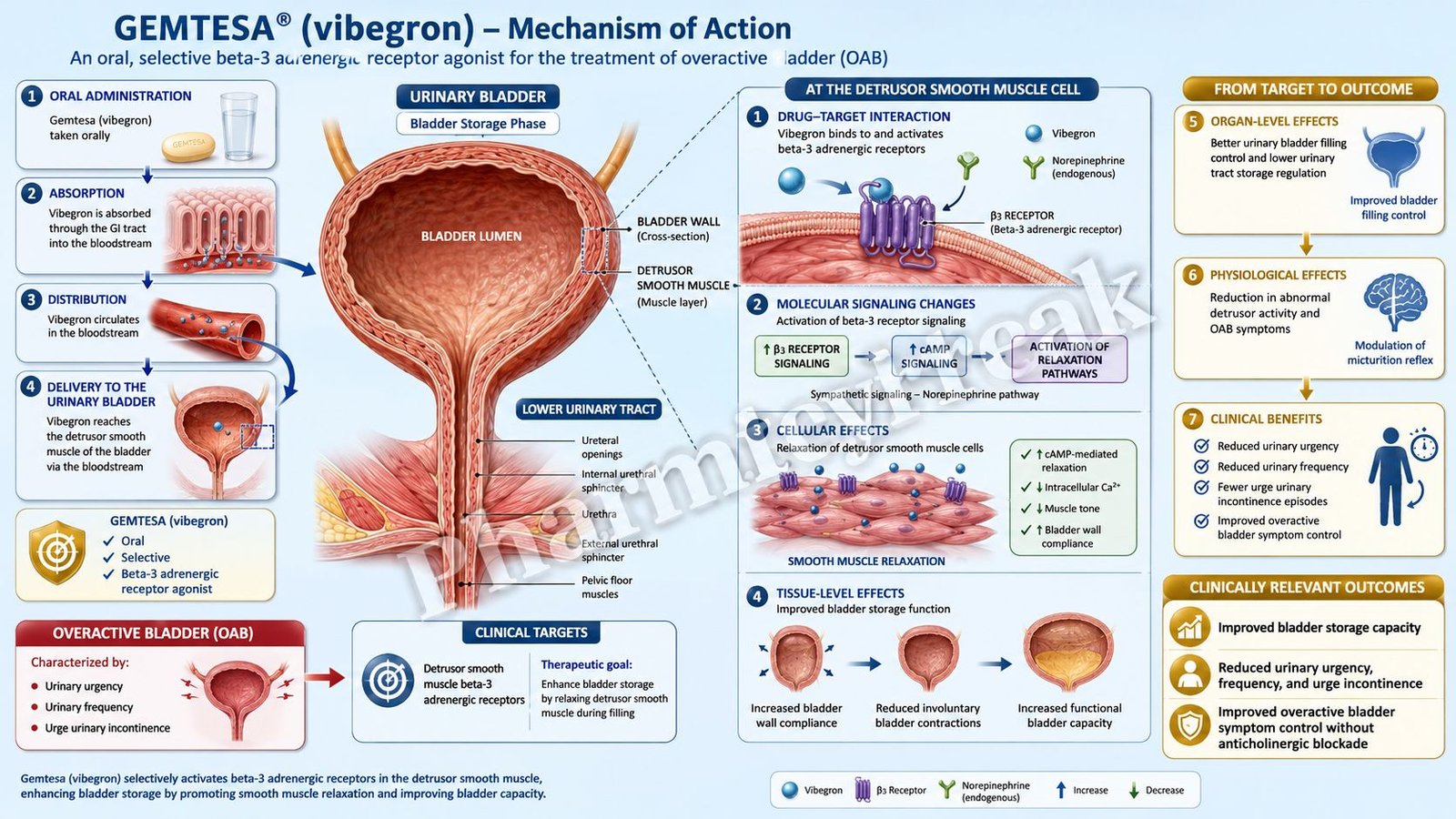
Gemtesa works by activating beta-3 adrenergic receptors in the bladder. The official Gemtesa label states that vibegron is a selective human beta-3 adrenergic receptor agonist and that activation of the beta-3 receptor increases bladder capacity by relaxing detrusor smooth muscle during bladder filling.
Gemtesa is indicated for overactive bladder with symptoms of urge urinary incontinence, urgency, and urinary frequency in adults. It is also indicated for OAB symptoms in adult males on pharmacological therapy for benign prostatic hyperplasia, or BPH.
For exam purposes, Gemtesa should be remembered as vibegron, a selective beta-3 adrenergic agonist that relaxes detrusor smooth muscle during bladder filling, increases bladder capacity, and reduces symptoms of overactive bladder.
Mechanism of Action (Step-wise)
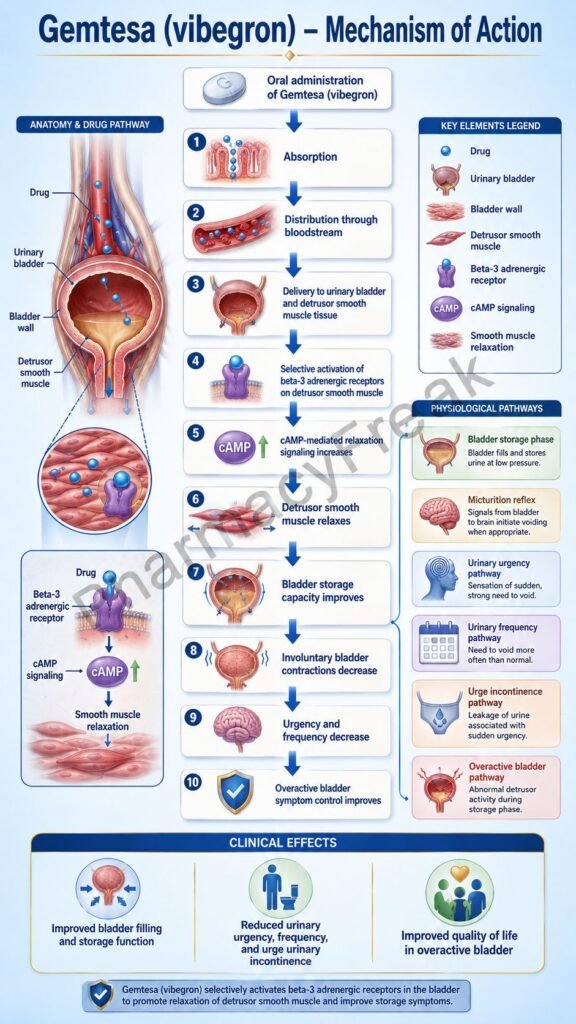
Step 1: The bladder stores urine during the filling phase
During the filling phase, the bladder gradually expands as urine accumulates. For normal storage, the detrusor smooth muscle must remain relaxed while the urethral sphincter maintains continence.
Step 2: Detrusor overactivity contributes to OAB symptoms
In overactive bladder, the detrusor muscle may contract too early or too strongly during bladder filling. This can produce urgency, increased frequency, nocturia, and urge urinary incontinence.
Step 3: The sympathetic nervous system supports urine storage
During urine storage, sympathetic signaling helps relax the detrusor muscle and supports bladder filling. Beta-3 adrenergic receptors are important mediators of detrusor relaxation.
Step 4: Beta-3 receptors are present on bladder detrusor smooth muscle
Beta-3 adrenergic receptors are located on detrusor smooth muscle cells. When activated, they promote relaxation of the bladder wall.
Step 5: Gemtesa activates beta-3 adrenergic receptors
Vibegron, the active drug in Gemtesa, selectively activates human beta-3 adrenergic receptors. This is the core molecular mechanism of the drug.
Step 6: Detrusor smooth muscle relaxes
Activation of beta-3 receptors relaxes detrusor smooth muscle during the bladder filling phase. This allows the bladder to hold more urine before urgency develops.
Step 7: Bladder capacity increases
Because the detrusor muscle remains more relaxed during filling, functional bladder capacity increases. The label specifically states that beta-3 receptor activation increases bladder capacity by relaxing detrusor smooth muscle during bladder filling.
Step 8: Urgency decreases
When bladder filling is better tolerated, the sudden urgent need to urinate may decrease. This helps patients with OAB symptoms feel better control over urination.
Step 9: Urinary frequency decreases
Because the bladder can store urine more effectively, patients may need to urinate less often during the day.
Step 10: Urge urinary incontinence may improve
Reduced detrusor overactivity and improved bladder storage can decrease leakage episodes associated with urgency.
Step 11: Gemtesa does not work by blocking muscarinic receptors
Gemtesa is not an antimuscarinic drug. It does not primarily block M3 muscarinic receptors. This makes it different from drugs such as oxybutynin, tolterodine, solifenacin, darifenacin, fesoterodine, and trospium.
Step 12: Gemtesa has less anticholinergic burden than antimuscarinics
Because Gemtesa is not an anticholinergic drug, it is not expected to produce the same degree of classic anticholinergic effects such as dry mouth, constipation, blurred vision, cognitive impairment, and urinary retention. However, urinary retention can still occur and is an important warning.
Step 13: Gemtesa does not directly treat BPH obstruction
In adult males with BPH, Gemtesa treats OAB storage symptoms such as urgency, frequency, and urge urinary incontinence. It does not shrink the prostate and does not directly relieve mechanical bladder outlet obstruction.
Step 14: Urinary retention risk must be monitored
Relaxing the bladder during filling can be useful, but patients with bladder outlet obstruction or those taking antimuscarinic drugs may be at increased risk of urinary retention. The label recommends monitoring for urinary retention and discontinuing Gemtesa if urinary retention develops.
Step 15: Final therapeutic outcome
The final therapeutic effect of Gemtesa is improved bladder storage. By activating beta-3 adrenergic receptors, Gemtesa relaxes detrusor smooth muscle, increases bladder capacity, and reduces OAB symptoms such as urgency, frequency, and urge urinary incontinence.
Pharmacokinetics
Gemtesa is administered orally as a 75 mg tablet. The recommended dose is one 75 mg tablet once daily, with or without food. The tablet should be swallowed whole with water, but in adults it may also be crushed, mixed with about one tablespoon of applesauce, and taken immediately with water.
Gemtesa is available as a 75 mg light green film-coated tablet. It is taken once daily, which is supported by its pharmacokinetic profile.
Median time to peak plasma concentration is approximately 1 to 3 hours. Steady-state concentrations are achieved within 7 days of once-daily dosing.
A high-fat meal does not produce clinically significant changes in vibegron pharmacokinetics, which supports administration with or without food. Crushing the 75 mg tablet and mixing it with applesauce also does not produce clinically relevant pharmacokinetic changes compared with taking the tablet intact.
Vibegron has a mean apparent volume of distribution of approximately 6304 L. Human plasma protein binding is about 50%, and the average blood-to-plasma concentration ratio is about 0.9.
The effective half-life of vibegron is approximately 30.8 hours across populations. This relatively long half-life supports once-daily dosing.
Metabolism plays a minor role in the elimination of vibegron. CYP3A4 is the predominant enzyme responsible for in vitro metabolism. After a radiolabeled dose, about 59% of the dose was recovered in feces, mostly unchanged, and about 20% was recovered in urine, mostly unchanged.
No clinically significant pharmacokinetic differences were observed based on age, sex, race or ethnicity, mild to severe renal impairment down to eGFR 15 mL/min/1.73 m², or moderate hepatic impairment. However, Gemtesa has not been studied in patients with eGFR below 15 mL/min/1.73 m², with or without hemodialysis, or in severe hepatic impairment.
Gemtesa is not recommended in end-stage renal disease with or without hemodialysis and is not recommended in severe hepatic impairment.
A clinically important drug interaction occurs with digoxin. Vibegron increased digoxin Cmax and AUC, so serum digoxin concentrations should be measured before starting Gemtesa and monitored during therapy to guide digoxin dose titration.
Clinical Uses
Gemtesa is used for the treatment of overactive bladder with symptoms of urge urinary incontinence, urgency, and urinary frequency in adults.
Gemtesa is also used for overactive bladder symptoms in adult males who are receiving pharmacological therapy for benign prostatic hyperplasia. This is useful when an adult male with BPH therapy continues to have storage symptoms such as urgency, frequency, and urge urinary incontinence.
Gemtesa is not a drug for stress urinary incontinence. Stress incontinence occurs when urine leaks during coughing, sneezing, laughing, lifting, or exertion because of weakness of pelvic floor or urethral support. Gemtesa is mainly for urgency-related bladder symptoms.
Gemtesa is not a prostate-shrinking drug. It does not inhibit 5-alpha reductase like finasteride or dutasteride and does not relax prostate/bladder neck alpha-1 receptors like tamsulosin.
Gemtesa is not an anticholinergic or antimuscarinic OAB drug. This distinction is important because many older OAB medications work by blocking muscarinic receptors, while Gemtesa activates beta-3 receptors.
Gemtesa is not approved for pediatric patients. The label states that safety and effectiveness in pediatric patients have not been established.
Adverse Effects
The most important warnings of Gemtesa are urinary retention and angioedema.
Urinary retention has been reported in patients taking Gemtesa. The risk may be increased in patients with bladder outlet obstruction and in patients taking muscarinic antagonist medications for overactive bladder. Patients should be monitored for signs and symptoms of urinary retention, and Gemtesa should be discontinued if urinary retention develops.
Angioedema of the face and/or larynx has been reported with Gemtesa. It may occur hours after the first dose or after multiple doses. Angioedema involving the tongue, hypopharynx, or larynx may be life-threatening and requires immediate discontinuation and appropriate emergency management.
Gemtesa is contraindicated in patients with known hypersensitivity to vibegron or any component of Gemtesa. Hypersensitivity reactions such as angioedema have occurred.
The most common adverse reactions reported with Gemtesa in adults include headache, urinary tract infection, nasopharyngitis, diarrhea, nausea, and upper respiratory tract infection.
Other adverse reactions reported in fewer than 2% of patients included dry mouth, constipation, increased residual urine volume, urinary retention, and hot flush.
In a 4-week ambulatory blood pressure study in OAB patients, daily treatment with Gemtesa 75 mg was not associated with clinically significant changes in blood pressure. Gemtesa also did not prolong the QT interval to a clinically relevant extent at a single dose 5.3 times the approved dose.
Patients should tell their healthcare provider if they have difficulty emptying the bladder, weak urinary stream, bladder outlet obstruction, kidney disease, liver disease, pregnancy, breastfeeding, or use digoxin.
Comparative Analysis
Gemtesa is commonly compared with mirabegron, oxybutynin, tolterodine, solifenacin, darifenacin, fesoterodine, trospium, tamsulosin, finasteride, and pelvic floor therapy.
Compared with mirabegron, Gemtesa belongs to the same broad beta-3 adrenergic agonist class. Both drugs relax detrusor smooth muscle during bladder filling. However, they differ in pharmacokinetics, drug interaction profile, dosing details, and labeling.
Compared with oxybutynin, Gemtesa has a different mechanism. Oxybutynin is an antimuscarinic drug that blocks muscarinic receptors, while Gemtesa activates beta-3 receptors. Oxybutynin is more strongly associated with anticholinergic adverse effects such as dry mouth, constipation, blurred vision, and cognitive concerns.
Compared with tolterodine, Gemtesa again differs by receptor target. Tolterodine blocks muscarinic receptors to reduce bladder contractions, while vibegron activates beta-3 receptors to relax detrusor smooth muscle during filling.
Compared with solifenacin and darifenacin, Gemtesa is not an M3 receptor antagonist. Solifenacin and darifenacin are antimuscarinic drugs with selectivity toward M3 receptors, while Gemtesa is a beta-3 agonist.
Compared with trospium, Gemtesa is different because trospium is a quaternary ammonium antimuscarinic drug. Trospium has limited CNS penetration compared with some older antimuscarinics, but it still belongs to the anticholinergic class.
Compared with tamsulosin, Gemtesa treats a different component of urinary symptoms. Tamsulosin relaxes alpha-1 receptors in the prostate and bladder neck to improve urinary flow in BPH, while Gemtesa relaxes the detrusor muscle during filling to reduce OAB symptoms.
Compared with finasteride and dutasteride, Gemtesa does not reduce prostate size. Finasteride and dutasteride inhibit 5-alpha reductase and lower dihydrotestosterone levels, while Gemtesa targets beta-3 receptors in the bladder.
Compared with pelvic floor therapy and bladder training, Gemtesa is pharmacological treatment. Behavioral therapy can improve bladder control through timed voiding, pelvic floor strengthening, urgency suppression techniques, fluid timing, and caffeine reduction. These may be combined with medication when clinically appropriate.
MCQs
- Gemtesa contains which active drug?
a) Mirabegron
b) Vibegron
c) Oxybutynin
d) Solifenacin
Answer: b) Vibegron
- Gemtesa belongs to which pharmacological class?
a) Beta-3 adrenergic receptor agonist
b) Muscarinic receptor antagonist
c) Alpha-1 receptor blocker
d) 5-alpha reductase inhibitor
Answer: a) Beta-3 adrenergic receptor agonist
- The main site of therapeutic action of Gemtesa is the:
a) Detrusor smooth muscle of the bladder
b) Gastric parietal cell
c) Renal glomerulus only
d) Dopamine receptor in the brain
Answer: a) Detrusor smooth muscle of the bladder
- Activation of beta-3 receptors in the bladder causes:
a) Detrusor relaxation during bladder filling
b) Stronger bladder contraction during filling
c) Prostate shrinkage
d) Increased gastric acid secretion
Answer: a) Detrusor relaxation during bladder filling
- Gemtesa improves OAB symptoms mainly by:
a) Increasing bladder capacity
b) Destroying bacteria in the urine
c) Blocking androgen formation
d) Increasing urine production
Answer: a) Increasing bladder capacity
- Gemtesa is indicated for overactive bladder symptoms including:
a) Urge urinary incontinence, urgency, and urinary frequency
b) Stress urinary incontinence only
c) Kidney stones only
d) Acute bacterial prostatitis only
Answer: a) Urge urinary incontinence, urgency, and urinary frequency
- Gemtesa is also indicated for OAB symptoms in adult males on pharmacological therapy for:
a) Benign prostatic hyperplasia
b) Prostate cancer chemotherapy
c) Testicular torsion
d) Acute renal failure
Answer: a) Benign prostatic hyperplasia
- The recommended Gemtesa dose is:
a) 75 mg orally once daily
b) 5 mg orally twice daily
c) 50 mg orally three times daily
d) 300 mg once weekly
Answer: a) 75 mg orally once daily
- Gemtesa may be taken:
a) With or without food
b) Only with a high-fat meal
c) Only after fasting overnight
d) Only as an injection
Answer: a) With or without food
- Which drug requires serum concentration monitoring when used with Gemtesa?
a) Digoxin
b) Paracetamol
c) Amoxicillin
d) Cetirizine
Answer: a) Digoxin
- Gemtesa is contraindicated in patients with:
a) Known hypersensitivity to vibegron or product components
b) Mild seasonal allergy only
c) Controlled hypertension only
d) Stable myopia
Answer: a) Known hypersensitivity to vibegron or product components
- Which serious hypersensitivity reaction has been reported with Gemtesa?
a) Angioedema
b) Stevens-Johnson syndrome as the main boxed warning
c) Mandatory anaphylaxis in every patient
d) Severe ototoxicity
Answer: a) Angioedema
- Which adverse effect should be monitored, especially in bladder outlet obstruction?
a) Urinary retention
b) Severe hypoglycemia
c) Retinal detachment
d) Hearing loss
Answer: a) Urinary retention
- Which common adverse reaction is reported with Gemtesa?
a) Headache
b) Severe alopecia
c) Ototoxicity
d) Permanent tremor
Answer: a) Headache
- Which statement best describes Gemtesa?
a) It selectively activates beta-3 adrenergic receptors to relax detrusor smooth muscle and increase bladder capacity
b) It blocks muscarinic receptors to produce anticholinergic effects
c) It shrinks the prostate by inhibiting 5-alpha reductase
d) It blocks alpha-1 receptors in the prostate and bladder neck
Answer: a) It selectively activates beta-3 adrenergic receptors to relax detrusor smooth muscle and increase bladder capacity
FAQs
What is the mechanism of action of Gemtesa?
Gemtesa contains vibegron, a selective beta-3 adrenergic receptor agonist. It activates beta-3 receptors in the bladder, relaxes detrusor smooth muscle during bladder filling, increases bladder capacity, and reduces overactive bladder symptoms.
What is the generic name of Gemtesa?
The generic name of Gemtesa is vibegron.
What is Gemtesa used for?
Gemtesa is used for overactive bladder with symptoms of urge urinary incontinence, urgency, and urinary frequency in adults. It is also used for these OAB symptoms in adult males on pharmacological therapy for BPH.
Is Gemtesa an anticholinergic drug?
No. Gemtesa is not an anticholinergic or antimuscarinic drug. It is a beta-3 adrenergic receptor agonist.
Does Gemtesa shrink the prostate?
No. Gemtesa does not shrink the prostate. It treats bladder storage symptoms by relaxing detrusor smooth muscle. Drugs such as finasteride and dutasteride reduce prostate size through 5-alpha reductase inhibition.
Can Gemtesa cause urinary retention?
Yes. Urinary retention has been reported. The risk may be higher in patients with bladder outlet obstruction and in patients taking antimuscarinic medications for OAB.
Can Gemtesa cause angioedema?
Yes. Angioedema of the face and/or larynx has been reported. If swelling of the tongue, throat, or airway symptoms occur, Gemtesa should be stopped and emergency care should be sought.
What are common adverse effects of Gemtesa?
Common adverse effects include headache, urinary tract infection, nasopharyngitis, diarrhea, nausea, and upper respiratory tract infection.
References
Goodman & Gilman’s The Pharmacological Basis of Therapeutics
Katzung Basic & Clinical Pharmacology