Table of Contents
Introduction
Uplizna is the brand name of inebilizumab-cdon, a CD19-directed humanized monoclonal antibody used in selected autoimmune neurological and immune-mediated diseases. It belongs to the class of B-cell-depleting biologic therapies.
Uplizna is indicated in adults for anti-aquaporin-4 antibody-positive neuromyelitis optica spectrum disorder, immunoglobulin G4-related disease, and generalized myasthenia gravis in patients who are anti-acetylcholine receptor antibody positive or anti-muscle-specific tyrosine kinase antibody positive. It is administered by intravenous infusion, with two initial 300 mg doses given 2 weeks apart, followed by 300 mg every 6 months.
The key pharmacological concept of Uplizna is CD19-positive B-cell depletion. B cells play an important role in autoantibody production, antigen presentation, immune activation, and inflammatory tissue damage. In diseases such as neuromyelitis optica spectrum disorder, IgG4-related disease, and generalized myasthenia gravis, pathogenic antibodies and B-cell-mediated immune mechanisms contribute to disease activity.
For pharmacy, medical, nursing, and competitive exam students, Uplizna is important because it is not a steroid, not a conventional immunosuppressant, and not a simple anti-inflammatory drug. It is a targeted monoclonal antibody that binds CD19 on B cells and causes antibody-dependent cellular cytolysis.
Mechanism of Action (Step-wise)
- Primary target: CD19 antigen
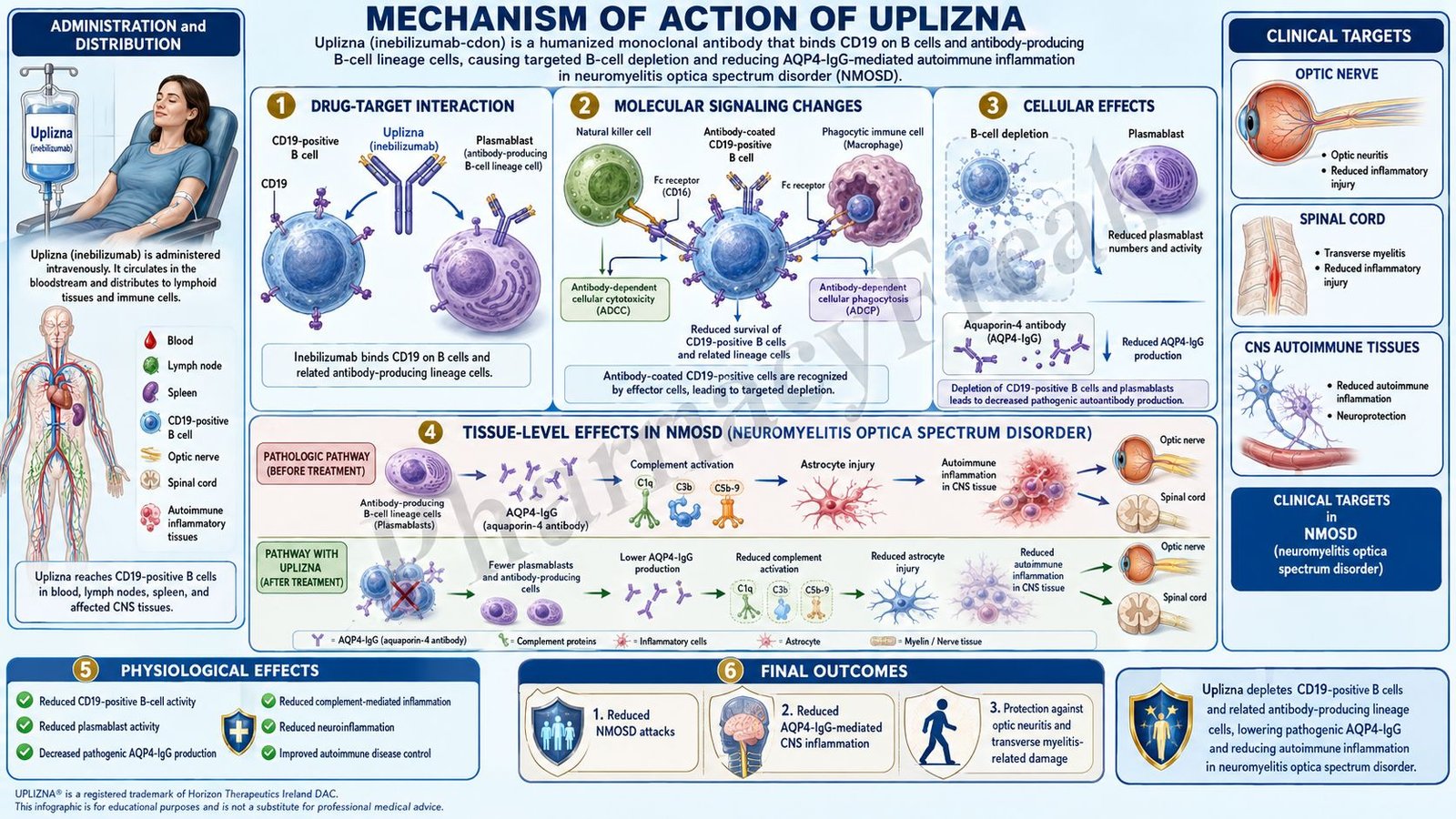
Uplizna contains inebilizumab-cdon, a CD19-directed humanized afucosylated IgG1 monoclonal antibody. CD19 is a surface antigen expressed on B-lineage cells, including pre-B cells and mature B lymphocytes.
- Binding to CD19-positive B cells
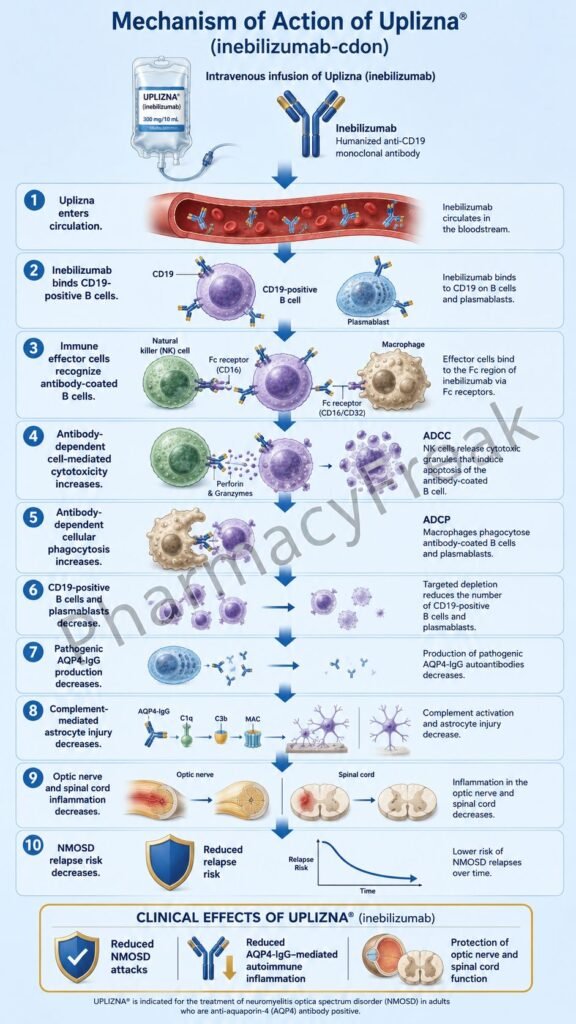
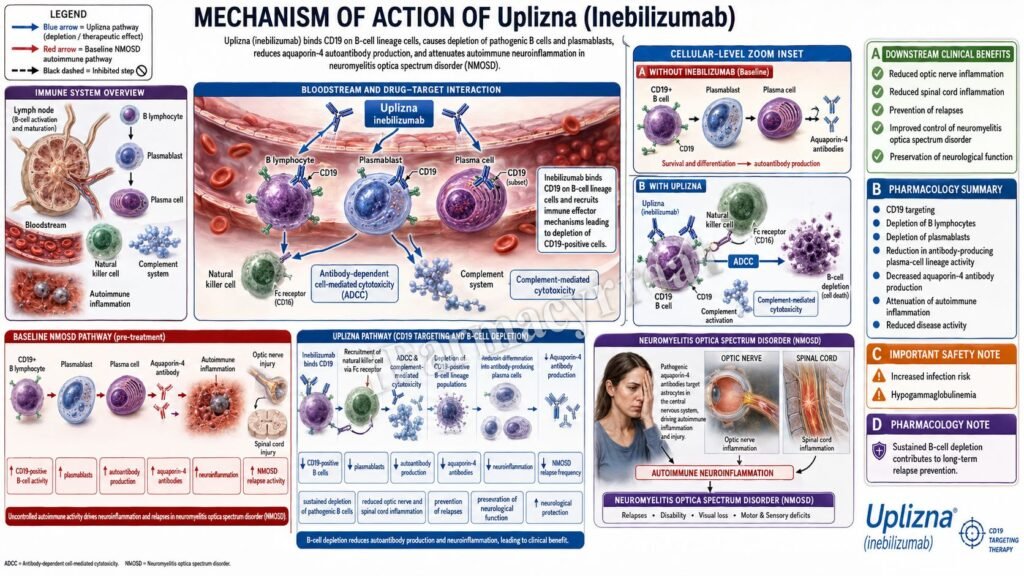
After intravenous administration, Uplizna circulates in the blood and binds to CD19 on the surface of B cells. CD19 is an important B-cell marker involved in B-cell receptor signaling, activation, and survival.
By targeting CD19, Uplizna affects a broader range of B-lineage cells than some CD20-targeting therapies because CD19 is expressed across multiple stages of B-cell development.
- Antibody-dependent cellular cytolysis
Once Uplizna binds to CD19-positive B cells, immune effector cells recognize the Fc region of the antibody. This triggers antibody-dependent cellular cytolysis, leading to destruction of targeted B cells. The official mechanism states that after binding to B lymphocytes, inebilizumab-cdon results in antibody-dependent cellular cytolysis.
- Reduction of circulating B cells
Uplizna causes rapid and sustained reduction of circulating B-cell counts. Pharmacodynamic data show that CD20-positive B-cell counts are reduced in blood by 8 days after infusion, which is used for monitoring because Uplizna can interfere with CD19-positive B-cell assays.
- Reduction in autoantibody-producing immune pathways
B cells can differentiate into antibody-producing cells and also support autoimmune inflammation by presenting antigen and releasing cytokines. By depleting CD19-positive B cells, Uplizna reduces upstream immune activity that contributes to autoantibody-mediated disease.
- Effect in neuromyelitis optica spectrum disorder
In AQP4-IgG-positive NMOSD, pathogenic antibodies against aquaporin-4 damage astrocytes and trigger inflammatory injury in the optic nerves, spinal cord, and brainstem. By reducing B-cell activity, Uplizna helps reduce production and maintenance of pathogenic antibody responses and lowers relapse risk.
- Effect in IgG4-related disease
IgG4-related disease is a chronic immune-mediated fibroinflammatory disease involving B cells, plasmablasts, IgG4-positive plasma cells, and tissue inflammation. By targeting CD19-positive B-lineage cells, Uplizna reduces B-cell-driven immune activity and helps control inflammatory disease manifestations.
- Effect in generalized myasthenia gravis
In antibody-positive generalized myasthenia gravis, autoantibodies against acetylcholine receptor or MuSK impair neuromuscular transmission. By depleting CD19-positive B cells, Uplizna reduces upstream B-cell contribution to pathogenic antibody production and immune activation.
- Final therapeutic effect
The final therapeutic effect of Uplizna is depletion of CD19-positive B cells, reduction in pathogenic B-cell-mediated immune activity, decreased autoantibody-related inflammation, and improved disease control in selected adult patients with NMOSD, IgG4-related disease, or antibody-positive generalized myasthenia gravis.
Pharmacokinetics
Uplizna is administered by intravenous infusion. Since it is given directly into the bloodstream, absorption from the gastrointestinal tract or subcutaneous tissue is not required.
Absorption:
Uplizna is administered intravenously, so systemic bioavailability is complete after infusion. The infusion is given under medical supervision because infusion reactions can occur.
Distribution:
Inebilizumab-cdon is a monoclonal antibody and mainly distributes in vascular and extracellular fluid compartments. Population pharmacokinetic analysis estimated the central volume of distribution at about 2.95 L and the peripheral volume of distribution at about 2.57 L.
Metabolism:
Inebilizumab-cdon is not metabolized by cytochrome P450 enzymes. Like other IgG monoclonal antibodies, it is degraded by proteolytic enzymes into smaller peptides and amino acids.
Excretion:
Uplizna is not primarily eliminated unchanged through the kidneys. Clearance occurs mainly through protein catabolism and target-mediated pathways. At low exposure levels, CD19-mediated clearance may occur, but this decreases as B cells are depleted.
Half-life and duration:
The pharmacokinetic profile is biphasic, with a mean terminal half-life of approximately 18 days. This long half-life supports maintenance dosing every 6 months after the initial loading doses.
Special pharmacokinetic point:
CYP enzymes and transporters are not involved in inebilizumab-cdon clearance, so the risk of classic CYP-mediated drug interactions is low. However, additive immunosuppression may occur when Uplizna is combined with other immunosuppressive therapies.
Clinical Uses
- Neuromyelitis optica spectrum disorder:
Uplizna is used in adults with NMOSD who are anti-aquaporin-4 antibody positive. It helps reduce relapse risk by targeting B-cell-mediated autoimmune activity. - Immunoglobulin G4-related disease:
Uplizna is used in adults with IgG4-related disease. This condition can affect multiple organs and is associated with B-cell and plasmablast-driven immune inflammation. - Generalized myasthenia gravis:
Uplizna is used in adults with generalized myasthenia gravis who are anti-AChR or anti-MuSK antibody positive. It helps reduce B-cell contribution to pathogenic antibody-mediated neuromuscular dysfunction. - Autoantibody-mediated disease control:
Uplizna is clinically useful in diseases where B cells contribute to autoantibody production and immune tissue injury. - Long-interval biologic therapy:
After two initial doses, Uplizna is given every 6 months, making it a long-interval maintenance biologic therapy. - Targeted B-cell depletion:
It is used when targeted depletion of CD19-positive B cells is clinically appropriate to reduce autoimmune activity.
Adverse Effects
Common adverse effects of Uplizna include:
- Urinary tract infection
- Arthralgia
- Headache
- Infusion-related reactions
- Nasopharyngitis
- Upper respiratory tract infection
- Influenza
- Lymphopenia
- Nausea
- Fatigue
- Back pain
- Fever
- Rash
- Myalgia
Important serious adverse effects include:
- Serious infections
- Life-threatening infections
- Infusion reactions, including anaphylaxis
- Hepatitis B reactivation
- Progressive multifocal leukoencephalopathy risk
- Tuberculosis reactivation or worsening
- Reduction in immunoglobulin levels
- Opportunistic infections
- Fetal harm due to B-cell lymphopenia
- Hypogammaglobulinemia
Uplizna is contraindicated in patients with a previous life-threatening infusion reaction to Uplizna, active hepatitis B infection, or active or untreated latent tuberculosis. Before treatment, screening for hepatitis B virus, tuberculosis, and quantitative serum immunoglobulin levels is required.
Serious bacterial, fungal, and viral infections can occur with B-cell-depleting therapies. Vaccination with live or live-attenuated vaccines is not recommended during treatment and after discontinuation until B-cell repletion.
Infusion reactions are clinically important. Premedication with a corticosteroid, antihistamine, and antipyretic is given before infusion to reduce the frequency and severity of infusion reactions. Patients are monitored during infusion and for at least one hour after completion.
Comparative Analysis
| Feature | Uplizna | Rituximab | Eculizumab | Satralizumab |
|---|---|---|---|---|
| Generic name | Inebilizumab-cdon | Rituximab | Eculizumab | Satralizumab |
| Drug class | CD19-directed monoclonal antibody | Anti-CD20 monoclonal antibody | Complement C5 inhibitor | IL-6 receptor inhibitor |
| Main target | CD19 on B cells | CD20 on B cells | Complement protein C5 | Interleukin-6 receptor |
| Main action | Depletes CD19-positive B cells | Depletes CD20-positive B cells | Blocks terminal complement activation | Reduces IL-6-mediated inflammation |
| Important NMOSD role | Approved for AQP4-IgG-positive NMOSD | Used off-label in some settings | Approved for AQP4-IgG-positive NMOSD | Approved for AQP4-IgG-positive NMOSD |
| Route | Intravenous infusion | Intravenous infusion or subcutaneous form depending on product | Intravenous infusion | Subcutaneous injection |
| Major concern | Infection, infusion reactions, HBV reactivation, low immunoglobulins | Infusion reactions, HBV reactivation, infections | Meningococcal infection | Infection, liver enzymes, neutropenia |
| Dosing style | Initial 2 doses, then every 6 months | Variable by indication | More frequent maintenance dosing | Regular subcutaneous dosing |
Uplizna differs from rituximab because it targets CD19 rather than CD20. CD19 targeting affects a broad B-cell lineage population. Eculizumab works through complement inhibition rather than B-cell depletion. Satralizumab blocks IL-6 receptor signaling and reduces inflammatory cytokine activity rather than directly depleting B cells.
MCQs
- Uplizna contains which active drug?
a) Rituximab
b) Inebilizumab-cdon
c) Eculizumab
d) Satralizumab
Answer: b) Inebilizumab-cdon
- Uplizna primarily targets which antigen?
a) CD20
b) CD19
c) CD3
d) CD52
Answer: b) CD19
- Uplizna is best classified as a:
a) CD19-directed cytolytic monoclonal antibody
b) Beta-blocker
c) JAK inhibitor
d) Calcineurin inhibitor
Answer: a) CD19-directed cytolytic monoclonal antibody
- The main immune cell type depleted by Uplizna is:
a) B cell
b) Neutrophil
c) Erythrocyte
d) Platelet
Answer: a) B cell
- Uplizna causes B-cell depletion mainly through:
a) Antibody-dependent cellular cytolysis
b) Cyclooxygenase inhibition
c) Dopamine receptor blockade
d) Sodium channel blockade
Answer: a) Antibody-dependent cellular cytolysis
- Which condition is treated with Uplizna?
a) AQP4 antibody-positive NMOSD
b) Acute bacterial pneumonia
c) Type 1 diabetes ketoacidosis
d) Malaria
Answer: a) AQP4 antibody-positive NMOSD
- Uplizna is also approved for adults with:
a) IgG4-related disease
b) Acute appendicitis
c) Chronic migraine only
d) Hypertensive emergency
Answer: a) IgG4-related disease
- In generalized myasthenia gravis, Uplizna is used in patients positive for:
a) Anti-AChR or anti-MuSK antibodies
b) Anti-HBs only
c) Anti-dsDNA only
d) Rheumatoid factor only
Answer: a) Anti-AChR or anti-MuSK antibodies
- Which route is used for Uplizna administration?
a) Intravenous infusion
b) Oral tablet
c) Inhalation
d) Sublingual tablet
Answer: a) Intravenous infusion
- Which screening is required before starting Uplizna?
a) Hepatitis B virus, tuberculosis, and serum immunoglobulins
b) Blood group only
c) Serum calcium only
d) Visual acuity only
Answer: a) Hepatitis B virus, tuberculosis, and serum immunoglobulins
- Uplizna is contraindicated in:
a) Active hepatitis B infection
b) Mild headache
c) Seasonal allergy
d) Iron deficiency anemia
Answer: a) Active hepatitis B infection
- Which adverse effect is associated with Uplizna?
a) Infusion reaction
b) Severe ototoxicity
c) Gingival hyperplasia
d) Hyperkalemia only
Answer: a) Infusion reaction
- Live vaccines during Uplizna therapy are generally:
a) Avoided until B-cell repletion
b) Required weekly
c) Used to improve infusion tolerance
d) Given during every infusion
Answer: a) Avoided until B-cell repletion
- Uplizna differs from rituximab because rituximab targets:
a) CD20
b) CD19
c) IL-6 receptor
d) Complement C5
Answer: a) CD20
- Which statement about Uplizna is correct?
a) It binds CD19 and causes depletion of B cells through antibody-dependent cellular cytolysis
b) It directly stimulates insulin secretion
c) It blocks bacterial cell wall synthesis
d) It acts as a rescue bronchodilator
Answer: a) It binds CD19 and causes depletion of B cells through antibody-dependent cellular cytolysis
FAQs
- What is Uplizna used for?
Uplizna is used in adults for anti-AQP4 antibody-positive neuromyelitis optica spectrum disorder, immunoglobulin G4-related disease, and antibody-positive generalized myasthenia gravis.
- What is the mechanism of action of Uplizna?
Uplizna contains inebilizumab-cdon, a CD19-directed monoclonal antibody. It binds CD19 on B cells and causes antibody-dependent cellular cytolysis, leading to depletion of CD19-positive B cells.
- Is Uplizna a steroid?
No. Uplizna is not a steroid. It is a targeted biologic monoclonal antibody that depletes CD19-positive B cells.
- Why does Uplizna target B cells?
B cells contribute to autoimmune diseases by producing pathogenic antibodies, presenting antigen, and supporting inflammatory immune responses. Depleting B cells helps reduce autoimmune disease activity.
- How is Uplizna different from rituximab?
Uplizna targets CD19, while rituximab targets CD20. Both are B-cell-depleting antibodies, but they bind different B-cell surface markers.
- How is Uplizna given?
Uplizna is given as an intravenous infusion. The initial dose is followed by a second dose 2 weeks later, and subsequent doses are generally given every 6 months.
- What are common side effects of Uplizna?
Common side effects include urinary tract infection, arthralgia, headache, infusion reactions, nasopharyngitis, upper respiratory tract infection, influenza, and lymphopenia.
- Why is hepatitis B screening required before Uplizna?
B-cell-depleting therapies can reactivate hepatitis B virus. Screening helps identify patients at risk before treatment begins.
- Can live vaccines be given during Uplizna therapy?
Live or live-attenuated vaccines are generally not recommended during Uplizna treatment and after stopping therapy until B-cell repletion occurs.
References
Goodman & Gilman’s The Pharmacological Basis of Therapeutics
Katzung Basic & Clinical Pharmacology