Table of Contents
Introduction
Nivolumab is an anticancer immunotherapy marketed under the brand name Opdivo. Pharmacologically, nivolumab is a programmed death receptor-1 blocking antibody, commonly called a PD-1 inhibitor or immune checkpoint inhibitor.
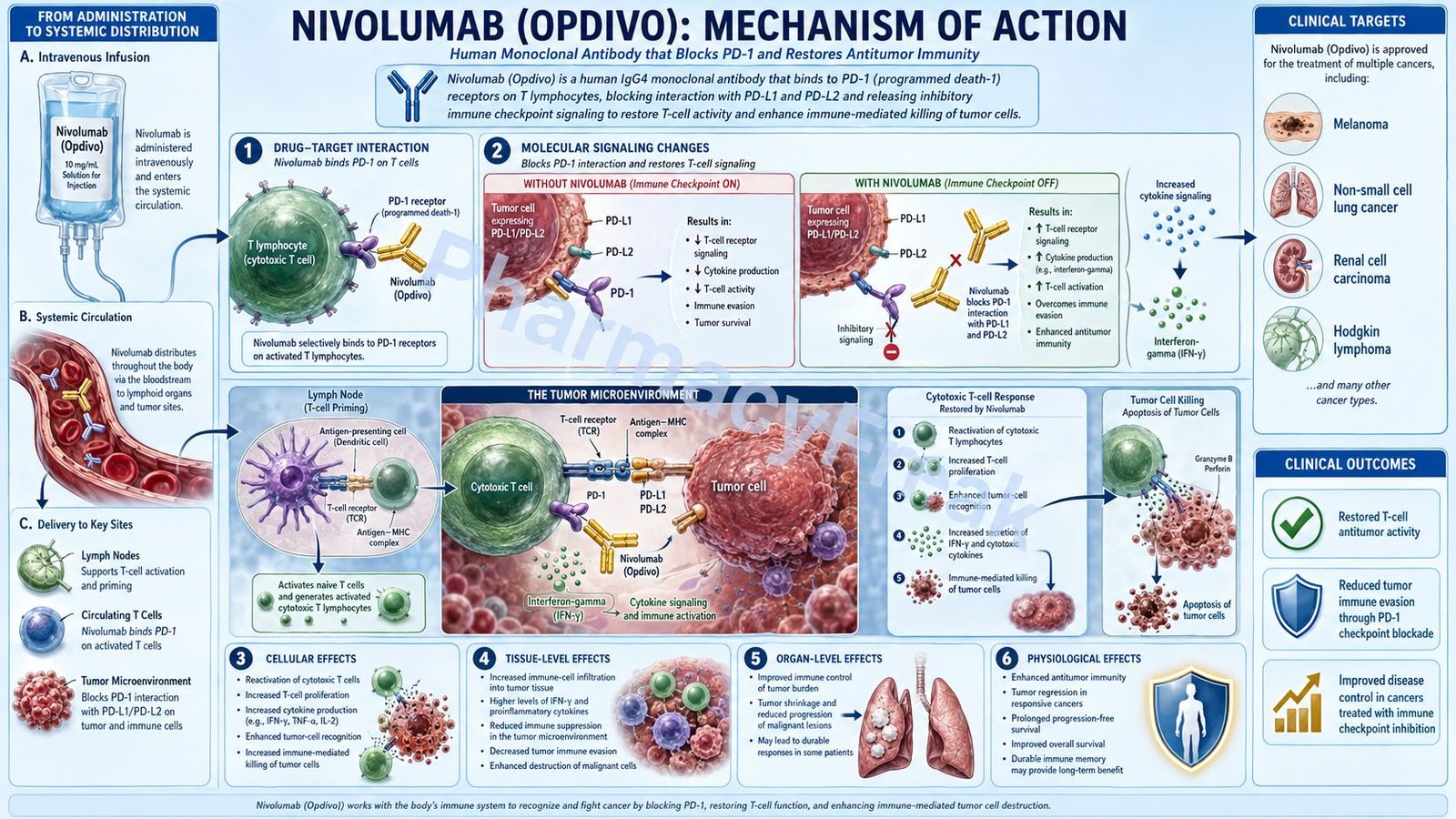
Cancer cells can escape immune destruction by activating inhibitory pathways that suppress T-cell function. One of the most important immune escape pathways is the PD-1/PD-L1 pathway. PD-1 is an inhibitory checkpoint receptor found on activated T cells. Its ligands, PD-L1 and PD-L2, may be expressed on tumor cells or immune cells in the tumor microenvironment.
When PD-L1 or PD-L2 binds PD-1 on T cells, T-cell proliferation and cytokine production decrease. This weakens active T-cell immune surveillance against tumors. The official Opdivo label states that nivolumab is a human IgG4 monoclonal antibody that binds the PD-1 receptor and blocks interaction with PD-L1 and PD-L2, thereby releasing PD-1 pathway-mediated inhibition of the immune response, including antitumor immune response.
Opdivo is used in many selected malignancies, including melanoma, non-small cell lung cancer, malignant pleural mesothelioma, renal cell carcinoma, classical Hodgkin lymphoma, squamous cell carcinoma of the head and neck, urothelial carcinoma, MSI-H/dMMR colorectal cancer, hepatocellular carcinoma, esophageal cancer, gastric cancer, gastroesophageal junction cancer, and esophageal adenocarcinoma, depending on stage, biomarker status, prior therapy, and combination regimen.
For exam purposes, nivolumab should be remembered as a PD-1 immune checkpoint inhibitor that blocks PD-1 interaction with PD-L1 and PD-L2, restores T-cell activity, increases antitumor immune response, and may produce immune-mediated adverse reactions.
Mechanism of Action (Step-wise)
Step 1: T cells normally detect and destroy abnormal cells
Cytotoxic T lymphocytes can recognize tumor-associated antigens presented through major histocompatibility complex molecules. Once activated, T cells can release cytokines and cytotoxic molecules that help destroy cancer cells.
Step 2: Immune checkpoints prevent excessive immune activation
Immune checkpoints are regulatory pathways that prevent uncontrolled immune responses and protect normal tissues from excessive inflammation. PD-1 is one such checkpoint receptor.
Step 3: PD-1 is expressed on activated T cells
Programmed death receptor-1, or PD-1, is present on T cells. When activated by its ligands, it sends inhibitory signals that reduce T-cell activity.
Step 4: PD-L1 and PD-L2 bind PD-1
PD-L1 and PD-L2 are ligands for PD-1. Binding of these ligands to PD-1 inhibits T-cell proliferation and cytokine production.
Step 5: Tumors can exploit the PD-1 pathway
Some tumors upregulate PD-1 ligands. This allows tumor cells or tumor-associated immune cells to suppress T-cell immune surveillance and escape immune destruction.
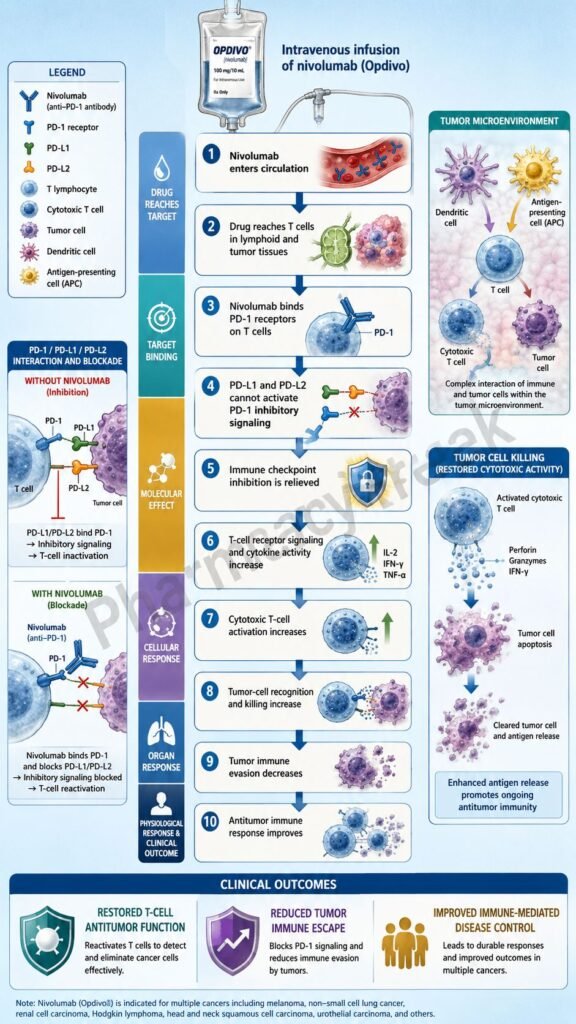
Step 6: Nivolumab binds PD-1 receptor
Nivolumab is a human IgG4 monoclonal antibody that binds the PD-1 receptor. This is the central molecular action of the drug.
Step 7: Nivolumab blocks PD-1 interaction with PD-L1 and PD-L2
After binding PD-1, nivolumab prevents PD-1 from interacting with PD-L1 and PD-L2. This interrupts the inhibitory checkpoint signal.
Step 8: PD-1 pathway-mediated inhibition is released
By blocking PD-1 ligand binding, nivolumab releases PD-1 pathway-mediated inhibition of immune response. This includes release of inhibition affecting antitumor immunity.
Step 9: T-cell proliferation and cytokine production may increase
Because PD-1 signaling normally suppresses T-cell proliferation and cytokine production, blocking this pathway can restore T-cell activity in the tumor microenvironment.
Step 10: Antitumor immune surveillance improves
Activated T cells can better recognize and attack tumor cells. This helps restore immune surveillance against cancers that rely on PD-1-mediated immune escape.
Step 11: Cytotoxic T-cell killing increases
Once T cells are reactivated, they can release cytotoxic granules, inflammatory cytokines, and other immune mediators that contribute to tumor-cell death.
Step 12: Tumor growth may decrease
In syngeneic mouse tumor models, blocking PD-1 activity resulted in decreased tumor growth.
Step 13: Combination with ipilimumab enhances T-cell activity differently
Ipilimumab blocks CTLA-4, another immune checkpoint. When nivolumab is combined with ipilimumab, PD-1 blockade and CTLA-4 blockade can enhance T-cell function through complementary immune checkpoint mechanisms.
Step 14: Immune activation can affect normal tissues
The same immune activation that improves antitumor response can also break peripheral tolerance and cause immune-mediated adverse reactions in normal organs and tissues.
Step 15: Final therapeutic outcome
The final therapeutic effect of nivolumab is restored antitumor T-cell activity through PD-1 blockade. This can reduce tumor growth and improve clinical outcomes in selected cancers, but it can also produce serious immune-mediated toxicity.
Pharmacokinetics
Nivolumab is administered by intravenous infusion. Opdivo is an injection for intravenous use and is commonly administered as a 30-minute infusion according to regimen and indication. The label includes dosing schedules such as 240 mg every 2 weeks, 480 mg every 4 weeks, and combination-specific dosing regimens with ipilimumab, chemotherapy, cabozantinib, or other agents depending on cancer type.
Nivolumab pharmacokinetics were assessed using a population pharmacokinetic approach for Opdivo as a single agent and in combination with ipilimumab. Nivolumab exposure increases dose proportionally over the 0.1 to 10 mg/kg dose range when administered every 2 weeks.
The predicted exposure after a 30-minute infusion is comparable to exposure after a 60-minute infusion. Steady-state concentrations were reached by approximately 12 weeks with 3 mg/kg every 2 weeks, and systemic accumulation was about 3.7-fold.
The geometric mean volume of distribution at steady state is approximately 6.8 L. This small distribution volume is consistent with monoclonal antibody distribution mainly within vascular and extracellular fluid compartments.
Nivolumab clearance decreases over time in patients with metastatic tumors, but this change is not considered clinically relevant. The geometric mean elimination half-life is approximately 25 days.
Age, weight, sex, race, baseline LDH, PD-L1 expression, solid tumor type, tumor size, renal impairment down to eGFR 15 mL/min/1.73 m², and mild or moderate hepatic impairment had no clinically important effect on nivolumab clearance. Nivolumab has not been studied in severe hepatic impairment.
Because nivolumab is a monoclonal antibody, it is not metabolized like small-molecule drugs through CYP450 pathways. Its elimination is expected to occur mainly through protein catabolism into peptides and amino acids.
Clinical Uses
Nivolumab is used in selected cancers where immune checkpoint blockade can restore antitumor immunity. It may be used as monotherapy or in combination with other therapies depending on cancer type, stage, biomarker status, prior treatment, and clinical setting.
Opdivo has labeled uses in melanoma, including unresectable or metastatic melanoma and adjuvant treatment of completely resected melanoma in selected adult and pediatric patients. It is also used in non-small cell lung cancer in neoadjuvant, adjuvant, metastatic, and previously treated settings depending on tumor features and combination regimen.
Opdivo is used in renal cell carcinoma as first-line therapy in combination with ipilimumab for intermediate or poor risk advanced RCC, in combination with cabozantinib for first-line advanced RCC, and as a single agent after prior anti-angiogenic therapy.
Opdivo is used in classical Hodgkin lymphoma, squamous cell carcinoma of the head and neck, urothelial carcinoma, MSI-H/dMMR colorectal cancer, hepatocellular carcinoma, esophageal cancer, and gastric/GEJ/esophageal adenocarcinoma settings according to specific label criteria.
Nivolumab is not conventional chemotherapy. It does not directly alkylate DNA, inhibit microtubules, block topoisomerase, or inhibit tyrosine kinases. It works by immune checkpoint blockade.
Nivolumab is not a targeted mutation inhibitor like osimertinib, dabrafenib, imatinib, or sotorasib. It targets an immune checkpoint receptor on T cells rather than a tumor-specific mutant kinase.
Nivolumab is not a cancer vaccine and not CAR-T therapy. It does not introduce a tumor antigen and does not genetically engineer T cells. Instead, it removes inhibitory PD-1 signaling from T cells.
Adverse Effects
The most important adverse effects of nivolumab are immune-mediated adverse reactions. Opdivo can remove immune inhibition and potentially break peripheral tolerance, causing the immune system to attack normal organs and tissues. These reactions may be severe or fatal and may occur in any organ system or tissue, during treatment or even after discontinuation.
Important immune-mediated toxicities include pneumonitis, colitis, hepatitis, endocrinopathies, nephritis with renal dysfunction, dermatologic reactions, myocarditis, neurologic toxicities, ocular inflammation, hematologic immune reactions, and transplant rejection. The label recommends monitoring symptoms and signs, and evaluating liver enzymes, creatinine, and thyroid function at baseline and periodically during treatment.
Immune-mediated pneumonitis can occur and may be more frequent in patients who previously received thoracic radiation. Symptoms may include cough, dyspnea, chest discomfort, and hypoxia.
Immune-mediated colitis can occur and may present with diarrhea, abdominal pain, blood or mucus in stool, or bowel perforation risk. Cytomegalovirus infection or reactivation has been reported in corticosteroid-refractory immune-mediated colitis.
Immune-mediated hepatitis, nephritis, rash, adrenal insufficiency, hypophysitis, and thyroid disorders can occur. Thyroid dysfunction may include thyroiditis, hyperthyroidism, and hypothyroidism.
Management may require withholding or permanently discontinuing Opdivo depending on severity. In general, when interruption or discontinuation is required, systemic corticosteroid therapy such as prednisone 1 to 2 mg/kg/day or equivalent may be used until improvement, followed by a taper over at least one month.
Infusion-related reactions can occur. Severe infusion reactions have been reported in less than 1% of patients in clinical trials. Severe or life-threatening reactions require discontinuation, while mild or moderate reactions may require interruption or slowing of the infusion.
Fatal and serious complications can occur in patients who receive allogeneic hematopoietic stem cell transplantation before or after PD-1 receptor blockade. These include hyperacute, acute, or chronic graft-versus-host disease and hepatic veno-occlusive disease.
Opdivo can cause fetal harm based on its mechanism and animal data. Females of reproductive potential should use effective contraception during treatment and for 5 months after the last dose.
The label also warns that adding a PD-1 blocking antibody, including Opdivo, to a thalidomide analogue plus dexamethasone in multiple myeloma increased mortality; such treatment is not recommended outside controlled clinical trials.
Comparative Analysis
Nivolumab is commonly compared with pembrolizumab, cemiplimab, dostarlimab, atezolizumab, durvalumab, avelumab, ipilimumab, targeted kinase inhibitors, chemotherapy, and CAR-T therapy.
Compared with pembrolizumab, nivolumab belongs to the same broad PD-1 inhibitor class. Both block PD-1 signaling and restore antitumor T-cell activity, but they differ in labeled indications, dosing schedules, clinical-trial data, and combination regimens.
Compared with cemiplimab and dostarlimab, nivolumab also targets PD-1. Cemiplimab is commonly associated with cutaneous squamous cell carcinoma and other selected cancers, while dostarlimab is strongly associated with dMMR/MSI-H tumor settings. Each product has its own label and clinical uses.
Compared with atezolizumab, durvalumab, and avelumab, nivolumab blocks PD-1, while those drugs block PD-L1. PD-1 inhibitors prevent PD-1 from binding both PD-L1 and PD-L2, whereas PD-L1 inhibitors block the PD-L1 ligand.
Compared with ipilimumab, nivolumab targets a different checkpoint. Ipilimumab blocks CTLA-4, which primarily regulates early T-cell activation, while nivolumab blocks PD-1, which is important in peripheral tissues and tumor microenvironments.
Compared with chemotherapy, nivolumab does not directly kill rapidly dividing cells. Chemotherapy often acts through DNA damage, microtubule inhibition, or antimetabolite effects, while nivolumab enhances immune-mediated tumor killing.
Compared with targeted therapy, nivolumab is less dependent on one tumor driver mutation. Targeted drugs such as EGFR, BRAF, ALK, or MET inhibitors directly block oncogenic signaling proteins. Nivolumab targets the immune checkpoint PD-1 on T cells.
Compared with CAR-T therapy, nivolumab is not a cell-based treatment. CAR-T therapy engineers T cells to recognize tumor antigens, while nivolumab releases inhibitory signaling from existing T cells.
MCQs
- Nivolumab is marketed under which brand name?
a) Opdivo
b) Keytruda
c) Tecentriq
d) Yervoy
Answer: a) Opdivo
- Nivolumab belongs to which pharmacological class?
a) PD-1 blocking antibody
b) PD-L1 blocking antibody
c) CTLA-4 blocking antibody
d) EGFR tyrosine kinase inhibitor
Answer: a) PD-1 blocking antibody
- PD-1 is mainly found on:
a) T cells
b) Red blood cells only
c) Platelets only
d) Gastric parietal cells
Answer: a) T cells
- The ligands for PD-1 are:
a) PD-L1 and PD-L2
b) CD20 and CD38
c) HER2 and EGFR
d) VEGF and FGF
Answer: a) PD-L1 and PD-L2
- Binding of PD-L1 or PD-L2 to PD-1 normally causes:
a) Inhibition of T-cell proliferation and cytokine production
b) Direct tumor DNA crosslinking
c) Bacterial ribosome blockade
d) Platelet aggregation inhibition
Answer: a) Inhibition of T-cell proliferation and cytokine production
- Nivolumab blocks:
a) PD-1 interaction with PD-L1 and PD-L2
b) CTLA-4 binding to CD80 only
c) HER2 dimerization only
d) BCR-ABL kinase only
Answer: a) PD-1 interaction with PD-L1 and PD-L2
- The main therapeutic result of nivolumab is:
a) Restoration of antitumor immune response
b) Direct inhibition of DNA polymerase
c) Direct thrombin inhibition
d) Proton pump inhibition
Answer: a) Restoration of antitumor immune response
- Nivolumab is a:
a) Human IgG4 monoclonal antibody
b) Small-molecule kinase inhibitor
c) Alkylating chemotherapy drug
d) Platinum compound
Answer: a) Human IgG4 monoclonal antibody
- Opdivo is administered by:
a) Intravenous infusion
b) Oral tablet
c) Subcutaneous daily injection only
d) Inhalation
Answer: a) Intravenous infusion
- The approximate elimination half-life of nivolumab is:
a) 25 days
b) 30 minutes
c) 3 hours
d) 2 days
Answer: a) 25 days
- Which immune-mediated adverse reaction can occur with nivolumab?
a) Pneumonitis
b) Severe hypoglycemia in every patient
c) Ototoxicity only
d) Permanent alopecia only
Answer: a) Pneumonitis
- Which laboratory monitoring is important during nivolumab therapy?
a) Liver enzymes, creatinine, and thyroid function
b) Only serum calcium every hour
c) Only blood glucose every 5 minutes
d) Only hemoglobin A1c once yearly
Answer: a) Liver enzymes, creatinine, and thyroid function
- Severe infusion-related reactions to Opdivo require:
a) Discontinuation of Opdivo
b) Increasing infusion rate
c) Giving extra chemotherapy immediately
d) Starting warfarin
Answer: a) Discontinuation of Opdivo
- Which drug blocks CTLA-4 and is commonly combined with nivolumab in some cancers?
a) Ipilimumab
b) Osimertinib
c) Trastuzumab
d) Rituximab
Answer: a) Ipilimumab
- Which statement best describes nivolumab?
a) It blocks PD-1, prevents PD-L1/PD-L2 interaction, and restores T-cell antitumor activity
b) It inhibits EGFR kinase inside tumor cells
c) It binds potassium in the intestine
d) It directly dissolves fibrin clots
Answer: a) It blocks PD-1, prevents PD-L1/PD-L2 interaction, and restores T-cell antitumor activity
FAQs
What is the mechanism of action of nivolumab?
Nivolumab binds PD-1 on T cells and blocks its interaction with PD-L1 and PD-L2. This releases PD-1-mediated inhibition of immune response and restores antitumor T-cell activity.
What is the brand name of nivolumab?
The brand name of nivolumab is Opdivo.
What type of drug is nivolumab?
Nivolumab is a human IgG4 monoclonal antibody and immune checkpoint inhibitor.
Is nivolumab chemotherapy?
No. Nivolumab is not conventional chemotherapy. It does not directly damage DNA or inhibit cell division. It works by helping the immune system recognize and attack tumor cells.
What cancers is nivolumab used for?
Nivolumab is used in selected cases of melanoma, NSCLC, mesothelioma, RCC, classical Hodgkin lymphoma, head and neck cancer, urothelial carcinoma, MSI-H/dMMR colorectal cancer, hepatocellular carcinoma, esophageal cancer, gastric cancer, GEJ cancer, and esophageal adenocarcinoma, depending on specific label criteria.
Why does nivolumab cause immune-mediated adverse effects?
Nivolumab removes PD-1-mediated immune inhibition. This can improve antitumor immunity, but it can also allow immune cells to attack normal tissues, causing pneumonitis, colitis, hepatitis, endocrinopathies, nephritis, rash, myocarditis, and other immune toxicities.
Is nivolumab the same as pembrolizumab?
No. Both are PD-1 inhibitors, but they are different monoclonal antibodies with different labels, dosing schedules, clinical-trial data, and approved uses.
How is nivolumab different from ipilimumab?
Nivolumab blocks PD-1, while ipilimumab blocks CTLA-4. Both are immune checkpoint inhibitors, but they target different inhibitory pathways.
References
Goodman & Gilman’s The Pharmacological Basis of Therapeutics
Katzung Basic & Clinical Pharmacology