Table of Contents
Introduction
Trintellix is the brand name of vortioxetine, an oral antidepressant used for the treatment of major depressive disorder in adults. It is commonly described as a multimodal serotonergic antidepressant because it affects serotonin reuptake and multiple serotonin receptor subtypes. Current prescribing information lists Trintellix as indicated for major depressive disorder in adults.
Trintellix is important in pharmacology because it is different from classical selective serotonin reuptake inhibitors. While SSRIs mainly inhibit the serotonin transporter, vortioxetine inhibits serotonin reuptake and also modulates several 5-HT receptors. This makes its pharmacological profile broader than a simple serotonin transporter blocker.
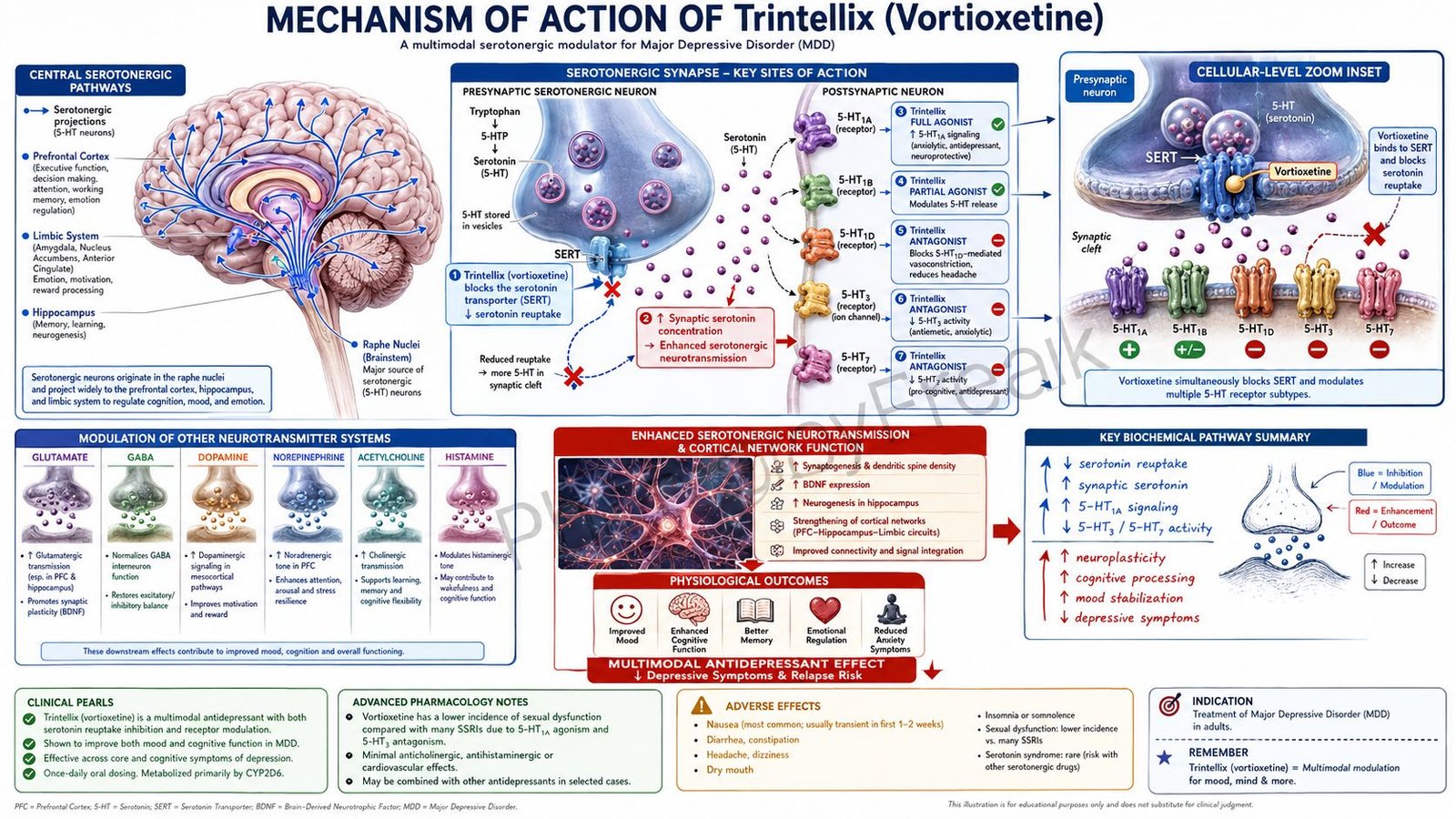
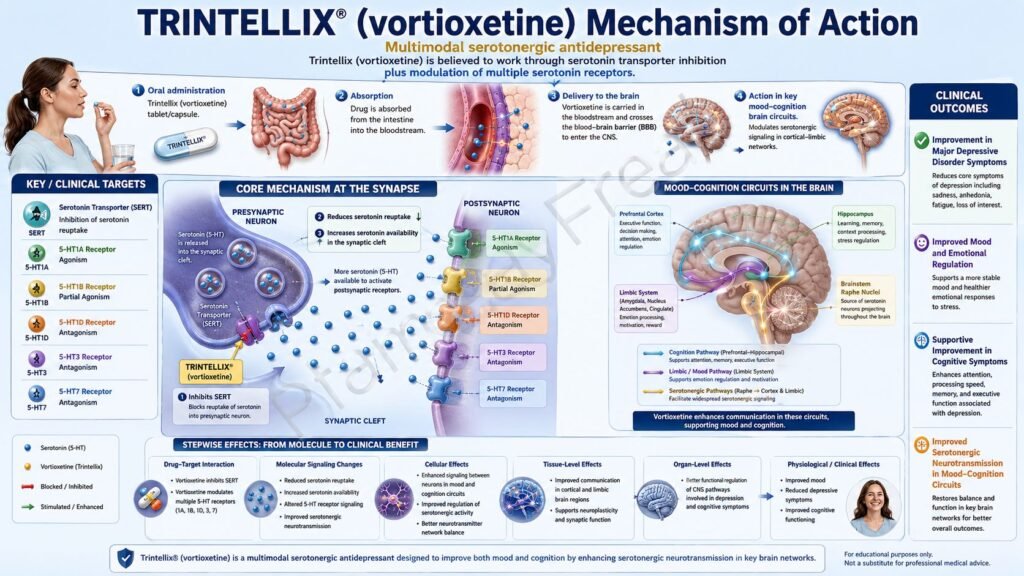
For pharmacy, medical, nursing, and competitive exam students, Trintellix is important because its mechanism includes serotonin transporter inhibition, 5-HT1A receptor agonism, 5-HT1B receptor partial agonism, and antagonism at 5-HT3, 5-HT7, and 5-HT1D receptors. These combined actions enhance serotonergic neurotransmission and may influence mood, cognition, anxiety symptoms, and emotional regulation.
Trintellix is not a benzodiazepine, antipsychotic, stimulant, or monoamine oxidase inhibitor. It is an antidepressant used for long-term treatment of major depressive disorder and should not be considered an immediate mood-elevating drug.
Mechanism of Action (Step-wise)
- Primary target: Serotonin transporter inhibition
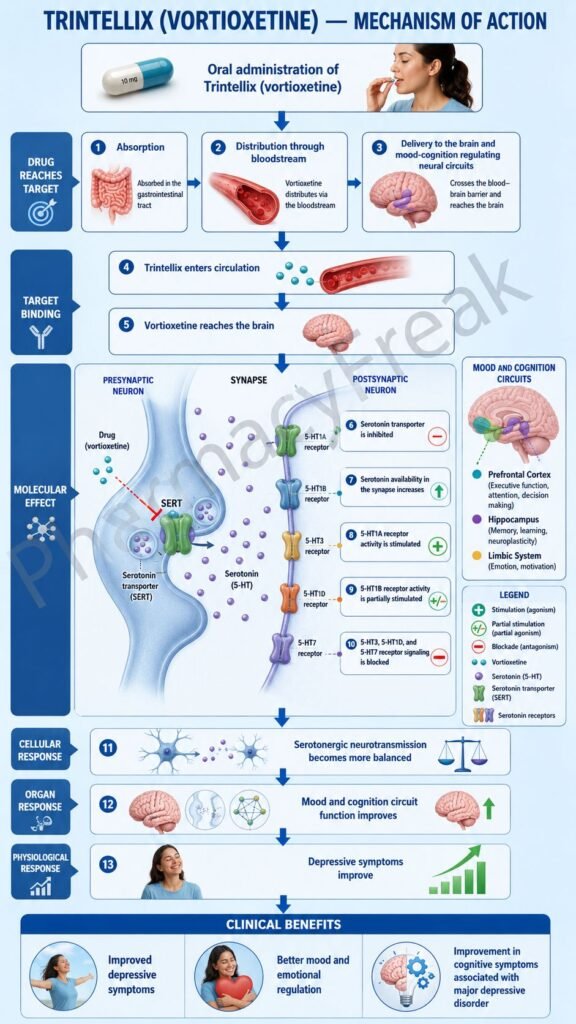
Trintellix contains vortioxetine, which inhibits the serotonin transporter, also known as SERT. SERT is responsible for reuptake of serotonin from the synaptic cleft back into the presynaptic neuron.
By inhibiting SERT, vortioxetine increases serotonin availability in the synaptic cleft. The official label states that vortioxetine’s antidepressant effect is not fully understood but is thought to be related to enhancement of serotonergic activity in the CNS through inhibition of serotonin reuptake.
- Increased synaptic serotonin
When serotonin reuptake is inhibited, serotonin remains available for a longer time at postsynaptic receptors. This enhances serotonergic signaling in brain regions involved in mood regulation, emotional processing, sleep, appetite, cognition, and anxiety control.
- 5-HT1A receptor agonism
Vortioxetine acts as an agonist at 5-HT1A receptors. 5-HT1A receptors are involved in mood regulation, anxiety modulation, and serotonergic feedback control.
Activation of 5-HT1A receptors may contribute to antidepressant and anxiolytic effects. It may also influence downstream neurotransmitter systems involved in emotional regulation.
- 5-HT1B receptor partial agonism
Trintellix acts as a partial agonist at 5-HT1B receptors. Partial agonism means that vortioxetine can activate the receptor but produces a less than maximal response compared with the natural neurotransmitter serotonin.
This partial modulation may help regulate serotonergic neurotransmission without producing excessive receptor stimulation.
- 5-HT3 receptor antagonism
Vortioxetine antagonizes 5-HT3 receptors. 5-HT3 receptors are ligand-gated ion channels involved in nausea, vomiting, gastrointestinal signaling, and central neurotransmitter modulation.
Blocking 5-HT3 receptors may influence release of other neurotransmitters such as acetylcholine, dopamine, norepinephrine, histamine, and GABA in certain brain circuits. This may be relevant to cognition and mood, although the exact clinical contribution is not fully established.
- 5-HT7 and 5-HT1D receptor antagonism
Trintellix also acts as an antagonist at 5-HT7 and 5-HT1D receptors. These receptors are involved in serotonin-mediated effects on mood, circadian rhythm, cognition, and neuronal signaling.
The official label reports that vortioxetine binds to 5-HT3, 5-HT1A, 5-HT7, 5-HT1D, and 5-HT1B receptors and acts as a 5-HT3, 5-HT1D, and 5-HT7 antagonist, a 5-HT1B partial agonist, and a 5-HT1A agonist.
- Downstream neurotransmitter modulation
Through serotonin transporter inhibition and serotonin receptor modulation, Trintellix may indirectly affect other neurotransmitter systems, including dopamine, norepinephrine, acetylcholine, histamine, glutamate, and GABA. These downstream effects may be relevant to mood, cognition, motivation, and emotional processing.
- Final therapeutic effect
The final therapeutic effect of Trintellix is improvement in depressive symptoms in adults with major depressive disorder. These effects are thought to result from enhanced serotonergic activity and multimodal serotonin receptor modulation, but the exact contribution of each receptor action to the antidepressant effect has not been fully established.
Pharmacokinetics
Trintellix is administered orally as an immediate-release tablet. It is usually taken once daily, with or without food.
Absorption:
Vortioxetine is absorbed after oral administration. Peak plasma concentration is reached approximately 7 to 11 hours after dosing, and absolute bioavailability is about 75%. Food does not have a significant effect on vortioxetine pharmacokinetics.
Distribution:
Vortioxetine has extensive tissue distribution. Its apparent volume of distribution is approximately 2600 L, and plasma protein binding is about 98%.
Metabolism:
Vortioxetine is extensively metabolized in the liver. CYP2D6 is the primary enzyme involved in metabolism to its major pharmacologically inactive carboxylic acid metabolite. Other enzymes, including CYP3A4/5, CYP2C19, CYP2C9, CYP2A6, CYP2C8, and CYP2B6, also contribute. Poor CYP2D6 metabolizers may have higher vortioxetine exposure.
Excretion:
After oral administration of radiolabeled vortioxetine, approximately 59% of radioactivity is recovered in urine and about 26% in feces, mainly as metabolites. Negligible unchanged vortioxetine is excreted in urine.
Half-life and duration:
The mean terminal half-life of vortioxetine is approximately 66 hours. Steady-state plasma concentration is usually achieved within about two weeks of once-daily dosing.
Special pharmacokinetic point:
The maximum recommended dose is lower in known CYP2D6 poor metabolizers. Strong CYP2D6 inhibitors may increase vortioxetine exposure, while strong CYP inducers may reduce its exposure.
Clinical Uses
- Major depressive disorder:
Trintellix is used for the treatment of major depressive disorder in adults. - Depressive symptoms involving mood and cognition:
Because vortioxetine modulates serotonergic signaling and may affect downstream neurotransmitter systems, it is clinically relevant in depression associated with low mood, reduced interest, poor concentration, and cognitive complaints. - Long-term antidepressant therapy:
Trintellix may be used as ongoing therapy to reduce depressive symptoms and help maintain improvement in suitable patients. - Alternative to conventional SSRIs or SNRIs:
Trintellix may be considered when a multimodal serotonergic antidepressant is clinically appropriate. - Patients where once-daily oral dosing is preferred:
Its once-daily administration improves convenience and supports adherence in long-term therapy.
Trintellix is not approved for pediatric use and is not indicated for acute emergency treatment of suicidal ideation or severe agitation.
Adverse Effects
Common adverse effects of Trintellix include:
- Nausea
- Vomiting
- Constipation
- Diarrhea
- Dry mouth
- Dizziness
- Headache
- Abnormal dreams
- Sexual dysfunction
- Dyspepsia
- Sweating
- Fatigue
The most common adverse reactions reported in labeling include nausea, constipation, and vomiting.
Important serious or clinically significant adverse effects include:
- Suicidal thoughts and behaviors in pediatric and young adult patients
- Serotonin syndrome
- Increased bleeding risk
- Activation of mania or hypomania
- Discontinuation symptoms
- Angle-closure glaucoma
- Hyponatremia or SIADH
- Hypersensitivity reactions
- Seizures, rarely reported postmarketing
- Sexual dysfunction
Trintellix carries a boxed warning for suicidal thoughts and behaviors in pediatric and young adult patients taking antidepressants. It is not approved for pediatric patients.
Serotonin syndrome is an important exam point. The risk increases when Trintellix is used with other serotonergic drugs such as SSRIs, SNRIs, triptans, tramadol, fentanyl, lithium, buspirone, St. John’s wort, linezolid, methylene blue, or MAO inhibitors.
Trintellix is contraindicated with monoamine oxidase inhibitors because of the risk of serotonin syndrome. It should also be used cautiously with anticoagulants, antiplatelet drugs, and NSAIDs because serotonergic antidepressants may increase bleeding risk.
Comparative Analysis
| Feature | Trintellix | Fluoxetine | Venlafaxine | Bupropion |
|---|---|---|---|---|
| Generic name | Vortioxetine | Fluoxetine | Venlafaxine | Bupropion |
| Drug class | Multimodal serotonergic antidepressant | SSRI | SNRI | Norepinephrine-dopamine reuptake inhibitor |
| Main target | SERT and multiple 5-HT receptors | Serotonin transporter | Serotonin and norepinephrine transporters | Norepinephrine and dopamine transporters |
| Main action | Inhibits serotonin reuptake and modulates 5-HT receptors | Inhibits serotonin reuptake | Inhibits serotonin and norepinephrine reuptake | Inhibits norepinephrine and dopamine reuptake |
| Receptor activity | 5-HT1A agonist, 5-HT1B partial agonist, 5-HT3/5-HT7/5-HT1D antagonist | Minimal direct receptor modulation | Minimal direct receptor modulation | Nicotinic receptor antagonism also relevant |
| Main use | Major depressive disorder | Depression, OCD, panic disorder, others | Depression, anxiety disorders, others | Depression, smoking cessation, ADHD off-label in some cases |
| Common adverse effects | Nausea, constipation, vomiting | GI upset, sexual dysfunction, insomnia | Nausea, hypertension, sweating | Insomnia, dry mouth, seizure risk |
| Serotonin syndrome risk | Yes | Yes | Yes | Lower than serotonergic antidepressants |
Trintellix differs from fluoxetine because it is not only a serotonin reuptake inhibitor; it also modulates several serotonin receptors. It differs from venlafaxine because venlafaxine increases both serotonin and norepinephrine through reuptake inhibition, while vortioxetine mainly enhances serotonergic activity through SERT inhibition and receptor modulation. Bupropion is different because it primarily affects norepinephrine and dopamine and has minimal direct serotonergic activity.
MCQs
- Trintellix contains which active drug?
a) Fluoxetine
b) Vortioxetine
c) Venlafaxine
d) Duloxetine
Answer: b) Vortioxetine
- Trintellix is mainly used for:
a) Major depressive disorder
b) Hypertension
c) Acute bacterial infection
d) Type 1 diabetes mellitus
Answer: a) Major depressive disorder
- The primary transporter inhibited by vortioxetine is:
a) Dopamine transporter
b) Serotonin transporter
c) GABA transporter
d) Choline transporter
Answer: b) Serotonin transporter
- Trintellix increases synaptic levels of:
a) Serotonin
b) Insulin
c) Histamine only
d) Acetylcholine only
Answer: a) Serotonin
- Vortioxetine acts as an agonist at which receptor?
a) 5-HT1A receptor
b) D2 receptor
c) Beta-1 receptor
d) NMDA receptor
Answer: a) 5-HT1A receptor
- Vortioxetine acts as a partial agonist at:
a) 5-HT1B receptor
b) Muscarinic M3 receptor
c) Alpha-1 receptor
d) Histamine H1 receptor
Answer: a) 5-HT1B receptor
- Which receptor is antagonized by vortioxetine?
a) 5-HT3 receptor
b) Insulin receptor
c) GABA-A receptor
d) Beta-2 receptor
Answer: a) 5-HT3 receptor
- Which of the following is a common adverse effect of Trintellix?
a) Nausea
b) Ototoxicity
c) Severe hypoglycemia
d) Gingival hyperplasia
Answer: a) Nausea
- Trintellix is contraindicated with:
a) Monoamine oxidase inhibitors
b) Vitamin C
c) Oral rehydration solution
d) Calcium carbonate only
Answer: a) Monoamine oxidase inhibitors
- Which enzyme is primarily involved in vortioxetine metabolism?
a) CYP2D6
b) Acetylcholinesterase
c) MAO-B only
d) Xanthine oxidase only
Answer: a) CYP2D6
- The approximate terminal half-life of vortioxetine is:
a) 4 hours
b) 12 hours
c) 66 hours
d) 7 days
Answer: c) 66 hours
- Which serious reaction may occur when Trintellix is combined with other serotonergic drugs?
a) Serotonin syndrome
b) Severe ototoxicity
c) Acute gout
d) Hypocalcemia
Answer: a) Serotonin syndrome
- Trintellix differs from a classical SSRI because it:
a) Also modulates multiple serotonin receptor subtypes
b) Has no serotonergic action
c) Directly blocks bacterial ribosomes
d) Acts only as a dopamine agonist
Answer: a) Also modulates multiple serotonin receptor subtypes
- Which serotonin receptors are antagonized by vortioxetine?
a) 5-HT3, 5-HT7, and 5-HT1D
b) 5-HT1A only
c) 5-HT2A only
d) 5-HT4 only
Answer: a) 5-HT3, 5-HT7, and 5-HT1D
- Which statement about Trintellix is correct?
a) It is a multimodal serotonergic antidepressant
b) It is an insulin analog
c) It is a benzodiazepine sedative
d) It is a beta-lactam antibiotic
Answer: a) It is a multimodal serotonergic antidepressant
FAQs
- What is Trintellix used for?
Trintellix is used for the treatment of major depressive disorder in adults.
- What is the mechanism of action of Trintellix?
Trintellix inhibits serotonin reuptake through the serotonin transporter and modulates several serotonin receptors. It acts as a 5-HT1A agonist, 5-HT1B partial agonist, and antagonist at 5-HT3, 5-HT7, and 5-HT1D receptors.
- Is Trintellix an SSRI?
Trintellix inhibits serotonin reuptake like SSRIs, but it is not considered a simple SSRI because it also directly modulates multiple serotonin receptor subtypes.
- Why is Trintellix called a multimodal antidepressant?
It is called multimodal because it works through more than one serotonergic mechanism: serotonin transporter inhibition and serotonin receptor modulation.
- Does Trintellix increase serotonin?
Yes. Trintellix increases serotonergic activity mainly by inhibiting serotonin reuptake. This increases serotonin availability in the synaptic cleft.
- What are common side effects of Trintellix?
Common side effects include nausea, constipation, vomiting, diarrhea, dry mouth, dizziness, headache, and sexual dysfunction.
- Can Trintellix cause serotonin syndrome?
Yes. Trintellix can cause serotonin syndrome, especially when combined with other serotonergic medicines such as SSRIs, SNRIs, MAO inhibitors, triptans, tramadol, fentanyl, lithium, or St. John’s wort.
- Which enzyme metabolizes Trintellix?
Vortioxetine is mainly metabolized by CYP2D6, with contributions from other CYP enzymes. CYP2D6 poor metabolizers may have higher drug exposure.
- Is Trintellix approved for children?
No. Trintellix is not approved for pediatric patients.
References
Goodman & Gilman’s The Pharmacological Basis of Therapeutics
Katzung Basic & Clinical Pharmacology