Table of Contents
Introduction
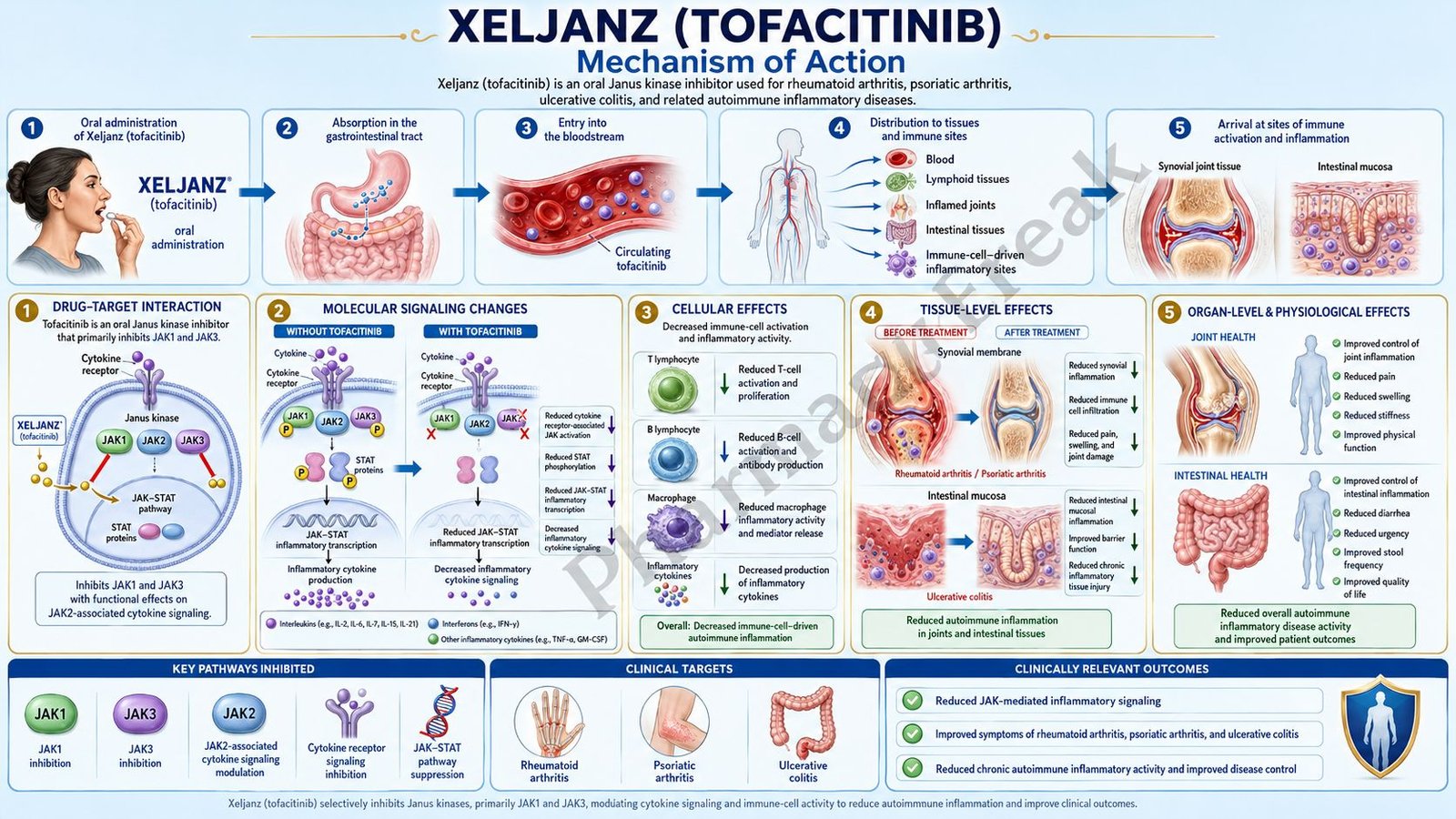
Xeljanz is the brand name of tofacitinib, an oral immunomodulatory drug. Pharmacologically, tofacitinib is a Janus kinase inhibitor, commonly called a JAK inhibitor.
Inflammatory autoimmune diseases such as rheumatoid arthritis, psoriatic arthritis, ankylosing spondylitis, polyarticular course juvenile idiopathic arthritis, and ulcerative colitis are driven by abnormal immune-cell activation and cytokine signaling. Cytokines are chemical messengers that allow immune cells to communicate, activate inflammation, recruit other immune cells, and maintain chronic tissue damage.
Many cytokines signal through the JAK-STAT pathway. In this pathway, cytokines bind to receptors on immune cells. This activates Janus kinase enzymes inside the cell. Activated JAKs phosphorylate STAT proteins, which then move toward the nucleus and regulate gene expression involved in inflammation, immune-cell survival, and immune-cell activation.
Tofacitinib works by inhibiting Janus kinases. The official Xeljanz label states that tofacitinib is a JAK inhibitor and that JAKs transmit signals from cytokine or growth-factor receptor interactions to influence hematopoiesis and immune-cell function. Tofacitinib modulates signaling at the level of JAKs and prevents phosphorylation and activation of STATs.
Xeljanz tablets and Xeljanz XR are indicated for adults with moderately to severely active rheumatoid arthritis, active psoriatic arthritis, active ankylosing spondylitis, and moderately to severely active ulcerative colitis after inadequate response or intolerance to one or more TNF blockers. Xeljanz tablets and oral solution are also indicated for pediatric patients 2 years of age and older with active psoriatic arthritis or active polyarticular course juvenile idiopathic arthritis after inadequate response or intolerance to one or more TNF blockers.
For exam purposes, Xeljanz should be remembered as an oral JAK inhibitor that blocks JAK-mediated STAT activation, reduces cytokine-driven immune signaling, and decreases inflammation in selected autoimmune diseases.
Mechanism of Action (Step-wise)
Step 1: Cytokines drive autoimmune inflammation
Autoimmune diseases involve abnormal activation of immune cells. Cytokines such as interleukins, interferons, and other inflammatory mediators stimulate T cells, B cells, macrophages, dendritic cells, synovial cells, intestinal immune cells, and epithelial cells.
Step 2: Cytokines bind cell-surface receptors
Many cytokines act by binding to specific receptors on immune and inflammatory cells. These receptors do not always have their own intrinsic kinase activity, so they depend on intracellular kinases such as JAK enzymes.
Step 3: JAK enzymes are activated
Janus kinases are intracellular enzymes attached to cytokine receptors. Important JAK family members include JAK1, JAK2, JAK3, and TYK2. When cytokines bind their receptors, paired JAK enzymes become activated.
Step 4: JAKs phosphorylate STAT proteins
Activated JAKs phosphorylate Signal Transducers and Activators of Transcription, called STAT proteins. STAT activation is a key step in converting an extracellular cytokine signal into a gene-expression response.
Step 5: STAT proteins regulate inflammatory genes
Activated STAT proteins move into the nucleus and regulate transcription of genes involved in immune-cell activation, cytokine production, lymphocyte proliferation, inflammation, and tissue damage.
Step 6: Chronic JAK-STAT signaling maintains inflammation
In diseases such as rheumatoid arthritis, psoriatic arthritis, ankylosing spondylitis, ulcerative colitis, and juvenile idiopathic arthritis, persistent cytokine signaling helps maintain chronic inflammation.
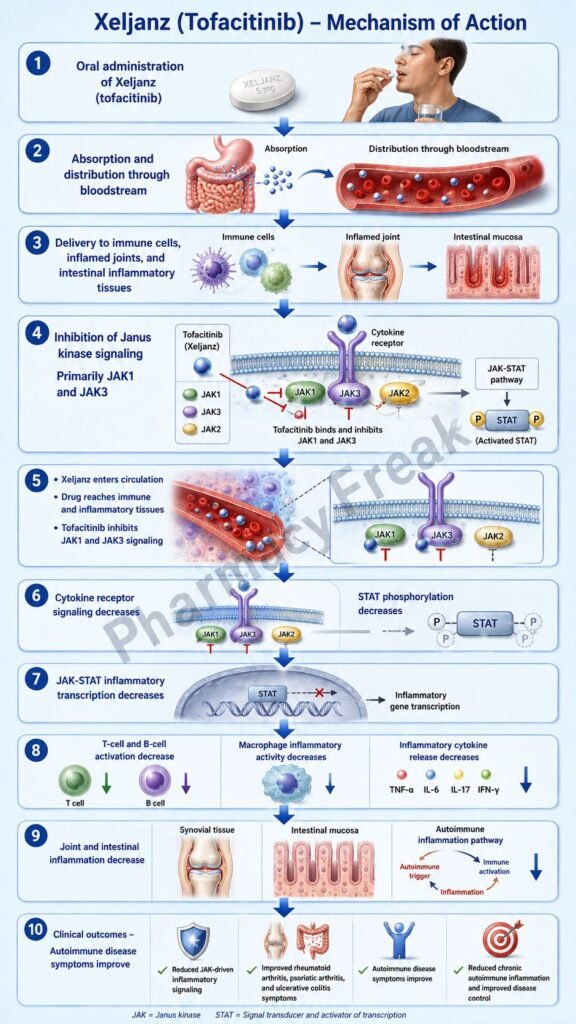
Step 7: Tofacitinib inhibits JAK enzymes
Tofacitinib inhibits JAK signaling. The label notes that JAK enzymes transmit cytokine signaling through combinations such as JAK1/JAK3, JAK1/JAK2, JAK1/TYK2, and JAK2/JAK2. Tofacitinib inhibited in vitro activities of JAK1/JAK2, JAK1/JAK3, and JAK2/JAK2 combinations, although the relevance of specific JAK combinations to therapeutic effectiveness is not fully known.
Step 8: STAT phosphorylation decreases
By inhibiting JAK enzymes, tofacitinib prevents phosphorylation and activation of STAT proteins. This reduces downstream transcription of inflammatory genes.
Step 9: Cytokine-mediated immune activation decreases
Reduced JAK-STAT signaling decreases responses to multiple cytokines involved in immune-cell activation. This leads to reduced inflammatory communication between immune cells.
Step 10: T-cell and B-cell activity is modified
Tofacitinib affects immune-cell function. The label reports dose-dependent reductions in circulating CD16/56-positive natural killer cells and dose-dependent increases in B-cell counts, while changes in T-cell counts and T-cell subsets were small and inconsistent. The clinical significance of these changes is unknown.
Step 11: Inflammatory biomarkers decrease
In rheumatoid arthritis, treatment with Xeljanz was associated with rapid decreases in serum C-reactive protein, or CRP. Similar changes in T cells, B cells, and serum CRP were observed in patients with active psoriatic arthritis.
Step 12: Synovial inflammation decreases
In rheumatoid arthritis and psoriatic arthritis, reduced cytokine signaling decreases inflammatory activity in the synovium. This can reduce joint pain, swelling, morning stiffness, and inflammatory joint damage.
Step 13: Enthesis and axial inflammation may decrease
In ankylosing spondylitis and psoriatic arthritis, cytokine-driven inflammation affects entheses, spine, sacroiliac joints, and peripheral joints. JAK inhibition reduces inflammatory signaling involved in these processes.
Step 14: Intestinal inflammation decreases
In ulcerative colitis, abnormal immune activation in the colonic mucosa drives chronic inflammation. Tofacitinib reduces cytokine-mediated immune signaling and helps reduce inflammatory activity in the colon.
Step 15: Final therapeutic outcome
The final therapeutic effect of Xeljanz is reduction of JAK-STAT-mediated inflammatory signaling. This helps improve disease activity in approved immune-mediated diseases but does not cure the underlying autoimmune condition.
Pharmacokinetics
Xeljanz is administered orally as immediate-release tablets, extended-release tablets, or oral solution. Available dosage forms include Xeljanz tablets 5 mg and 10 mg, Xeljanz XR extended-release tablets 11 mg and 22 mg, and Xeljanz oral solution 1 mg/mL.
For adult rheumatoid arthritis, psoriatic arthritis, and ankylosing spondylitis, the recommended dosage is Xeljanz 5 mg twice daily or Xeljanz XR 11 mg once daily. Xeljanz 10 mg twice daily or Xeljanz XR 22 mg once daily is not recommended for RA, PsA, AS, or pcJIA.
For adult ulcerative colitis, induction therapy is Xeljanz 10 mg twice daily or Xeljanz XR 22 mg once daily for 8 weeks. If needed, induction can continue for a maximum of 16 weeks. Maintenance therapy is Xeljanz 5 mg twice daily or Xeljanz XR 11 mg once daily. Higher maintenance dosing may be considered only for selected patients with loss of response and should be limited to the shortest duration using the lowest effective dose.
For pediatric patients 2 years of age and older with active psoriatic arthritis or polyarticular course juvenile idiopathic arthritis, dosing is weight-based. Patients weighing at least 40 kg may receive 5 mg twice daily or a weight-based equivalent for lower body weights.
Xeljanz and Xeljanz XR may be taken with or without food. Xeljanz XR should be swallowed whole and should not be crushed, split, or chewed. Xeljanz XR is not automatically substitutable with Xeljanz tablets or oral solution; switching should be directed by a healthcare provider.
After oral administration of Xeljanz tablets or oral solution, peak plasma concentration occurs within about 0.5 to 1 hour, and the elimination half-life is about 3 hours. Steady state is reached within 24 to 48 hours with negligible accumulation after twice-daily dosing.
After oral administration of Xeljanz XR, peak plasma concentration occurs at about 4 hours, and the half-life is about 6 to 8 hours. Steady state is reached within 48 hours with negligible accumulation after once-daily dosing.
The absolute oral bioavailability of Xeljanz is about 74%. A high-fat meal does not change AUC but reduces Cmax by about 32%. In clinical trials, Xeljanz was administered without regard to meals.
Tofacitinib has a volume of distribution of about 87 L after intravenous administration and is approximately 40% protein bound, mainly to albumin. It distributes equally between red blood cells and plasma.
Clearance is approximately 70% hepatic metabolism and 30% renal excretion of the parent drug. Metabolism is primarily mediated by CYP3A4, with minor contribution from CYP2C19. The pharmacologic activity is attributed to the parent molecule.
Before starting Xeljanz, clinicians should evaluate for active and latent tuberculosis, perform viral hepatitis screening according to guidelines, obtain a complete blood count, evaluate hepatic function, and update immunizations. Treatment should generally not be started if lymphocyte count is less than 500 cells/mm³, ANC is less than 1000 cells/mm³, or hemoglobin is less than 9 g/dL.
Clinical Uses
Xeljanz is used in adults with moderately to severely active rheumatoid arthritis who have had an inadequate response or intolerance to one or more TNF blockers. It may be used as monotherapy or with non-biologic DMARDs depending on the clinical situation.
Xeljanz is used in adults with active psoriatic arthritis after inadequate response or intolerance to one or more TNF blockers. It is also approved in pediatric patients 2 years of age and older with active psoriatic arthritis after inadequate response or intolerance to one or more TNF blockers.
Xeljanz is used in adults with active ankylosing spondylitis who have had an inadequate response or intolerance to one or more TNF blockers.
Xeljanz tablets and Xeljanz XR are used in adults with moderately to severely active ulcerative colitis who have had an inadequate response or intolerance to one or more TNF blockers.
Xeljanz tablets and oral solution are used in pediatric patients 2 years of age and older with active polyarticular course juvenile idiopathic arthritis after inadequate response or intolerance to one or more TNF blockers.
Xeljanz should not be combined with biologic DMARDs or potent immunosuppressants such as azathioprine and cyclosporine for RA, PsA, AS, or pcJIA. For ulcerative colitis, Xeljanz should not be combined with biologic therapies for UC or potent immunosuppressants such as azathioprine and cyclosporine.
Xeljanz is not a corticosteroid, NSAID, monoclonal antibody, TNF blocker, IL-17 inhibitor, IL-23 inhibitor, or conventional cytotoxic chemotherapy. It is an oral small-molecule JAK inhibitor.
Adverse Effects
Xeljanz has a boxed warning for serious infections, mortality, malignancy, major adverse cardiovascular events, and thrombosis. These warnings are major exam points.
Serious infections can occur, including bacterial, fungal, viral, mycobacterial, and opportunistic infections. Reported infections include pneumonia, urinary tract infection, cellulitis, herpes zoster, septic shock, diverticulitis, appendicitis, sepsis, tuberculosis, cryptococcosis, histoplasmosis, esophageal candidiasis, pneumocystosis, cytomegalovirus infection, BK virus infection, and listeriosis.
Xeljanz should be avoided during active serious infection. If a serious infection, opportunistic infection, or sepsis develops, treatment should be interrupted until the infection is controlled. Patients should be tested for latent or active tuberculosis before and during therapy, and latent TB should be treated before starting Xeljanz.
Viral reactivation can occur. Herpes zoster reactivation has been observed in clinical studies, and postmarketing hepatitis B reactivation has been reported. Viral hepatitis screening should be performed according to clinical guidelines before starting therapy.
In a large postmarketing safety study in rheumatoid arthritis patients 50 years of age and older with at least one cardiovascular risk factor, Xeljanz was associated with a higher observed rate of all-cause mortality, including sudden cardiovascular death, compared with TNF blockers.
Malignancies and lymphoproliferative disorders may occur. A higher rate of malignancies excluding non-melanoma skin cancer was observed with Xeljanz compared with TNF blockers in the RA safety study. Lymphomas and lung cancers were observed at higher rates, and current or past smokers are at additional increased risk.
Major adverse cardiovascular events, including cardiovascular death, myocardial infarction, and stroke, occurred at a higher rate with Xeljanz than TNF blockers in rheumatoid arthritis patients 50 years of age and older with at least one cardiovascular risk factor.
Thrombosis can occur. The boxed warning includes increased incidence of pulmonary embolism, venous thrombosis, and arterial thrombosis with Xeljanz compared with TNF blockers in rheumatoid arthritis patients.
Gastrointestinal perforation is an important warning. Patients at increased risk who develop new abdominal symptoms should be evaluated promptly.
Laboratory monitoring is required because Xeljanz can affect lymphocytes, neutrophils, hemoglobin, liver enzymes, and lipids. Lipid parameters should be checked about 4 to 8 weeks after starting therapy. Live vaccines should be avoided during treatment.
Common adverse reactions in adult RA, PsA, and AS include upper respiratory tract infection, nasopharyngitis, diarrhea, and headache. In ulcerative colitis, common adverse reactions include nasopharyngitis, elevated cholesterol levels, headache, upper respiratory tract infection, increased blood creatine phosphokinase, rash, diarrhea, and herpes zoster.
Comparative Analysis
Xeljanz is commonly compared with methotrexate, TNF inhibitors, IL-6 inhibitors, IL-17 inhibitors, IL-23 inhibitors, integrin inhibitors, S1P modulators, corticosteroids, and other JAK inhibitors.
Compared with methotrexate, Xeljanz has a more direct intracellular cytokine-signaling mechanism. Methotrexate has broader anti-inflammatory and antiproliferative effects, while tofacitinib inhibits JAK-mediated STAT activation.
Compared with TNF inhibitors such as adalimumab, infliximab, etanercept, golimumab, and certolizumab, Xeljanz is an oral small molecule rather than a biologic. TNF inhibitors neutralize TNF-alpha or block TNF receptor signaling extracellularly, while Xeljanz blocks intracellular JAK-STAT signaling.
Compared with IL-6 inhibitors such as tocilizumab and sarilumab, Xeljanz affects multiple cytokine pathways rather than only IL-6 receptor signaling. IL-6 inhibitors are monoclonal antibody therapies, while Xeljanz is an oral JAK inhibitor.
Compared with IL-17 inhibitors such as secukinumab and ixekizumab, Xeljanz is less specific to one cytokine. IL-17 inhibitors directly neutralize IL-17 pathway signaling, while Xeljanz reduces intracellular signaling for multiple cytokines that use JAKs.
Compared with IL-23 inhibitors such as guselkumab, risankizumab, and tildrakizumab, Xeljanz works intracellularly. IL-23 inhibitors target cytokines extracellularly, while Xeljanz blocks JAK-dependent signal transmission inside immune cells.
Compared with vedolizumab in ulcerative colitis, Xeljanz has a systemic immunomodulatory mechanism. Vedolizumab blocks gut-selective lymphocyte trafficking through alpha-4 beta-7 integrin, while Xeljanz inhibits intracellular cytokine signaling.
Compared with ozanimod in ulcerative colitis, Xeljanz has a different mechanism. Ozanimod is an S1P receptor modulator that affects lymphocyte trafficking, while Xeljanz blocks JAK-mediated cytokine signaling.
Compared with corticosteroids, Xeljanz is more targeted but still immunosuppressive. Corticosteroids broadly regulate inflammatory gene transcription, while Xeljanz specifically blocks JAK-STAT signaling pathways.
Compared with upadacitinib, baricitinib, filgotinib, and ruxolitinib, Xeljanz belongs to the same broad JAK inhibitor family, but each drug differs in JAK selectivity, approved indications, dosing, safety profile, and clinical use.
Compared with deucravacitinib, Xeljanz is a traditional JAK inhibitor, while deucravacitinib selectively inhibits TYK2 allosterically by binding the regulatory domain of TYK2.
MCQs
- Xeljanz contains which active drug?
a) Tofacitinib
b) Upadacitinib
c) Baricitinib
d) Deucravacitinib
Answer: a) Tofacitinib
- Xeljanz belongs to which pharmacological class?
a) Janus kinase inhibitor
b) TNF-alpha inhibitor
c) IL-17 inhibitor
d) S1P receptor modulator
Answer: a) Janus kinase inhibitor
- The main intracellular pathway affected by Xeljanz is:
a) JAK-STAT pathway
b) RAS-RAF-MEK-ERK pathway
c) GABA-A receptor pathway
d) Dopamine D2 pathway
Answer: a) JAK-STAT pathway
- JAK enzymes activate which transcription factors?
a) STAT proteins
b) NF-kappa opioid receptors
c) GABA receptors
d) Dopamine transporters
Answer: a) STAT proteins
- Tofacitinib reduces inflammation mainly by:
a) Preventing JAK-mediated STAT phosphorylation and activation
b) Neutralizing TNF-alpha extracellularly only
c) Blocking bacterial ribosomes
d) Activating beta-2 receptors
Answer: a) Preventing JAK-mediated STAT phosphorylation and activation
- Xeljanz tablets and Xeljanz XR are indicated in adults with:
a) Rheumatoid arthritis after inadequate response or intolerance to TNF blockers
b) Acute bacterial meningitis
c) Parkinson’s disease
d) Acute myocardial infarction
Answer: a) Rheumatoid arthritis after inadequate response or intolerance to TNF blockers
- Xeljanz is also used in adults with moderately to severely active:
a) Ulcerative colitis
b) Type 1 diabetes mellitus
c) Chronic migraine
d) Asthma only
Answer: a) Ulcerative colitis
- The usual adult dose for RA, PsA, or AS is:
a) Xeljanz 5 mg twice daily or Xeljanz XR 11 mg once daily
b) Xeljanz 50 mg once weekly
c) Xeljanz 100 mg IV monthly
d) Xeljanz 1 mg once yearly
Answer: a) Xeljanz 5 mg twice daily or Xeljanz XR 11 mg once daily
- Xeljanz XR tablets should be:
a) Swallowed whole without crushing, splitting, or chewing
b) Crushed before every dose
c) Dissolved in alcohol
d) Chewed for faster effect
Answer: a) Swallowed whole without crushing, splitting, or chewing
- The metabolism of tofacitinib is mainly mediated by:
a) CYP3A4 with minor CYP2C19 contribution
b) CYP2D6 only
c) Monoamine oxidase-B only
d) Acetylcholinesterase only
Answer: a) CYP3A4 with minor CYP2C19 contribution
- Which boxed warning is associated with Xeljanz?
a) Serious infections, mortality, malignancy, MACE, and thrombosis
b) Thyroid C-cell tumors only
c) Severe hypoglycemia only
d) Ototoxicity only
Answer: a) Serious infections, mortality, malignancy, MACE, and thrombosis
- Which infection risk is especially important with Xeljanz?
a) Tuberculosis and herpes zoster
b) Malaria cure
c) Mandatory rabies infection
d) Fungal infection prevention
Answer: a) Tuberculosis and herpes zoster
- Which laboratory parameters require monitoring with Xeljanz?
a) Lymphocytes, neutrophils, hemoglobin, liver enzymes, and lipids
b) Only blood glucose every hour
c) Only serum calcium
d) Only hearing test
Answer: a) Lymphocytes, neutrophils, hemoglobin, liver enzymes, and lipids
- Which vaccine type should be avoided during Xeljanz therapy?
a) Live vaccines
b) Inactivated vaccines only
c) Recombinant vaccines only
d) Toxoid vaccines only
Answer: a) Live vaccines
- Which statement best describes Xeljanz?
a) It inhibits JAK enzymes, prevents STAT activation, and reduces cytokine-driven inflammatory signaling
b) It directly neutralizes TNF-alpha as a monoclonal antibody
c) It blocks IL-17A as a biologic
d) It inhibits acetylcholinesterase to increase acetylcholine
Answer: a) It inhibits JAK enzymes, prevents STAT activation, and reduces cytokine-driven inflammatory signaling
FAQs
What is the mechanism of action of Xeljanz?
Xeljanz, or tofacitinib, inhibits Janus kinase enzymes. This prevents JAK-mediated phosphorylation and activation of STAT proteins, reducing cytokine-driven gene expression and inflammatory immune signaling.
What is the generic name of Xeljanz?
The generic name of Xeljanz is tofacitinib.
What is Xeljanz used for?
Xeljanz is used for selected patients with rheumatoid arthritis, psoriatic arthritis, ankylosing spondylitis, ulcerative colitis, pediatric psoriatic arthritis, and polyarticular course juvenile idiopathic arthritis after inadequate response or intolerance to one or more TNF blockers.
Is Xeljanz a biologic?
No. Xeljanz is not a biologic monoclonal antibody. It is an oral small-molecule JAK inhibitor.
Is Xeljanz a steroid?
No. Xeljanz is not a corticosteroid. It reduces inflammation by inhibiting JAK-STAT cytokine signaling.
What are the major boxed warnings of Xeljanz?
The boxed warnings include serious infections, increased mortality, malignancy, major adverse cardiovascular events, and thrombosis.
Why is TB screening needed before Xeljanz?
Xeljanz suppresses immune signaling and increases the risk of serious infections, including tuberculosis. Patients should be evaluated for latent and active TB before and during therapy.
Can live vaccines be given with Xeljanz?
Live vaccines should be avoided during Xeljanz therapy. Immunizations should be updated before starting treatment according to current vaccination guidelines.
References
Goodman & Gilman’s The Pharmacological Basis of Therapeutics
Katzung Basic & Clinical Pharmacology