Table of Contents
Introduction
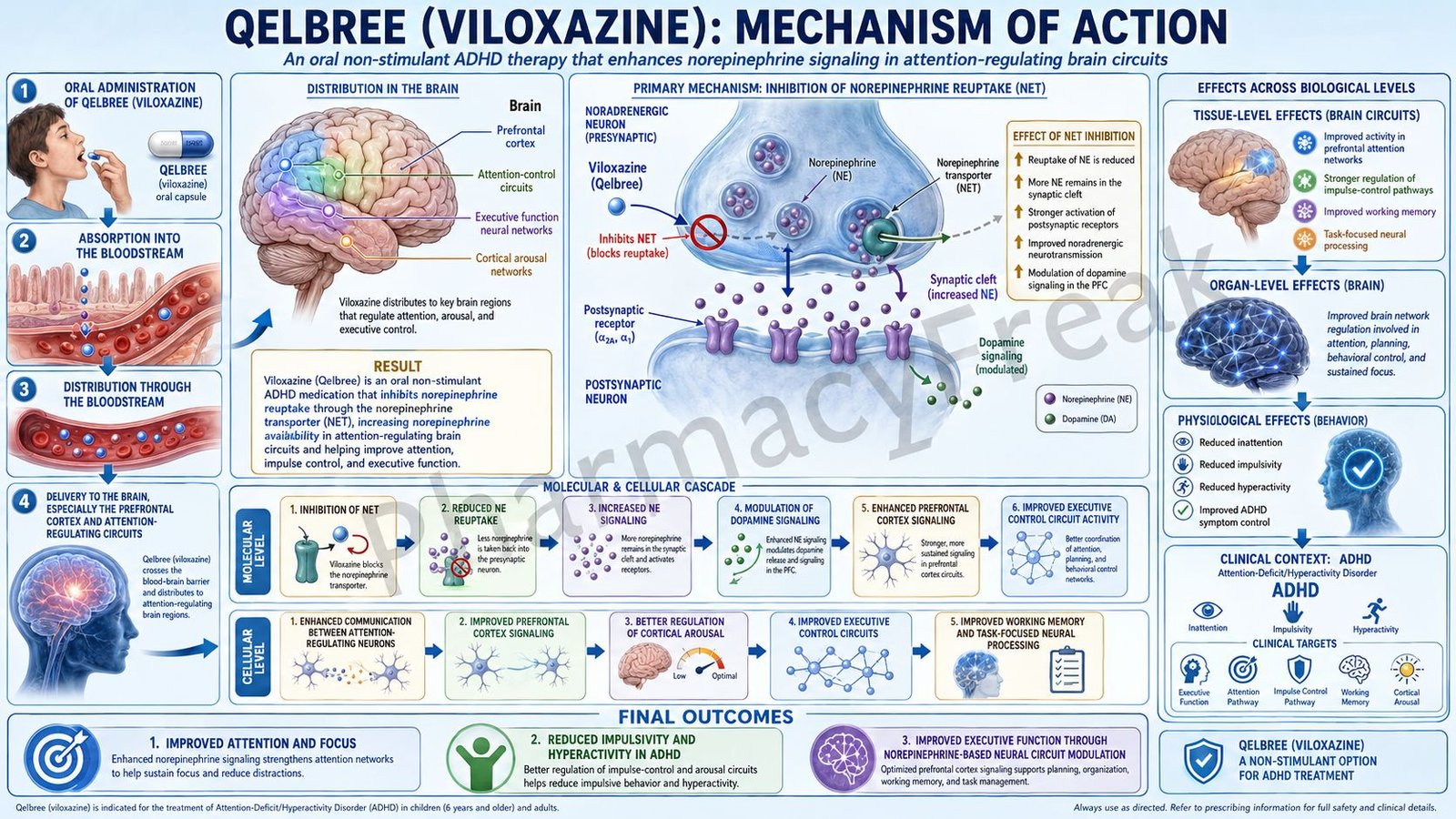
Viloxazine is an oral non-stimulant drug marketed under the brand name Qelbree. Pharmacologically, viloxazine is a selective norepinephrine reuptake inhibitor used in attention-deficit/hyperactivity disorder, commonly called ADHD.
ADHD is a neurodevelopmental disorder characterized by persistent patterns of inattention, hyperactivity, impulsivity, or a combination of these symptoms. It can affect academic performance, work productivity, behavior, emotional regulation, executive function, and social functioning.
The brain areas commonly discussed in ADHD include the prefrontal cortex, basal ganglia, anterior cingulate cortex, cerebellum, and frontostriatal circuits. These circuits are involved in attention control, impulse regulation, working memory, planning, motivation, and behavioral inhibition.
Viloxazine works mainly by increasing norepinephrine signaling. The official Qelbree label states that the mechanism of action of viloxazine in ADHD is unclear; however, it is thought to be through inhibiting the reuptake of norepinephrine. The label also states that viloxazine binds to and inhibits the norepinephrine transporter and exhibits partial agonist activity at the serotonin 5-HT2C receptor.
Qelbree is indicated for the treatment of ADHD in adults and pediatric patients 6 years of age and older. It is not a stimulant and is not listed as a controlled substance in the prescribing information.
For exam purposes, viloxazine should be remembered as an oral non-stimulant ADHD drug that inhibits norepinephrine reuptake, increases norepinephrine signaling in attention-related brain circuits, and may also have serotonergic pharmacodynamic activity through 5-HT2C partial agonism.
Mechanism of Action (Step-wise)
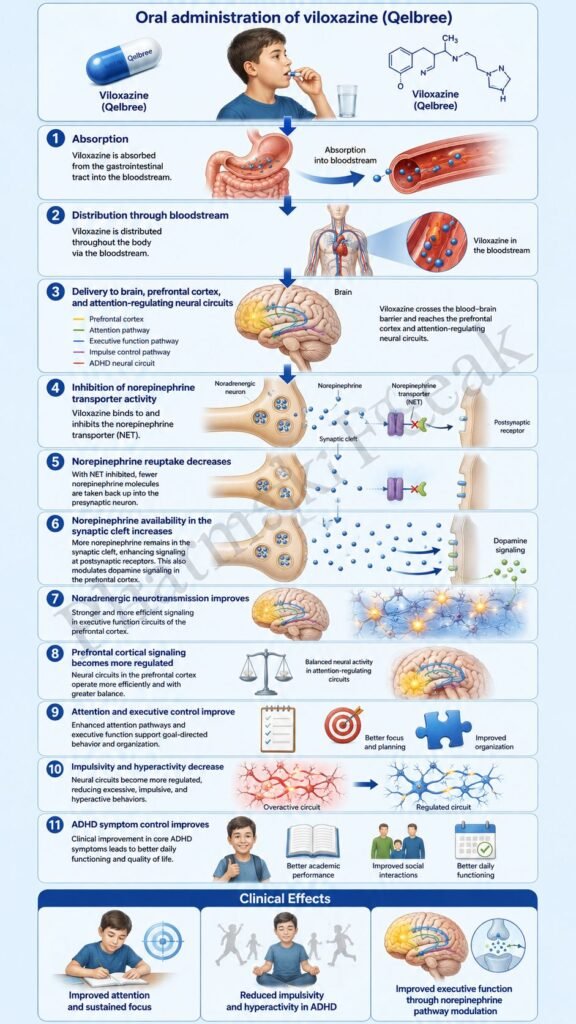
Step 1: ADHD involves impaired attention and executive control
ADHD involves difficulty sustaining attention, controlling impulses, organizing tasks, regulating activity level, and maintaining goal-directed behavior. These functions are strongly associated with prefrontal cortex and frontostriatal circuits.
Step 2: Catecholamines regulate attention networks
Norepinephrine and dopamine are important catecholamine neurotransmitters involved in attention, alertness, working memory, response inhibition, and executive function. Low or inefficient catecholamine signaling in prefrontal networks can worsen ADHD symptoms.
Step 3: Norepinephrine is cleared by reuptake
After norepinephrine is released into the synaptic cleft, it is taken back into presynaptic neurons mainly by the norepinephrine transporter. This process limits the duration and intensity of norepinephrine signaling.
Step 4: Viloxazine inhibits the norepinephrine transporter
Viloxazine binds to and inhibits the norepinephrine transporter. The official label reports that viloxazine binds to the norepinephrine transporter with a Ki value of 0.13 micromolar.
Step 5: Norepinephrine reuptake decreases
When the norepinephrine transporter is inhibited, less norepinephrine is taken back into the presynaptic neuron. This increases norepinephrine availability in synaptic spaces.
Step 6: Norepinephrine signaling increases
Increased synaptic norepinephrine can strengthen signaling in brain regions involved in attention, vigilance, and executive function. This is the main proposed mechanism by which viloxazine improves ADHD symptoms.
Step 7: Prefrontal cortical function may improve
The prefrontal cortex requires balanced catecholamine signaling for optimal working memory, attention control, planning, and impulse regulation. By increasing norepinephrine signaling, viloxazine may improve prefrontal network function in ADHD.
Step 8: Attention and impulse regulation may improve
Improved norepinephrine signaling can help reduce inattentive symptoms and may also help with impulsivity and hyperactivity. Clinically, improvement is measured by ADHD symptom rating scales and functional response.
Step 9: The exact ADHD mechanism remains unclear
The label specifically states that the mechanism of action of viloxazine in ADHD is unclear. Therefore, norepinephrine reuptake inhibition is the main proposed mechanism, not a fully complete explanation of all therapeutic effects.
Step 10: Viloxazine also affects serotonin pharmacodynamics
Viloxazine exhibits partial agonist activity at the serotonin 5-HT2C receptor, with a reported Ki value of 0.66 micromolar. This serotonergic activity may contribute to its overall neurochemical profile, although its exact clinical role in ADHD is not fully established.
Step 11: Viloxazine does not directly stimulate dopamine release like amphetamines
Viloxazine is not an amphetamine and does not work by directly promoting catecholamine release in the same way as amphetamine-based stimulants. Its primary proposed action is norepinephrine transporter inhibition.
Step 12: Viloxazine is different from methylphenidate
Methylphenidate blocks dopamine and norepinephrine reuptake and is a stimulant. Viloxazine is a non-stimulant selective norepinephrine reuptake inhibitor.
Step 13: Viloxazine may improve both inattentive and hyperactive-impulsive symptoms
Clinical ADHD symptom improvement can involve reduced distractibility, better task completion, improved attention span, reduced impulsivity, and better behavioral control.
Step 14: Therapeutic response requires titration and monitoring
Viloxazine dosing is gradually titrated depending on age, response, and tolerability. Heart rate, blood pressure, mood, suicidality, sedation, and fatigue must be monitored during therapy.
Step 15: Final therapeutic outcome
The final therapeutic effect of viloxazine is improvement in ADHD symptoms through modulation of norepinephrine signaling, with additional serotonin 5-HT2C receptor pharmacodynamic activity. It does not cure ADHD but can help improve attention, impulse control, and functional performance in appropriately selected patients.
Pharmacokinetics
Viloxazine is administered orally as Qelbree extended-release capsules. It may be taken with or without food. Capsules should not be cut, crushed, or chewed. They may be swallowed whole or opened and sprinkled over applesauce or pudding, and the mixture should be consumed according to label instructions without chewing.
Qelbree capsules are available as 100 mg, 150 mg, and 200 mg extended-release capsules.
For pediatric patients 6 to 11 years of age, the recommended starting dose is 100 mg once daily. The dose may be titrated in 100 mg weekly increments to a maximum recommended dose of 400 mg once daily, depending on response and tolerability.
For pediatric patients 12 to 17 years of age, the recommended starting dose is 200 mg once daily. After 1 week, the dose may be increased by 200 mg to a maximum recommended dose of 400 mg once daily.
For adults, the recommended starting dose is 200 mg once daily. The dose may be increased in 200 mg weekly increments to a maximum recommended dose of 600 mg once daily, depending on response and tolerability.
In severe renal impairment, defined as eGFR less than 30 mL/min/1.73 m², the recommended starting dose is 100 mg once daily. The dose may be titrated in weekly increments of 50 to 100 mg to a maximum recommended dose of 200 mg once daily. No dosage adjustment is recommended in mild to moderate renal impairment.
Viloxazine extended-release has a relative bioavailability of about 88% compared with an immediate-release formulation. After a single 200 mg dose, median time to peak plasma concentration is about 5 hours, with a range of 3 to 9 hours.
A high-fat meal decreases viloxazine Cmax and AUC by about 9% and 8%, respectively, and delays Tmax by about 2 hours. Sprinkling capsule contents on applesauce decreases Cmax and AUC by about 10% and 5%, respectively. These changes are not considered large enough to require fasting administration.
Viloxazine is 76% to 82% bound to human plasma proteins. Its mean half-life is approximately 7 hours. Steady state is reached after about 2 days of once-daily administration, and no accumulation was observed.
Viloxazine is primarily metabolized by CYP2D6, UGT1A9, and UGT2B15. The major plasma metabolite is 5-hydroxy-viloxazine glucuronide.
Renal excretion is the primary route of elimination. After radiolabeled viloxazine administration, about 90% of the dose was recovered in urine within the first 24 hours, while less than 1% was excreted in feces.
Viloxazine is a strong CYP1A2 inhibitor. Qelbree is contraindicated with sensitive CYP1A2 substrates or CYP1A2 substrates with a narrow therapeutic range, because exposure to those drugs may increase. It is also contraindicated with monoamine oxidase inhibitors or within 14 days after stopping an MAOI because of hypertensive crisis risk.
Clinical Uses
Viloxazine is used for the treatment of attention-deficit/hyperactivity disorder in adults and pediatric patients 6 years of age and older.
In children, viloxazine can be used when a non-stimulant ADHD option is appropriate based on clinical assessment, tolerability, comorbidities, response history, family preference, or stimulant-related concerns.
In adolescents, viloxazine may help improve inattentive symptoms, hyperactivity, impulsivity, school functioning, and behavioral regulation when used as part of a broader ADHD management plan.
In adults, viloxazine may help with symptoms such as distractibility, poor sustained attention, disorganization, impulsivity, restlessness, procrastination, and executive dysfunction.
Viloxazine is not a stimulant. It is different from methylphenidate, amphetamine, lisdexamfetamine, and mixed amphetamine salts.
Viloxazine is not an antipsychotic, benzodiazepine, antidepressant approved for depression in the United States, sedative-hypnotic, or mood stabilizer. It is a non-stimulant ADHD medication.
Viloxazine is not approved for children younger than 6 years of age. Geriatric pharmacokinetic studies have not been conducted according to the label.
Adverse Effects
The most important boxed warning of Qelbree is suicidal thoughts and behaviors. The label states that higher rates of suicidal thoughts and behavior were reported in patients with ADHD treated with Qelbree than in patients treated with placebo. Patients should be closely monitored for clinical worsening and emergence of suicidal thoughts or behaviors.
In pediatric short-term trials, suicidal ideation or behavior was reported in patients treated with Qelbree. In an adult study, suicidal ideation was also reported in Qelbree-treated patients and not in placebo-treated patients, although no attempted or completed suicides occurred in that study.
Blood pressure and heart rate increases are important. Qelbree can increase heart rate and diastolic blood pressure. Heart rate and blood pressure should be assessed before starting treatment, after dosage increases, and periodically during therapy.
Activation of mania or hypomania can occur. Noradrenergic drugs such as viloxazine may induce a manic or mixed episode in patients with bipolar disorder. Patients should be screened for personal or family history of suicide, bipolar disorder, and depression before starting treatment.
Somnolence and fatigue are common and clinically important. Patients should avoid driving or operating hazardous machinery until they know how Qelbree affects them. In pediatric trials, somnolence and fatigue were reported more often with Qelbree than placebo. In adult trials, somnolence and fatigue were also more common with Qelbree than placebo.
Common adverse reactions in pediatric patients 6 to 17 years of age include somnolence, decreased appetite, fatigue, nausea, vomiting, insomnia, and irritability.
Common adverse reactions in adults include insomnia, headache, somnolence, fatigue, nausea, decreased appetite, dry mouth, and constipation.
Overdose experience with immediate-release viloxazine includes drowsiness, impaired consciousness, diminished reflexes, and increased heart rate. There is no specific antidote for Qelbree overdose; treatment is symptomatic and supportive.
Pregnancy is an important safety consideration. The label states that Qelbree may cause maternal harm and should be discontinued when pregnancy is recognized.
Because viloxazine is a strong CYP1A2 inhibitor, drug interaction risks are clinically important. Concomitant use with sensitive CYP1A2 substrates or CYP1A2 substrates with a narrow therapeutic range is contraindicated. Moderate sensitive CYP1A2 substrates are not recommended for coadministration, and dose reduction may be needed.
Comparative Analysis
Viloxazine is commonly compared with atomoxetine, methylphenidate, amphetamine stimulants, lisdexamfetamine, guanfacine, clonidine, bupropion, and behavioral therapy.
Compared with atomoxetine, viloxazine belongs to the same broad non-stimulant category and both are norepinephrine reuptake inhibitors. Atomoxetine is a selective norepinephrine reuptake inhibitor commonly used in ADHD, while viloxazine is an extended-release selective norepinephrine reuptake inhibitor with additional serotonin 5-HT2C partial agonist pharmacodynamic activity listed in the label.
Compared with methylphenidate, viloxazine is non-stimulant. Methylphenidate blocks dopamine and norepinephrine transporters and is a controlled stimulant medication. Viloxazine mainly inhibits norepinephrine reuptake and is not a stimulant.
Compared with amphetamine-based stimulants, viloxazine has a different mechanism. Amphetamines increase catecholamine signaling partly by promoting dopamine and norepinephrine release and inhibiting reuptake. Viloxazine does not act as an amphetamine releaser.
Compared with lisdexamfetamine, viloxazine is not a prodrug stimulant. Lisdexamfetamine is converted into dextroamphetamine, while viloxazine is an extended-release norepinephrine reuptake inhibitor.
Compared with guanfacine, viloxazine affects norepinephrine transport rather than directly activating alpha-2A adrenergic receptors. Guanfacine is an alpha-2A receptor agonist that strengthens prefrontal cortical regulation through postsynaptic receptor effects.
Compared with clonidine, viloxazine has a different receptor profile. Clonidine is an alpha-2 adrenergic agonist that can reduce hyperarousal and impulsivity but is often associated with sedation, hypotension, and bradycardia. Viloxazine can cause somnolence but may also increase heart rate and diastolic blood pressure.
Compared with bupropion, viloxazine is specifically approved for ADHD, while bupropion is commonly discussed as an off-label ADHD option in some clinical settings. Bupropion inhibits norepinephrine and dopamine reuptake, while viloxazine is described as a selective norepinephrine reuptake inhibitor.
Compared with behavioral therapy, viloxazine is pharmacological treatment. Behavioral therapy, parent training, school interventions, coaching, sleep optimization, and organizational strategies can be important non-drug parts of ADHD management.
Compared with antidepressants such as SSRIs, viloxazine does not primarily inhibit serotonin reuptake. Its approved ADHD mechanism is thought to involve norepinephrine reuptake inhibition, although it also has serotonin 5-HT2C partial agonist activity.
MCQs
- Viloxazine is marketed under which brand name?
a) Strattera
b) Qelbree
c) Intuniv
d) Concerta
Answer: b) Qelbree
- Viloxazine belongs to which pharmacological class?
a) Selective norepinephrine reuptake inhibitor
b) Dopamine D2 receptor blocker
c) GABA-A receptor modulator
d) NMDA receptor antagonist
Answer: a) Selective norepinephrine reuptake inhibitor
- Qelbree is mainly used for:
a) Attention-deficit/hyperactivity disorder
b) Hypertension only
c) Epilepsy
d) Parkinson’s disease
Answer: a) Attention-deficit/hyperactivity disorder
- The exact mechanism of viloxazine in ADHD is:
a) Unclear, but thought to involve norepinephrine reuptake inhibition
b) Fully explained by irreversible MAO inhibition
c) Due to direct dopamine D2 blockade
d) Due to opioid receptor activation
Answer: a) Unclear, but thought to involve norepinephrine reuptake inhibition
- Viloxazine binds to and inhibits the:
a) Norepinephrine transporter
b) Proton pump
c) Acetylcholinesterase enzyme
d) HER2 receptor
Answer: a) Norepinephrine transporter
- Viloxazine also exhibits partial agonist activity at which serotonin receptor?
a) 5-HT2C receptor
b) 5-HT3 receptor
c) 5-HT1A receptor only
d) 5-HT7 receptor only
Answer: a) 5-HT2C receptor
- Qelbree is approved for ADHD in adults and pediatric patients aged:
a) 6 years and older
b) 2 years and older
c) 12 months and older
d) Newborns only
Answer: a) 6 years and older
- The recommended starting dose for pediatric patients 6 to 11 years is:
a) 100 mg once daily
b) 600 mg once daily
c) 10 mg twice daily
d) 5 mg at bedtime
Answer: a) 100 mg once daily
- The recommended starting dose for adults is:
a) 200 mg once daily
b) 50 mg three times daily
c) 5 mg once weekly
d) 400 mg twice daily
Answer: a) 200 mg once daily
- The maximum recommended adult dose of Qelbree is:
a) 600 mg once daily
b) 100 mg once daily
c) 20 mg once daily
d) 1000 mg twice daily
Answer: a) 600 mg once daily
- Qelbree is contraindicated with:
a) Monoamine oxidase inhibitors
b) Paracetamol only
c) Inhaled saline
d) Topical emollients
Answer: a) Monoamine oxidase inhibitors
- Qelbree is also contraindicated with:
a) Sensitive CYP1A2 substrates or CYP1A2 substrates with a narrow therapeutic range
b) All beta-lactam antibiotics
c) All vitamins
d) Proton pump inhibitors only
Answer: a) Sensitive CYP1A2 substrates or CYP1A2 substrates with a narrow therapeutic range
- Which boxed warning is associated with Qelbree?
a) Suicidal thoughts and behaviors
b) Thyroid C-cell tumors
c) Severe hypoglycemia
d) Ototoxicity
Answer: a) Suicidal thoughts and behaviors
- Which monitoring is important with viloxazine?
a) Heart rate, blood pressure, mood, and suicidality
b) Only blood glucose every hour
c) Only serum calcium
d) Only hearing test
Answer: a) Heart rate, blood pressure, mood, and suicidality
- Which statement best describes viloxazine?
a) It is a non-stimulant ADHD drug thought to work by inhibiting norepinephrine reuptake
b) It is an amphetamine that directly releases dopamine
c) It is a benzodiazepine used for insomnia
d) It is an antipsychotic used for schizophrenia
Answer: a) It is a non-stimulant ADHD drug thought to work by inhibiting norepinephrine reuptake
FAQs
What is the mechanism of action of viloxazine?
Viloxazine’s exact mechanism in ADHD is unclear, but it is thought to work by inhibiting norepinephrine reuptake. It binds to the norepinephrine transporter and also shows partial agonist activity at serotonin 5-HT2C receptors.
What is the brand name of viloxazine?
The brand name of viloxazine is Qelbree.
What is viloxazine used for?
Viloxazine is used for the treatment of ADHD in adults and pediatric patients 6 years of age and older.
Is viloxazine a stimulant?
No. Viloxazine is a non-stimulant ADHD medication. It is different from stimulant drugs such as methylphenidate, amphetamine, and lisdexamfetamine.
Is viloxazine the same as atomoxetine?
No. Both are non-stimulant ADHD medications that affect norepinephrine reuptake, but they are different drugs with different pharmacokinetics, dosing, interaction profiles, and safety considerations.
Why does viloxazine have a suicidal thoughts warning?
In clinical studies, suicidal thoughts and behaviors were reported at higher rates in Qelbree-treated patients than placebo-treated patients. Patients should be monitored for mood changes, clinical worsening, and suicidal thoughts or behaviors.
Can viloxazine increase blood pressure?
Yes. Qelbree can increase heart rate and diastolic blood pressure. Heart rate and blood pressure should be checked before starting treatment, after dose increases, and periodically during therapy.
What are common adverse effects of viloxazine?
Common adverse effects include somnolence, fatigue, decreased appetite, nausea, vomiting, insomnia, irritability, headache, dry mouth, and constipation.
References
Goodman & Gilman’s The Pharmacological Basis of Therapeutics
Katzung Basic & Clinical Pharmacology