Table of Contents
Introduction
Caplyta is the brand name of lumateperone, an oral atypical antipsychotic used in adults for schizophrenia, depressive episodes associated with bipolar I or bipolar II disorder, and as adjunctive treatment with an antidepressant for major depressive disorder. It is not known whether Caplyta is safe and effective in children.
Caplyta is important in pharmacology because it has a different receptor-binding profile from many older antipsychotics. Its exact mechanism of action is not fully understood, but its clinical activity is thought to involve modulation of serotonin, dopamine, and possibly glutamate neurotransmission. The most important exam point is that Caplyta acts mainly through serotonin 5-HT2A receptor antagonism and dopamine D2 receptor partial agonism.
For pharmacy, medical, nursing, and competitive exam students, Caplyta is useful because it connects psychiatric pharmacology with receptor-based mechanisms. It is not a benzodiazepine, stimulant, SSRI, or typical antipsychotic. It is an atypical antipsychotic with antipsychotic and mood-related therapeutic effects.
Caplyta is also clinically relevant because it is generally given once daily and does not require dose titration in standard adult dosing. Its pharmacology is commonly discussed in relation to schizophrenia, bipolar depression, and adjunctive treatment of major depressive disorder.
Mechanism of Action (Step-wise)
- Primary pharmacological concept: Multimodal neurotransmitter modulation
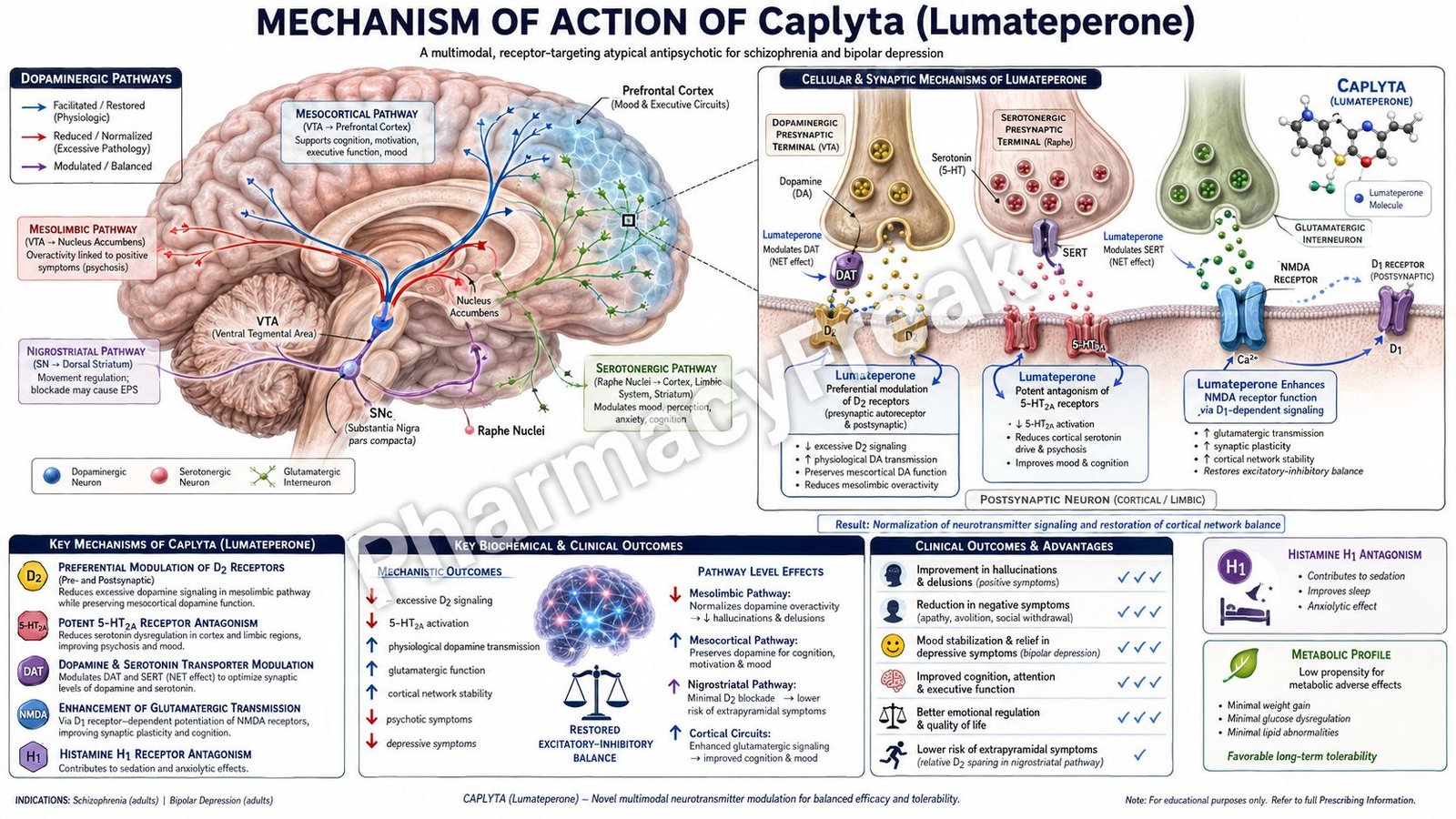
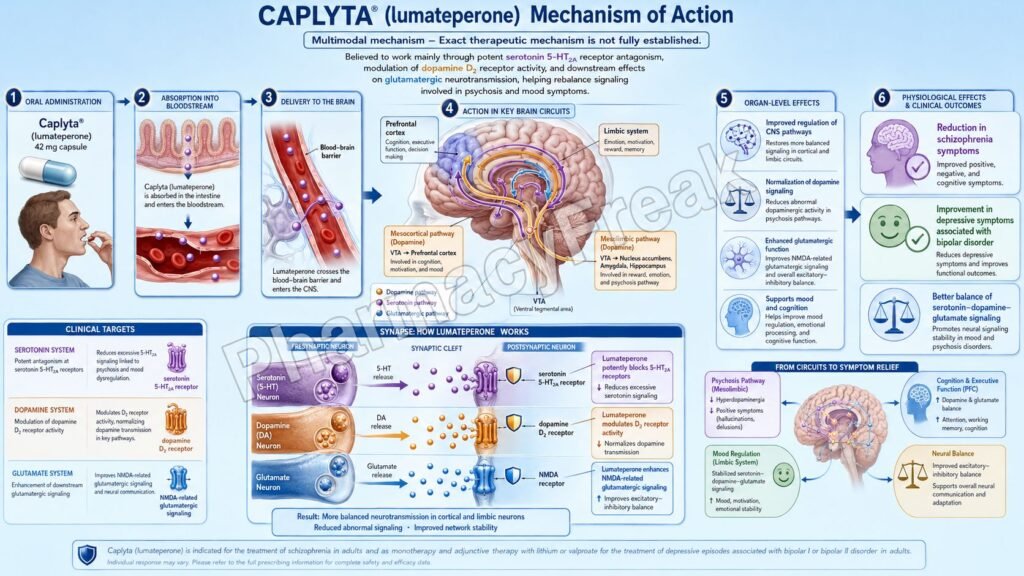
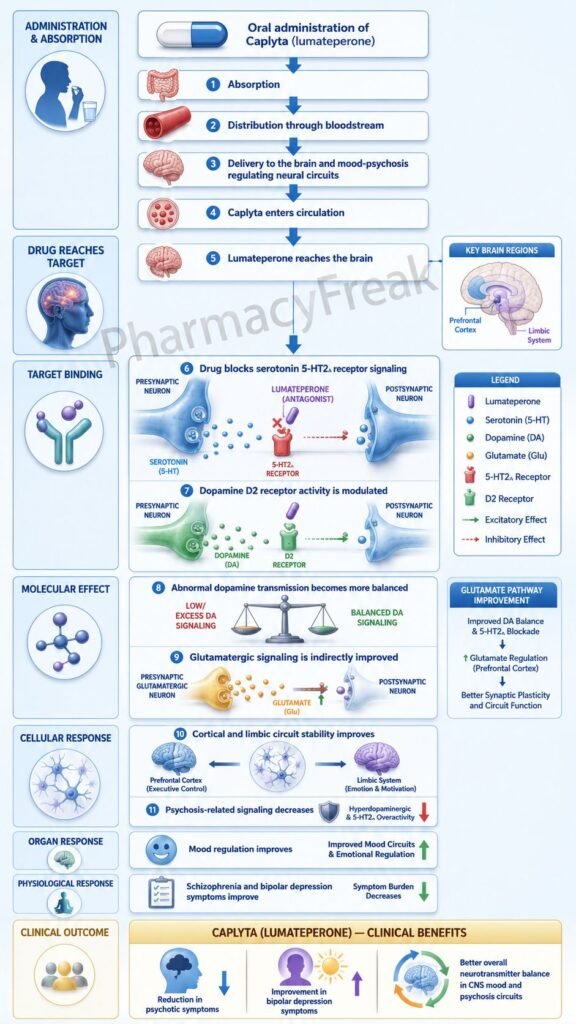
Caplyta contains lumateperone. The exact mechanism of lumateperone in schizophrenia, bipolar depression, and major depressive disorder is not completely known. However, its activity is thought to involve combined effects on serotonin, dopamine, and possibly glutamate pathways.
- Serotonin 5-HT2A receptor antagonism
One of the most important actions of Caplyta is antagonism of central serotonin 5-HT2A receptors. Blocking 5-HT2A receptors is a key feature of many atypical antipsychotics.
5-HT2A antagonism may help reduce psychotic symptoms, improve mood-related symptoms, and reduce the risk of extrapyramidal adverse effects compared with strong dopamine-blocking typical antipsychotics.
- Dopamine D2 receptor partial agonism
Caplyta also has partial agonist activity at central dopamine D2 receptors. Dopamine D2 receptors are strongly involved in psychosis, reward, motivation, movement regulation, and endocrine effects such as prolactin release.
Partial agonism means the drug can modulate dopamine signaling rather than completely blocking it in all situations. This may help reduce excessive dopamine activity in pathways related to psychosis while avoiding excessive dopamine blockade in pathways involved in movement and prolactin regulation.
- Effect on dopamine pathways
In schizophrenia, excessive dopaminergic activity in the mesolimbic pathway is associated with positive symptoms such as hallucinations and delusions. By modulating D2 receptor activity, Caplyta may help reduce these symptoms.
At the same time, relatively lower D2 receptor occupancy compared with some antipsychotics may contribute to a lower tendency for extrapyramidal symptoms and prolactin elevation, although clinical monitoring is still required.
- Serotonin transporter activity
Lumateperone has moderate affinity for serotonin transporters and can inhibit serotonin uptake in cells expressing human serotonin transporters. This may contribute to increased serotonin availability in synaptic areas, although the exact clinical importance of this effect is not fully established.
- Possible glutamate modulation
Caplyta may indirectly modulate glutamatergic neurotransmission. Some data suggest effects on NMDA receptor-related signaling, including GluN2B-type NMDA receptor phosphorylation. The clinical relevance of this glutamate-related effect is still not fully confirmed.
- Effect in schizophrenia
In schizophrenia, Caplyta may improve symptoms by balancing dopamine and serotonin signaling. This can reduce positive symptoms such as hallucinations and delusions and may also help with mood and cognitive-related symptom domains in some patients.
- Effect in bipolar depression and major depressive disorder
In bipolar depression and adjunctive major depressive disorder therapy, Caplyta’s effects may involve serotonin-dopamine modulation and possible downstream effects on mood circuits. These circuits are involved in emotional regulation, motivation, sleep, appetite, and cognitive processing.
- Final therapeutic effect
The final therapeutic effect of Caplyta is improvement in psychotic symptoms in schizophrenia and improvement in depressive symptoms in bipolar depression and adjunctive major depressive disorder treatment. Its benefit is mainly linked to serotonin 5-HT2A antagonism, dopamine D2 partial agonism, serotonin transporter effects, and possible glutamate pathway modulation.
Pharmacokinetics
Caplyta is administered orally as lumateperone capsules. It is usually taken once daily, with or without food. Standard adult dosing does not require gradual titration.
Absorption:
After oral administration, lumateperone is absorbed with an absolute bioavailability of about 4.4%. Peak plasma concentration is reached approximately 1 to 2 hours after dosing. A high-fat meal lowers mean Cmax by about 33%, increases mean AUC by about 9%, and delays median Tmax by about 1 hour.
Distribution:
Lumateperone is highly protein-bound, with protein binding of approximately 97.4%. The volume of distribution after intravenous administration is about 4.1 L/kg, indicating distribution beyond the central vascular compartment.
Metabolism:
Lumateperone is extensively metabolized, with more than twenty metabolites identified. Multiple enzymes are involved, including UGT1A1, UGT1A4, UGT2B15, AKR1C1, AKR1B10, AKR1C4, CYP3A4, CYP2C8, and CYP1A2.
Excretion:
In a human mass-balance study, approximately 58% of the radioactive dose was recovered in urine and 29% in feces. Less than 1% of the dose was excreted as unchanged lumateperone in urine.
Half-life and duration:
The terminal half-life of lumateperone is about 18 hours after intravenous administration. With once-daily oral dosing, steady state is reached in about 5 days.
Special pharmacokinetic point:
Because CYP3A4 is involved in lumateperone metabolism, clinically important drug interactions can occur with CYP3A4 inhibitors or inducers. Dose adjustment or avoidance may be needed depending on the interacting drug.
Clinical Uses
- Schizophrenia in adults:
Caplyta is used for the treatment of schizophrenia in adults. It helps reduce psychotic symptoms such as hallucinations, delusions, disorganized thinking, and behavioral disturbance. - Bipolar depression:
Caplyta is used for depressive episodes associated with bipolar I or bipolar II disorder in adults. It can be used alone or as adjunctive therapy with lithium or valproate. - Major depressive disorder as adjunctive therapy:
Caplyta is approved for adults with major depressive disorder when used along with an antidepressant. It is not used as a stand-alone antidepressant for this indication. - Mood and psychosis-related symptom control:
Due to serotonin and dopamine modulation, Caplyta may help with mood-related and psychosis-related symptoms in selected patients. - Alternative atypical antipsychotic option:
Caplyta may be considered when an atypical antipsychotic with a distinct receptor profile is clinically appropriate.
Adverse Effects
Common adverse effects of Caplyta include:
- Somnolence
- Sedation
- Dizziness
- Nausea
- Dry mouth
- Fatigue
- Headache
- Constipation
- Decreased appetite
- Sleep disturbance
- Orthostatic symptoms in susceptible patients
Important serious or clinically significant adverse effects include:
- Increased mortality in elderly patients with dementia-related psychosis
- Suicidal thoughts and behaviors in young patients when used as antidepressant therapy
- Neuroleptic malignant syndrome
- Tardive dyskinesia
- Metabolic changes, including hyperglycemia, dyslipidemia, and weight gain
- Leukopenia, neutropenia, and agranulocytosis
- Orthostatic hypotension and syncope
- Falls due to somnolence, dizziness, or postural hypotension
- Seizures
- Cognitive and motor impairment
- Body temperature dysregulation
- Dysphagia
Caplyta carries a boxed warning for increased mortality in elderly patients with dementia-related psychosis and for suicidal thoughts and behaviors in certain patients treated with antidepressant drugs. It is not approved for the treatment of dementia-related psychosis.
Patients should be monitored for mood worsening, suicidal ideation, abnormal movements, metabolic changes, blood pressure changes, sedation, and signs of severe reactions such as neuroleptic malignant syndrome.
Comparative Analysis
| Feature | Caplyta | Risperidone | Aripiprazole | Quetiapine |
|---|---|---|---|---|
| Generic name | Lumateperone | Risperidone | Aripiprazole | Quetiapine |
| Drug class | Atypical antipsychotic | Atypical antipsychotic | Atypical antipsychotic | Atypical antipsychotic |
| Main receptor action | 5-HT2A antagonism, D2 partial agonism | D2 and 5-HT2A antagonism | D2 partial agonism, 5-HT1A partial agonism, 5-HT2A antagonism | 5-HT2A and D2 antagonism |
| Main uses | Schizophrenia, bipolar depression, adjunctive MDD | Schizophrenia, bipolar disorder, irritability in autism | Schizophrenia, bipolar disorder, adjunctive MDD | Schizophrenia, bipolar disorder, depression-related uses |
| Dopamine effect | Modulates D2 activity | Strong D2 blockade | D2 partial agonism | D2 antagonism |
| Prolactin risk | Generally lower than strong D2 blockers | Higher | Usually low | Usually low |
| Sedation risk | Possible | Moderate | Usually lower | Higher |
| Route | Oral | Oral, injectable forms | Oral, injectable forms | Oral |
Caplyta differs from risperidone because it does not primarily act as a strong D2 antagonist. It differs from aripiprazole because both have dopamine partial agonist-related activity, but their receptor profiles are not identical. Quetiapine is generally more sedating due to stronger histamine-related effects, while Caplyta is often discussed for its serotonin-dopamine-glutamate multimodal profile.
MCQs
- Caplyta contains which active drug?
a) Lumateperone
b) Lurasidone
c) Olanzapine
d) Risperidone
Answer: a) Lumateperone
- Caplyta belongs to which drug class?
a) Typical antipsychotic
b) Atypical antipsychotic
c) Benzodiazepine
d) SSRI
Answer: b) Atypical antipsychotic
- One major receptor action of Caplyta is:
a) 5-HT2A receptor antagonism
b) Beta-2 receptor stimulation
c) Muscarinic receptor activation
d) Insulin receptor blockade
Answer: a) 5-HT2A receptor antagonism
- Caplyta has partial agonist activity at which receptor?
a) Dopamine D2 receptor
b) Histamine H1 receptor
c) GABA-A receptor
d) NMDA receptor directly
Answer: a) Dopamine D2 receptor
- Caplyta is used for treatment of:
a) Schizophrenia in adults
b) Acute bacterial meningitis
c) Type 1 diabetes mellitus
d) Malaria
Answer: a) Schizophrenia in adults
- Caplyta may be used in bipolar disorder mainly for:
a) Bipolar depression
b) Acute bacterial infection
c) Hypertensive emergency
d) Migraine aura only
Answer: a) Bipolar depression
- In major depressive disorder, Caplyta is used:
a) As adjunctive therapy with an antidepressant
b) As an antibiotic
c) As insulin replacement
d) As an opioid analgesic
Answer: a) As adjunctive therapy with an antidepressant
- Which neurotransmitter systems are mainly associated with Caplyta’s mechanism?
a) Serotonin, dopamine, and possibly glutamate
b) Acetylcholine only
c) Histamine only
d) Insulin and glucagon only
Answer: a) Serotonin, dopamine, and possibly glutamate
- Which adverse effect is common with Caplyta?
a) Somnolence
b) Severe ototoxicity
c) Gingival hyperplasia
d) Hyperkalemia
Answer: a) Somnolence
- Caplyta is not approved for:
a) Dementia-related psychosis
b) Adult schizophrenia
c) Bipolar depression in adults
d) Adjunctive treatment of MDD in adults
Answer: a) Dementia-related psychosis
- The terminal half-life of lumateperone is approximately:
a) 2 hours
b) 8 hours
c) 18 hours
d) 7 days
Answer: c) 18 hours
- Lumateperone is metabolized by multiple enzymes, including:
a) CYP3A4 and UGT enzymes
b) Acetylcholinesterase only
c) Renin only
d) Monoamine oxidase only
Answer: a) CYP3A4 and UGT enzymes
- Which serious adverse reaction may occur with antipsychotics such as Caplyta?
a) Neuroleptic malignant syndrome
b) Acute otitis media only
c) Simple rhinitis only
d) Hypocalcemia only
Answer: a) Neuroleptic malignant syndrome
- Caplyta differs from typical antipsychotics because it:
a) Has atypical serotonin-dopamine receptor activity
b) Is a beta-lactam antibiotic
c) Directly increases insulin secretion
d) Blocks bacterial folate synthesis
Answer: a) Has atypical serotonin-dopamine receptor activity
- Which statement about Caplyta is correct?
a) Its exact mechanism is unknown, but activity is thought to involve 5-HT2A antagonism and D2 partial agonism
b) It is a rescue drug for asthma
c) It is approved for pediatric ADHD
d) It is a platelet transfusion substitute
Answer: a) Its exact mechanism is unknown, but activity is thought to involve 5-HT2A antagonism and D2 partial agonism
FAQs
- What is Caplyta used for?
Caplyta is used in adults for schizophrenia, depressive episodes associated with bipolar I or bipolar II disorder, and as adjunctive therapy with an antidepressant for major depressive disorder.
- What is the mechanism of action of Caplyta?
The exact mechanism is not completely known. Caplyta’s activity is thought to involve serotonin 5-HT2A receptor antagonism, dopamine D2 receptor partial agonism, serotonin transporter activity, and possible glutamate pathway modulation.
- Is Caplyta a typical or atypical antipsychotic?
Caplyta is an atypical antipsychotic. It has a receptor profile involving serotonin and dopamine modulation rather than simple strong dopamine blockade alone.
- Is Caplyta an antidepressant?
Caplyta is not a traditional antidepressant like an SSRI or SNRI. However, it is approved as adjunctive treatment with an antidepressant for major depressive disorder in adults and is also used for bipolar depression.
- Does Caplyta block dopamine?
Caplyta does not act only as a simple dopamine blocker. It has partial agonist activity at central dopamine D2 receptors, meaning it modulates dopamine signaling.
- What are common side effects of Caplyta?
Common side effects include sleepiness, sedation, dizziness, nausea, dry mouth, fatigue, headache, and constipation.
- What are serious warnings with Caplyta?
Important warnings include increased mortality in elderly patients with dementia-related psychosis, suicidal thoughts and behaviors, neuroleptic malignant syndrome, tardive dyskinesia, metabolic changes, blood count abnormalities, orthostatic hypotension, seizures, and cognitive or motor impairment.
- Can Caplyta be used in dementia-related psychosis?
No. Caplyta is not approved for the treatment of dementia-related psychosis.
- Does Caplyta require dose titration?
Standard adult dosing of Caplyta generally does not require dose titration, although dose adjustment may be needed in certain drug interaction situations.
References
Goodman & Gilman’s The Pharmacological Basis of Therapeutics
Katzung Basic & Clinical Pharmacology