Table of Contents
Introduction
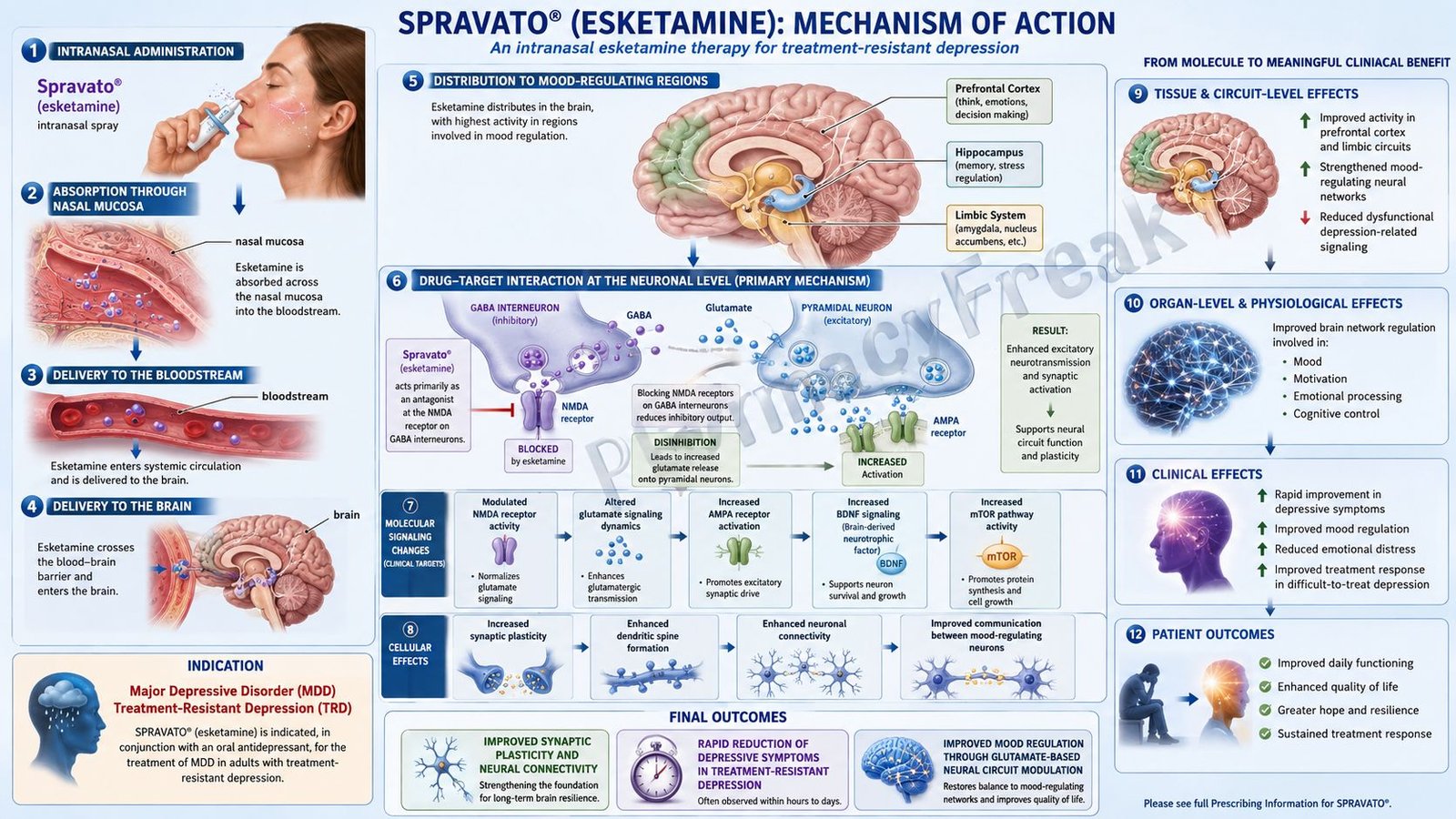
Spravato is the brand name of esketamine, a nasal spray antidepressant used in selected adults with major depressive disorder. Pharmacologically, esketamine is a non-selective, non-competitive N-methyl-D-aspartate receptor antagonist, commonly called an NMDA receptor antagonist.
Depression is a complex psychiatric disorder involving mood, cognition, sleep, appetite, motivation, reward processing, stress regulation, neuroplasticity, and multiple neurotransmitter systems. Traditional antidepressants often act mainly through monoamine systems such as serotonin, norepinephrine, and dopamine. Spravato is different because it acts mainly through glutamatergic neurotransmission.
Esketamine is the S-enantiomer of racemic ketamine. Ketamine contains two enantiomers: S-ketamine, called esketamine, and R-ketamine, called arketamine. Spravato contains esketamine hydrochloride and is administered intranasally under medical supervision.
The official Spravato label states that esketamine is the S-enantiomer of racemic ketamine and is a non-selective, non-competitive antagonist of the NMDA receptor, an ionotropic glutamate receptor. The label also states that the exact mechanism by which esketamine produces its antidepressant effect is unknown. Its major circulating metabolite, noresketamine, also has activity at the same receptor but with lower affinity.
Spravato is indicated for treatment-resistant depression in adults as monotherapy or in combination with an oral antidepressant. It is also indicated, in combination with an oral antidepressant, for depressive symptoms in adults with major depressive disorder with acute suicidal ideation or behavior. The label clarifies that its effectiveness in preventing suicide or reducing suicidal ideation or behavior has not been demonstrated, and it is not approved as an anesthetic agent.
For exam purposes, Spravato should be remembered as an intranasal esketamine NMDA receptor antagonist that modulates glutamate neurotransmission and is used under REMS supervision for treatment-resistant depression and selected depressive symptoms in MDD with acute suicidal ideation or behavior.
Mechanism of Action (Step-wise)
Step 1: Depression involves complex neurotransmitter and neuroplasticity changes
Major depressive disorder is not explained by one neurotransmitter alone. It involves altered monoamine signaling, glutamate signaling, stress pathways, synaptic plasticity, neurotrophic signaling, inflammation, and abnormal function of cortical-limbic brain circuits.
Step 2: Glutamate is the major excitatory neurotransmitter in the CNS
Glutamate is the main excitatory neurotransmitter in the brain. It acts through ionotropic receptors such as NMDA, AMPA, and kainate receptors, and through metabotropic glutamate receptors.
Step 3: NMDA receptors regulate excitatory neurotransmission
NMDA receptors are glutamate-gated ion channels involved in synaptic transmission, calcium entry, neuronal signaling, learning, memory, and neuroplasticity. Excessive or abnormal NMDA receptor signaling may contribute to mood-circuit dysfunction in some patients.
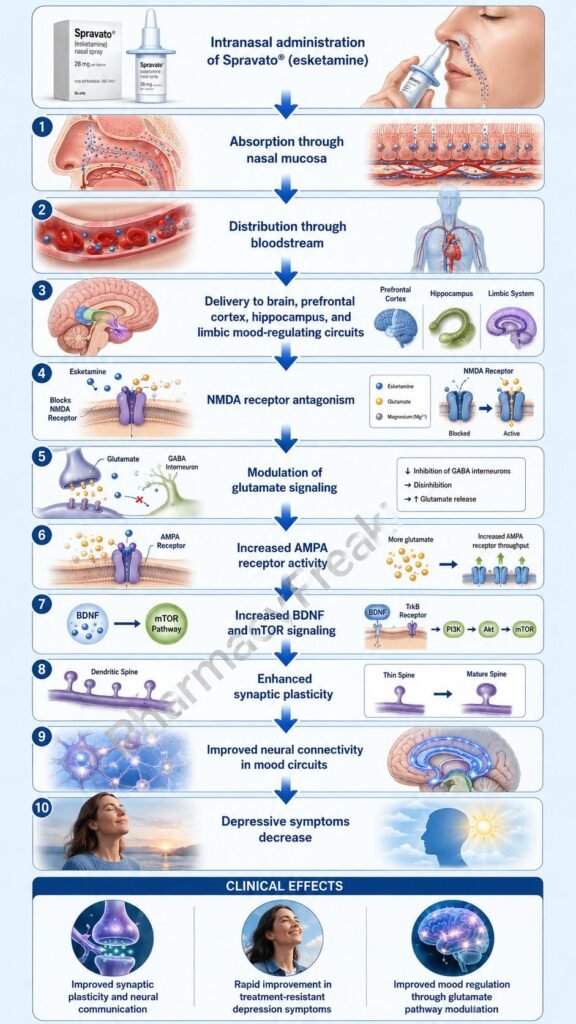
Step 4: Esketamine blocks NMDA receptors
Esketamine is a non-selective, non-competitive NMDA receptor antagonist. Non-competitive antagonism means it reduces receptor activity without simply competing with glutamate at the main agonist binding site.
Step 5: The exact antidepressant mechanism remains unknown
The official label clearly states that the mechanism by which esketamine exerts its antidepressant effect is unknown. Therefore, the NMDA receptor mechanism is established pharmacologically, but the complete pathway from NMDA blockade to clinical antidepressant response is not fully defined.
Step 6: NMDA blockade alters glutamatergic signaling
By blocking NMDA receptor activity, esketamine changes glutamatergic neurotransmission in mood-regulating brain circuits. This distinguishes it from SSRIs, SNRIs, and tricyclic antidepressants, which primarily influence monoamine neurotransmitters.
Step 7: Increased downstream AMPA signaling is a proposed mechanism
A commonly taught pharmacology model proposes that NMDA receptor blockade by ketamine-like drugs may increase downstream AMPA receptor-mediated signaling. This may support rapid changes in synaptic activity and plasticity.
Step 8: Synaptic plasticity may improve
Depression is associated with impaired synaptic connectivity in brain regions involved in mood and cognition. Esketamine-related glutamate modulation may help restore synaptic plasticity, although the exact clinical mechanism is not fully established.
Step 9: Neurotrophic signaling may be affected
Experimental models suggest ketamine-like NMDA receptor antagonists may influence neurotrophic pathways such as BDNF and mTOR signaling. These pathways are often discussed in rapid-acting antidepressant pharmacology, but they should be presented as proposed downstream mechanisms rather than fully proven explanations.
Step 10: Mood-regulating circuits are modulated
Esketamine may influence cortical and limbic circuits involved in mood, motivation, emotional processing, and stress response. These circuit-level changes may contribute to improvement in depressive symptoms.
Step 11: Rapid antidepressant effects may occur
Unlike many conventional antidepressants that may take several weeks for full effect, esketamine can produce clinically meaningful improvement earlier in some patients. This is one reason it is used in treatment-resistant depression and selected acute MDD settings.
Step 12: Noresketamine also has receptor activity
Noresketamine is the major circulating metabolite of esketamine. The label states that noresketamine demonstrates activity at the NMDA receptor but with lower affinity than esketamine.
Step 13: Dissociation is mechanism-related
NMDA receptor antagonism can produce dissociation, perceptual changes, derealization, depersonalization, altered time perception, dizziness, sedation, and feeling detached. These effects are clinically important and explain the need for supervised administration and monitoring.
Step 14: Spravato is not self-administered at home
Because of sedation, dissociation, respiratory depression, abuse, and misuse risks, Spravato is administered only in certified healthcare settings under the Spravato REMS program. Patients must be monitored for at least 2 hours after each treatment session.
Step 15: Final therapeutic outcome
The final therapeutic effect is improvement in depressive symptoms in selected adults through NMDA receptor antagonism and downstream modulation of glutamatergic neurotransmission. However, the precise antidepressant mechanism remains unknown.
Pharmacokinetics
Spravato is administered intranasally. Each nasal spray device delivers two sprays containing a total of 28 mg of esketamine. A 56 mg dose uses two devices, and an 84 mg dose uses three devices, with a 5-minute rest between devices. Spravato is for nasal use only and must be administered under direct healthcare supervision.
For treatment-resistant depression in adults, the induction phase is twice weekly dosing during weeks 1 to 4 with 56 mg or 84 mg. During weeks 5 to 8, dosing is once weekly with 56 mg or 84 mg. From week 9 onward, dosing is every 2 weeks or once weekly, individualized to the least frequent schedule that maintains response or remission.
For depressive symptoms in adults with MDD with acute suicidal ideation or behavior, Spravato is given with an oral antidepressant. The recommended dose is 84 mg twice weekly for 4 weeks, with reduction to 56 mg twice weekly if needed for tolerability.
Patients should avoid food for at least 2 hours before administration and avoid drinking liquids for at least 30 minutes before administration because nausea and vomiting may occur. If nasal corticosteroids or nasal decongestants are needed on the dosing day, they should be administered at least 1 hour before Spravato.
Esketamine exposure increases over the 28 mg to 84 mg dose range, and no plasma accumulation was observed after twice-weekly administration. The mean absolute bioavailability after nasal administration is approximately 48%. Peak plasma concentration occurs about 20 to 40 minutes after the last nasal spray in a treatment session.
The mean steady-state volume of distribution after intravenous administration is approximately 709 L. Plasma protein binding is about 43% to 45%, which is lower than many highly protein-bound psychiatric drugs.
After intranasal dosing, esketamine plasma concentration declines in a biphasic manner. The initial decline occurs over about 2 to 4 hours, and the mean terminal half-life ranges from 7 to 12 hours. The major metabolite noresketamine declines more slowly and has a mean terminal half-life of about 8 hours.
Esketamine is primarily metabolized to noresketamine by CYP2B6 and CYP3A4, with smaller contributions from CYP2C9 and CYP2C19. Noresketamine is further metabolized by CYP-dependent pathways, and some metabolites undergo glucuronidation. Less than 1% of a nasal esketamine dose is excreted unchanged in urine.
Spravato is not recommended in severe hepatic impairment. Patients with moderate hepatic impairment may need longer monitoring because esketamine exposure and half-life are increased.
Clinical Uses
Spravato is used for treatment-resistant depression in adults. Treatment-resistant depression generally refers to depression that has not responded adequately to appropriate antidepressant treatment.
Spravato may be used as monotherapy or in combination with an oral antidepressant for adult treatment-resistant depression according to the current label.
Spravato is also used, in combination with an oral antidepressant, for depressive symptoms in adults with major depressive disorder with acute suicidal ideation or behavior.
Spravato is not proven to prevent suicide or reduce suicidal ideation or behavior. Therefore, even if symptoms improve after treatment, hospitalization or intensive management may still be required when clinically appropriate.
Spravato is not approved as an anesthetic agent. Although esketamine is related to ketamine pharmacologically, the Spravato nasal spray product is approved for specific psychiatric indications, not for anesthesia.
Spravato is not a selective serotonin reuptake inhibitor, serotonin-norepinephrine reuptake inhibitor, tricyclic antidepressant, monoamine oxidase inhibitor, antipsychotic, benzodiazepine, or mood stabilizer. It is an intranasal NMDA receptor antagonist.
Spravato is not approved for pediatric patients. The boxed warning also discusses suicidal thoughts and behaviors in adolescents and young adults in relation to antidepressant therapy, and patients must be monitored for clinical worsening and suicidality.
Adverse Effects
Spravato has a boxed warning for sedation, dissociation, respiratory depression, abuse and misuse, and suicidal thoughts and behaviors. These are the most important safety points for exams and clinical counseling.
Sedation can occur after administration. In clinical trials, 48% to 61% of Spravato-treated patients developed sedation based on a sedation scale, and 0.3% to 0.4% experienced loss of consciousness. Because sedation may be delayed or prolonged, patients must be monitored by a healthcare provider for at least 2 hours after each treatment session.
Dissociation is very common. The label reports dissociative or perceptual changes, including distortion of time and space, illusions, derealization, and depersonalization, in 61% to 84% of Spravato-treated patients in clinical trials. Patients with psychosis require careful risk-benefit assessment before treatment.
Respiratory depression has been reported in postmarketing experience, with rare reports of respiratory arrest. Respiratory status must be monitored for at least 2 hours at each treatment session, including pulse oximetry.
Abuse and misuse are important because Spravato contains esketamine, a Schedule III controlled substance. Patients with a history of substance use disorder may be at higher risk and should be assessed carefully before and during treatment.
Blood pressure increases can occur. Blood pressure should be assessed before dosing and again after dosing, around the expected peak concentration period. Spravato is contraindicated when an increase in blood pressure or intracranial pressure would pose a serious risk.
Contraindications include aneurysmal vascular disease, arteriovenous malformation, history of intracerebral hemorrhage, and hypersensitivity to esketamine, ketamine, or any excipient.
Cognitive impairment may occur. Spravato can impair attention, judgment, thinking, reaction speed, and motor skills. Patients should not drive or operate machinery until the next day after a restful sleep.
Ulcerative or interstitial cystitis is listed as a warning. Although cystitis is classically associated with frequent ketamine misuse, urinary symptoms should still be monitored in patients receiving esketamine.
Embryo-fetal toxicity is important. Spravato may cause fetal harm, and breastfeeding is not recommended during treatment because esketamine is present in human milk and there is potential neurotoxicity risk.
Common adverse reactions in treatment-resistant depression include dissociation, dizziness, nausea, sedation, vertigo, hypoesthesia, anxiety, lethargy, increased blood pressure, vomiting, feeling drunk, and headache. In adults with MDD with acute suicidal ideation or behavior, common adverse reactions include dissociation, dizziness, sedation, increased blood pressure, hypoesthesia, vomiting, euphoric mood, and vertigo.
Comparative Analysis
Spravato is commonly compared with racemic ketamine, SSRIs, SNRIs, tricyclic antidepressants, monoamine oxidase inhibitors, atypical antidepressants, antipsychotic augmentation, electroconvulsive therapy, and transcranial magnetic stimulation.
Compared with racemic ketamine, Spravato contains only esketamine, the S-enantiomer of ketamine. Racemic ketamine contains both esketamine and arketamine. Spravato is an FDA-approved intranasal product for specific depression indications and is administered through a REMS program, while ketamine is also used as an anesthetic and may be used off-label in psychiatric settings.
Compared with SSRIs such as fluoxetine, sertraline, and escitalopram, Spravato has a different mechanism. SSRIs inhibit serotonin reuptake, while Spravato antagonizes NMDA receptors and modulates glutamatergic neurotransmission.
Compared with SNRIs such as venlafaxine and duloxetine, Spravato does not primarily inhibit serotonin and norepinephrine reuptake. It acts on the glutamate system.
Compared with tricyclic antidepressants such as amitriptyline and nortriptyline, Spravato does not primarily block monoamine reuptake or muscarinic, histamine, and alpha-adrenergic receptors. TCAs have broad receptor effects and more anticholinergic and cardiac toxicity concerns.
Compared with monoamine oxidase inhibitors, Spravato does not inhibit monoamine oxidase. MAO inhibitors increase monoamine availability by reducing enzymatic breakdown of serotonin, norepinephrine, and dopamine.
Compared with bupropion, Spravato does not primarily inhibit norepinephrine and dopamine reuptake. Bupropion acts through catecholamine-related mechanisms, while Spravato acts through NMDA receptor antagonism.
Compared with mirtazapine, Spravato has a different target. Mirtazapine enhances noradrenergic and serotonergic signaling through alpha-2 antagonism and has antihistaminic sedative effects. Spravato affects glutamatergic neurotransmission.
Compared with antipsychotic augmentation, Spravato is not a dopamine D2 receptor blocker. Antipsychotic augmentation in depression often involves dopamine and serotonin receptor modulation, while Spravato acts through NMDA receptor antagonism.
Compared with electroconvulsive therapy, Spravato is a pharmacological treatment. ECT produces controlled therapeutic seizures under anesthesia and is highly effective in severe depression, catatonia, and psychotic depression. Spravato is intranasal and does not intentionally induce a seizure.
Compared with transcranial magnetic stimulation, Spravato is a drug therapy, while TMS is a noninvasive neuromodulation procedure that uses magnetic pulses to stimulate cortical brain regions.
MCQs
- Spravato contains which active drug?
a) Ketorolac
b) Esketamine
c) Sertraline
d) Venlafaxine
Answer: b) Esketamine
- Esketamine is the:
a) S-enantiomer of racemic ketamine
b) R-enantiomer of fluoxetine
c) Active metabolite of diazepam
d) Prodrug of dopamine
Answer: a) S-enantiomer of racemic ketamine
- Spravato belongs to which pharmacological class?
a) NMDA receptor antagonist
b) SSRI
c) SNRI
d) MAO inhibitor
Answer: a) NMDA receptor antagonist
- The NMDA receptor is an ionotropic receptor for:
a) Glutamate
b) Dopamine
c) Acetylcholine
d) GABA only
Answer: a) Glutamate
- Esketamine acts at the NMDA receptor as a:
a) Non-selective, non-competitive antagonist
b) Selective serotonin reuptake inhibitor
c) Dopamine D2 antagonist
d) GABA-A positive allosteric modulator
Answer: a) Non-selective, non-competitive antagonist
- The exact antidepressant mechanism of esketamine is:
a) Unknown
b) Fully explained by serotonin reuptake inhibition
c) Due to irreversible MAO inhibition only
d) Due to direct dopamine receptor activation only
Answer: a) Unknown
- Spravato is indicated for adults with:
a) Treatment-resistant depression
b) Parkinson’s disease
c) Epilepsy
d) Acute bacterial meningitis
Answer: a) Treatment-resistant depression
- Spravato for MDD with acute suicidal ideation or behavior is used:
a) In conjunction with an oral antidepressant
b) As an anesthetic agent only
c) As a pediatric monotherapy
d) As an antibiotic adjunct
Answer: a) In conjunction with an oral antidepressant
- Each Spravato nasal spray device delivers:
a) 28 mg esketamine
b) 5 mg esketamine
c) 100 mg esketamine
d) 1 mg esketamine
Answer: a) 28 mg esketamine
- A 56 mg Spravato dose requires:
a) Two nasal spray devices
b) One 84 mg device
c) Four oral tablets
d) One intravenous infusion bag
Answer: a) Two nasal spray devices
- Spravato must be monitored after administration for at least:
a) 2 hours
b) 5 minutes
c) 24 hours in every patient
d) 7 days
Answer: a) 2 hours
- Spravato is available only through:
a) Spravato REMS
b) iPLEDGE only
c) Clozapine REMS only
d) Opioid REMS only
Answer: a) Spravato REMS
- Which boxed warning is associated with Spravato?
a) Sedation, dissociation, respiratory depression, abuse and misuse, and suicidal thoughts and behaviors
b) Thyroid C-cell tumors only
c) Severe hypoglycemia only
d) Ototoxicity only
Answer: a) Sedation, dissociation, respiratory depression, abuse and misuse, and suicidal thoughts and behaviors
- Spravato is classified under controlled substances as:
a) Schedule III
b) Schedule I
c) Schedule V
d) Not controlled
Answer: a) Schedule III
- Which statement best describes Spravato?
a) It is intranasal esketamine, an NMDA receptor antagonist used under supervision for selected adult depression indications
b) It is an SSRI used for mild insomnia
c) It is an oral benzodiazepine for anxiety
d) It is an IV anesthetic approved as Spravato for surgery
Answer: a) It is intranasal esketamine, an NMDA receptor antagonist used under supervision for selected adult depression indications
FAQs
What is the mechanism of action of Spravato?
Spravato contains esketamine, a non-selective, non-competitive NMDA receptor antagonist. It modulates glutamate neurotransmission, but the exact mechanism by which it produces antidepressant effects is unknown.
What is the generic name of Spravato?
The generic name of Spravato is esketamine.
Is Spravato the same as ketamine?
No. Spravato contains esketamine, the S-enantiomer of racemic ketamine. Racemic ketamine contains both S-ketamine and R-ketamine.
What is Spravato used for?
Spravato is used for treatment-resistant depression in adults as monotherapy or with an oral antidepressant. It is also used with an oral antidepressant for depressive symptoms in adults with major depressive disorder with acute suicidal ideation or behavior.
Is Spravato proven to prevent suicide?
No. The label states that Spravato has not been demonstrated to prevent suicide or reduce suicidal ideation or behavior. Hospitalization or other urgent care may still be needed when clinically appropriate.
Why is Spravato given only under supervision?
Spravato can cause sedation, dissociation, respiratory depression, increased blood pressure, and abuse or misuse risk. Therefore, it is administered only in certified healthcare settings under the Spravato REMS program.
Can patients drive after taking Spravato?
No. Patients should not drive or operate machinery until the next day after a restful sleep.
What are important adverse effects of Spravato?
Important adverse effects include sedation, dissociation, respiratory depression, dizziness, nausea, vomiting, increased blood pressure, vertigo, hypoesthesia, anxiety, lethargy, feeling drunk, headache, cognitive impairment, abuse or misuse, and suicidal thoughts or behaviors.
References
Goodman & Gilman’s The Pharmacological Basis of Therapeutics
Katzung Basic & Clinical Pharmacology