Table of Contents
Introduction
Rybrevant is the brand name of amivantamab-vmjw, an anticancer biologic used in selected patients with non-small cell lung cancer, commonly abbreviated as NSCLC. Pharmacologically, Rybrevant is a bispecific antibody directed against two important receptor targets: epidermal growth factor receptor, or EGFR, and MET receptor.
NSCLC is a major type of lung cancer. In some patients, tumor growth is driven by activating EGFR mutations such as exon 19 deletions, exon 21 L858R substitution mutations, or exon 20 insertion mutations. These mutations activate signaling pathways that promote cancer-cell proliferation, survival, invasion, and resistance to apoptosis.
EGFR is a receptor tyrosine kinase involved in cell growth and survival. MET is another receptor tyrosine kinase that is activated by hepatocyte growth factor. Both EGFR and MET can contribute to tumor growth, signaling escape, resistance, and disease progression.
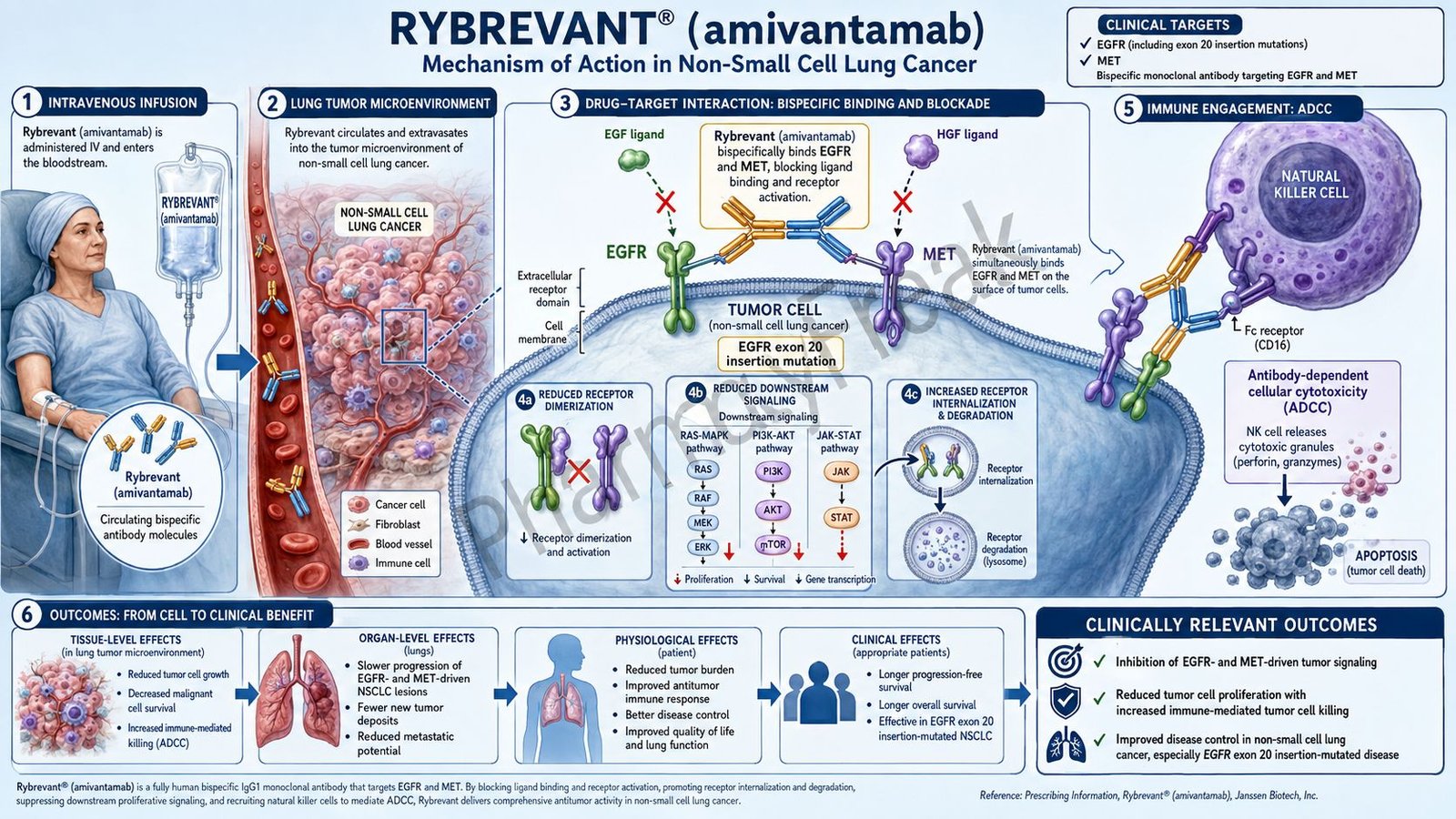
Rybrevant is different from small-molecule EGFR tyrosine kinase inhibitors because it is an antibody, not an oral kinase inhibitor. It binds to extracellular domains of EGFR and MET. The official label describes Rybrevant as a low-fucose human IgG1-based bispecific antibody directed against the EGF and MET receptors. It binds the extracellular domains of EGFR and MET, disrupts signaling through these receptors, and can recruit immune effector mechanisms against tumor cells.
Rybrevant is indicated in several adult locally advanced or metastatic NSCLC settings, including use with lazertinib for first-line EGFR exon 19 deletion or exon 21 L858R substitution disease, use with carboplatin and pemetrexed after progression on an EGFR TKI in exon 19 deletion or L858R disease, use with carboplatin and pemetrexed as first-line treatment for EGFR exon 20 insertion disease, and single-agent use for EGFR exon 20 insertion disease after progression on platinum-based chemotherapy.
For exam purposes, Rybrevant should be remembered as an EGFR-MET bispecific monoclonal antibody. It blocks EGFR and MET signaling, promotes receptor degradation, and recruits immune effector cells through ADCC and trogocytosis to kill EGFR/MET-expressing tumor cells.
Mechanism of Action (Step-wise)
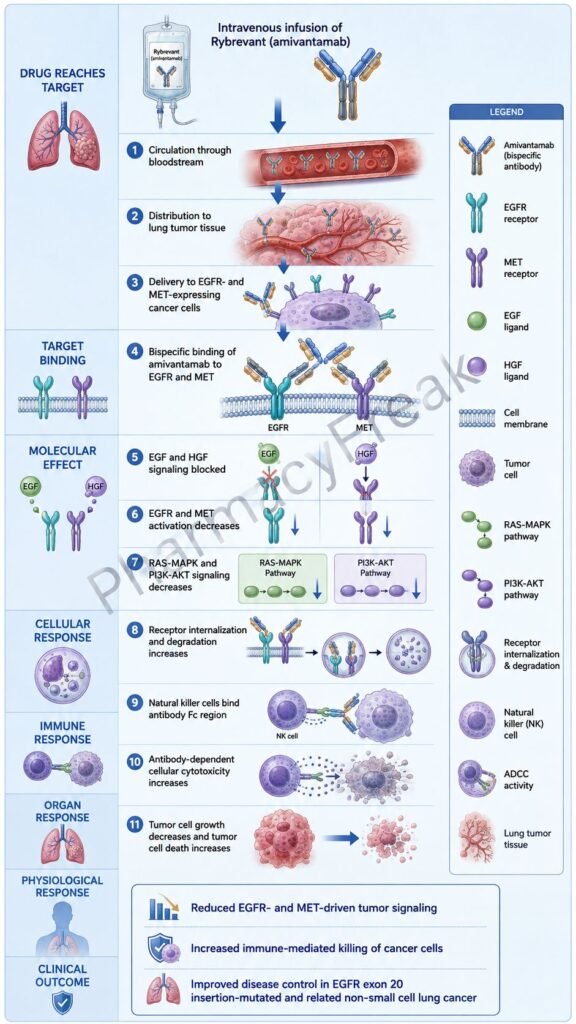
Step 1: NSCLC can be driven by EGFR mutations
Some NSCLC tumors depend on abnormal EGFR signaling. Important EGFR mutations include exon 19 deletions, exon 21 L858R substitution mutations, and exon 20 insertion mutations.
Step 2: EGFR activation promotes tumor growth
When EGFR is activated, it stimulates downstream signaling pathways such as RAS-RAF-MEK-ERK, PI3K-AKT, and JAK-STAT. These pathways promote tumor-cell proliferation, survival, migration, and resistance to apoptosis.
Step 3: MET signaling can also support cancer progression
MET is a receptor tyrosine kinase activated by hepatocyte growth factor. MET signaling can promote cell growth, motility, invasion, survival, angiogenesis, and metastatic behavior.
Step 4: EGFR and MET can cooperate in tumor signaling
EGFR and MET pathways may interact in cancer cells. MET activation can support bypass signaling and may contribute to resistance after EGFR-targeted therapy in some clinical contexts.
Step 5: Rybrevant is a bispecific antibody
Rybrevant contains amivantamab-vmjw, a bispecific antibody. Bispecific means the antibody can bind two different targets. In this case, Rybrevant targets EGFR and MET.
Step 6: Rybrevant binds extracellular EGFR
Rybrevant binds to the extracellular domain of EGFR on tumor cells. This differs from small-molecule EGFR inhibitors, which usually bind inside the kinase domain.
Step 7: Rybrevant binds extracellular MET
Rybrevant also binds to the extracellular domain of MET. This dual binding gives Rybrevant activity against signaling pathways involving both EGFR and MET.
Step 8: Ligand binding is blocked
By binding EGFR and MET, Rybrevant can interfere with normal ligand-driven activation of these receptors. The label states that amivantamab-vmjw disrupts EGFR and MET signaling through blocking ligand binding or degradation of EGFR and MET.
Step 9: EGFR and MET receptor degradation occurs
Rybrevant can promote degradation of EGFR and MET. Receptor degradation reduces the number of functional receptors available on the tumor-cell surface, lowering signaling intensity.
Step 10: Downstream oncogenic signaling decreases
When EGFR and MET signaling are disrupted, downstream tumor-promoting pathways such as MAPK and PI3K-AKT become less active. This reduces proliferative and survival signaling.
Step 11: Tumor-cell growth slows
Reduced EGFR/MET signaling can slow cancer-cell proliferation. This is especially important in tumors that are dependent on EGFR mutation-driven signaling.
Step 12: Immune effector cells are recruited
Because Rybrevant is an IgG1-based antibody, it can engage immune effector cells. The presence of EGFR and MET on tumor cells allows Rybrevant-bound cells to be targeted by immune cells such as natural killer cells and macrophages.
Step 13: ADCC contributes to tumor-cell killing
Natural killer cells can recognize antibody-coated tumor cells through Fc receptor interactions. This can trigger antibody-dependent cellular cytotoxicity, or ADCC, leading to tumor-cell destruction.
Step 14: Trogocytosis contributes to antitumor effect
Macrophages can participate through trogocytosis, a process in which immune cells remove portions of the target-cell membrane. The Rybrevant label specifically mentions ADCC and trogocytosis as immune effector mechanisms.
Step 15: Combination with lazertinib adds intracellular EGFR blockade
Lazertinib is an oral EGFR tyrosine kinase inhibitor. When Rybrevant is used with lazertinib, the treatment combines extracellular EGFR/MET antibody targeting with intracellular EGFR kinase inhibition. The label notes that amivantamab plus lazertinib increased in vivo antitumor activity compared with either agent alone in a mouse xenograft model with EGFR L858R mutation.
Step 16: Final therapeutic outcome
The final therapeutic effect of Rybrevant is inhibition of EGFR/MET-driven tumor signaling plus immune-mediated killing of EGFR/MET-expressing cancer cells. This helps control selected EGFR-mutated locally advanced or metastatic NSCLC.
Pharmacokinetics
Rybrevant is administered by intravenous infusion after dilution. It is supplied as a 350 mg/7 mL solution in a single-dose vial. The recommended dose is based on baseline body weight. For Rybrevant with lazertinib or as a single agent, the recommended dose is 1,050 mg for patients weighing less than 80 kg and 1,400 mg for patients weighing at least 80 kg.
For Rybrevant with carboplatin and pemetrexed, the recommended dose is also body-weight based but uses a different schedule and dose level. Patients weighing less than 80 kg receive 1,400 mg during weeks 1 to 4 and 1,750 mg from week 7 onward. Patients weighing at least 80 kg receive 1,750 mg during weeks 1 to 4 and 2,100 mg from week 7 onward.
For Rybrevant with lazertinib or as a single agent, treatment is given weekly for 5 weeks, with the first dose split between week 1 day 1 and week 1 day 2. Treatment then continues every 2 weeks starting at week 7.
For Rybrevant with chemotherapy, treatment is given weekly for 4 weeks, with the first dose split between week 1 day 1 and week 1 day 2. Treatment then continues every 3 weeks starting at week 7. When used with carboplatin and pemetrexed, pemetrexed is infused first, carboplatin second, and Rybrevant last.
Premedication is important because infusion-related reactions are common. The label recommends premedication with antihistamines, antipyretics, and glucocorticoids, and recommends peripheral-line administration during week 1 and week 2 to reduce infusion-related reaction risk.
Rybrevant exposure increases proportionally over the studied dose range. Steady-state concentrations are reached by week 13 for both the 2-week and 3-week dosing regimens, with systemic accumulation of about 1.9-fold.
The mean volume of distribution is approximately 5 L. The mean linear clearance is approximately 0.26 L/day, and the mean terminal half-life is approximately 14 days.
No clinically meaningful pharmacokinetic differences were observed based on age, body weight range, sex, race, ethnicity, mild or moderate renal impairment, or mild hepatic impairment. However, the effects of severe renal impairment, end-stage renal disease, and moderate-to-severe hepatic impairment have not been studied.
Body weight affects Rybrevant pharmacokinetics. Patients weighing at least 80 kg have lower exposure at the same dose, which is why body-weight-based dosing is used to produce comparable exposure.
Clinical Uses
Rybrevant is used in adults with locally advanced or metastatic NSCLC with specific EGFR mutations detected by an FDA-approved test.
In the first-line setting, Rybrevant is used with lazertinib for locally advanced or metastatic NSCLC with EGFR exon 19 deletions or exon 21 L858R substitution mutations.
Rybrevant is also used with carboplatin and pemetrexed for adults with locally advanced or metastatic NSCLC with EGFR exon 19 deletions or exon 21 L858R substitution mutations whose disease has progressed on or after treatment with an EGFR tyrosine kinase inhibitor.
Rybrevant is used with carboplatin and pemetrexed as first-line treatment for adults with locally advanced or metastatic NSCLC with EGFR exon 20 insertion mutations.
Rybrevant is also used as a single agent for adults with locally advanced or metastatic NSCLC with EGFR exon 20 insertion mutations whose disease has progressed on or after platinum-based chemotherapy.
Rybrevant is not traditional chemotherapy. It is not an oral EGFR TKI, not a MET TKI, not an immune checkpoint inhibitor, and not a cytotoxic antimetabolite. It is a bispecific EGFR-MET-directed antibody.
Rybrevant is not used for all lung cancers. It is used only in selected EGFR-mutated NSCLC settings, and mutation testing is required before therapy.
Rybrevant FASPRO is a related subcutaneous formulation containing amivantamab and hyaluronidase, but it has different dosing and administration from intravenous Rybrevant. The article here focuses on intravenous Rybrevant, amivantamab-vmjw.
Adverse Effects
Infusion-related reactions are among the most important adverse effects of Rybrevant. The label states that Rybrevant can cause infusion-related reactions, including anaphylaxis. Symptoms may include dyspnea, flushing, fever, chills, nausea, chest discomfort, hypotension, and vomiting. Median onset is approximately 1 hour.
Infusion reactions are especially common during early treatment. With Rybrevant plus lazertinib in MARIPOSA, infusion-related reactions occurred in 63% of patients, including Grade 3 in 5% and Grade 4 in 1%. With Rybrevant plus carboplatin and pemetrexed, infusion-related reactions occurred in 50% of patients.
Interstitial lung disease and pneumonitis are serious warnings. Patients should be monitored for new or worsening respiratory symptoms. Rybrevant should be withheld if ILD or pneumonitis is suspected and permanently discontinued if ILD or pneumonitis is confirmed.
Venous thromboembolic events are important when Rybrevant is used with lazertinib. The label recommends prophylactic anticoagulation for the first four months of treatment and monitoring for signs and symptoms of VTE. Recurrent VTE despite therapeutic anticoagulation requires permanent discontinuation of Rybrevant while continuing lazertinib.
Dermatologic adverse reactions are very common and can be severe. Rybrevant can cause rash, acneiform dermatitis, nail toxicity, paronychia, dry skin, pruritus, and rarely toxic epidermal necrolysis. Prophylactic and concomitant dermatologic medications are recommended at treatment initiation. Patients should limit sun exposure during treatment and for 2 months after treatment.
Ocular toxicity can occur. Patients with worsening eye symptoms should be referred promptly to an ophthalmologist. Dose withholding, reduction, or discontinuation may be needed depending on severity.
Embryo-fetal toxicity is an important warning. Based on mechanism of action and animal data involving EGFR and MET signaling, Rybrevant can cause fetal harm. Females of reproductive potential should use effective contraception during treatment and for the recommended period after the last dose.
Common adverse reactions with Rybrevant plus lazertinib include rash, nail toxicity, infusion-related reaction, musculoskeletal pain, stomatitis, edema, venous thromboembolism, paresthesia, fatigue, diarrhea, constipation, COVID-19, hemorrhage, dry skin, decreased appetite, pruritus, and nausea.
Common adverse reactions with Rybrevant plus carboplatin and pemetrexed include rash, nail toxicity, infusion-related reaction, fatigue, nausea, stomatitis, constipation, edema, decreased appetite, musculoskeletal pain, vomiting, and COVID-19.
Common adverse reactions with single-agent Rybrevant include rash, infusion-related reaction, paronychia, musculoskeletal pain, dyspnea, nausea, fatigue, edema, stomatitis, cough, constipation, and vomiting.
Comparative Analysis
Rybrevant is commonly compared with osimertinib, lazertinib, mobocertinib, poziotinib, platinum chemotherapy, pemetrexed, immune checkpoint inhibitors, and MET inhibitors.
Compared with osimertinib, Rybrevant has a different drug type and binding site. Osimertinib is an oral EGFR tyrosine kinase inhibitor that blocks the intracellular EGFR kinase domain, while Rybrevant is an intravenous bispecific antibody that binds extracellular EGFR and MET.
Compared with lazertinib, Rybrevant is an antibody therapy. Lazertinib is an oral EGFR TKI. When used together, Rybrevant provides extracellular EGFR/MET targeting and immune-effector recruitment, while lazertinib provides intracellular EGFR kinase inhibition.
Compared with chemotherapy, Rybrevant is more molecularly targeted. Carboplatin and pemetrexed broadly affect cancer-cell DNA synthesis and survival, while Rybrevant targets EGFR and MET receptors.
Compared with immune checkpoint inhibitors such as pembrolizumab, nivolumab, or atezolizumab, Rybrevant does not primarily release T-cell inhibition through PD-1, PD-L1, or CTLA-4 blockade. It targets EGFR/MET and recruits immune effector mechanisms such as ADCC and trogocytosis.
Compared with MET inhibitors such as capmatinib, tepotinib, or crizotinib, Rybrevant targets both EGFR and MET at extracellular receptor domains. MET TKIs mainly inhibit intracellular MET kinase signaling.
Compared with EGFR exon 20 insertion-directed small molecules, Rybrevant is not a small-molecule kinase inhibitor. Its antibody mechanism allows receptor targeting, signaling disruption, receptor degradation, and immune-cell-mediated killing.
Compared with cetuximab, Rybrevant has broader receptor targeting. Cetuximab targets EGFR only, while Rybrevant targets both EGFR and MET.
Compared with bispecific T-cell engagers, Rybrevant does not primarily connect tumor cells to CD3-positive T cells. Its immune activity is mainly described through NK-cell ADCC and macrophage trogocytosis.
MCQs
- Rybrevant contains which active drug?
a) Osimertinib
b) Amivantamab-vmjw
c) Lazertinib
d) Pemetrexed
Answer: b) Amivantamab-vmjw
- Rybrevant belongs to which pharmacological class?
a) EGFR-MET bispecific antibody
b) PD-1 monoclonal antibody
c) MEK inhibitor
d) ALK inhibitor
Answer: a) EGFR-MET bispecific antibody
- The main cancer type treated with Rybrevant is:
a) Multiple myeloma
b) Breast cancer
c) Prostate cancer
d) Non-small cell lung cancer
Answer: d) Non-small cell lung cancer
- Rybrevant binds to the extracellular domains of:
a) HER2 and VEGFR
b) PD-1 and PD-L1
c) EGFR and MET
d) CD20 and CD19
Answer: c) EGFR and MET
- EGFR activation commonly stimulates which downstream pathway?
a) GABA-chloride channel pathway
b) RAS-RAF-MEK-ERK pathway
c) Dopamine transporter pathway
d) Acetylcholinesterase pathway
Answer: b) RAS-RAF-MEK-ERK pathway
- Rybrevant disrupts EGFR and MET signaling by:
a) Blocking ligand binding or promoting receptor degradation
b) Directly blocking DNA polymerase
c) Activating beta-2 receptors
d) Inhibiting bacterial ribosomes
Answer: a) Blocking ligand binding or promoting receptor degradation
- Rybrevant can recruit natural killer cells for tumor killing through:
a) Opsonin-independent phagocytosis only
b) Complement C5 cleavage only
c) Dopamine receptor blockade
d) Antibody-dependent cellular cytotoxicity
Answer: d) Antibody-dependent cellular cytotoxicity
- Macrophage-related tumor-cell targeting by Rybrevant includes:
a) Glycolysis
b) Reverse transcriptase inhibition
c) Trogocytosis
d) Anticholinergic signaling
Answer: c) Trogocytosis
- Rybrevant with lazertinib is used first-line in NSCLC with:
a) EGFR exon 19 deletions or exon 21 L858R substitution mutations
b) BCR-ABL T315I mutation
c) HER2-positive gastric cancer only
d) ALK fusion only
Answer: a) EGFR exon 19 deletions or exon 21 L858R substitution mutations
- Rybrevant plus carboplatin and pemetrexed is used first-line for NSCLC with:
a) ROS1 fusion
b) KRAS wild-type status only
c) BRAF V600E only
d) EGFR exon 20 insertion mutations
Answer: d) EGFR exon 20 insertion mutations
- Single-agent Rybrevant is used after platinum-based chemotherapy in NSCLC with:
a) EGFR exon 19 deletion only
b) EGFR exon 20 insertion mutation
c) ALK fusion
d) NTRK fusion
Answer: b) EGFR exon 20 insertion mutation
- Rybrevant is administered by:
a) Oral tablet
b) Subcutaneous auto-injector only
c) Intravenous infusion
d) Inhalation
Answer: c) Intravenous infusion
- A major early adverse effect of Rybrevant is:
a) Infusion-related reaction
b) Severe hypoglycemia
c) Ototoxicity
d) Thyroid C-cell tumor
Answer: a) Infusion-related reaction
- With Rybrevant plus lazertinib, prophylactic anticoagulation is recommended to reduce:
a) Hyperglycemia
b) Alopecia
c) Hypothyroidism
d) Venous thromboembolic events
Answer: d) Venous thromboembolic events
- Which statement best describes Rybrevant?
a) It blocks PD-1 and restores T-cell activity
b) It binds EGFR and MET, disrupts receptor signaling, and recruits immune effector mechanisms
c) It inhibits ALK and ROS1 kinases intracellularly
d) It blocks VEGF and prevents angiogenesis only
Answer: b) It binds EGFR and MET, disrupts receptor signaling, and recruits immune effector mechanisms
FAQs
What is the mechanism of action of Rybrevant?
Rybrevant binds to the extracellular domains of EGFR and MET. It disrupts EGFR and MET signaling by blocking ligand binding or promoting receptor degradation. It also helps immune effector cells destroy tumor cells through ADCC and trogocytosis.
What is the generic name of Rybrevant?
The generic name of Rybrevant is amivantamab-vmjw.
What type of drug is Rybrevant?
Rybrevant is a low-fucose human IgG1-based bispecific monoclonal antibody directed against EGFR and MET receptors.
What is Rybrevant used for?
Rybrevant is used in selected adults with locally advanced or metastatic non-small cell lung cancer with specific EGFR mutations, including exon 19 deletions, exon 21 L858R substitution mutations, and exon 20 insertion mutations.
Is Rybrevant chemotherapy?
No. Rybrevant is not conventional chemotherapy. It is a targeted bispecific antibody against EGFR and MET.
Is Rybrevant an EGFR TKI?
No. Rybrevant is not an oral EGFR tyrosine kinase inhibitor. It is an intravenous antibody that binds extracellular EGFR and MET domains.
Why is Rybrevant combined with lazertinib?
Lazertinib inhibits intracellular EGFR kinase signaling, while Rybrevant targets extracellular EGFR and MET and recruits immune effector mechanisms. The combination provides complementary EGFR-directed activity.
What are important adverse effects of Rybrevant?
Important adverse effects include infusion-related reactions, interstitial lung disease or pneumonitis, venous thromboembolic events with lazertinib, dermatologic reactions, ocular toxicity, embryo-fetal toxicity, rash, nail toxicity, edema, stomatitis, fatigue, diarrhea, constipation, nausea, vomiting, dyspnea, and cough.
References
Goodman & Gilman’s The Pharmacological Basis of Therapeutics
Katzung Basic & Clinical Pharmacology
K.D. Tripathi Essentials of Medical Pharmacology
Harrison’s Principles of Internal Medicine