Table of Contents
Introduction
Lumateperone is an oral atypical antipsychotic marketed under the brand name Caplyta. It is used in adults for schizophrenia, depressive episodes associated with bipolar I or bipolar II disorder, and as adjunctive therapy with antidepressants for major depressive disorder. The current U.S. prescribing information lists the recommended Caplyta dose as 42 mg orally once daily with or without food, and the adjunctive major depressive disorder indication was added as a recent major change in 2025.
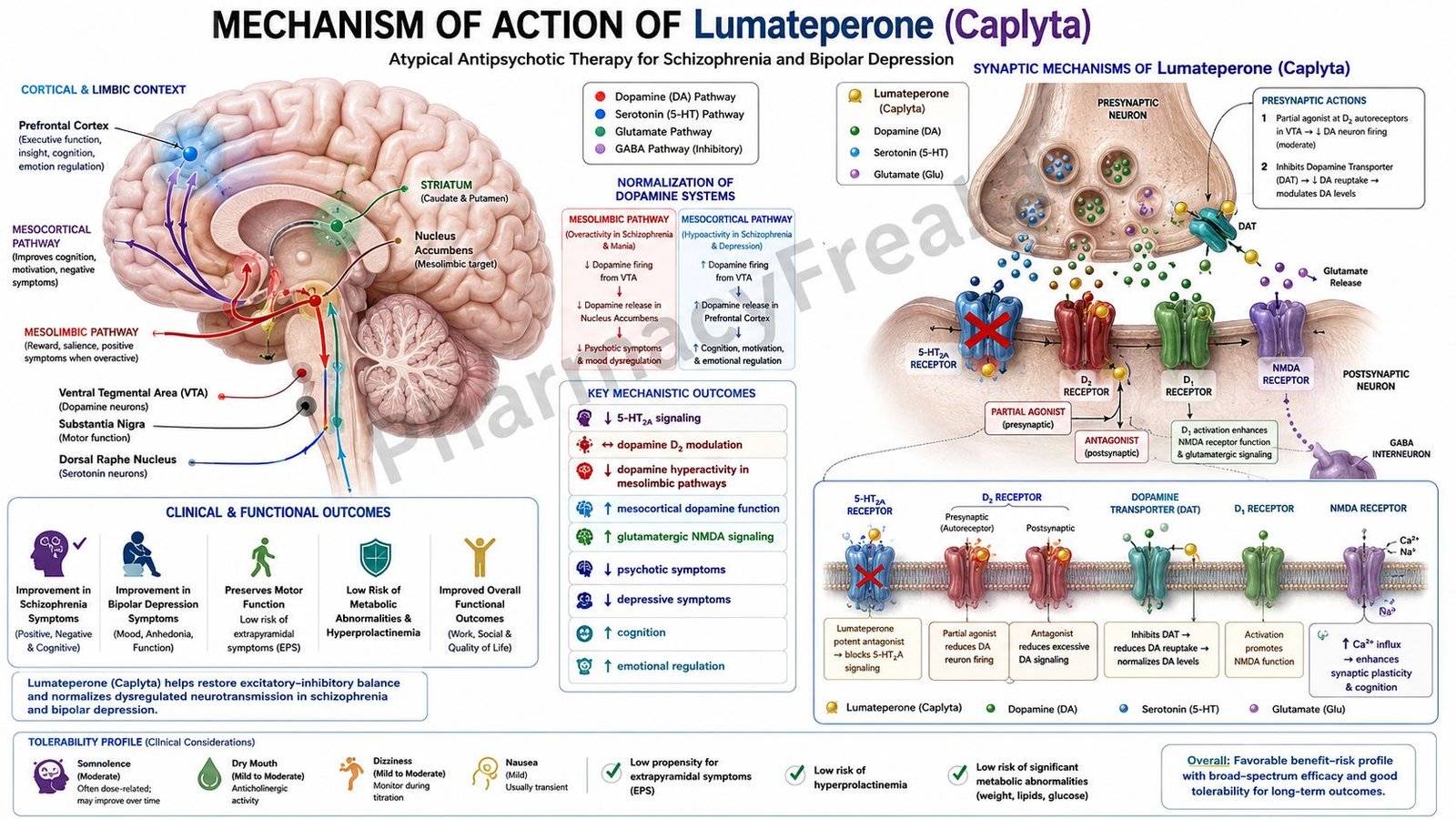
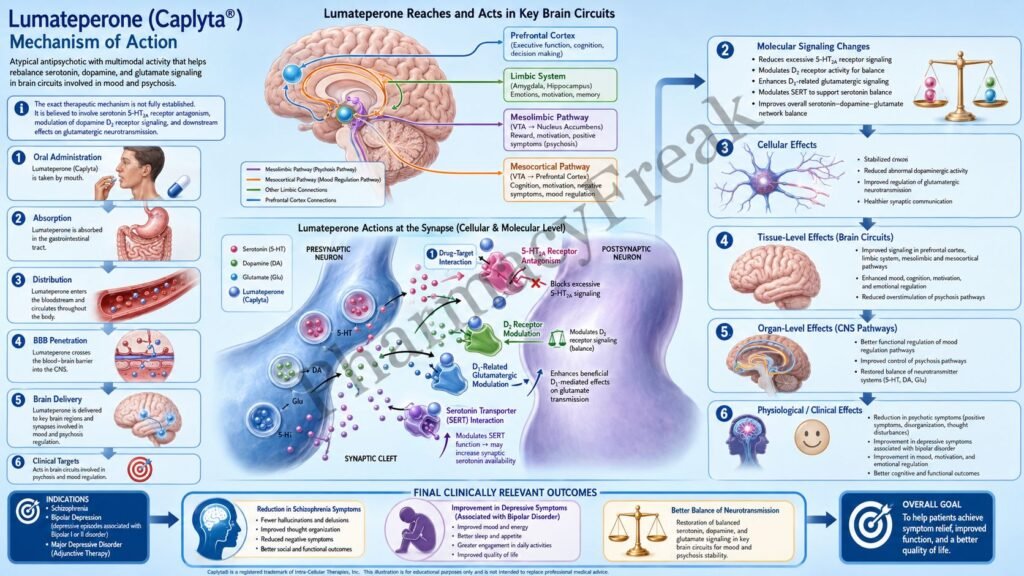
Lumateperone has a unique pharmacological profile compared with many older antipsychotics. It does not act as a simple dopamine D2 receptor blocker. Instead, it modulates serotonin, dopamine, and serotonin transporter-related pathways. Its exact mechanism of action in schizophrenia, bipolar depression, and major depressive disorder is not fully known, but it is thought to involve serotonin 5-HT2A receptor antagonism and dopamine D2 receptor partial agonist activity.
Schizophrenia involves abnormalities in dopamine, serotonin, glutamate, and cortical-limbic signaling. Bipolar depression and major depressive disorder involve dysregulation of mood, reward, motivation, sleep, cognition, and emotional processing pathways. By influencing serotonin and dopamine transmission, lumateperone may help improve psychotic symptoms and depressive symptoms in approved adult patients.
For exam purposes, lumateperone should be remembered as an atypical antipsychotic with strong serotonin 5-HT2A antagonism, moderate dopamine D2 receptor modulation, serotonin transporter interaction, and relatively low muscarinic and histaminergic receptor affinity.
Mechanism of Action (Step-wise)
Step 1: Dopamine and serotonin imbalance contributes to psychiatric symptoms
In schizophrenia, excessive dopamine signaling in mesolimbic pathways contributes to positive symptoms such as hallucinations, delusions, suspiciousness, and disorganized thinking. Reduced or dysregulated dopamine activity in prefrontal cortical pathways may contribute to negative symptoms, cognitive impairment, poor motivation, and emotional blunting.
Step 2: Traditional antipsychotic therapy mainly blocks D2 receptors
Many first-generation antipsychotics strongly block dopamine D2 receptors. This can reduce positive psychotic symptoms, but strong D2 blockade in the nigrostriatal pathway increases extrapyramidal symptoms, while blockade in the tuberoinfundibular pathway can increase prolactin.
Step 3: Lumateperone has moderate D2 receptor affinity
Lumateperone has moderate binding affinity for dopamine D2 receptors. In schizophrenia patients treated with Caplyta 42 mg for 2 weeks, the label reports mean dorsal striatal D2 receptor occupancy of 39%, which is lower than many conventional antipsychotic occupancy ranges.
Step 4: Lumateperone partially modulates D2 signaling
Lumateperone is described as having partial agonist activity at central dopamine D2 receptors. A partial agonist can reduce excessive dopamine signaling when dopamine tone is high, while providing some receptor activity when dopamine tone is low. This dopamine modulation may help reduce psychotic symptoms while potentially limiting strong D2 blockade-related adverse effects.
Step 5: 5-HT2A receptor antagonism is a major action
Lumateperone has high binding affinity for serotonin 5-HT2A receptors. 5-HT2A antagonism is an important feature of many atypical antipsychotics and may help regulate dopamine release in cortical and striatal pathways. The label reports high 5-HT2A affinity and greater than 80% cortical 5-HT2A receptor occupancy after a single 7 mg dose in healthy volunteers.
Step 6: 5-HT2A blockade helps balance dopamine pathways
By blocking 5-HT2A receptors, lumateperone may improve dopamine balance in different brain regions. This can help reduce psychosis while lowering the risk of motor side effects compared with strong dopamine-only blockade.
Step 7: Lumateperone interacts with serotonin transporters
Lumateperone has moderate binding affinity for serotonin transporters and inhibits serotonin uptake in cells expressing human SERT. This may contribute to antidepressant-related effects, especially in bipolar depression and adjunctive treatment of major depressive disorder.
Step 8: Serotonin transporter modulation may support mood improvement
By influencing serotonin transporter activity, lumateperone may increase serotonergic signaling in mood-related circuits. This may help improve depressive symptoms, emotional regulation, motivation, and anxiety-related components in selected patients.
Step 9: Dopamine D1 receptor interaction may influence cortical signaling
Lumateperone has moderate binding affinity for dopamine D1 receptors. D1 signaling is important in prefrontal cortex function, cognition, working memory, and executive processing. The exact clinical importance of D1 receptor interaction is not fully established, but it may contribute to lumateperone’s broader receptor profile.
Step 10: Alpha-1 adrenergic receptor interaction may contribute to side effects
Lumateperone has moderate affinity for adrenergic alpha-1A and alpha-1B receptors. Alpha-1 antagonism may contribute to dizziness, postural dizziness, orthostatic hypotension, and falls in susceptible patients.
Step 11: Low muscarinic and histaminergic affinity affects tolerability
Lumateperone has low binding affinity for muscarinic and histaminergic receptors. This is clinically relevant because strong muscarinic blockade is associated with dry mouth, constipation, urinary retention, blurred vision, and cognitive impairment, while strong histamine H1 blockade is associated with sedation and weight gain. However, dry mouth, somnolence, and sedation can still occur with lumateperone.
Step 12: Glutamate-related effects may be involved
Preclinical literature has suggested that lumateperone may influence glutamatergic signaling indirectly through dopamine and serotonin pathway effects. However, the official therapeutic mechanism remains described as unknown, and the most exam-relevant labeled mechanism is 5-HT2A antagonism plus D2 partial agonist activity.
Step 13: Psychotic symptoms may improve
In schizophrenia, modulation of dopamine and serotonin pathways can reduce positive symptoms such as hallucinations, delusions, suspiciousness, hostility, and conceptual disorganization. Longer-term therapy may also help reduce relapse risk in appropriate adult patients.
Step 14: Depressive symptoms may improve
In bipolar depression and adjunctive treatment of major depressive disorder, combined effects on serotonin, dopamine, and serotonin transporter-related signaling may improve mood, interest, energy, emotional regulation, and functional symptoms. Lumateperone is not an SSRI, but it has receptor and transporter actions that may support antidepressant effects.
Step 15: Final therapeutic outcome
The final therapeutic effect is modulation of abnormal neurotransmission rather than simple receptor blockade. Lumateperone helps regulate serotonin-dopamine signaling in approved adult psychiatric conditions, with clinical benefit in schizophrenia, bipolar depression, and adjunctive treatment of major depressive disorder.
Pharmacokinetics
Lumateperone is administered orally as Caplyta capsules. The recommended dosage is 42 mg once daily with or without food, and dose titration is not required. Available capsule strengths include 42 mg, 21 mg, and 10.5 mg.
After oral administration, lumateperone reaches peak plasma concentration in approximately 1 to 2 hours. Its absolute bioavailability is about 4.4%. A high-fat meal lowers peak concentration by about 33% and increases overall exposure by about 9%, which is why it can be taken without regard to meals.
Steady state is reached in about 5 days after once-daily administration. Lumateperone is highly protein bound, with about 97.4% binding in human plasma. Its volume of distribution after intravenous administration is about 4.1 L/kg.
Lumateperone is extensively metabolized. Multiple enzymes are involved, including UGT1A1, UGT1A4, UGT2B15, AKR1C1, AKR1B10, AKR1C4, CYP3A4, CYP2C8, and CYP1A2. This means its metabolism is multi-pathway, but CYP3A4 interactions are still clinically important.
Strong CYP3A4 inhibitors can markedly increase lumateperone exposure, while strong CYP3A4 inducers can greatly reduce exposure. The label reports that itraconazole increased lumateperone AUC about 3.8-fold, while rifampin reduced AUC by about 98%. Therefore, strong CYP3A4 inducers are especially important because they may make treatment ineffective.
The terminal half-life of lumateperone is about 18 hours after intravenous administration. In a human mass-balance study, about 58% of the radioactive dose was recovered in urine and 29% in feces, with less than 1% excreted unchanged in urine.
For patients with moderate or severe hepatic impairment, the recommended Caplyta dosage is 21 mg once daily. No clinically significant pharmacokinetic differences were observed based on age, sex, or race.
Clinical Uses
Lumateperone is used for the treatment of schizophrenia in adults. Schizophrenia is a chronic psychiatric disorder characterized by positive symptoms, negative symptoms, cognitive impairment, mood symptoms, and functional decline. Caplyta is not approved for schizophrenia in pediatric patients.
Lumateperone is used for depressive episodes associated with bipolar I or bipolar II disorder in adults. It can be used as monotherapy or as adjunctive therapy with lithium or valproate. This makes it important in bipolar depression pharmacology because many antipsychotics are used for mania, but lumateperone has a specific bipolar depression indication.
Lumateperone is also used as adjunctive therapy with antidepressants for major depressive disorder in adults. This means it is added to background antidepressant therapy when antidepressant response is inadequate; it is not simply a replacement for antidepressants in this indication.
Lumateperone is not approved for pediatric patients. The boxed warning states that antidepressants increased the risk of suicidal thoughts and behaviors in pediatric and young adult patients, and that Caplyta safety and effectiveness have not been established in pediatric patients.
Lumateperone is not approved for dementia-related psychosis. Elderly patients with dementia-related psychosis treated with antipsychotic drugs have an increased risk of death, and Caplyta is not approved for that population.
Adverse Effects
The adverse effects of lumateperone are related to central nervous system effects, dopamine-serotonin modulation, antipsychotic class warnings, metabolic effects, and drug-specific tolerability.
The boxed warning includes increased mortality in elderly patients with dementia-related psychosis and suicidal thoughts and behaviors in pediatric and young adult patients treated with antidepressants. Caplyta is not approved for dementia-related psychosis or pediatric use.
In schizophrenia trials, common adverse reactions included somnolence or sedation and dry mouth. Other reported reactions included nausea, dizziness, increased creatine phosphokinase, fatigue, vomiting, hepatic transaminase increases, and decreased appetite.
In bipolar depression monotherapy trials, common adverse reactions included somnolence or sedation, dizziness, nausea, and dry mouth. Headache, diarrhea, vomiting, abdominal pain, and upper respiratory tract infection were also reported more often than placebo in the label table.
When lumateperone was used with lithium or valproate for bipolar depression, common adverse reactions included somnolence or sedation, dizziness, nausea, and dry mouth. Other reported reactions included vomiting, diarrhea, upper respiratory tract infection, blurred vision, and increased blood prolactin.
In adjunctive major depressive disorder studies, common adverse reactions included dizziness, dry mouth, somnolence or sedation, nausea, fatigue, and diarrhea. Headache, tremor, vomiting, vertigo, and insomnia were also reported in the adverse reaction table.
Neuroleptic malignant syndrome is a rare but potentially fatal antipsychotic adverse effect. It may present with high fever, muscle rigidity, delirium, autonomic instability, elevated creatine phosphokinase, rhabdomyolysis, and acute renal failure. Caplyta should be discontinued immediately if NMS is suspected.
Tardive dyskinesia can occur with antipsychotic drugs. It involves involuntary, repetitive movements, often affecting the face, tongue, lips, jaw, trunk, or extremities. Risk increases with treatment duration and cumulative exposure, especially in older adults.
Metabolic changes may occur with atypical antipsychotics, including hyperglycemia, diabetes mellitus, dyslipidemia, and weight gain. Lumateperone may have a different metabolic profile from more weight-promoting antipsychotics, but metabolic monitoring remains important.
Leukopenia, neutropenia, orthostatic hypotension, syncope, falls, seizures, cognitive and motor impairment, body temperature dysregulation, dysphagia, and hypersensitivity reactions are important antipsychotic-related warnings.
Lumateperone is contraindicated in patients with a history of hypersensitivity reaction to lumateperone or any Caplyta component. Reported hypersensitivity reactions include pruritus, rash, allergic dermatitis, papular rash, generalized rash, and urticaria.
Comparative Analysis
Lumateperone is commonly compared with risperidone, olanzapine, quetiapine, aripiprazole, brexpiprazole, cariprazine, lurasidone, and haloperidol.
Compared with haloperidol, lumateperone is an atypical antipsychotic with serotonin-dopamine modulation rather than strong D2 blockade alone. Haloperidol is a high-potency first-generation antipsychotic and is more strongly associated with extrapyramidal symptoms.
Compared with risperidone, lumateperone generally has lower dopamine D2 receptor occupancy at the approved dose. Risperidone is more likely to cause prolactin elevation because of stronger D2 blockade, although increased blood prolactin can still occur with lumateperone in some settings.
Compared with olanzapine, lumateperone has lower histaminergic and muscarinic receptor affinity. Olanzapine is strongly associated with weight gain, sedation, dyslipidemia, and insulin resistance. Lumateperone still requires metabolic monitoring, but its receptor profile is different.
Compared with quetiapine, lumateperone has a different receptor profile. Quetiapine has strong antihistaminic activity and is often sedating, while lumateperone combines 5-HT2A antagonism, D2 modulation, and serotonin transporter interaction.
Compared with aripiprazole and brexpiprazole, lumateperone shares the concept of dopamine-serotonin modulation, but its receptor profile is distinct. Aripiprazole and brexpiprazole are more commonly described as D2 partial agonist antipsychotics, while lumateperone is often highlighted for high 5-HT2A occupancy, lower D2 occupancy, and serotonin transporter interaction.
Compared with cariprazine, lumateperone is less defined by D3-preferring pharmacology. Cariprazine has strong D3/D2 partial agonist activity and is used for schizophrenia and bipolar disorder indications. Lumateperone is used for schizophrenia, bipolar depression, and adjunctive MDD in adults.
Compared with lurasidone, both drugs are atypical antipsychotics with important serotonin-dopamine effects and bipolar depression relevance. Lurasidone requires administration with food for adequate absorption, while Caplyta can be taken with or without food.
Compared with SSRIs and SNRIs, lumateperone is not a first-line antidepressant monotherapy. In major depressive disorder, it is used as adjunctive therapy with antidepressants in adults.
MCQs
- Lumateperone is marketed under which brand name?
a) Rexulti
b) Caplyta
c) Latuda
d) Vraylar
Answer: b) Caplyta
- Lumateperone belongs to which pharmacological class?
a) Typical antipsychotic
b) Atypical antipsychotic
c) Benzodiazepine
d) SSRI antidepressant
Answer: b) Atypical antipsychotic
- The exact therapeutic mechanism of lumateperone is:
a) Fully explained by acetylcholinesterase inhibition
b) Unknown, but likely related to serotonin and dopamine modulation
c) Direct bacterial ribosome inhibition
d) Complete NMDA receptor blockade only
Answer: b) Unknown, but likely related to serotonin and dopamine modulation
- Lumateperone has high binding affinity for which receptor?
a) Serotonin 5-HT2A receptor
b) Muscarinic M1 receptor
c) Histamine H1 receptor only
d) Beta-2 receptor
Answer: a) Serotonin 5-HT2A receptor
- Lumateperone has partial agonist activity at which receptor?
a) Dopamine D2 receptor
b) GABA-A receptor
c) Nicotinic receptor
d) Insulin receptor
Answer: a) Dopamine D2 receptor
- Lumateperone also interacts with which transporter?
a) Serotonin transporter
b) Sodium-glucose cotransporter
c) Dopamine beta-hydroxylase transporter
d) Bile acid transporter only
Answer: a) Serotonin transporter
- Caplyta is approved for schizophrenia in:
a) Adults
b) Neonates only
c) Pediatric patients only
d) Dogs and cats only
Answer: a) Adults
- Lumateperone is approved for depressive episodes associated with:
a) Bipolar I or bipolar II disorder
b) Parkinson’s disease only
c) Dementia-related psychosis only
d) Acute alcohol withdrawal only
Answer: a) Bipolar I or bipolar II disorder
- Lumateperone is approved as adjunctive therapy with antidepressants for:
a) Major depressive disorder in adults
b) Acute mania in children
c) Epilepsy
d) Migraine
Answer: a) Major depressive disorder in adults
- The recommended Caplyta dosage for most adults is:
a) 42 mg once daily
b) 500 mg twice daily
c) 5 mg every month
d) 1 mg once weekly
Answer: a) 42 mg once daily
- Caplyta may be taken:
a) With or without food
b) Only after a high-fat meal
c) Only with grapefruit juice
d) Only by injection
Answer: a) With or without food
- Which adverse effect is common in schizophrenia trials with lumateperone?
a) Somnolence or sedation
b) Severe hypoglycemia
c) Irreversible hearing loss
d) Gingival hyperplasia
Answer: a) Somnolence or sedation
- Which CYP interaction is clinically important for lumateperone?
a) Strong CYP3A4 inhibitors and inducers
b) CYP2E1 alcohol metabolism only
c) Acetylcholinesterase inhibition only
d) Monoamine oxidase-B activation only
Answer: a) Strong CYP3A4 inhibitors and inducers
- Which serious antipsychotic adverse effect can occur with lumateperone?
a) Neuroleptic malignant syndrome
b) Mandatory renal stones
c) Severe ototoxicity in every patient
d) Acute bacterial meningitis
Answer: a) Neuroleptic malignant syndrome
- Which statement best describes lumateperone?
a) It is an atypical antipsychotic with 5-HT2A antagonism, D2 partial agonist activity, and serotonin transporter interaction
b) It is a pure dopamine D2 full antagonist with no serotonin activity
c) It is an antibiotic used for pneumonia
d) It is an oral insulin sensitizer
Answer: a) It is an atypical antipsychotic with 5-HT2A antagonism, D2 partial agonist activity, and serotonin transporter interaction
FAQs
What is the mechanism of action of lumateperone?
Lumateperone’s exact therapeutic mechanism is not fully known. It is believed to work through serotonin 5-HT2A receptor antagonism, dopamine D2 receptor partial agonist activity, serotonin transporter interaction, and broader modulation of serotonin-dopamine neurotransmission.
What is the brand name of lumateperone?
The brand name of lumateperone is Caplyta.
Is lumateperone an antipsychotic?
Yes. Lumateperone is an atypical antipsychotic. It is used in adults for schizophrenia, bipolar depression, and adjunctive treatment of major depressive disorder.
Is lumateperone used for bipolar depression?
Yes. Lumateperone is used for depressive episodes associated with bipolar I or bipolar II disorder in adults. It can be used as monotherapy or with lithium or valproate.
Is lumateperone used for major depressive disorder?
Yes. Lumateperone is used as adjunctive therapy with antidepressants for major depressive disorder in adults. It is added to antidepressant treatment rather than used as a standard first-line antidepressant alone.
Does lumateperone cause sedation?
Yes. Somnolence or sedation can occur with lumateperone. Patients should be cautious with driving or operating machinery until they know how the medicine affects them.
Does lumateperone cause extrapyramidal symptoms?
Extrapyramidal symptoms can occur with antipsychotics, including lumateperone. However, lumateperone has lower D2 receptor occupancy than many traditional antipsychotics, which may influence its movement-disorder profile.
Can lumateperone be used in dementia-related psychosis?
No. Caplyta is not approved for dementia-related psychosis. Antipsychotic drugs carry a boxed warning for increased mortality in elderly patients with dementia-related psychosis.
References
Goodman & Gilman’s The Pharmacological Basis of Therapeutics
Katzung Basic & Clinical Pharmacology