Table of Contents
Introduction
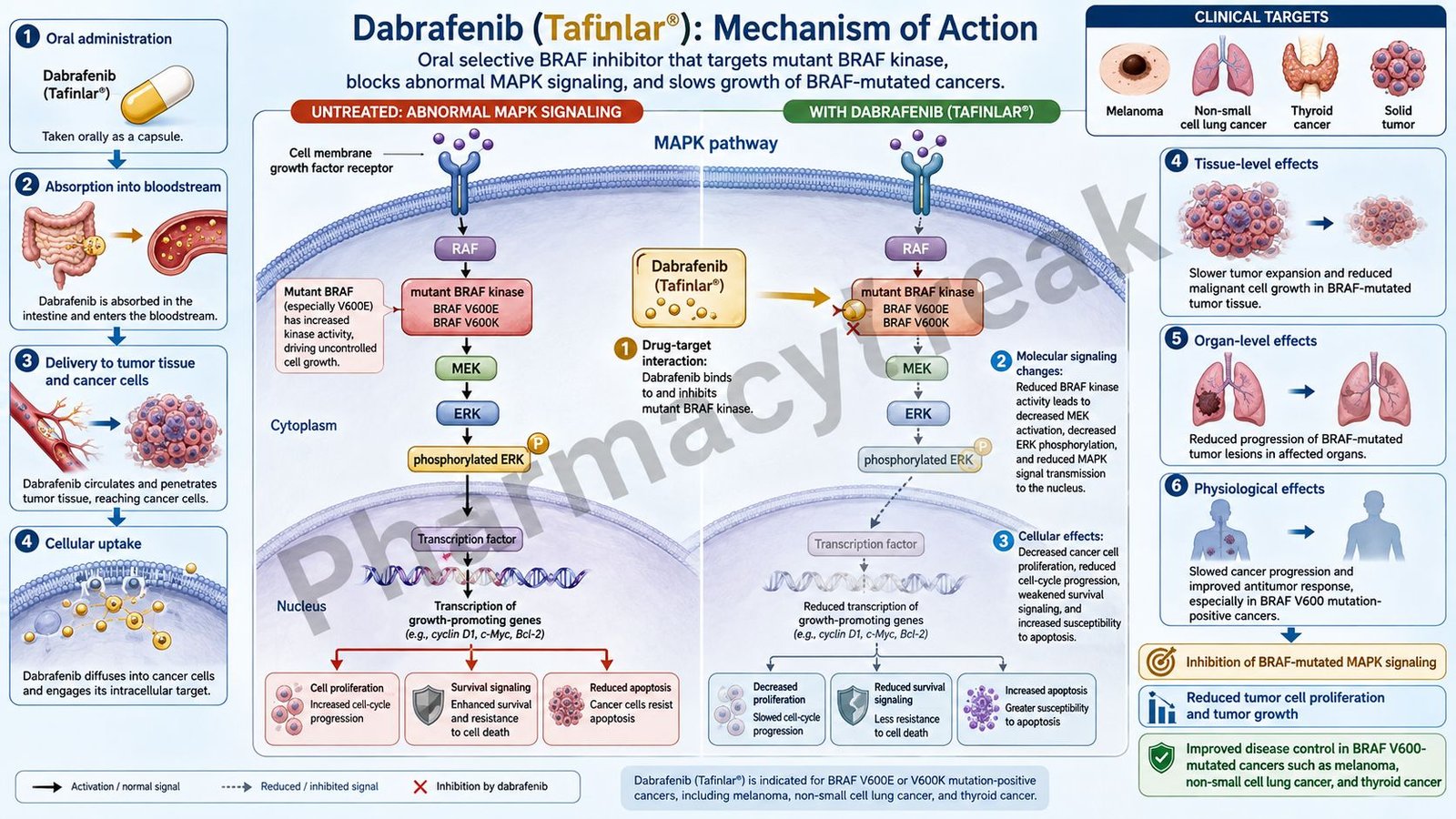
Dabrafenib is an oral targeted anticancer drug marketed under the brand name Tafinlar. Pharmacologically, dabrafenib is a BRAF kinase inhibitor used in selected cancers with activating BRAF mutations.
The BRAF protein is a serine/threonine kinase in the RAS-RAF-MEK-ERK signaling pathway, also called the MAPK pathway. This pathway normally transmits growth signals from cell-surface receptors to the nucleus. When activated in a controlled manner, it helps regulate cell proliferation, differentiation, survival, and gene transcription.
In many cancers, the BRAF gene becomes mutated. The most important mutation is BRAF V600E, where valine at position 600 is replaced by glutamic acid. Other clinically important mutations include BRAF V600K and BRAF V600D. These mutations cause constitutive BRAF kinase activation, meaning the pathway remains turned on even without normal growth-factor stimulation.
Dabrafenib inhibits some mutated forms of BRAF kinase. The official Tafinlar label states that dabrafenib inhibits BRAF V600E, BRAF V600K, and BRAF V600D enzymes, and that BRAF V600 mutations can produce constitutively activated BRAF kinases that stimulate tumor-cell growth.
Tafinlar is used as a single agent for unresectable or metastatic melanoma with BRAF V600E mutation. It is also used with trametinib for several BRAF V600 mutation-positive cancers, including melanoma, adjuvant melanoma, metastatic non-small cell lung cancer, anaplastic thyroid cancer, selected unresectable or metastatic solid tumors, and pediatric low-grade glioma.
For exam purposes, dabrafenib should be remembered as an oral BRAF inhibitor that blocks mutant BRAF-driven MAPK signaling. Its key mechanism is inhibition of abnormal BRAF kinase activity, leading to reduced MEK-ERK signaling, decreased tumor-cell proliferation, and increased tumor control in BRAF V600 mutation-positive cancers.
Mechanism of Action (Step-wise)
Step 1: Growth-factor signaling activates the MAPK pathway
Normally, growth factors bind to receptor tyrosine kinases on the cell membrane. This activates RAS, which then activates RAF kinases. RAF activates MEK, and MEK activates ERK. ERK then enters the nucleus and regulates genes involved in cell growth and survival.
Step 2: BRAF is a key RAF-family kinase
BRAF is one of the RAF-family kinases. It lies downstream of RAS and upstream of MEK in the MAPK pathway. When BRAF is activated normally, it helps transmit controlled mitogenic signals.
Step 3: BRAF V600 mutations cause constitutive activation
BRAF V600E, V600K, and related mutations make BRAF abnormally active. This means the kinase can stimulate downstream signaling even without normal upstream control.
Step 4: Constitutive BRAF activation drives cancer-cell growth
Mutant BRAF continuously activates MEK and ERK. This increases transcription of genes that promote cancer-cell proliferation, survival, invasion, and resistance to apoptosis.
Step 5: BRAF V600E is the most important mutation
BRAF V600E is a common actionable mutation in melanoma and is also found in several other cancers. It produces strong activation of the MAPK pathway and makes the tumor sensitive to BRAF-targeted therapy in selected settings.
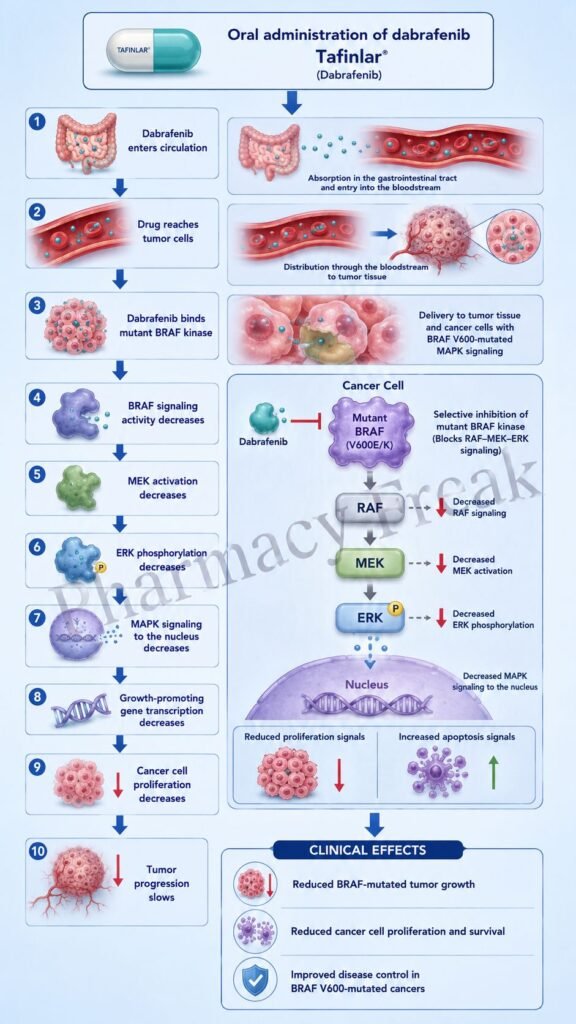
Step 6: Dabrafenib binds and inhibits mutant BRAF kinase
Dabrafenib inhibits mutated BRAF kinases, especially BRAF V600E and BRAF V600K. This is the central molecular mechanism of dabrafenib. The label reports in vitro IC50 values of 0.65 nM, 0.5 nM, and 1.84 nM for BRAF V600E, V600K, and V600D enzymes, respectively.
Step 7: BRAF kinase activity decreases
When dabrafenib inhibits mutant BRAF, phosphorylation of MEK is reduced. This decreases downstream MAPK pathway activation.
Step 8: MEK and ERK signaling decreases
Because BRAF is upstream of MEK and ERK, BRAF inhibition reduces signaling through the RAF-MEK-ERK cascade. This decreases nuclear transcription of genes required for tumor growth and survival.
Step 9: Tumor-cell proliferation slows
With reduced MAPK signaling, cancer cells receive fewer proliferative signals. This can slow cell-cycle progression and reduce tumor-cell expansion.
Step 10: Tumor-cell survival signaling decreases
MAPK signaling also supports survival and resistance to apoptosis. Dabrafenib reduces this oncogenic survival signaling in BRAF V600 mutation-positive tumor cells.
Step 11: Tumor growth is inhibited
The label states that dabrafenib inhibits cell growth of various BRAF V600 mutation-positive tumors in vitro and in vivo.
Step 12: Combination with trametinib gives dual MAPK blockade
Trametinib is a MEK inhibitor. Dabrafenib blocks BRAF, while trametinib blocks MEK downstream. The combination targets two different kinases in the RAS-RAF-MEK-ERK pathway. The label states that dabrafenib plus trametinib produced greater growth inhibition and prolonged tumor-growth inhibition compared with either drug alone in BRAF V600 mutation-positive models.
Step 13: Combination therapy reduces resistance and paradoxical effects
BRAF inhibitor monotherapy can allow pathway reactivation through MEK/ERK signaling or other feedback mechanisms. Combining dabrafenib with trametinib helps suppress downstream pathway reactivation and improves clinical activity in many approved settings.
Step 14: BRAF inhibition can promote growth in wild-type BRAF tumors
BRAF inhibitors can paradoxically activate MAPK signaling in cells with upstream RAS activation and wild-type BRAF. This is why Tafinlar is not indicated for wild-type BRAF solid tumors. The label warns that increased cell proliferation can occur with BRAF inhibitors in BRAF wild-type tumors.
Step 15: Final therapeutic outcome
The final therapeutic outcome is inhibition of mutant BRAF-driven MAPK signaling. This reduces cancer-cell proliferation and tumor growth in selected BRAF V600 mutation-positive cancers.
Pharmacokinetics
Dabrafenib is administered orally as Tafinlar capsules or tablets for oral suspension. In adults, the recommended dosage is 150 mg orally twice daily. The doses should be taken approximately 12 hours apart.
Tafinlar should be taken on an empty stomach, at least 1 hour before or 2 hours after a meal. Capsules should not be opened, crushed, or broken. If vomiting occurs after a dose, an additional dose should not be taken; the next dose should be taken at the scheduled time.
For pediatric patients, dosing is based on body weight. Tafinlar capsules have established pediatric dosing for patients weighing at least 26 kg, while tablets for oral suspension have weight-based dosing for adult and pediatric patients.
Dabrafenib reaches peak plasma concentration at a median time of about 2 hours. The mean absolute bioavailability is approximately 95% for Tafinlar capsules and 76% for tablets for oral suspension.
Food significantly decreases dabrafenib exposure. A high-fat meal decreased capsule Cmax by 51% and AUC by 31%, and delayed Tmax by 3.6 hours compared with fasting conditions. This explains the empty-stomach dosing instruction.
Dabrafenib is highly plasma protein bound, approximately 99.7%. Its apparent volume of distribution is about 70.3 L.
The mean terminal half-life of dabrafenib is about 8 hours. Hydroxy-dabrafenib has a half-life of about 10 hours, while carboxy-dabrafenib and desmethyl-dabrafenib have longer half-lives of about 21 to 22 hours.
Dabrafenib is metabolized mainly by CYP2C8 and CYP3A4 to hydroxy-dabrafenib. Hydroxy-dabrafenib is further metabolized through CYP3A4. Both hydroxy-dabrafenib and desmethyl-dabrafenib likely contribute to clinical activity.
Fecal excretion is the major route of elimination, accounting for about 71% of the radioactive dose. Urinary excretion accounts for about 23%, mainly as metabolites.
Drug interactions are important. Strong CYP3A4 or CYP2C8 inhibitors can increase dabrafenib exposure, while strong CYP3A4 or moderate CYP2C8 inducers can reduce exposure. Dabrafenib can also reduce exposure to several enzyme substrates, including CYP3A4 and CYP2C9 substrates.
Clinical Uses
Dabrafenib is used as a single agent for patients with unresectable or metastatic melanoma with BRAF V600E mutation detected by an FDA-approved test.
Dabrafenib is used with trametinib for unresectable or metastatic melanoma with BRAF V600E or BRAF V600K mutations.
Dabrafenib plus trametinib is used as adjuvant treatment for melanoma with BRAF V600E or V600K mutation and lymph-node involvement after complete resection.
Dabrafenib plus trametinib is used for metastatic non-small cell lung cancer with BRAF V600E mutation. It is also used for locally advanced or metastatic anaplastic thyroid cancer with BRAF V600E mutation when there are no satisfactory locoregional treatment options.
Dabrafenib plus trametinib is used in adult and pediatric patients 1 year of age and older with unresectable or metastatic solid tumors with BRAF V600E mutation who have progressed after prior treatment and have no satisfactory alternative treatment options. This indication is under accelerated approval based on response rate and duration of response.
Dabrafenib plus trametinib is also used for pediatric patients 1 year of age and older with low-grade glioma with BRAF V600E mutation who require systemic therapy.
Tafinlar is not indicated for colorectal cancer because of known intrinsic resistance to BRAF inhibition. It is also not indicated for wild-type BRAF solid tumors.
Dabrafenib is not traditional cytotoxic chemotherapy. It is not an immune checkpoint inhibitor, not a monoclonal antibody, and not a MEK inhibitor. It is an oral targeted BRAF kinase inhibitor.
Adverse Effects
The adverse effects of dabrafenib include cutaneous toxicity, fever, secondary malignancies, hemorrhage, cardiomyopathy, ocular toxicity, hyperglycemia, hemolytic anemia risk in G6PD deficiency, hemophagocytic lymphohistiocytosis, and embryo-fetal toxicity.
New primary malignancies can occur with dabrafenib alone or with trametinib. These include cutaneous malignancies such as cutaneous squamous cell carcinoma and keratoacanthoma, and non-cutaneous malignancies. Patients require skin monitoring before, during, and after therapy.
Tumor promotion in BRAF wild-type tumors is an important mechanism-based warning. BRAF inhibitors can increase cell proliferation in tumors with upstream RAS activation and wild-type BRAF. This is why BRAF mutation confirmation is essential before therapy.
Hemorrhage can occur, especially with dabrafenib plus trametinib. Major hemorrhagic events may occur, and patients should be monitored for signs of bleeding.
Cardiomyopathy is an important warning in combination therapy with trametinib. Left ventricular ejection fraction should be assessed before treatment, after one month, and every 2 to 3 months during treatment.
Uveitis can occur with dabrafenib. Patients with visual symptoms should receive ophthalmologic evaluation. Symptoms may include eye pain, redness, photophobia, blurred vision, or visual disturbance.
Serious febrile reactions are very important. Fever is common with dabrafenib, and the incidence and severity of pyrexia increase when dabrafenib is used with trametinib. Fever may be associated with chills, dehydration, hypotension, or kidney injury.
Serious skin toxicities may occur. Severe cutaneous adverse reactions can include Stevens-Johnson syndrome and DRESS. Rash, hyperkeratosis, papillomas, palmar-plantar erythrodysesthesia, and other skin reactions are also clinically important.
Hyperglycemia can occur. Serum glucose should be monitored in patients with pre-existing diabetes or hyperglycemia.
Dabrafenib may cause hemolytic anemia in patients with glucose-6-phosphate dehydrogenase deficiency, so these patients require close monitoring.
Hemophagocytic lymphohistiocytosis, or HLH, has been reported. Treatment should be interrupted if HLH is suspected and discontinued if HLH is confirmed.
Embryo-fetal toxicity is an important warning. Based on animal studies and mechanism of action, dabrafenib can cause fetal harm. Females of reproductive potential should use effective non-hormonal contraception because dabrafenib can make hormonal contraceptives less effective.
Common adverse reactions with single-agent Tafinlar include hyperkeratosis, headache, pyrexia, arthralgia, papilloma, alopecia, and palmar-plantar erythrodysesthesia syndrome. With trametinib combination therapy, common adverse reactions vary by indication but often include pyrexia, rash, chills, fatigue, nausea, headache, diarrhea, vomiting, cough, hemorrhage, edema, and musculoskeletal symptoms.
Comparative Analysis
Dabrafenib is commonly compared with vemurafenib, encorafenib, trametinib, cobimetinib, binimetinib, immune checkpoint inhibitors, EGFR inhibitors, and conventional chemotherapy.
Compared with vemurafenib, dabrafenib belongs to the same broad class of BRAF inhibitors. Both target mutant BRAF, especially BRAF V600E, and are used in BRAF-mutated melanoma. They differ in dosing, pharmacokinetics, toxicity profile, and approved combination regimens.
Compared with encorafenib, dabrafenib also inhibits mutant BRAF, but encorafenib is commonly paired with binimetinib in melanoma and with cetuximab in BRAF V600E-mutated colorectal cancer. Dabrafenib is commonly paired with trametinib in several BRAF V600-mutated tumors.
Compared with trametinib, dabrafenib acts upstream. Dabrafenib inhibits BRAF, while trametinib inhibits MEK1/2. Their combination blocks two levels of the same MAPK pathway and improves tumor control compared with either single-agent pathway blockade in many settings.
Compared with cobimetinib and binimetinib, dabrafenib has a different target. Cobimetinib and binimetinib are MEK inhibitors, while dabrafenib is a BRAF inhibitor.
Compared with immune checkpoint inhibitors such as pembrolizumab, nivolumab, and ipilimumab, dabrafenib does not primarily activate antitumor immunity. Checkpoint inhibitors enhance immune recognition and killing of tumor cells, while dabrafenib directly blocks oncogenic kinase signaling.
Compared with EGFR inhibitors, dabrafenib targets BRAF rather than EGFR. In BRAF-mutant colorectal cancer, EGFR-mediated MAPK pathway reactivation contributes to intrinsic resistance to BRAF inhibition, which is why single-agent BRAF inhibition is not used for colorectal cancer.
Compared with conventional chemotherapy, dabrafenib is more molecularly targeted. Chemotherapy broadly affects rapidly dividing cells, while dabrafenib targets cancers with specific BRAF V600 mutations.
MCQs
- Dabrafenib is marketed under which brand name?
a) Mekinist
b) Tafinlar
c) Zelboraf
d) Braftovi
Answer: b) Tafinlar
- Dabrafenib belongs to which pharmacological class?
a) BRAF kinase inhibitor
b) MEK inhibitor
c) PD-1 inhibitor
d) EGFR monoclonal antibody
Answer: a) BRAF kinase inhibitor
- The main pathway affected by dabrafenib is:
a) RAS-RAF-MEK-ERK pathway
b) JAK-STAT only
c) GABAergic pathway
d) Cholinergic pathway
Answer: a) RAS-RAF-MEK-ERK pathway
- Dabrafenib is especially active against which BRAF mutation?
a) BRAF V600E
b) EGFR L858R
c) KRAS G12C
d) ALK fusion
Answer: a) BRAF V600E
- BRAF V600 mutations cause:
a) Constitutive activation of BRAF kinase
b) Direct insulin receptor blockade
c) Acetylcholine receptor destruction
d) Dopamine transporter inhibition
Answer: a) Constitutive activation of BRAF kinase
- Dabrafenib decreases downstream activation of:
a) MEK and ERK
b) GABA-A and GABA-B
c) CD20 and CD19
d) OX1R and OX2R
Answer: a) MEK and ERK
- Dabrafenib is commonly combined with:
a) Trametinib
b) Levodopa
c) Metformin
d) Amoxicillin
Answer: a) Trametinib
- Trametinib inhibits:
a) MEK1/2
b) BRAF only
c) CD20
d) VEGFR only
Answer: a) MEK1/2
- Tafinlar as a single agent is indicated for unresectable or metastatic melanoma with:
a) BRAF V600E mutation
b) Wild-type BRAF
c) EGFR exon 19 deletion
d) HER2 amplification
Answer: a) BRAF V600E mutation
- Tafinlar is not indicated for colorectal cancer because of:
a) Known intrinsic resistance to BRAF inhibition
b) Lack of oral absorption
c) Complete absence of BRAF mutations in colorectal cancer
d) Mandatory renal failure
Answer: a) Known intrinsic resistance to BRAF inhibition
- The recommended adult dose of Tafinlar capsules is:
a) 150 mg orally twice daily
b) 5 mg orally once daily
c) 300 mg IV every 4 weeks
d) 80 mg orally once daily
Answer: a) 150 mg orally twice daily
- Tafinlar should be taken:
a) On an empty stomach
b) Only with a high-fat meal
c) Only with grapefruit juice
d) Only after crushing capsules
Answer: a) On an empty stomach
- Which adverse effect is common with dabrafenib?
a) Pyrexia
b) Severe hypoglycemia in every patient
c) Ototoxicity
d) Gingival hyperplasia
Answer: a) Pyrexia
- Which eye-related adverse effect may occur with dabrafenib?
a) Uveitis
b) Cataract in every patient
c) Acute glaucoma in all patients
d) Complete color blindness
Answer: a) Uveitis
- Which statement best describes dabrafenib?
a) It inhibits mutant BRAF kinase and reduces MAPK pathway signaling in BRAF V600 mutation-positive cancers
b) It blocks PD-1 on T cells
c) It inhibits EGFR only
d) It activates MEK and ERK signaling
Answer: a) It inhibits mutant BRAF kinase and reduces MAPK pathway signaling in BRAF V600 mutation-positive cancers
FAQs
What is the mechanism of action of dabrafenib?
Dabrafenib inhibits mutated BRAF kinases, especially BRAF V600E and BRAF V600K. This reduces activation of the RAF-MEK-ERK pathway, decreases tumor-cell proliferation, and inhibits growth of BRAF V600 mutation-positive tumors.
What is the brand name of dabrafenib?
The brand name of dabrafenib is Tafinlar.
What is dabrafenib used for?
Dabrafenib is used for selected BRAF V600 mutation-positive cancers. It is used alone for BRAF V600E-mutated unresectable or metastatic melanoma and with trametinib for several BRAF V600 mutation-positive cancers, including melanoma, NSCLC, anaplastic thyroid cancer, selected solid tumors, and pediatric low-grade glioma.
Is dabrafenib chemotherapy?
No. Dabrafenib is not traditional cytotoxic chemotherapy. It is an oral targeted BRAF kinase inhibitor.
Why is dabrafenib combined with trametinib?
Dabrafenib blocks BRAF, while trametinib blocks MEK downstream. This gives dual blockade of the MAPK pathway and can improve tumor inhibition compared with either drug alone.
Why is BRAF mutation testing needed before dabrafenib?
Dabrafenib is intended for tumors with specific BRAF V600 mutations. In BRAF wild-type tumors, BRAF inhibitors can paradoxically increase MAPK pathway signaling and may promote tumor growth.
Why is dabrafenib not indicated for colorectal cancer?
Tafinlar is not indicated for colorectal cancer because BRAF-mutant colorectal cancer can show intrinsic resistance to BRAF inhibition, partly through EGFR-mediated MAPK pathway reactivation.
What are important adverse effects of dabrafenib?
Important adverse effects include pyrexia, skin toxicities, new primary malignancies, tumor promotion in BRAF wild-type tumors, hemorrhage, cardiomyopathy with trametinib, uveitis, hyperglycemia, hemolytic anemia in G6PD deficiency, hemophagocytic lymphohistiocytosis, and embryo-fetal toxicity.
References
Goodman & Gilman’s The Pharmacological Basis of Therapeutics
Katzung Basic & Clinical Pharmacology