Table of Contents
Introduction
Blenrep is the brand name of belantamab mafodotin-blmf, an anticancer biologic used in relapsed or refractory multiple myeloma. Pharmacologically, Blenrep is a B-cell maturation antigen-directed antibody-drug conjugate, commonly called a BCMA-directed ADC.
Multiple myeloma is a plasma-cell malignancy in which abnormal plasma cells multiply in the bone marrow and produce monoclonal immunoglobulin or light chains. These malignant plasma cells can cause anemia, bone pain, osteolytic lesions, kidney injury, hypercalcemia, recurrent infections, and progressive marrow failure.
BCMA, or B-cell maturation antigen, is a cell-surface protein expressed on normal B lymphocytes and multiple myeloma cells. Because malignant plasma cells commonly express BCMA, this receptor is an important therapeutic target in multiple myeloma.
Blenrep combines a monoclonal antibody with a cytotoxic payload. The antibody part is an afucosylated humanized IgG1 antibody directed against BCMA. The drug payload is mcMMAF, a microtubule inhibitor, attached through a protease-resistant maleimidocaproyl linker. The current U.S. label describes Blenrep as a BCMA-directed antibody and microtubule inhibitor conjugate.
Blenrep is currently indicated in combination with bortezomib and dexamethasone for adults with relapsed or refractory multiple myeloma who have received at least two prior lines of therapy, including a proteasome inhibitor and an immunomodulatory agent.
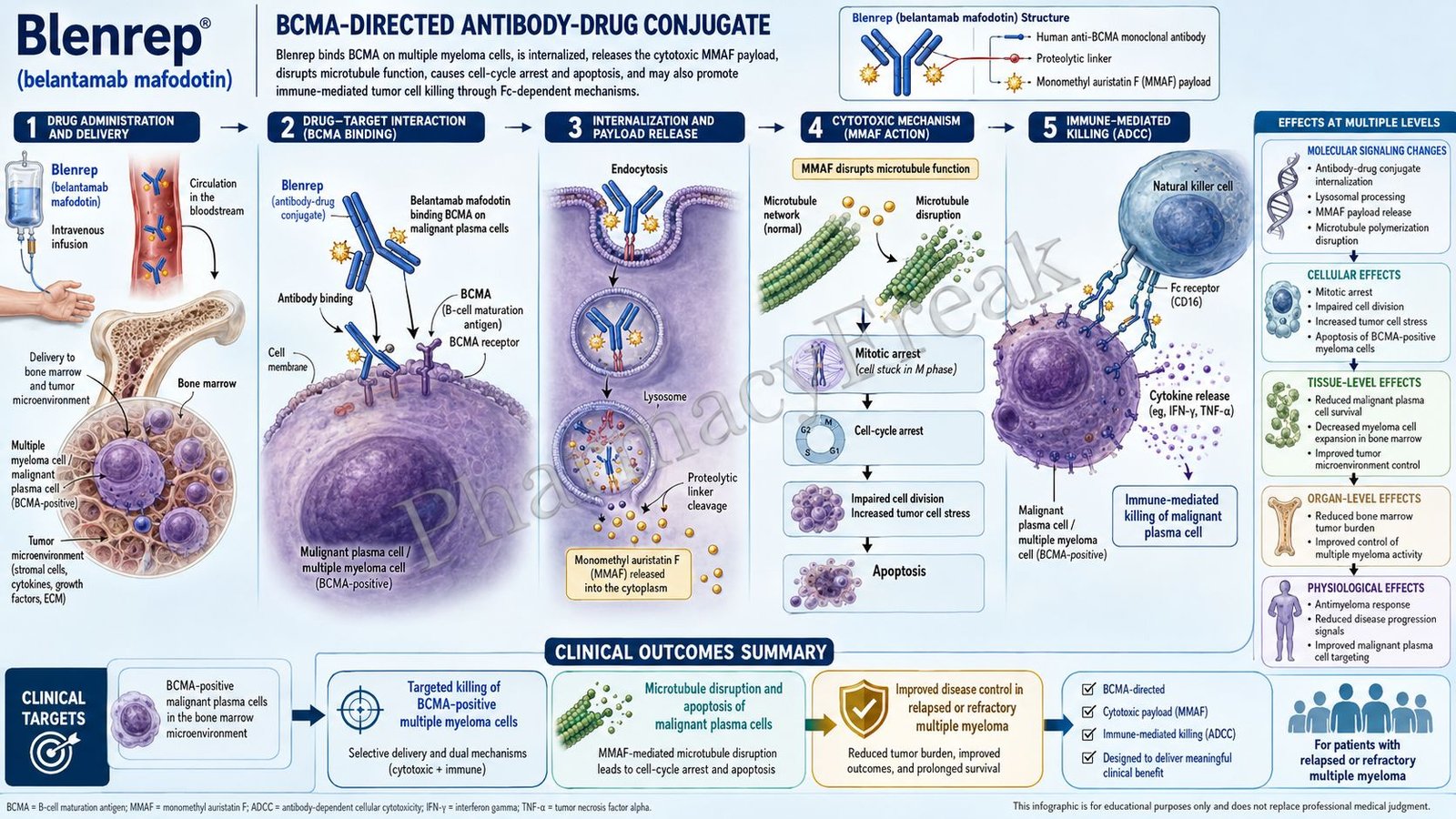
For exam purposes, Blenrep should be remembered as a BCMA-directed antibody-drug conjugate. It binds BCMA on myeloma cells, is internalized, releases MMAF-related cytotoxic payload inside the cell, disrupts microtubules, causes cell-cycle arrest and apoptosis, and can also mediate immune effector killing through ADCC and antibody-dependent cellular phagocytosis.
Mechanism of Action (Step-wise)
Step 1: Multiple myeloma arises from malignant plasma cells
Multiple myeloma is a cancer of plasma cells. These abnormal plasma cells accumulate in the bone marrow and interfere with normal blood-cell production, bone remodeling, immune function, and kidney function.
Step 2: Myeloma cells express BCMA
BCMA is expressed on normal B lymphocytes and multiple myeloma cells. Because myeloma cells commonly express this antigen, BCMA can be used as a selective surface target for anticancer therapy.
Step 3: Blenrep uses antibody-drug conjugate design
Blenrep is an antibody-drug conjugate. This means it contains an antibody for target recognition and a cytotoxic drug payload for tumor-cell killing.
Step 4: The antibody component targets BCMA
The antibody component of belantamab mafodotin is an afucosylated humanized IgG1 monoclonal antibody directed against BCMA. Afucosylation can enhance immune effector activity such as antibody-dependent cellular cytotoxicity.
Step 5: The cytotoxic payload is mcMMAF
The small-molecule cytotoxic component is mcMMAF, a microtubule inhibitor. It is linked to the antibody through a protease-resistant maleimidocaproyl linker.
Step 6: Blenrep binds BCMA on myeloma cells
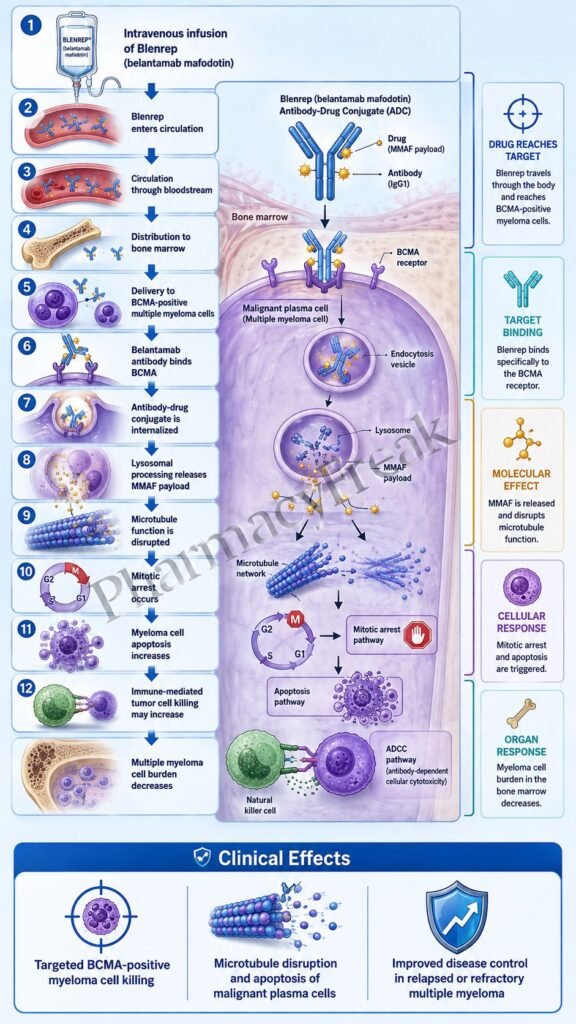
After intravenous administration, Blenrep circulates in the blood and binds BCMA on the surface of multiple myeloma cells.
Step 7: The antibody-drug conjugate is internalized
After binding to BCMA, the Blenrep-BCMA complex is internalized into the myeloma cell. Internalization allows the cytotoxic payload to act inside the target cell.
Step 8: Proteolytic cleavage releases the cytotoxic agent
Inside the cell, proteolytic cleavage releases cys-mcMMAF, the active cytotoxic payload derived from the ADC. The label describes release of cys-mcMMAF after internalization and proteolytic cleavage.
Step 9: cys-mcMMAF disrupts microtubules
cys-mcMMAF disrupts the intracellular microtubule network. Microtubules are essential for mitotic spindle formation, chromosome separation, cell structure, and intracellular transport.
Step 10: Cell-cycle arrest occurs
When microtubules are disrupted, myeloma cells cannot complete normal cell division. This leads to cell-cycle arrest.
Step 11: Apoptosis is triggered
Microtubule disruption and cell-cycle arrest ultimately promote apoptosis, or programmed cell death, in BCMA-expressing myeloma cells.
Step 12: Immune-mediated tumor killing also contributes
Belantamab mafodotin can also mediate tumor-cell killing through antibody-dependent cellular cytotoxicity and antibody-dependent cellular phagocytosis. This means immune cells can recognize antibody-coated tumor cells and help destroy them.
Step 13: Tumor burden decreases
As BCMA-positive myeloma cells undergo apoptosis and immune-mediated killing, malignant plasma-cell burden may decrease.
Step 14: Combination therapy adds complementary mechanisms
Blenrep is used with bortezomib and dexamethasone. Bortezomib is a proteasome inhibitor that increases proteotoxic stress in myeloma cells, while dexamethasone provides lympholytic and anti-myeloma effects. Blenrep adds BCMA-targeted payload delivery.
Step 15: Final therapeutic outcome
The final therapeutic effect is selective killing of BCMA-expressing myeloma cells through ADC-mediated intracellular microtubule disruption plus immune effector mechanisms. This helps control relapsed or refractory multiple myeloma in approved combination therapy.
Pharmacokinetics
Blenrep is administered by intravenous infusion. The current recommended dosage is 2.5 mg/kg of actual body weight once every 3 weeks with bortezomib and dexamethasone for the first 8 cycles, followed by Blenrep 2.5 mg/kg once every 3 weeks as a single agent until disease progression or unacceptable toxicity. The infusion is given over 30 minutes.
Blenrep is supplied as a 70 mg lyophilized powder in a single-dose vial for reconstitution and further dilution before intravenous use. It is not an oral drug, subcutaneous injection, or intramuscular injection.
Belantamab mafodotin shows dose-proportional pharmacokinetics, and maximum plasma concentrations occur at or shortly after the end of the infusion. Accumulation is minimal to moderate with once-every-3-weeks dosing.
The steady-state volume of distribution is about 10.8 L. The initial elimination half-life of the ADC is about 13 days, and after treatment the half-life is about 17 days.
The monoclonal antibody portion is expected to undergo proteolysis into small peptides and amino acids. The cytotoxic payload cys-mcMMAF has limited metabolic clearance in human hepatic S9 fraction studies and is not an inhibitor, inducer, or sensitive substrate of CYP enzymes.
No clinically significant pharmacokinetic differences were observed based on age, sex, race, body weight, mild to severe renal impairment, kidney failure, or mild hepatic impairment. The effects of moderate or severe hepatic impairment are unknown.
Blenrep has no meaningful QTc prolongation at the recommended dosage.
Clinical Uses
Blenrep is used in combination with bortezomib and dexamethasone for adults with relapsed or refractory multiple myeloma who have received at least two prior lines of therapy, including a proteasome inhibitor and an immunomodulatory agent.
This means Blenrep is not a first-line treatment for newly diagnosed multiple myeloma in the current U.S. indication. It is used after prior exposure to key myeloma drug classes.
Blenrep is useful because it targets BCMA, a major antigen on multiple myeloma cells. BCMA-directed therapy is an important modern strategy in myeloma treatment.
Blenrep is not traditional chemotherapy. It is not a plain monoclonal antibody, not a CAR-T cell therapy, not a bispecific T-cell engager, and not a proteasome inhibitor. It is an antibody-drug conjugate that delivers a microtubule inhibitor payload to BCMA-expressing cells.
Blenrep should not be confused with other BCMA-directed treatments such as idecabtagene vicleucel, ciltacabtagene autoleucel, teclistamab, elranatamab, or linvoseltamab. These therapies also target BCMA but use different platforms and mechanisms.
Blenrep is not approved for pediatric patients in the current U.S. label.
Adverse Effects
The most important adverse effect of Blenrep is ocular toxicity. The boxed warning states that Blenrep causes changes in the corneal epithelium that can lead to vision deterioration, severe visual impairment, corneal ulcers, blurred vision, and dry eyes.
In the DREAMM-7 clinical study, ocular toxicity occurred in 92% of patients receiving belantamab mafodotin, including Grade 3 or 4 ocular toxicity in 77%. Dosage modification due to ocular toxicity was required in 83% of patients.
Ophthalmic examinations are required at baseline, before each dose, and promptly for new or worsening ocular symptoms. Preservative-free lubricant eye drops are recommended, and contact lenses should generally be avoided unless directed by an eye care professional.
Because of ocular toxicity risk, Blenrep is available only through the BLENREP Risk Evaluation and Mitigation Strategy program, called the BLENREP REMS.
Thrombocytopenia is another important warning. Platelet counts should be monitored at baseline and periodically during treatment. Dose interruption, dose reduction, or discontinuation may be needed depending on severity.
Embryo-fetal toxicity is important because Blenrep contains a genotoxic microtubule inhibitor payload and targets actively dividing cells. It can cause fetal harm when administered during pregnancy.
Common adverse reactions include reduction in best-corrected visual acuity, corneal exam findings, blurred vision, dry eye, photophobia, foreign body sensation in the eyes, eye irritation, upper respiratory tract infection, hepatotoxicity, eye pain, diarrhea, fatigue, pneumonia, cataract, and COVID-19.
Common severe laboratory abnormalities include decreased platelets, decreased lymphocytes, decreased neutrophils, decreased white blood cells, increased gamma-glutamyl transferase, and decreased hemoglobin.
Serious adverse reactions reported with the Blenrep, bortezomib, and dexamethasone regimen included pneumonia, pyrexia, thrombocytopenia, COVID-19, upper respiratory tract infection, sepsis, second primary malignancy, and anemia. Fatal adverse reactions included pneumonia, sepsis, COVID-19, respiratory failure, and intracranial hemorrhage.
Comparative Analysis
Blenrep is commonly compared with other multiple myeloma therapies such as bortezomib, carfilzomib, lenalidomide, pomalidomide, daratumumab, isatuximab, elotuzumab, idecabtagene vicleucel, ciltacabtagene autoleucel, teclistamab, and elranatamab.
Compared with bortezomib, Blenrep has a different mechanism. Bortezomib is a proteasome inhibitor that blocks protein degradation and causes proteotoxic stress. Blenrep is a BCMA-directed ADC that delivers a microtubule inhibitor payload into BCMA-expressing myeloma cells.
Compared with lenalidomide or pomalidomide, Blenrep is not an immunomodulatory imide drug. IMiDs affect immune signaling, cereblon-mediated protein degradation, T-cell and NK-cell function, and myeloma-cell survival. Blenrep targets BCMA and delivers MMAF-related cytotoxic activity.
Compared with daratumumab, Blenrep targets a different antigen. Daratumumab targets CD38, while Blenrep targets BCMA. Daratumumab is a monoclonal antibody, whereas Blenrep is an antibody-drug conjugate.
Compared with isatuximab, Blenrep again differs by target and drug design. Isatuximab targets CD38, while Blenrep targets BCMA and carries a microtubule inhibitor payload.
Compared with CAR-T therapies such as idecabtagene vicleucel and ciltacabtagene autoleucel, Blenrep is not a cellular therapy. CAR-T therapy uses genetically modified patient T cells to attack BCMA-positive cells, while Blenrep is an off-the-shelf antibody-drug conjugate.
Compared with BCMA bispecific antibodies such as teclistamab or elranatamab, Blenrep does not primarily redirect T cells through CD3 engagement. Bispecific antibodies link T cells to myeloma cells, while Blenrep delivers a cytotoxic payload and can also mediate immune effector killing.
Compared with conventional chemotherapy, Blenrep is more targeted. Traditional chemotherapy broadly affects rapidly dividing cells, while Blenrep uses BCMA recognition to direct cytotoxic activity toward myeloma cells.
MCQs
- Blenrep contains which active drug?
a) Daratumumab
b) Belantamab mafodotin-blmf
c) Bortezomib
d) Teclistamab
Answer: b) Belantamab mafodotin-blmf
- Blenrep belongs to which pharmacological class?
a) BCMA-directed antibody-drug conjugate
b) CD38 monoclonal antibody
c) Proteasome inhibitor
d) Immunomodulatory imide drug
Answer: a) BCMA-directed antibody-drug conjugate
- The main target antigen of Blenrep is:
a) BCMA
b) CD20
c) HER2
d) EGFR
Answer: a) BCMA
- BCMA is expressed on:
a) Multiple myeloma cells and normal B lymphocytes
b) Only red blood cells
c) Hepatocytes only
d) Skeletal muscle cells only
Answer: a) Multiple myeloma cells and normal B lymphocytes
- The antibody component of Blenrep is:
a) Afucosylated humanized IgG1 directed against BCMA
b) Murine IgM directed against CD20
c) Humanized IgG4 against alpha-4 integrin
d) Soluble TNF receptor fusion protein
Answer: a) Afucosylated humanized IgG1 directed against BCMA
- The cytotoxic payload of Blenrep is related to:
a) MMAF microtubule inhibitor
b) Methotrexate antifolate
c) Doxorubicin anthracycline
d) Cisplatin platinum complex
Answer: a) MMAF microtubule inhibitor
- After Blenrep binds BCMA, the ADC is:
a) Internalized into the cell
b) Immediately excreted unchanged in urine
c) Converted into insulin
d) Activated only in the stomach
Answer: a) Internalized into the cell
- Released cys-mcMMAF mainly causes:
a) Microtubule disruption
b) DNA methylation reversal
c) Direct PD-1 blockade
d) Acetylcholinesterase inhibition
Answer: a) Microtubule disruption
- Microtubule disruption by Blenrep leads to:
a) Cell-cycle arrest and apoptosis
b) Increased myeloma-cell proliferation
c) Increased insulin secretion
d) Platelet activation only
Answer: a) Cell-cycle arrest and apoptosis
- Blenrep can also mediate tumor-cell killing through:
a) ADCC and antibody-dependent cellular phagocytosis
b) Dopamine receptor blockade
c) Orexin receptor antagonism
d) GnRH receptor inhibition
Answer: a) ADCC and antibody-dependent cellular phagocytosis
- Current U.S. Blenrep therapy is used with:
a) Bortezomib and dexamethasone
b) Metformin and insulin
c) Levodopa and carbidopa
d) Amlodipine and atenolol
Answer: a) Bortezomib and dexamethasone
- Blenrep is administered by:
a) Intravenous infusion
b) Oral tablet
c) Inhalation
d) Topical eye drop
Answer: a) Intravenous infusion
- The boxed warning of Blenrep is mainly for:
a) Ocular toxicity
b) Severe hypoglycemia
c) Thyroid C-cell tumors
d) Ototoxicity
Answer: a) Ocular toxicity
- Blenrep is available only through:
a) BLENREP REMS
b) Clozapine REMS only
c) iPLEDGE only
d) Opioid REMS only
Answer: a) BLENREP REMS
- Which statement best describes Blenrep?
a) It binds BCMA, is internalized, releases MMAF-related payload, disrupts microtubules, and causes myeloma-cell apoptosis
b) It blocks CD38 without any cytotoxic payload
c) It inhibits proteasomes like bortezomib
d) It directly activates dopamine receptors
Answer: a) It binds BCMA, is internalized, releases MMAF-related payload, disrupts microtubules, and causes myeloma-cell apoptosis
FAQs
What is the mechanism of action of Blenrep?
Blenrep binds BCMA on multiple myeloma cells, is internalized, and releases cys-mcMMAF inside the cell. This payload disrupts microtubules, causing cell-cycle arrest and apoptosis. Blenrep can also mediate antibody-dependent cellular cytotoxicity and antibody-dependent cellular phagocytosis.
What is the generic name of Blenrep?
The generic name of Blenrep is belantamab mafodotin-blmf.
What is Blenrep used for?
Blenrep is used with bortezomib and dexamethasone for adults with relapsed or refractory multiple myeloma who have received at least two prior lines of therapy, including a proteasome inhibitor and an immunomodulatory agent.
Is Blenrep chemotherapy?
Blenrep is not conventional chemotherapy. It is an antibody-drug conjugate that uses an anti-BCMA antibody to deliver a microtubule inhibitor payload to BCMA-expressing myeloma cells.
What is BCMA?
BCMA stands for B-cell maturation antigen. It is a surface protein found on normal B lineage cells and multiple myeloma cells, making it an important target in myeloma therapy.
Why does Blenrep cause eye toxicity?
Blenrep can cause corneal epithelial changes that may produce blurred vision, dry eyes, reduced visual acuity, corneal exam findings, and, rarely, corneal ulcers. This toxicity requires eye examinations and dose modification when needed.
What is the BLENREP REMS?
The BLENREP REMS is a restricted safety program required because of the risk of serious ocular toxicity. It helps ensure eye monitoring and appropriate dose modification.
How is Blenrep different from daratumumab?
Daratumumab targets CD38 and works as a monoclonal antibody. Blenrep targets BCMA and is an antibody-drug conjugate carrying a microtubule inhibitor payload.
References
Goodman & Gilman’s The Pharmacological Basis of Therapeutics
Katzung Basic & Clinical Pharmacology