Table of Contents
Introduction
Teriflunomide is an oral immunomodulatory drug marketed under the brand name Aubagio. Pharmacologically, teriflunomide is a pyrimidine synthesis inhibitor used in multiple sclerosis.
Multiple sclerosis, or MS, is a chronic immune-mediated disease of the central nervous system. In MS, autoreactive immune cells attack myelin, oligodendrocytes, and axonal structures in the brain and spinal cord. This causes inflammatory demyelinating lesions, neurological relapses, MRI activity, disability progression, and symptoms such as weakness, numbness, visual disturbance, imbalance, fatigue, and cognitive changes.
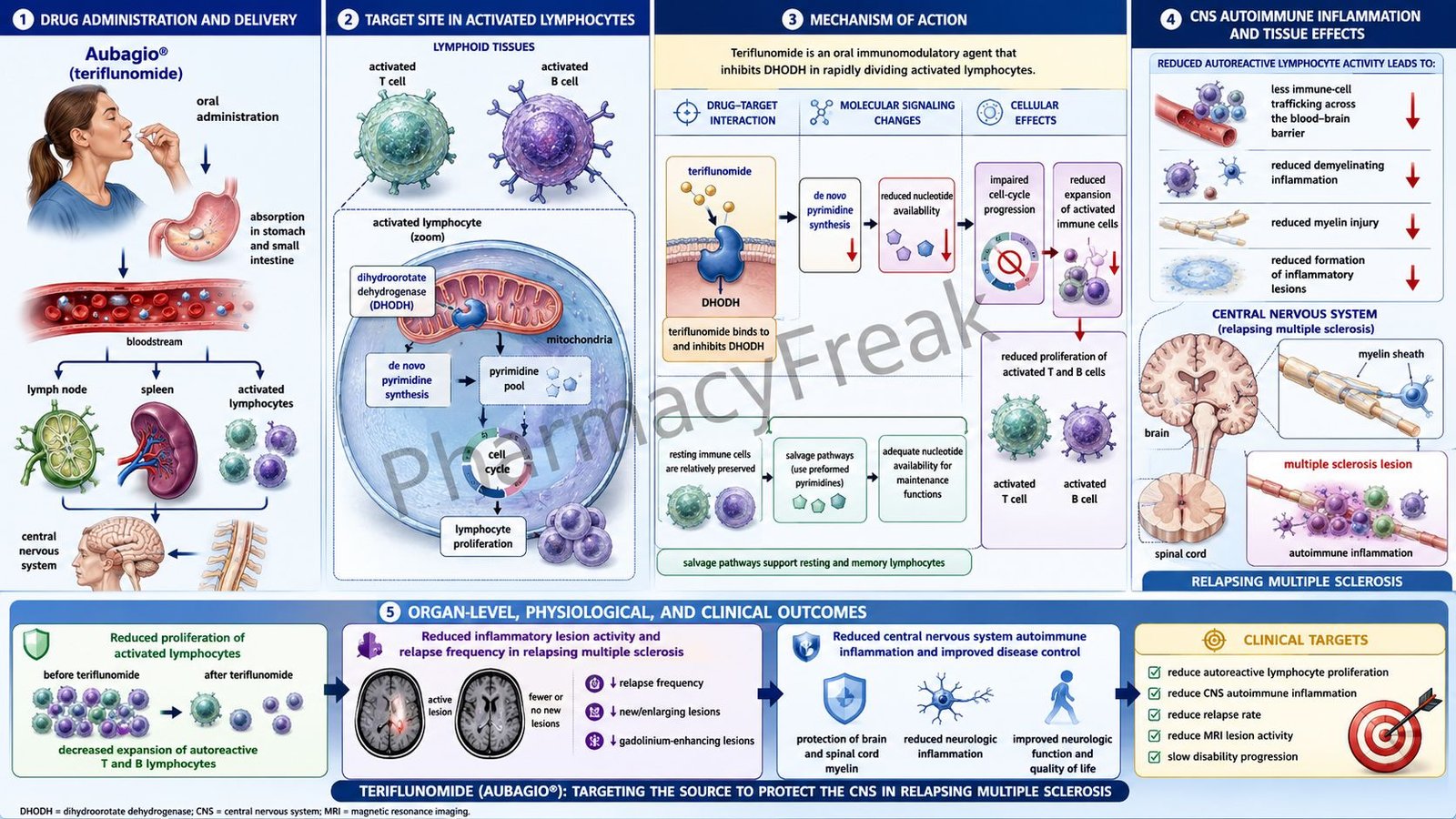
Teriflunomide works mainly by inhibiting dihydroorotate dehydrogenase, commonly abbreviated as DHODH. DHODH is a mitochondrial enzyme required for de novo pyrimidine synthesis. Activated T and B lymphocytes need rapid pyrimidine synthesis for clonal expansion. By inhibiting DHODH, teriflunomide reduces proliferation of activated lymphocytes and decreases immune-mediated CNS inflammation.
The official Aubagio label describes teriflunomide as an immunomodulatory agent with anti-inflammatory properties that inhibits dihydroorotate dehydrogenase, a mitochondrial enzyme involved in de novo pyrimidine synthesis. The exact mechanism by which teriflunomide produces its therapeutic effect in MS is unknown, but it may involve reduction in the number of activated lymphocytes in the CNS.
Aubagio is indicated for the treatment of relapsing forms of multiple sclerosis in adults, including clinically isolated syndrome, relapsing-remitting disease, and active secondary progressive disease.
For exam purposes, teriflunomide should be remembered as an oral DHODH inhibitor that reduces de novo pyrimidine synthesis and limits activated lymphocyte proliferation in relapsing forms of MS.
Mechanism of Action (Step-wise)
Step 1: Multiple sclerosis involves immune-mediated CNS injury
In multiple sclerosis, autoreactive immune cells enter the central nervous system and trigger inflammation. This inflammation damages myelin, oligodendrocytes, and axons.
Step 2: Activated lymphocytes contribute to MS lesions
Activated T cells and B cells play a major role in MS pathogenesis. They release cytokines, activate macrophages and microglia, support antibody-mediated immune activity, and contribute to demyelinating plaque formation.
Step 3: Activated lymphocytes need rapid nucleotide synthesis
When lymphocytes become activated, they proliferate rapidly. To divide, they require DNA and RNA synthesis. This creates a high demand for pyrimidine nucleotides.
Step 4: Pyrimidines can be made by de novo synthesis
Cells can obtain pyrimidines through salvage pathways or through de novo synthesis. Resting cells can often rely more on salvage pathways, but activated lymphocytes depend strongly on de novo pyrimidine synthesis for rapid proliferation.
Step 5: DHODH is essential for de novo pyrimidine synthesis
Dihydroorotate dehydrogenase is a mitochondrial enzyme involved in the de novo pyrimidine synthesis pathway. It helps generate pyrimidine nucleotides needed for DNA and RNA production.
Step 6: Teriflunomide inhibits DHODH
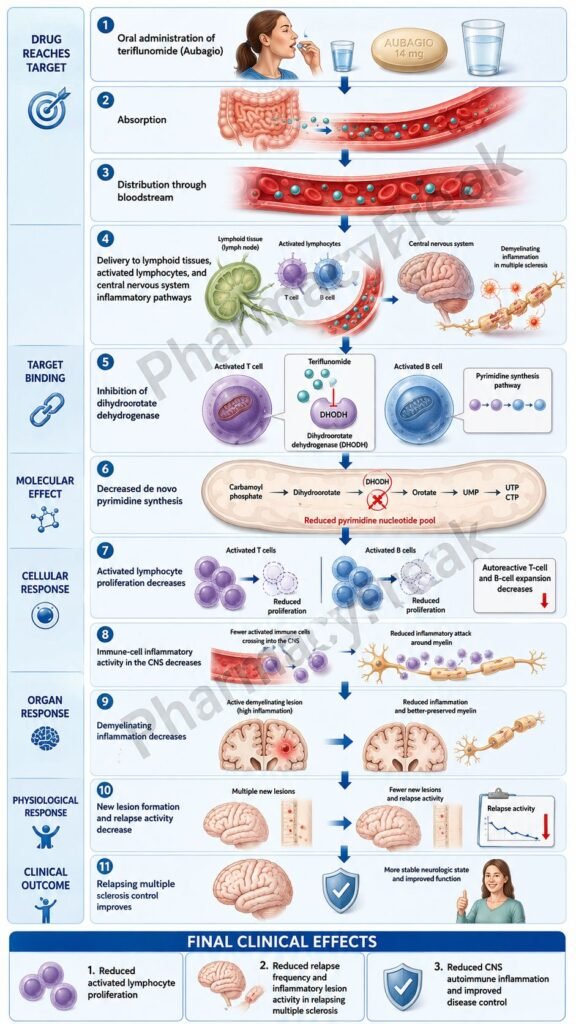
Teriflunomide inhibits DHODH. This is the central biochemical mechanism of teriflunomide. The label specifically describes teriflunomide as an inhibitor of dihydroorotate dehydrogenase, a mitochondrial enzyme involved in de novo pyrimidine synthesis.
Step 7: De novo pyrimidine synthesis decreases
When DHODH is inhibited, de novo pyrimidine synthesis decreases. This limits the availability of pyrimidine nucleotides needed for rapid DNA and RNA synthesis.
Step 8: Activated T-cell and B-cell proliferation decreases
Because activated lymphocytes need pyrimidines for clonal expansion, teriflunomide reduces proliferation of activated T and B cells. This effect is more prominent in rapidly dividing immune cells than in resting cells.
Step 9: Autoimmune inflammatory activity decreases
With fewer activated lymphocytes expanding and participating in immune attack, inflammatory activity in MS decreases. This may reduce immune-cell movement into the CNS and decrease CNS inflammatory lesions.
Step 10: CNS immune-cell burden may decrease
The exact therapeutic mechanism in MS is not completely established, but the label states that it may involve reduction in the number of activated lymphocytes in the CNS.
Step 11: Myelin injury may decrease
By reducing lymphocyte-driven inflammation, teriflunomide may reduce immune-mediated demyelination and inflammatory plaque activity. This helps lower relapse activity in relapsing MS.
Step 12: MRI lesion activity may decrease
In clinical studies, Aubagio reduced MRI lesion activity compared with placebo, including fewer gadolinium-enhancing T1 lesions in treated groups.
Step 13: Relapse frequency may decrease
In a pivotal clinical study, Aubagio 7 mg and 14 mg reduced annualized relapse rate compared with placebo.
Step 14: Teriflunomide does not broadly deplete immune cells
Teriflunomide is not a monoclonal antibody and does not directly deplete CD20-positive B cells like ocrelizumab or ofatumumab. It mainly limits proliferation of activated lymphocytes by targeting pyrimidine synthesis.
Step 15: Final therapeutic outcome
The final therapeutic effect is reduced inflammatory disease activity in relapsing forms of multiple sclerosis. Teriflunomide helps reduce relapse activity and MRI inflammatory lesion activity, but it does not cure MS or reverse established neurological damage.
Pharmacokinetics
Teriflunomide is administered orally as Aubagio tablets. The recommended dose is 7 mg or 14 mg orally once daily, with or without food. Aubagio tablets are available as 7 mg and 14 mg tablets.
Before starting Aubagio, safety assessment includes liver tests, CBC, tuberculosis screening, pregnancy exclusion in females of reproductive potential, and blood pressure assessment. The label recommends obtaining transaminase and bilirubin levels within 6 months before therapy, CBC within 6 months before therapy, TB screening before therapy, pregnancy exclusion before therapy, and blood pressure measurement before and during treatment.
Teriflunomide is also the principal active metabolite of leflunomide. At recommended doses, teriflunomide and leflunomide result in a similar range of plasma concentrations of teriflunomide. This is why Aubagio should not be coadministered with leflunomide.
After oral dosing, teriflunomide reaches peak plasma concentration in approximately 1 to 4 hours. Food does not have a clinically relevant effect on teriflunomide pharmacokinetics, so it can be taken without regard to meals.
Teriflunomide has a long half-life. The median half-life is approximately 18 days after repeated 7 mg dosing and approximately 19 days after repeated 14 mg dosing. It takes approximately 3 months to reach steady-state concentrations, and accumulation after repeated dosing is substantial.
Teriflunomide is extensively bound to plasma proteins, more than 99%, and is mainly distributed in plasma. Its volume of distribution after a single IV administration is approximately 11 L.
Teriflunomide is the major circulating moiety in plasma. Its primary biotransformation pathway to minor metabolites is hydrolysis, with oxidation as a minor pathway. Secondary pathways include oxidation, N-acetylation, and sulfate conjugation.
Teriflunomide is eliminated mainly through direct biliary excretion of unchanged drug and renal excretion of metabolites. Over 21 days, approximately 60.1% of the administered dose is recovered through feces and urine.
Teriflunomide is not metabolized by cytochrome P450 or flavin monoamine oxidase enzymes. However, it has important drug interaction effects, including inhibition of CYP2C8 in vivo and interactions with transporters.
Accelerated elimination is a very important exam point. Without accelerated elimination, teriflunomide can take on average 8 months to fall below 0.02 mg/L, and in some patients it may take up to 2 years. Elimination can be accelerated with cholestyramine 8 g every 8 hours for 11 days, cholestyramine 4 g three times daily if not tolerated, or activated charcoal 50 g every 12 hours for 11 days. These procedures can reduce plasma teriflunomide concentrations by more than 98%.
No dosage adjustment is required in mild or moderate hepatic impairment, but Aubagio is contraindicated in severe hepatic impairment. No dosage adjustment is required in mild, moderate, or severe renal impairment.
Clinical Uses
Teriflunomide is used for relapsing forms of multiple sclerosis in adults. The approved relapsing forms include clinically isolated syndrome, relapsing-remitting multiple sclerosis, and active secondary progressive multiple sclerosis.
In clinically isolated syndrome, teriflunomide may be used when the patient has a first demyelinating event and is at risk of developing definite MS, based on specialist evaluation and diagnostic criteria.
In relapsing-remitting MS, teriflunomide helps reduce relapse activity and inflammatory MRI activity by limiting activated lymphocyte proliferation.
In active secondary progressive MS, teriflunomide may be considered when there is ongoing inflammatory activity such as relapses or new MRI lesions.
Teriflunomide is not used for primary progressive MS. It is not an acute relapse treatment and does not replace corticosteroids for acute MS exacerbations.
Teriflunomide is not a biologic monoclonal antibody, not a sphingosine-1-phosphate receptor modulator, not a fumarate, not an anti-CD20 antibody, and not a corticosteroid. It is an oral pyrimidine synthesis inhibitor.
Aubagio is not approved for pediatric patients. The label states that safety and effectiveness in pediatric patients have not been established, and effectiveness in a pediatric relapsing MS trial was not established.
Adverse Effects
The two major boxed warnings of Aubagio are hepatotoxicity and embryo-fetal toxicity. Clinically significant and potentially life-threatening liver injury, including acute liver failure requiring transplant, has been reported. Teriflunomide is also contraindicated in pregnancy and in females of reproductive potential who are not using effective contraception because of potential fetal harm.
Hepatotoxicity is one of the most important safety issues. Liver injury can occur at any time during treatment, and the risk may be higher in patients with pre-existing liver disease or those taking other hepatotoxic drugs. The label recommends checking transaminase and bilirubin levels before starting therapy and monitoring ALT at least monthly for the first 6 months.
If drug-induced liver injury is suspected, Aubagio should be discontinued and an accelerated elimination procedure with cholestyramine or activated charcoal should be started. Aubagio is contraindicated in patients with severe hepatic impairment.
Embryo-fetal toxicity is a major exam point. Teriflunomide may cause fetal harm, and pregnancy should be excluded before treatment in females of reproductive potential. Effective contraception is required during treatment and during the accelerated elimination procedure after treatment. If pregnancy occurs, Aubagio should be stopped and accelerated elimination should be performed to reduce plasma teriflunomide below 0.02 mg/L.
Bone marrow effects and infection risk can occur. Aubagio may reduce white blood cells, mainly neutrophils and lymphocytes, and may reduce platelet count. A CBC should be available before starting therapy, and patients should be monitored for infection symptoms. Patients with active acute or chronic infection should not start treatment until the infection resolves.
Tuberculosis screening is required before treatment. Patients should be screened for latent TB infection before starting Aubagio.
Hypersensitivity reactions can occur, including anaphylaxis and angioedema. Aubagio is contraindicated in patients with hypersensitivity to teriflunomide, leflunomide, or inactive ingredients.
Serious skin reactions may occur, including Stevens-Johnson syndrome and toxic epidermal necrolysis. Drug reaction with eosinophilia and systemic symptoms, or DRESS, has also been reported. Clinically significant skin or systemic hypersensitivity reactions require discontinuation and accelerated elimination.
Cutaneous or mucocutaneous ulcers and impaired wound healing have been reported. This warning was listed as a recent major label change in February 2026. If an Aubagio-associated ulcer is suspected, if ulcers persist despite treatment, or if there is high risk for impaired wound healing after surgery, discontinuation and accelerated elimination should be considered.
Peripheral neuropathy can occur. In clinical trials, peripheral neuropathy was more frequent with Aubagio than placebo. Symptoms may include bilateral numbness, tingling, burning, or sensory changes in the hands or feet. Discontinuation and accelerated elimination may be considered if neuropathy develops.
Increased blood pressure can occur, so blood pressure should be checked before treatment and periodically thereafter.
Respiratory effects are relevant because interstitial lung disease and worsening pre-existing interstitial lung disease have been reported with leflunomide. New or worsening cough or dyspnea may require evaluation and possible discontinuation with accelerated elimination.
Pancreatitis has been reported in adults postmarketing and appeared at higher frequency in a pediatric trial, although Aubagio is not approved in pediatric patients. If pancreatitis is suspected, teriflunomide should be discontinued and accelerated elimination started.
The most common adverse reactions in pooled placebo-controlled trials were headache, increased ALT, diarrhea, alopecia, and nausea. Other reported adverse reactions included paresthesia, arthralgia, neutropenia, and hypertension.
Comparative Analysis
Teriflunomide is commonly compared with leflunomide, interferon beta, glatiramer acetate, dimethyl fumarate, diroximel fumarate, fingolimod, ozanimod, ponesimod, natalizumab, ocrelizumab, ofatumumab, cladribine, and alemtuzumab.
Compared with leflunomide, teriflunomide is directly related pharmacologically because teriflunomide is the principal active metabolite of leflunomide. Aubagio should not be coadministered with leflunomide because both result in systemic teriflunomide exposure.
Compared with interferon beta, teriflunomide is an oral small-molecule immunomodulator, while interferon beta is an injectable cytokine therapy. Interferon beta has broader immunomodulatory effects and commonly causes flu-like symptoms and injection-site reactions.
Compared with glatiramer acetate, teriflunomide has a more defined biochemical enzyme target. Glatiramer acetate is an injectable immune-modulating polymer that alters immune responses to myelin-like antigens, while teriflunomide inhibits DHODH.
Compared with dimethyl fumarate, teriflunomide has a different mechanism. Dimethyl fumarate activates the Nrf2 antioxidant pathway and has immunomodulatory effects, while teriflunomide reduces activated lymphocyte proliferation through pyrimidine synthesis inhibition.
Compared with fingolimod, teriflunomide does not trap lymphocytes in lymph nodes. Fingolimod is an S1P receptor modulator that reduces lymphocyte egress from lymphoid tissues, while teriflunomide limits proliferation of activated lymphocytes.
Compared with natalizumab, teriflunomide does not block leukocyte adhesion molecules. Natalizumab blocks alpha-4 integrin-mediated leukocyte trafficking into the CNS, while teriflunomide acts on activated lymphocyte proliferation.
Compared with ocrelizumab and ofatumumab, teriflunomide does not directly deplete CD20-positive B cells. Anti-CD20 therapies reduce B-cell populations, while teriflunomide inhibits an enzyme needed for rapid lymphocyte expansion.
Compared with cladribine, teriflunomide is less directly lymphocyte-depleting. Cladribine is a purine nucleoside analogue that preferentially reduces lymphocytes, while teriflunomide inhibits pyrimidine synthesis.
Compared with alemtuzumab, teriflunomide is less broadly depleting. Alemtuzumab targets CD52 and causes broad lymphocyte depletion, while teriflunomide mainly suppresses proliferation of activated lymphocytes.
MCQs
- Teriflunomide is marketed under which brand name?
a) Tecfidera
b) Aubagio
c) Gilenya
d) Tysabri
Answer: b) Aubagio
- Teriflunomide belongs to which pharmacological class?
a) Pyrimidine synthesis inhibitor
b) S1P receptor modulator
c) Anti-CD20 monoclonal antibody
d) Alpha-4 integrin inhibitor
Answer: a) Pyrimidine synthesis inhibitor
- The main enzyme inhibited by teriflunomide is:
a) Dihydroorotate dehydrogenase
b) Acetylcholinesterase
c) Monoamine oxidase-B
d) DPP-4
Answer: a) Dihydroorotate dehydrogenase
- DHODH is involved in:
a) De novo pyrimidine synthesis
b) Dopamine breakdown
c) Histamine release
d) Gastric acid secretion
Answer: a) De novo pyrimidine synthesis
- Teriflunomide reduces MS inflammatory activity mainly by limiting:
a) Activated lymphocyte proliferation
b) Platelet aggregation
c) Insulin secretion
d) Bacterial cell wall synthesis
Answer: a) Activated lymphocyte proliferation
- The exact therapeutic mechanism of teriflunomide in MS is:
a) Unknown, but may involve reduced activated lymphocytes in the CNS
b) Fully explained by direct myelin synthesis
c) Due to CD20-positive B-cell depletion only
d) Due to alpha-4 integrin blockade only
Answer: a) Unknown, but may involve reduced activated lymphocytes in the CNS
- Aubagio is indicated for:
a) Relapsing forms of multiple sclerosis in adults
b) Acute bacterial meningitis
c) Parkinson’s disease
d) Alzheimer’s disease
Answer: a) Relapsing forms of multiple sclerosis in adults
- Which MS category is included in Aubagio’s indication?
a) Clinically isolated syndrome
b) Primary progressive MS only
c) Neuromyelitis optica only
d) Acute transverse myelitis only
Answer: a) Clinically isolated syndrome
- The recommended Aubagio dose is:
a) 7 mg or 14 mg orally once daily
b) 300 mg IV every 4 weeks
c) 600 mg subcutaneously every 6 months
d) 5 mg orally twice daily
Answer: a) 7 mg or 14 mg orally once daily
- Aubagio can be taken:
a) With or without food
b) Only with a high-fat meal
c) Only after crushing the tablet
d) Only with grapefruit juice
Answer: a) With or without food
- Teriflunomide is the principal active metabolite of:
a) Leflunomide
b) Methotrexate
c) Azathioprine
d) Cyclophosphamide
Answer: a) Leflunomide
- The boxed warnings of Aubagio include:
a) Hepatotoxicity and embryo-fetal toxicity
b) Thyroid C-cell tumors and pancreatitis only
c) Severe hypoglycemia and ototoxicity
d) PML and meningococcal infection only
Answer: a) Hepatotoxicity and embryo-fetal toxicity
- Accelerated elimination of teriflunomide can be done using:
a) Cholestyramine or activated charcoal
b) Naloxone only
c) Vitamin K only
d) Insulin infusion only
Answer: a) Cholestyramine or activated charcoal
- Which monitoring is important before and during Aubagio therapy?
a) Liver tests, CBC, TB screening, pregnancy testing, and blood pressure
b) Only hearing test
c) Only serum lithium
d) Only blood glucose every hour
Answer: a) Liver tests, CBC, TB screening, pregnancy testing, and blood pressure
- Which statement best describes teriflunomide?
a) It inhibits DHODH, reducing de novo pyrimidine synthesis and activated lymphocyte proliferation
b) It blocks alpha-4 integrin and prevents leukocyte adhesion
c) It depletes CD20-positive B cells
d) It traps lymphocytes in lymph nodes by S1P receptor modulation
Answer: a) It inhibits DHODH, reducing de novo pyrimidine synthesis and activated lymphocyte proliferation
FAQs
What is the mechanism of action of teriflunomide?
Teriflunomide inhibits dihydroorotate dehydrogenase, a mitochondrial enzyme involved in de novo pyrimidine synthesis. This reduces the proliferation of activated T and B lymphocytes and may decrease the number of activated lymphocytes in the CNS.
What is the brand name of teriflunomide?
The brand name of teriflunomide is Aubagio.
What is teriflunomide used for?
Teriflunomide is used for relapsing forms of multiple sclerosis in adults, including clinically isolated syndrome, relapsing-remitting disease, and active secondary progressive disease.
Is teriflunomide a biologic?
No. Teriflunomide is not a biologic or monoclonal antibody. It is an oral small-molecule immunomodulatory drug.
Is teriflunomide related to leflunomide?
Yes. Teriflunomide is the principal active metabolite of leflunomide. Aubagio should not be used together with leflunomide.
Why is teriflunomide contraindicated in pregnancy?
Teriflunomide may cause fetal harm. Pregnancy should be excluded before treatment, and effective contraception is required during therapy and until drug levels are reduced to a safe threshold after discontinuation.
Why is accelerated elimination needed with teriflunomide?
Teriflunomide can remain in the body for a long time, sometimes up to 2 years without accelerated elimination. Cholestyramine or activated charcoal can rapidly reduce plasma concentrations when needed, such as pregnancy, toxicity, or serious adverse reactions.
What are important adverse effects of teriflunomide?
Important adverse effects include hepatotoxicity, embryo-fetal toxicity, infection risk, reduced white blood cells, serious skin reactions, DRESS, peripheral neuropathy, increased blood pressure, cutaneous or mucocutaneous ulcers, impaired wound healing, diarrhea, nausea, alopecia, headache, and increased ALT.
References
Goodman & Gilman’s The Pharmacological Basis of Therapeutics
Katzung Basic & Clinical Pharmacology
K.D. Tripathi Essentials of Medical Pharmacology
Harrison’s Principles of Internal Medicine