Table of Contents
Introduction
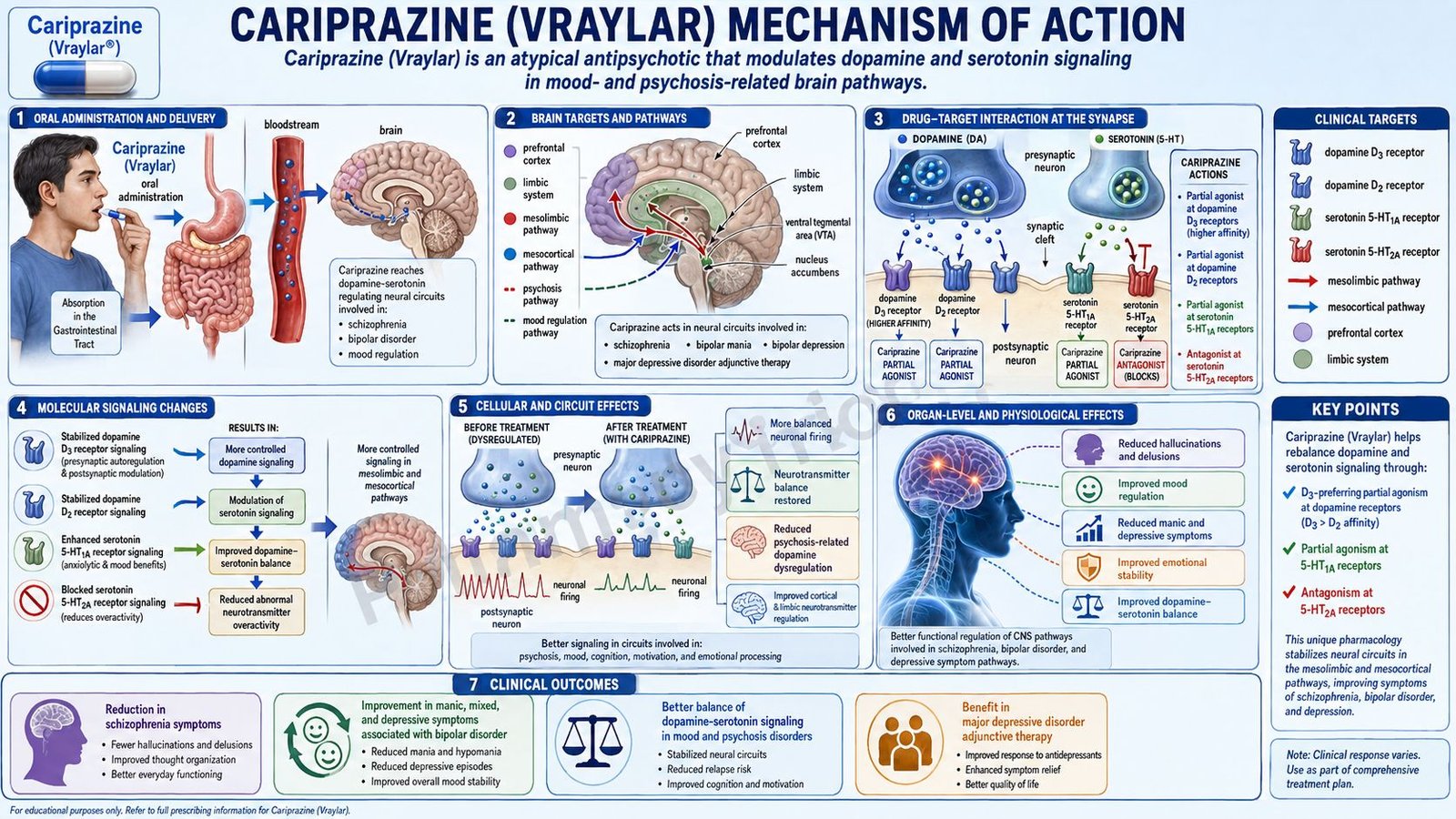
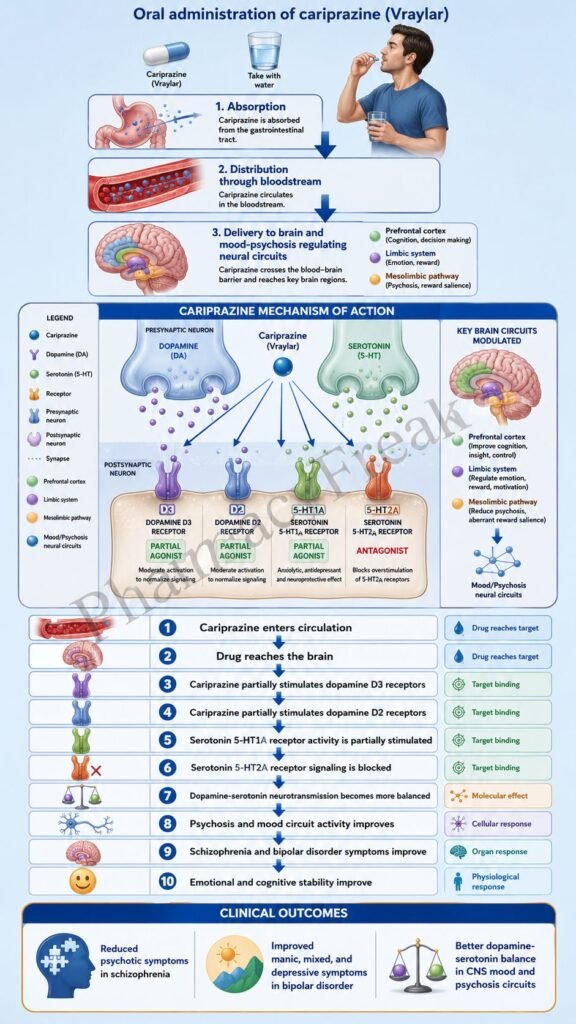
Cariprazine is an oral atypical antipsychotic marketed under the brand name Vraylar. Pharmacologically, cariprazine is a dopamine-serotonin receptor modulator with partial agonist activity at dopamine D3 and D2 receptors and serotonin 5-HT1A receptors, plus antagonist activity at serotonin 5-HT2A receptors.
Psychiatric disorders such as schizophrenia, bipolar I disorder, and major depressive disorder involve complex abnormalities in dopamine, serotonin, glutamate, GABA, neuroplasticity, mood circuits, reward pathways, salience processing, and cognitive-emotional regulation. No single neurotransmitter fully explains these disorders, but dopamine and serotonin signaling are major targets for many antipsychotic and mood-stabilizing drugs.
Cariprazine is classified as an atypical antipsychotic because it acts on dopamine and serotonin receptors and has a lower tendency than older first-generation antipsychotics to cause some dopamine-blockade-related adverse effects, although extrapyramidal symptoms and akathisia can still occur.
The official Vraylar label states that the exact mechanism of action of cariprazine is unknown. However, its efficacy may be mediated through partial agonist activity at central dopamine D2 and serotonin 5-HT1A receptors and antagonist activity at serotonin 5-HT2A receptors. The label also states that cariprazine forms two major active metabolites, desmethylcariprazine and didesmethylcariprazine, which have in vitro receptor binding profiles similar to the parent drug.
Cariprazine has high binding affinity at dopamine D3 and D2 receptors and also acts at serotonin receptors. The Vraylar label describes cariprazine as a partial agonist at dopamine D3 and D2 receptors and serotonin 5-HT1A receptors, and as an antagonist at serotonin 5-HT2B and 5-HT2A receptors. It has no appreciable affinity for cholinergic muscarinic receptors.
Vraylar is indicated for schizophrenia in adults and pediatric patients 13 years and older, acute manic or mixed episodes associated with bipolar I disorder in adults and pediatric patients 10 years and older, depressive episodes associated with bipolar I disorder in adults, and adjunctive therapy to antidepressants for major depressive disorder in adults.
For exam purposes, cariprazine should be remembered as an atypical antipsychotic and dopamine-serotonin receptor partial agonist, especially notable for dopamine D3/D2 partial agonism, 5-HT1A partial agonism, and 5-HT2A antagonism.
Mechanism of Action (Step-wise)
Step 1: Dopamine signaling is central to psychosis and mood regulation
Dopamine pathways in the brain are involved in reward, motivation, salience, movement, cognition, and emotional regulation. Abnormal dopamine signaling is strongly linked with psychosis, mania, and some mood symptoms.
Step 2: Excess mesolimbic dopamine contributes to positive psychotic symptoms
In schizophrenia, excessive dopamine signaling in mesolimbic pathways is associated with positive symptoms such as hallucinations, delusions, suspiciousness, agitation, and disorganized thinking.
Step 3: Low dopamine activity in other circuits may contribute to negative and cognitive symptoms
Reduced or inefficient dopamine signaling in mesocortical and prefrontal circuits may contribute to negative symptoms such as social withdrawal, reduced motivation, flattened affect, and cognitive dysfunction. This model is simplified, but it is useful for pharmacology exams.
Step 4: Cariprazine acts as a dopamine receptor partial agonist
Cariprazine is not a pure dopamine blocker. It is a partial agonist at dopamine D3 and D2 receptors. A partial agonist can stimulate the receptor less strongly than the natural neurotransmitter while also reducing excessive dopamine signaling when dopamine levels are high.
Step 5: D2 partial agonism stabilizes dopamine signaling
At dopamine D2 receptors, cariprazine may functionally reduce excessive dopamine activity in hyperdopaminergic pathways while providing some receptor stimulation in hypodopaminergic pathways. This is why it is often described as a dopamine system stabilizer.
Step 6: D2 modulation helps reduce psychotic and manic symptoms
By modulating D2 receptor activity, cariprazine can reduce dopamine-driven psychotic symptoms and manic symptoms such as elevated mood, irritability, increased energy, impulsivity, decreased need for sleep, and racing thoughts.
Step 7: D3 receptor activity is pharmacologically important
Cariprazine has high affinity for dopamine D3 receptors. D3 receptors are enriched in limbic and reward-related brain regions, which are involved in motivation, mood, reward processing, and emotional regulation.
Step 8: D3 partial agonism may contribute to mood and motivational effects
Because D3 receptors are linked with reward and motivation circuits, D3 partial agonism is often discussed as a possible contributor to cariprazine’s effects on bipolar depression and negative symptoms. However, the exact clinical contribution of D3 activity is not fully established.
Step 9: Cariprazine also partially activates 5-HT1A receptors
Cariprazine acts as a partial agonist at serotonin 5-HT1A receptors. 5-HT1A receptor activity is associated with mood regulation, anxiety modulation, and antidepressant-like effects in several psychiatric drug classes.
Step 10: 5-HT1A partial agonism may support antidepressant and anxiolytic effects
Through 5-HT1A partial agonism, cariprazine may help regulate mood and emotional symptoms. This may contribute to its role in bipolar depression and adjunctive treatment of major depressive disorder.
Step 11: Cariprazine antagonizes 5-HT2A receptors
Cariprazine also antagonizes serotonin 5-HT2A receptors. 5-HT2A antagonism is a common property of many atypical antipsychotics and can influence dopamine release in certain pathways.
Step 12: 5-HT2A antagonism may reduce extrapyramidal risk compared with pure D2 blockade
Blocking 5-HT2A receptors may increase dopamine release in nigrostriatal pathways, which may reduce the risk of movement-related adverse effects compared with strong pure D2 antagonism. However, cariprazine can still cause extrapyramidal symptoms and akathisia.
Step 13: Low muscarinic activity explains fewer anticholinergic effects
The label states that cariprazine has no appreciable affinity for cholinergic muscarinic receptors. This helps explain why classic anticholinergic effects such as dry mouth, constipation, blurred vision, urinary retention, and cognitive slowing may be less prominent than with strongly anticholinergic antipsychotics, although some of these symptoms can still occur from other mechanisms.
Step 14: Active metabolites prolong clinical effects
Cariprazine forms active metabolites, especially didesmethylcariprazine. These metabolites are pharmacologically active and contribute to the drug’s long duration of effect. Because of this, dose changes may take several weeks to be fully reflected clinically.
Step 15: Final therapeutic outcome
The final therapeutic effect of cariprazine is modulation of dopamine and serotonin receptor signaling. This helps reduce psychosis, mania, bipolar depression symptoms, and depressive symptoms when used as adjunctive therapy in approved adult MDD treatment.
Pharmacokinetics
Cariprazine is administered orally as Vraylar capsules once daily, with or without food. Available capsule strengths include 0.5 mg, 0.75 mg, 1.5 mg, 3 mg, 4.5 mg, and 6 mg.
For adults with schizophrenia, the starting dose is 1.5 mg once daily, with a recommended range of 1.5 mg to 6 mg once daily. For pediatric patients 13 to 17 years with schizophrenia, the starting dose is 0.5 mg once daily, with a recommended range of 1.5 mg to 4.5 mg once daily.
For adults with manic or mixed episodes associated with bipolar I disorder, the starting dose is 1.5 mg once daily, increased to 3 mg once daily on Day 2, with a recommended range of 3 mg to 6 mg once daily. For pediatric patients 10 to 17 years with bipolar mania or mixed episodes, the starting dose is 0.5 mg once daily, with a recommended dose of 3 mg or 4.5 mg once daily.
For adults with bipolar depression, the starting dose is 1.5 mg once daily. Depending on response and tolerability, it may be increased to 3 mg once daily on Day 15. The maximum recommended dose for bipolar depression is 3 mg once daily.
For adjunctive therapy to antidepressants in adult major depressive disorder, the starting dose is 1.5 mg once daily. It may be increased to 3 mg once daily on Day 15 depending on response and tolerability. The maximum recommended dose in this setting is 3 mg once daily.
A key pharmacokinetic point is the long half-life of cariprazine and its active metabolites. The label states that changes in dose will not be fully reflected in plasma for several weeks, so patients should be monitored for adverse reactions and response for several weeks after starting treatment and after each dosage change.
Cariprazine activity is thought to be mediated by the parent drug and two active metabolites: desmethylcariprazine, also called DCAR, and didesmethylcariprazine, also called DDCAR. These metabolites are pharmacologically equipotent to cariprazine.
After multiple dosing, cariprazine and DCAR reach steady state around week 1 to week 2, while DDCAR approaches steady state around week 4 to week 8. Estimated half-lives based on time to steady state are 2 to 4 days for cariprazine, 1 to 2 days for DCAR, and approximately 1 to 3 weeks for DDCAR.
Peak plasma cariprazine concentration occurs approximately 3 to 6 hours after a single dose. A high-fat meal does not significantly affect cariprazine or DCAR exposure. Cariprazine and its major metabolites are highly protein bound, about 91% to 97%.
Cariprazine is extensively metabolized by CYP3A4 and, to a lesser extent, CYP2D6. Strong or moderate CYP3A4 inhibitors can increase exposure and require dose modification. Concomitant use with CYP3A4 inducers is not recommended because the net effect on active drug exposure is unclear.
Vraylar is not recommended in severe hepatic impairment or severe renal impairment. It is not a controlled substance.
Clinical Uses
Cariprazine is used for the treatment of schizophrenia in adults and pediatric patients 13 years of age and older. Schizophrenia symptoms may include hallucinations, delusions, disorganized speech, disorganized behavior, negative symptoms, and cognitive dysfunction.
Cariprazine is used for acute treatment of manic or mixed episodes associated with bipolar I disorder in adults and pediatric patients 10 years of age and older. In mania, symptoms may include elevated or irritable mood, increased activity, decreased sleep, grandiosity, pressured speech, racing thoughts, distractibility, impulsivity, and risky behavior.
Cariprazine is used for depressive episodes associated with bipolar I disorder in adult patients. Bipolar depression may involve low mood, anhedonia, fatigue, impaired concentration, psychomotor changes, sleep disturbance, appetite changes, guilt, and suicidal thoughts.
Cariprazine is also used as adjunctive therapy to antidepressants for major depressive disorder in adult patients. In this use, it is added to antidepressant therapy when antidepressant response is inadequate.
Cariprazine is not approved for dementia-related psychosis. The boxed warning states that elderly patients with dementia-related psychosis treated with antipsychotic drugs are at increased risk of death, and Vraylar is not approved for this condition.
Cariprazine is not a benzodiazepine, lithium salt, anticonvulsant mood stabilizer, SSRI, SNRI, stimulant, or sedative-hypnotic. It is an atypical antipsychotic with dopamine-serotonin receptor partial agonist and antagonist properties.
Adverse Effects
Vraylar has a boxed warning for increased mortality in elderly patients with dementia-related psychosis and suicidal thoughts and behaviors. Antipsychotic drugs increase the risk of death in elderly patients with dementia-related psychosis, and Vraylar is not approved for this use. Antidepressants increased the risk of suicidal thoughts and behaviors in pediatric and young adult patients, so patients receiving Vraylar in antidepressant-related treatment contexts should be monitored for worsening depression and suicidality.
Neuroleptic malignant syndrome is a serious adverse reaction associated with antipsychotic drugs. Symptoms can include hyperpyrexia, muscle rigidity, delirium, autonomic instability, elevated creatine phosphokinase, rhabdomyolysis, and acute renal failure. If NMS is suspected, Vraylar should be discontinued immediately and intensive treatment started.
Tardive dyskinesia can occur with cariprazine. It involves potentially irreversible involuntary movements and risk increases with longer treatment duration and cumulative dose. The label recommends using the lowest effective dose for the shortest duration needed and considering discontinuation if tardive dyskinesia develops.
Late-occurring adverse reactions are especially important with cariprazine because the parent drug and metabolites accumulate over time. Adverse effects may first appear several weeks after starting therapy or after dose increases. Monitoring for extrapyramidal symptoms and akathisia should continue for several weeks after initiation and dosage changes.
Metabolic changes can occur with atypical antipsychotics, including Vraylar. These include hyperglycemia, diabetes mellitus, dyslipidemia, and weight gain. Fasting plasma glucose should be assessed before or soon after initiation and monitored periodically during long-term treatment.
Extrapyramidal symptoms and akathisia are major exam-relevant adverse effects. In schizophrenia trials, common adverse reactions included extrapyramidal symptoms and akathisia. In bipolar mania trials, common adverse reactions included extrapyramidal symptoms, akathisia, dyspepsia, vomiting, somnolence, and restlessness.
In bipolar depression trials, common adverse reactions included nausea, akathisia, restlessness, and extrapyramidal symptoms. In adjunctive MDD trials, common adverse reactions included akathisia, nausea, insomnia, restlessness, fatigue, constipation, increased appetite, dizziness, and extrapyramidal symptoms depending on trial design and dose.
Other important warnings include leukopenia, neutropenia, agranulocytosis, orthostatic hypotension, syncope, falls, seizures, cognitive and motor impairment, body temperature dysregulation, and dysphagia.
Hypersensitivity reactions can occur. Vraylar is contraindicated in patients with a history of hypersensitivity to cariprazine. Reported reactions include rash, pruritus, urticaria, and reactions suggestive of angioedema, such as swollen tongue, lip swelling, facial edema, pharyngeal edema, and swelling face.
Pregnancy requires caution. Neonates exposed to antipsychotic drugs during the third trimester are at risk for extrapyramidal and/or withdrawal symptoms after delivery. Cariprazine’s long-lasting active metabolite may persist for weeks after discontinuation.
Comparative Analysis
Cariprazine is commonly compared with aripiprazole, brexpiprazole, risperidone, olanzapine, quetiapine, lurasidone, ziprasidone, lumateperone, lithium, valproate, lamotrigine, SSRIs, and SNRIs.
Compared with aripiprazole, cariprazine belongs to the same broad dopamine partial agonist group. Both act as dopamine D2 partial agonists, but cariprazine is especially noted for high D3 receptor affinity, which is often discussed in relation to mood, reward, and motivation circuits.
Compared with brexpiprazole, cariprazine has a different receptor-binding balance. Brexpiprazole is also a serotonin-dopamine activity modulator, but cariprazine has stronger emphasis on D3/D2 partial agonism in pharmacology teaching.
Compared with risperidone, cariprazine is not a pure D2 antagonist. Risperidone strongly blocks D2 and 5-HT2A receptors, while cariprazine partially stimulates D2/D3 receptors and antagonizes 5-HT2A receptors.
Compared with olanzapine, cariprazine generally has less muscarinic receptor involvement. Olanzapine has broader receptor activity, including histamine and muscarinic effects, and is strongly associated with weight gain and metabolic adverse effects.
Compared with quetiapine, cariprazine has less sedating histamine-dominant pharmacology. Quetiapine has strong H1 antagonism and is commonly sedating, while cariprazine is more associated with akathisia, restlessness, and activating adverse effects in some patients.
Compared with lurasidone, cariprazine differs in dopamine receptor action. Lurasidone is mainly a D2 and 5-HT2A antagonist with additional serotonin receptor activity, while cariprazine is a dopamine D3/D2 partial agonist.
Compared with lithium, cariprazine is not a classic mood stabilizer salt. Lithium affects intracellular signaling, inositol pathways, glycogen synthase kinase-3, neuroprotection, and suicide risk reduction, while cariprazine works mainly through dopamine-serotonin receptor modulation.
Compared with valproate, cariprazine is not an anticonvulsant mood stabilizer. Valproate increases GABAergic tone and affects sodium channels and histone deacetylase activity, while cariprazine modulates dopamine and serotonin receptors.
Compared with lamotrigine, cariprazine has antipsychotic properties. Lamotrigine reduces glutamate release through sodium-channel effects and is important in bipolar depression maintenance, while cariprazine is an atypical antipsychotic approved for bipolar depression in adults.
Compared with SSRIs and SNRIs, cariprazine does not primarily inhibit serotonin or norepinephrine reuptake. In major depressive disorder, it is used as adjunctive therapy with antidepressants rather than replacing all antidepressant mechanisms.
MCQs
- Cariprazine is marketed under which brand name?
a) Latuda
b) Vraylar
c) Rexulti
d) Zyprexa
Answer: b) Vraylar
- Cariprazine belongs to which pharmacological class?
a) Atypical antipsychotic
b) SSRI
c) Benzodiazepine
d) Mood-stabilizing anticonvulsant only
Answer: a) Atypical antipsychotic
- The exact mechanism of action of cariprazine is:
a) Fully established through GABA-A activation
b) Unknown
c) Only due to serotonin reuptake inhibition
d) Only due to NMDA receptor blockade
Answer: b) Unknown
- Cariprazine acts as a partial agonist at which dopamine receptors?
a) D1 and D5
b) D3 and D2
c) D4 only
d) No dopamine receptors
Answer: b) D3 and D2
- Cariprazine also acts as a partial agonist at which serotonin receptor?
a) 5-HT1A
b) 5-HT3
c) 5-HT7 only
d) 5-HT2C only
Answer: a) 5-HT1A
- Cariprazine acts as an antagonist at which serotonin receptor important in atypical antipsychotic pharmacology?
a) 5-HT2A
b) 5-HT3
c) 5-HT4
d) 5-HT6 only
Answer: a) 5-HT2A
- Cariprazine has no appreciable affinity for:
a) Cholinergic muscarinic receptors
b) Dopamine D3 receptors
c) Dopamine D2 receptors
d) Serotonin 5-HT1A receptors
Answer: a) Cholinergic muscarinic receptors
- The major active metabolites of cariprazine include:
a) Desmethylcariprazine and didesmethylcariprazine
b) Norfluoxetine and fluoxetine
c) Norclozapine and clozapine-N-oxide
d) Morphine and codeine
Answer: a) Desmethylcariprazine and didesmethylcariprazine
- Cariprazine is indicated for schizophrenia in:
a) Adults and pediatric patients 13 years and older
b) Neonates only
c) Adults only with no pediatric indication
d) Children younger than 2 years
Answer: a) Adults and pediatric patients 13 years and older
- Vraylar is indicated for acute manic or mixed episodes associated with bipolar I disorder in:
a) Adults and pediatric patients 10 years and older
b) Adults only with no pediatric use
c) Children younger than 6 years only
d) Neonates only
Answer: a) Adults and pediatric patients 10 years and older
- For adult bipolar depression, the maximum recommended Vraylar dose is:
a) 3 mg once daily
b) 6 mg twice daily
c) 12 mg once daily
d) 20 mg once daily
Answer: a) 3 mg once daily
- Cariprazine is mainly metabolized by:
a) CYP3A4 and, to a lesser extent, CYP2D6
b) Acetylcholinesterase
c) Monoamine oxidase-B only
d) DPP-4
Answer: a) CYP3A4 and, to a lesser extent, CYP2D6
- Which adverse effect is especially common and exam-relevant with cariprazine?
a) Akathisia
b) Severe hypoglycemia in every patient
c) Ototoxicity
d) Retinal detachment
Answer: a) Akathisia
- Which boxed warning applies to Vraylar?
a) Increased mortality in elderly patients with dementia-related psychosis and suicidal thoughts and behaviors
b) Thyroid C-cell tumors only
c) Severe hepatotoxicity only
d) Meningococcal infection only
Answer: a) Increased mortality in elderly patients with dementia-related psychosis and suicidal thoughts and behaviors
- Which statement best describes cariprazine?
a) It is an atypical antipsychotic with D3/D2 partial agonism, 5-HT1A partial agonism, and 5-HT2A antagonism
b) It is a benzodiazepine that opens chloride channels directly
c) It is an SSRI used only for anxiety
d) It is a pure dopamine D2 irreversible antagonist
Answer: a) It is an atypical antipsychotic with D3/D2 partial agonism, 5-HT1A partial agonism, and 5-HT2A antagonism
FAQs
What is the mechanism of action of cariprazine?
The exact mechanism of cariprazine is unknown. However, its effects may be mediated through partial agonist activity at dopamine D3, dopamine D2, and serotonin 5-HT1A receptors, along with antagonist activity at serotonin 5-HT2A receptors.
What is the brand name of cariprazine?
The brand name of cariprazine is Vraylar.
What is cariprazine used for?
Cariprazine is used for schizophrenia, acute manic or mixed episodes associated with bipolar I disorder, bipolar depression in adults, and adjunctive therapy to antidepressants for major depressive disorder in adults.
Is cariprazine a dopamine blocker?
Cariprazine is not a pure dopamine blocker. It is a partial agonist at dopamine D3 and D2 receptors, meaning it can modulate dopamine signaling rather than completely blocking it in all settings.
Is cariprazine similar to aripiprazole?
Yes, both are atypical antipsychotics with dopamine partial agonist activity. However, cariprazine is especially noted for high dopamine D3 receptor affinity, while aripiprazole has its own receptor-binding and clinical profile.
Why can cariprazine adverse effects appear late?
Cariprazine has active metabolites with long half-lives, especially didesmethylcariprazine. Because these compounds accumulate over time, adverse reactions may first appear several weeks after starting treatment or increasing the dose.
What are common adverse effects of cariprazine?
Common adverse effects include akathisia, extrapyramidal symptoms, restlessness, nausea, vomiting, dyspepsia, insomnia, somnolence, dizziness, constipation, fatigue, increased appetite, and weight gain.
Is Vraylar approved for dementia-related psychosis?
No. Vraylar is not approved for dementia-related psychosis, and antipsychotic drugs carry a boxed warning for increased mortality in elderly patients with dementia-related psychosis.
References
Goodman & Gilman’s The Pharmacological Basis of Therapeutics
Katzung Basic & Clinical Pharmacology