Table of Contents
Introduction
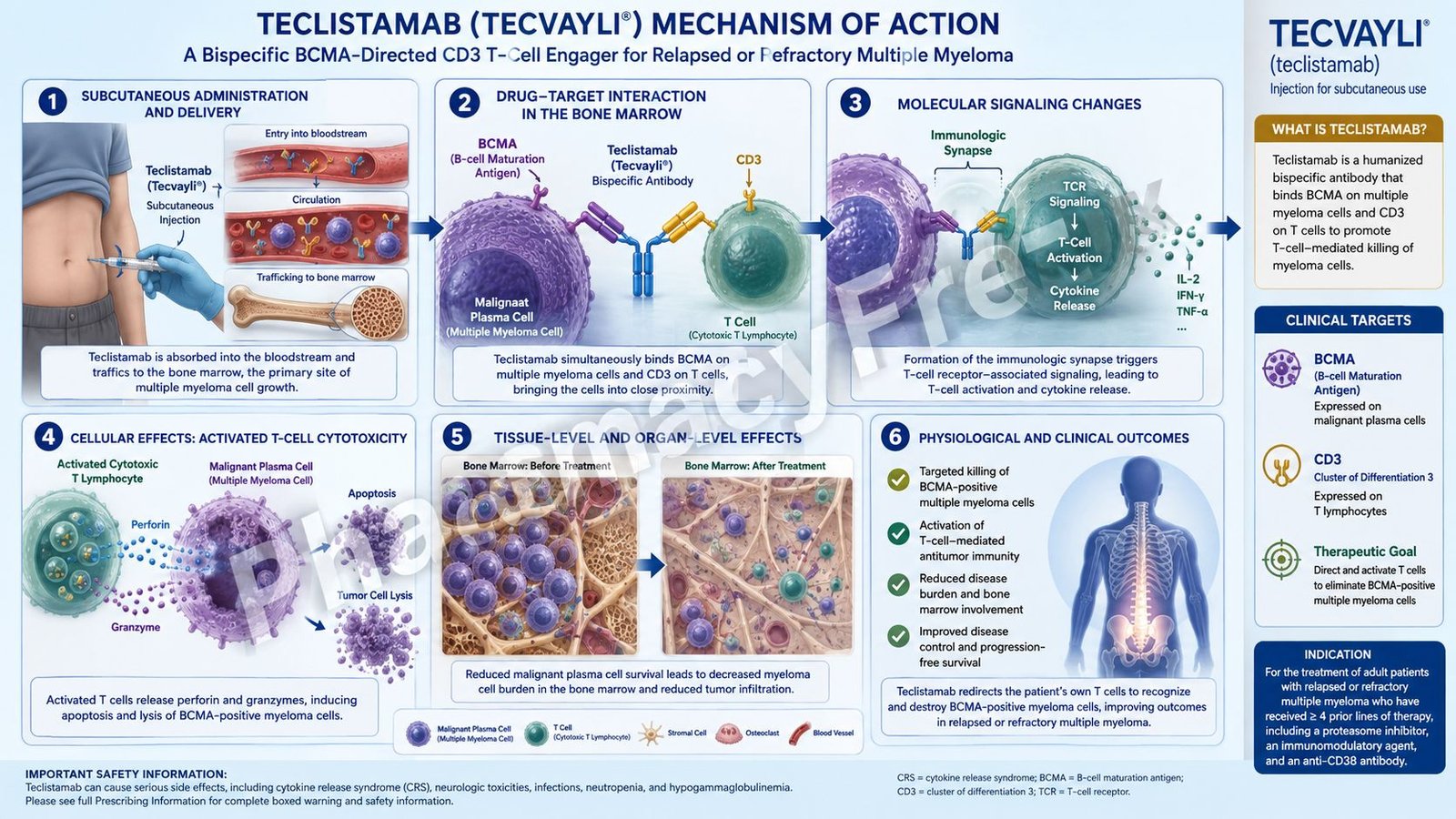
Teclistamab is an anticancer immunotherapy marketed under the brand name Tecvayli. Pharmacologically, teclistamab-cqyv is a bispecific B-cell maturation antigen-directed CD3 T-cell engager used in relapsed or refractory multiple myeloma.
Multiple myeloma is a malignant plasma-cell disorder. In this disease, abnormal plasma cells accumulate in the bone marrow and produce monoclonal immunoglobulin or light chains. This can lead to anemia, bone pain, osteolytic lesions, kidney injury, hypercalcemia, recurrent infections, and progressive marrow failure.
A major target in multiple myeloma is BCMA, or B-cell maturation antigen. BCMA is expressed on the surface of multiple myeloma cells and some healthy B-lineage cells. Because myeloma cells commonly express BCMA, it has become an important target for modern myeloma therapies, including antibody-drug conjugates, CAR-T therapies, and bispecific T-cell engagers.
Teclistamab is different from conventional chemotherapy because it does not directly damage DNA or inhibit cell division in a broad way. Instead, it redirects the patient’s own T cells toward BCMA-expressing myeloma cells. The official Tecvayli label describes teclistamab-cqyv as a bispecific T-cell engaging antibody that binds CD3 on T cells and BCMA on multiple myeloma cells and some healthy B-lineage cells. In vitro, it activates T cells, causes release of proinflammatory cytokines, and produces lysis of multiple myeloma cells.
Tecvayli is indicated for adult patients with relapsed or refractory multiple myeloma in two main settings: in combination with daratumumab and hyaluronidase-fihj after at least one prior line of therapy including a proteasome inhibitor and an immunomodulatory agent, and as monotherapy after at least four prior lines of therapy including a proteasome inhibitor, an immunomodulatory agent, and an anti-CD38 monoclonal antibody.
For exam purposes, teclistamab should be remembered as a BCMA-directed CD3 T-cell engager. It physically links CD3-positive T cells with BCMA-positive myeloma cells, activates T cells, triggers cytokine release, and causes immune-mediated myeloma-cell killing.
Mechanism of Action (Step-wise)
Step 1: Multiple myeloma arises from malignant plasma cells
Multiple myeloma is a cancer of plasma cells. These malignant plasma cells expand in the bone marrow and disrupt normal blood-cell formation, bone remodeling, immune defense, and kidney function.
Step 2: Myeloma cells commonly express BCMA
BCMA stands for B-cell maturation antigen. It is found on multiple myeloma cells and some normal B-lineage cells. This makes BCMA a useful surface target for immunotherapy in multiple myeloma.
Step 3: T cells can kill abnormal target cells
T lymphocytes are immune cells capable of killing abnormal cells when properly activated. Cytotoxic T-cell killing usually requires recognition, immune synapse formation, activation, and release of cytotoxic molecules.
Step 4: CD3 is part of the T-cell receptor complex
CD3 is present on the surface of T cells as part of the T-cell receptor complex. When CD3 is engaged appropriately, T-cell activation can occur.
Step 5: Teclistamab is a bispecific antibody
Teclistamab is called bispecific because it binds two different targets. One arm binds BCMA on myeloma cells, while the other arm binds CD3 on T cells.
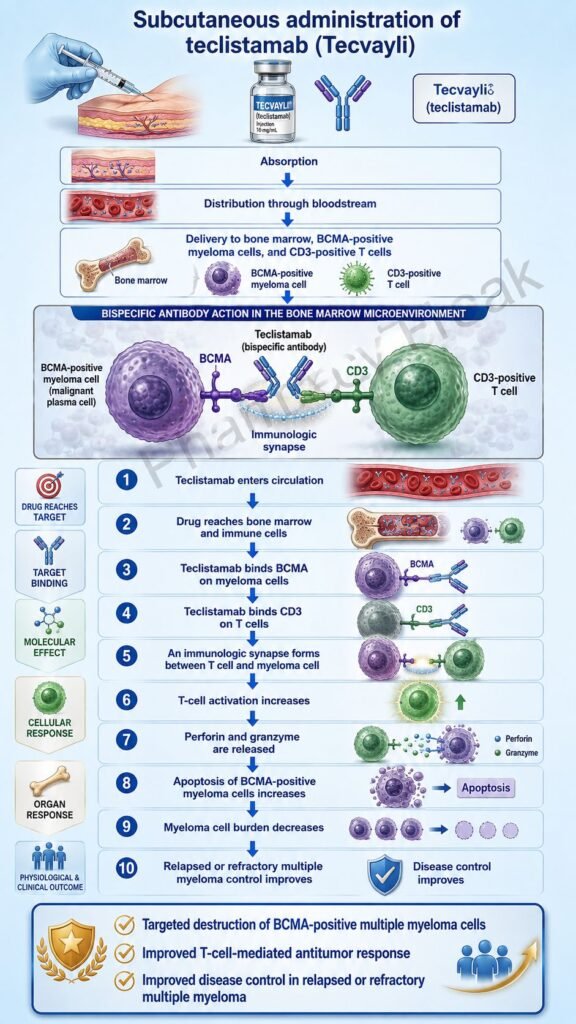
Step 6: Teclistamab binds BCMA on myeloma cells
After subcutaneous administration, teclistamab enters systemic circulation and can bind BCMA-expressing multiple myeloma cells.
Step 7: Teclistamab binds CD3 on T cells
At the same time, teclistamab binds CD3 receptors on T cells. This brings T cells close to the myeloma cells.
Step 8: T cells and myeloma cells are physically redirected together
By binding both BCMA and CD3, teclistamab acts like a molecular bridge. It redirects T cells toward BCMA-positive myeloma cells even if the T cell was not originally specific for that myeloma antigen.
Step 9: T-cell activation occurs
When teclistamab brings CD3-positive T cells into contact with BCMA-positive myeloma cells, T cells become activated. The label states that teclistamab activated T cells in vitro.
Step 10: Proinflammatory cytokines are released
Activated T cells release inflammatory cytokines. The Tecvayli label reports increased cytokines such as IL-6, IL-10, and IL-2 receptor after step-up dosing and early treatment doses.
Step 11: Cytotoxic killing of myeloma cells occurs
Activated T cells can kill the BCMA-expressing myeloma cell. In vitro, teclistamab resulted in lysis of multiple myeloma cells.
Step 12: Tumor burden may decrease
As more BCMA-positive myeloma cells are eliminated, malignant plasma-cell burden may decrease. This can improve disease markers such as M-protein, free light chains, and bone marrow plasma-cell involvement in responding patients.
Step 13: Healthy B-lineage cells may also be affected
Because BCMA is also present on some healthy B-lineage cells, teclistamab can affect normal humoral immunity. This helps explain risks such as hypogammaglobulinemia and serious infections.
Step 14: Cytokine release syndrome can occur
The same immune activation that helps destroy myeloma cells can also cause cytokine release syndrome, or CRS. CRS is a major boxed warning for Tecvayli and may be life-threatening or fatal.
Step 15: Neurologic toxicity can occur
T-cell activation and cytokine effects can also be associated with neurologic toxicity, including immune effector cell-associated neurotoxicity syndrome, or ICANS. This is also included in the boxed warning.
Step 16: Final therapeutic outcome
The final therapeutic effect of teclistamab is immune-mediated killing of BCMA-expressing multiple myeloma cells by redirected CD3-positive T cells. This helps control relapsed or refractory multiple myeloma in approved settings.
Pharmacokinetics
Tecvayli is administered by subcutaneous injection only. It is not an oral drug, not an intravenous infusion, and not a traditional chemotherapy injection.
For monotherapy, Tecvayli uses step-up dosing to reduce the risk of CRS. The schedule includes step-up dose 1 of 0.06 mg/kg on Day 1, step-up dose 2 of 0.3 mg/kg on Day 4, and the first treatment dose of 1.5 mg/kg on Day 7. After that, the treatment dose is 1.5 mg/kg once weekly. In patients who achieve and maintain complete response or better for at least 6 months, dosing frequency may be decreased to 1.5 mg/kg every 2 weeks.
When used in combination with daratumumab and hyaluronidase-fihj, Tecvayli is also started with step-up dosing. The label describes Day 1 step-up dose 1 of 0.06 mg/kg, Day 3 step-up dose 2 of 0.3 mg/kg, and Day 7 first treatment dose of 1.5 mg/kg. It then continues as 1.5 mg/kg once weekly during weeks 2 to 8, 3 mg/kg every 2 weeks during weeks 9 to 24, and 3 mg/kg every 4 weeks from week 25 onward.
Patients should be hospitalized for 48 hours after both step-up dose 1 and step-up dose 2. Patients should also remain near a healthcare facility and be monitored daily for 48 hours after the first treatment dose within the step-up schedule.
Premedication is given before each dose in the step-up dosing schedule to reduce CRS risk. This includes premedication before step-up dose 1, step-up dose 2, and the first treatment dose.
The mean bioavailability of teclistamab after subcutaneous administration is about 72%. The median time to maximum concentration after the first and thirteenth monotherapy treatment doses was 139 hours and 72 hours, respectively.
Following recommended monotherapy dosing, about 90% of steady-state exposure is achieved after 12 weekly doses of 1.5 mg/kg. The mean accumulation ratio between the first and thirteenth weekly dose is about 4.2-fold for Cmax, 4.1-fold for trough concentration, and 5.3-fold for average concentration.
The mean volume of distribution is approximately 5.63 L. Teclistamab clearance decreases over time, and body weight affects distribution and clearance, supporting weight-based dosing.
No clinically significant differences in exposure were observed based on age, sex, race, ethnicity, mild or moderate renal impairment, or mild hepatic impairment. The effects of severe renal impairment and moderate-to-severe hepatic impairment are unknown.
Drug interactions are relevant because Tecvayli causes cytokine release. Cytokine release may suppress CYP enzyme activity and increase exposure to certain CYP substrates, especially after step-up dosing and during or after CRS. The label recommends monitoring CYP substrates where small increases in concentration may cause serious adverse reactions.
Clinical Uses
Tecvayli is used for adult patients with relapsed or refractory multiple myeloma.
It is used in combination with daratumumab and hyaluronidase-fihj in adults who have received at least one prior line of therapy, including a proteasome inhibitor and an immunomodulatory agent.
It is also used as monotherapy in adults who have received at least four prior lines of therapy, including a proteasome inhibitor, an immunomodulatory agent, and an anti-CD38 monoclonal antibody.
Teclistamab is not first-line therapy for newly diagnosed multiple myeloma in the current label. It is used in relapsed or refractory disease after prior myeloma treatments.
Teclistamab is not conventional chemotherapy. It is not a proteasome inhibitor, immunomodulatory imide drug, corticosteroid, alkylating agent, antibody-drug conjugate, CAR-T cell therapy, or CD38 monoclonal antibody. It is a BCMA-directed CD3 T-cell engager.
Tecvayli is not approved for pediatric patients. The label states that safety and efficacy have not been established in pediatric patients.
Teclistamab should not be confused with talquetamab. Talquetamab is also a bispecific T-cell engager but targets GPRC5D and CD3, while teclistamab targets BCMA and CD3.
Adverse Effects
Tecvayli has a boxed warning for cytokine release syndrome and neurologic toxicity, including immune effector cell-associated neurotoxicity syndrome. CRS may be life-threatening or fatal, and neurologic toxicity may also be serious, life-threatening, or fatal.
Because of CRS and neurologic toxicity risk, Tecvayli is available only through a restricted REMS program called the Tecvayli and Talvey REMS.
CRS symptoms may include fever, hypoxia, chills, hypotension, sinus tachycardia, headache, and elevated liver enzymes. Patients must be monitored closely during step-up dosing because early immune activation is when CRS risk is especially important.
Neurologic toxicity may include headache, confusion, dysgraphia, decreased level of consciousness, aphasia, apraxia, somnolence, disorientation, motor dysfunction, neuropathy, or encephalopathy. Patients should avoid driving or operating dangerous machinery during and for 48 hours after completion of the step-up dosing schedule and during any new neurologic toxicity until symptoms resolve.
Hepatotoxicity can occur. Liver enzyme elevations may occur, and patients should report symptoms such as fatigue, anorexia, right upper abdominal discomfort, dark urine, or jaundice.
Serious infections are important with Tecvayli because T-cell redirection and BCMA targeting can impair immune defense. In monotherapy clinical data, serious adverse reactions included pneumonia, sepsis, COVID-19, and other infections. Fatal adverse reactions included COVID-19, pneumonia, and septic shock.
Neutropenia and febrile neutropenia can occur. Patients should be monitored for signs of infection and low neutrophil count. Hematologic laboratory abnormalities are common.
Hypogammaglobulinemia may occur because BCMA is associated with plasma-cell and B-lineage biology. Low immunoglobulin levels can increase infection risk.
Hypersensitivity and administration-related reactions can occur. Local injection-site reactions may also occur and should be reported if severe.
Embryo-fetal toxicity is important. Based on mechanism of action, Tecvayli may cause fetal harm. Females of reproductive potential should use effective contraception during treatment and for 5 months after the last dose.
In monotherapy clinical data, common adverse reactions included pyrexia, CRS, musculoskeletal pain, injection-site reaction, fatigue, upper respiratory tract infection, nausea, headache, pneumonia, and diarrhea. Common severe laboratory abnormalities included decreased lymphocytes, decreased neutrophils, decreased white blood cells, decreased hemoglobin, and decreased platelets.
Clinically relevant adverse reactions reported in fewer than 10% of monotherapy patients included febrile neutropenia, sepsis, ICANS, seizure, Guillain-Barré syndrome, hepatic failure, and new or reactivated viral infections including adenovirus, HBV, CMV, VZV, HSV, and progressive multifocal leukoencephalopathy.
Comparative Analysis
Teclistamab is commonly compared with belantamab mafodotin, idecabtagene vicleucel, ciltacabtagene autoleucel, elranatamab, talquetamab, daratumumab, isatuximab, bortezomib, carfilzomib, lenalidomide, pomalidomide, and conventional chemotherapy.
Compared with belantamab mafodotin, teclistamab has a different BCMA-targeted platform. Belantamab mafodotin is a BCMA-directed antibody-drug conjugate that delivers a microtubule inhibitor payload. Teclistamab is a BCMA-directed CD3 T-cell engager that redirects T cells to kill myeloma cells.
Compared with BCMA CAR-T therapies such as idecabtagene vicleucel and ciltacabtagene autoleucel, teclistamab is not a personalized cellular therapy. CAR-T therapy requires engineered patient T cells, while teclistamab is an off-the-shelf bispecific antibody.
Compared with elranatamab, teclistamab belongs to the same broad group of BCMA-directed CD3 bispecific antibodies. Both redirect T cells against BCMA-positive myeloma cells, but they differ in dosing schedules, clinical data, product-specific warnings, and administration protocols.
Compared with talquetamab, teclistamab has a different tumor antigen. Talquetamab targets GPRC5D and CD3, while teclistamab targets BCMA and CD3.
Compared with daratumumab, teclistamab has a different mechanism and target. Daratumumab targets CD38 on plasma cells and can mediate immune effector killing. Teclistamab targets BCMA and CD3 to directly recruit T cells against myeloma cells.
Compared with isatuximab, teclistamab again differs by target. Isatuximab is an anti-CD38 monoclonal antibody, while teclistamab is a BCMA-CD3 bispecific T-cell engager.
Compared with bortezomib and carfilzomib, teclistamab is not a proteasome inhibitor. Proteasome inhibitors cause accumulation of misfolded proteins and proteotoxic stress in myeloma cells, while teclistamab redirects T-cell cytotoxicity.
Compared with lenalidomide and pomalidomide, teclistamab is not an immunomodulatory imide drug. IMiDs work through cereblon-mediated protein degradation and immune modulation, while teclistamab physically bridges T cells and myeloma cells.
Compared with conventional chemotherapy, teclistamab is more immune-targeted. Chemotherapy broadly affects rapidly dividing cells, while teclistamab uses BCMA recognition and CD3 engagement to kill myeloma cells.
MCQs
- Teclistamab is marketed under which brand name?
a) Blenrep
b) Tecvayli
c) Darzalex
d) Talvey
Answer: b) Tecvayli
- Teclistamab belongs to which pharmacological class?
a) BCMA-directed CD3 T-cell engager
b) Proteasome inhibitor
c) Immunomodulatory imide drug
d) Alkylating agent
Answer: a) BCMA-directed CD3 T-cell engager
- Teclistamab targets BCMA on:
a) Multiple myeloma cells
b) Hepatocytes only
c) Red blood cells only
d) Skeletal muscle cells only
Answer: a) Multiple myeloma cells
- The T-cell target of teclistamab is:
a) CD3
b) CD20
c) CD38
d) HER2
Answer: a) CD3
- Teclistamab kills myeloma cells mainly by:
a) Redirecting T cells toward BCMA-positive myeloma cells
b) Blocking renal sodium absorption
c) Inhibiting gastric acid secretion
d) Activating dopamine receptors
Answer: a) Redirecting T cells toward BCMA-positive myeloma cells
- In vitro, teclistamab activates T cells and causes:
a) Lysis of multiple myeloma cells
b) Direct insulin release
c) Bronchodilation
d) Potassium binding in the gut
Answer: a) Lysis of multiple myeloma cells
- Tecvayli is administered by:
a) Subcutaneous injection
b) Oral tablet
c) Intravenous chemotherapy infusion only
d) Inhalation
Answer: a) Subcutaneous injection
- The first monotherapy step-up dose of Tecvayli is:
a) 0.06 mg/kg
b) 0.3 mg/kg
c) 1.5 mg/kg
d) 3 mg/kg
Answer: a) 0.06 mg/kg
- The monotherapy full treatment dose after step-up dosing is:
a) 1.5 mg/kg
b) 0.06 mg/kg
c) 0.3 mg/kg
d) 10 mg fixed dose
Answer: a) 1.5 mg/kg
- The boxed warning of Tecvayli includes:
a) Cytokine release syndrome and neurologic toxicity including ICANS
b) Thyroid C-cell tumors only
c) Severe hypoglycemia only
d) Ototoxicity only
Answer: a) Cytokine release syndrome and neurologic toxicity including ICANS
- Tecvayli is available only through:
a) Tecvayli and Talvey REMS
b) iPLEDGE only
c) Clozapine REMS only
d) Opioid REMS only
Answer: a) Tecvayli and Talvey REMS
- Which symptom may occur with CRS?
a) Fever
b) Permanent myopia only
c) Severe hypoglycemia in every patient
d) Hair color change only
Answer: a) Fever
- Which neurologic toxicity is specifically associated with Tecvayli?
a) ICANS
b) Parkinsonism only
c) Myasthenia gravis cure
d) Acute glaucoma only
Answer: a) ICANS
- Which infection-related issue is important with teclistamab?
a) Serious infections and viral reactivation
b) Complete prevention of pneumonia
c) Mandatory malaria cure
d) Antibacterial action against all pathogens
Answer: a) Serious infections and viral reactivation
- Which statement best describes teclistamab?
a) It binds BCMA on myeloma cells and CD3 on T cells to redirect T-cell killing
b) It binds potassium in the intestine
c) It blocks VEGF to inhibit angiogenesis only
d) It inhibits BRAF V600E kinase
Answer: a) It binds BCMA on myeloma cells and CD3 on T cells to redirect T-cell killing
FAQs
What is the mechanism of action of teclistamab?
Teclistamab is a bispecific antibody that binds BCMA on multiple myeloma cells and CD3 on T cells. This brings T cells close to myeloma cells, activates T cells, triggers cytokine release, and causes immune-mediated lysis of myeloma cells.
What is the brand name of teclistamab?
The brand name of teclistamab is Tecvayli.
What is teclistamab used for?
Teclistamab is used in adults with relapsed or refractory multiple myeloma. It may be used with daratumumab and hyaluronidase-fihj after at least one prior line including a proteasome inhibitor and an immunomodulatory agent, or as monotherapy after at least four prior lines including a proteasome inhibitor, immunomodulatory agent, and anti-CD38 monoclonal antibody.
Is teclistamab chemotherapy?
No. Teclistamab is not conventional chemotherapy. It is a bispecific T-cell engaging antibody that redirects T cells to kill BCMA-positive myeloma cells.
What does BCMA mean?
BCMA means B-cell maturation antigen. It is a surface protein expressed on multiple myeloma cells and some healthy B-lineage cells.
Why does teclistamab cause cytokine release syndrome?
Teclistamab activates T cells. Activated T cells release inflammatory cytokines, which can produce fever, hypotension, hypoxia, chills, tachycardia, and other CRS symptoms.
What is ICANS?
ICANS means immune effector cell-associated neurotoxicity syndrome. It is a neurologic toxicity that may occur with immune effector therapies such as bispecific T-cell engagers.
What are important adverse effects of teclistamab?
Important adverse effects include CRS, neurologic toxicity including ICANS, serious infections, hepatotoxicity, neutropenia, hypogammaglobulinemia, hypersensitivity, injection-site reactions, embryo-fetal toxicity, fever, fatigue, pneumonia, nausea, headache, diarrhea, and cytopenias.
References
Goodman & Gilman’s The Pharmacological Basis of Therapeutics
Katzung Basic & Clinical Pharmacology