Table of Contents
Introduction
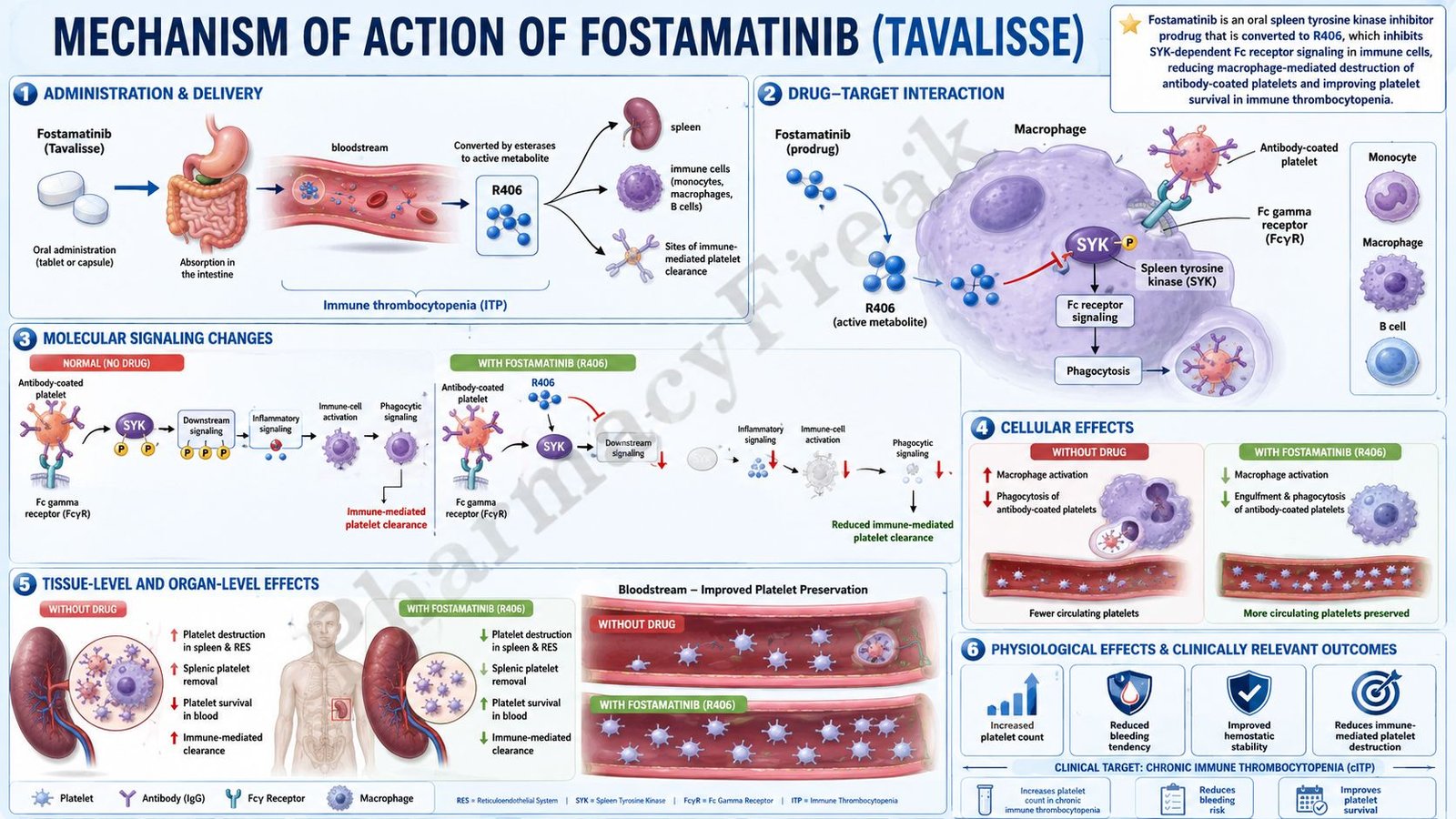
Fostamatinib is an oral targeted drug marketed under the brand name Tavalisse. Pharmacologically, fostamatinib is a spleen tyrosine kinase inhibitor, commonly called a SYK inhibitor.
Immune thrombocytopenia, or ITP, is an autoimmune bleeding disorder in which platelets are destroyed faster than they can be replaced. In chronic ITP, autoantibodies bind to platelets and mark them for removal by immune cells, especially macrophages in the spleen and liver. This leads to low platelet counts, easy bruising, petechiae, mucosal bleeding, and increased risk of clinically significant bleeding.
Fostamatinib is a phosphate prodrug. After oral administration, it is converted to its major active metabolite, R406. R406 inhibits spleen tyrosine kinase, an intracellular signaling enzyme involved in Fc receptor and B-cell receptor signaling. The official label describes fostamatinib as a tyrosine kinase inhibitor with activity against SYK, and states that R406 inhibits signal transduction of Fc-activating receptors and B-cell receptors.
Tavalisse is indicated for the treatment of thrombocytopenia in adult patients with chronic immune thrombocytopenia who have had an insufficient response to a previous treatment.
For exam purposes, fostamatinib should be remembered as an oral SYK inhibitor that reduces antibody-mediated platelet destruction in chronic ITP. It is different from thrombopoietin receptor agonists because it does not primarily stimulate platelet production; instead, it reduces immune-mediated platelet clearance.
Mechanism of Action (Step-wise)
Step 1: Chronic ITP involves autoimmune platelet destruction
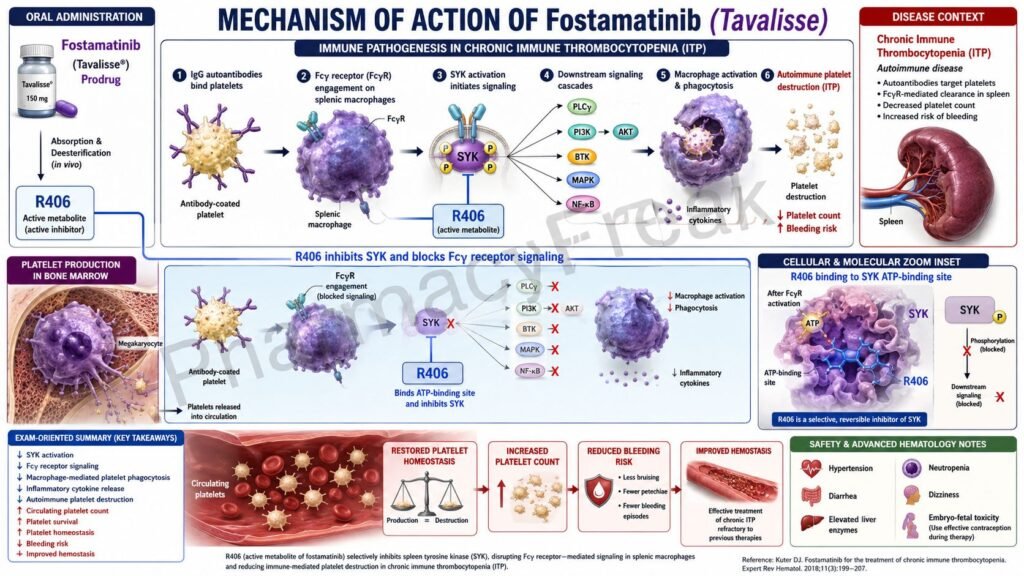
In chronic immune thrombocytopenia, the immune system produces antibodies against platelet surface antigens. These antibody-coated platelets are recognized by immune cells and removed from circulation.
Step 2: Platelet autoantibodies bind platelet membrane antigens
Autoantibodies commonly target platelet glycoproteins. Once antibodies attach to platelets, the Fc portion of the antibody becomes available for recognition by Fc receptors on macrophages.
Step 3: Macrophages recognize antibody-coated platelets
Macrophages in the spleen and liver express Fc gamma receptors. These receptors bind the Fc region of platelet-bound IgG antibodies. This interaction triggers intracellular signaling that promotes platelet phagocytosis.
Step 4: SYK transmits Fc receptor signals
Spleen tyrosine kinase is an intracellular kinase involved in signaling downstream of Fc-activating receptors. When Fc receptors are activated, SYK helps transmit the signal that leads to cytoskeletal rearrangement, immune activation, and phagocytosis.
Step 5: Platelets are phagocytosed and destroyed
After Fc receptor signaling is activated, macrophages engulf and destroy antibody-coated platelets. This reduces circulating platelet count and increases bleeding risk.
Step 6: B-cell receptor signaling may also contribute
B cells are involved in autoimmune antibody production. SYK also participates in B-cell receptor signaling, which is relevant because B-cell activation can support ongoing autoimmune responses in ITP.
Step 7: Fostamatinib is converted to R406
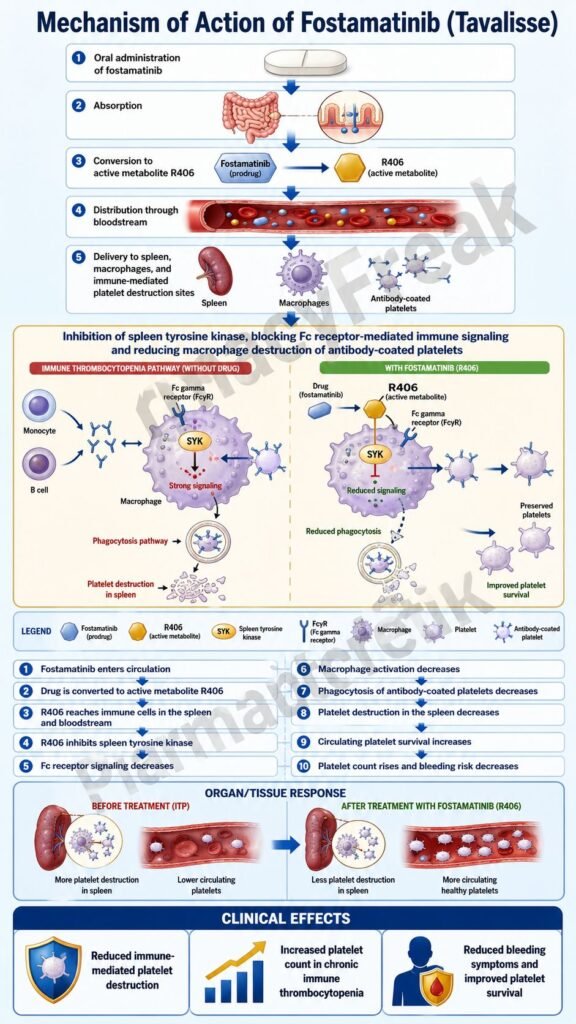
Fostamatinib itself is a prodrug. After oral administration, it is converted mainly in the gut to R406, the pharmacologically active metabolite. The label states that negligible levels of fostamatinib are found in plasma, while R406 is the major active circulating moiety.
Step 8: R406 inhibits spleen tyrosine kinase
R406 inhibits SYK activity. This is the central molecular mechanism of fostamatinib. By inhibiting SYK, R406 reduces intracellular signaling downstream of immune receptors involved in platelet destruction.
Step 9: Fc receptor signaling decreases
When SYK is inhibited, Fc receptor-mediated signaling in macrophages decreases. This makes macrophages less able to respond strongly to antibody-coated platelets.
Step 10: Platelet phagocytosis decreases
Because macrophage activation through Fc receptors is reduced, antibody-mediated platelet phagocytosis decreases. The label specifically states that R406 reduces antibody-mediated destruction of platelets.
Step 11: Platelet survival increases
When fewer antibody-coated platelets are destroyed, circulating platelet survival improves. This can increase platelet counts in patients who respond to treatment.
Step 12: Bleeding risk may decrease
The therapeutic goal in chronic ITP is not always to normalize platelet count completely. The goal is to raise platelet counts to a safer level that reduces the risk of clinically important bleeding.
Step 13: Fostamatinib does not directly stimulate megakaryocytes
Fostamatinib is not a thrombopoietin receptor agonist. It does not primarily act by stimulating megakaryocyte proliferation or platelet production in the bone marrow. Its main action is reducing immune-mediated platelet destruction.
Step 14: Fostamatinib does not broadly deplete B cells
Unlike rituximab, fostamatinib does not directly deplete CD20-positive B cells. It interferes with intracellular signaling pathways involved in Fc receptor and B-cell receptor responses.
Step 15: Final therapeutic outcome
The final therapeutic effect of fostamatinib is increased platelet count in some adults with chronic ITP by reducing immune-mediated platelet destruction. This helps reduce bleeding risk in patients who have not responded adequately to previous therapy.
Pharmacokinetics
Fostamatinib is administered orally as Tavalisse tablets. The recommended starting dose is 100 mg twice daily, with or without food. After 4 weeks, the dose may be increased to 150 mg twice daily if needed to achieve platelet counts of at least 50 × 10⁹/L to reduce bleeding risk.
The lowest effective dose should be used to achieve and maintain a platelet count high enough to reduce the risk of clinically important bleeding. If platelet count does not increase sufficiently after 12 weeks of treatment, Tavalisse should be discontinued.
Tavalisse is available as 100 mg and 150 mg oral tablets. If a dose is missed, the next dose should be taken at the regularly scheduled time rather than taking an extra replacement dose.
Fostamatinib is converted in the gut by alkaline phosphatase to the active metabolite R406. R406 is the main circulating active compound. After oral administration, the absolute bioavailability of R406 is about 55%, and median time to maximum concentration is about 1.5 hours.
Food does not prevent administration. A high-fat, high-calorie meal increases R406 exposure modestly, but Tavalisse can still be taken with or without food according to labeling guidance.
R406 is highly protein bound in plasma, about 98.3%. The mean steady-state volume of distribution is large, around 256 L, suggesting extensive distribution beyond the plasma compartment.
The terminal half-life of R406 is approximately 15 hours. This supports twice-daily dosing. R406 is extensively metabolized, mainly by CYP3A4-mediated oxidation and UGT1A9-mediated glucuronidation.
Most drug-related material is eliminated in feces, with a smaller amount eliminated in urine. Around 80% is excreted in feces and about 20% in urine after oral dosing.
Strong CYP3A4 inhibitors can increase exposure to R406 and may increase toxicity. Strong CYP3A4 inducers are not recommended because they can reduce R406 exposure and may reduce effectiveness.
Fostamatinib can also affect other drugs. The label reports interactions with CYP3A4 substrates, BCRP substrates, and P-gp substrates such as digoxin, so medication review is important before and during treatment.
Clinical Uses
Fostamatinib is used for thrombocytopenia in adult patients with chronic immune thrombocytopenia who have had an insufficient response to at least one previous treatment.
It is generally considered in patients whose platelet counts remain too low or whose bleeding risk remains clinically important despite prior therapy. Previous therapies may include corticosteroids, intravenous immunoglobulin, anti-D immunoglobulin, rituximab, thrombopoietin receptor agonists, or splenectomy depending on patient history.
In chronic ITP, fostamatinib is useful because it targets platelet destruction rather than platelet production. This makes it mechanistically different from drugs such as eltrombopag, avatrombopag, lusutrombopag, and romiplostim.
Fostamatinib is not used for emergency correction of severe bleeding. In acute severe bleeding, clinicians may use rescue therapies such as platelet transfusion, intravenous immunoglobulin, corticosteroids, antifibrinolytics, or other urgent interventions depending on the clinical situation.
Fostamatinib is not a general anticoagulant reversal drug, not a platelet transfusion substitute, not a chemotherapy drug, and not a thrombopoietin receptor agonist. It is an oral immunomodulatory kinase inhibitor used for selected adults with chronic ITP.
The safety and effectiveness of Tavalisse in pediatric patients have not been established. The patient information section also states that it is not known if Tavalisse is safe and effective in children.
Adverse Effects
The major adverse effects of fostamatinib are hypertension, hepatotoxicity, diarrhea, neutropenia, and embryo-fetal toxicity.
Hypertension is one of the most important warnings. Blood pressure should be monitored every 2 weeks until stable, then monthly. If hypertension develops, antihypertensive treatment, dose interruption, dose reduction, or discontinuation may be required.
Hypertension occurs because SYK inhibition and off-target kinase effects may influence vascular and inflammatory signaling. Clinically, patients with pre-existing hypertension may be more susceptible to blood pressure increases.
Hepatotoxicity is another important warning. Elevated liver function tests, mainly ALT and AST, can occur during treatment. Liver function tests should be monitored monthly, and dose interruption, reduction, or discontinuation may be needed if liver enzymes rise significantly.
Diarrhea is common and can be severe. It should be managed early with supportive measures such as dietary adjustment, hydration, and antidiarrheal therapy. Severe diarrhea may require temporary interruption, dose reduction, or discontinuation.
Neutropenia can occur and may increase infection risk. Absolute neutrophil count should be monitored monthly. If ANC decreases significantly, treatment interruption, dose reduction, or discontinuation may be required.
Embryo-fetal toxicity is an important warning. Based on animal findings and mechanism of action, Tavalisse can cause fetal harm. Females of reproductive potential should use effective contraception during treatment and for at least 1 month after the last dose.
The most common adverse reactions reported more often than placebo include diarrhea, hypertension, nausea, respiratory infection, dizziness, increased ALT or AST, rash, abdominal pain, fatigue, chest pain, and neutropenia.
Serious adverse reactions reported in clinical studies included febrile neutropenia, diarrhea, pneumonia, and hypertensive crisis. Patients should be counseled to report fever, infection symptoms, severe diarrhea, chest pain, severe headache, confusion, dizziness, shortness of breath, or signs of bleeding.
Because fostamatinib is used in patients who already have thrombocytopenia, bleeding symptoms should still be monitored. Increasing platelet count reduces bleeding risk, but patients may remain thrombocytopenic or fluctuate during treatment.
Breastfeeding is not recommended during treatment and for at least 1 month after the last dose because of potential risk to the infant.
Comparative Analysis
Fostamatinib is commonly compared with thrombopoietin receptor agonists, corticosteroids, IVIG, rituximab, splenectomy, and other immunomodulatory therapies used in ITP.
Compared with eltrombopag, fostamatinib has a different mechanism. Eltrombopag is a thrombopoietin receptor agonist that increases platelet production by stimulating megakaryocytes. Fostamatinib inhibits SYK signaling and reduces immune-mediated platelet destruction.
Compared with romiplostim, fostamatinib is oral and targets platelet destruction. Romiplostim is an injectable thrombopoietin receptor agonist that stimulates platelet production in the bone marrow.
Compared with avatrombopag, fostamatinib again differs by mechanism. Avatrombopag increases platelet production through TPO receptor stimulation, while fostamatinib reduces Fc receptor-mediated platelet phagocytosis.
Compared with corticosteroids, fostamatinib is more targeted. Corticosteroids broadly suppress immune activity and are often used earlier in ITP, but long-term use is limited by adverse effects such as hyperglycemia, weight gain, osteoporosis, hypertension, mood effects, and infection risk.
Compared with IVIG, fostamatinib is slower and used for ongoing management rather than rapid rescue. IVIG can raise platelet counts quickly in many patients by blocking Fc receptor-mediated platelet clearance, but its effect is usually temporary.
Compared with rituximab, fostamatinib does not deplete B cells. Rituximab is an anti-CD20 monoclonal antibody that reduces B-cell populations and autoantibody production. Fostamatinib inhibits SYK-dependent immune signaling downstream of Fc receptors and B-cell receptors.
Compared with splenectomy, fostamatinib is a medical therapy. Splenectomy removes a major site of antibody-mediated platelet destruction but carries surgical risks and long-term infection risks. Fostamatinib provides a non-surgical approach.
Compared with platelet transfusion, fostamatinib is not an emergency replacement therapy. Platelet transfusion provides temporary platelet support in severe bleeding or procedures, while fostamatinib aims to reduce immune destruction over time.
Compared with broad immunosuppressants such as azathioprine, mycophenolate, or cyclosporine, fostamatinib has a more defined intracellular kinase target related to Fc receptor and B-cell receptor signaling.
MCQs
- Fostamatinib is marketed under which brand name?
a) Promacta
b) Tavalisse
c) Nplate
d) Doptelet
Answer: b) Tavalisse
- Fostamatinib belongs to which pharmacological class?
a) Spleen tyrosine kinase inhibitor
b) Thrombopoietin receptor agonist
c) Anti-CD20 monoclonal antibody
d) Direct thrombin inhibitor
Answer: a) Spleen tyrosine kinase inhibitor
- The major active metabolite of fostamatinib is:
a) R406
b) SN-38
c) Oseltamivir carboxylate
d) Norfluoxetine
Answer: a) R406
- Fostamatinib is mainly used for:
a) Chronic immune thrombocytopenia in adults after insufficient response to previous treatment
b) Acute myocardial infarction
c) Hemophilia A replacement therapy
d) Acute bacterial meningitis
Answer: a) Chronic immune thrombocytopenia in adults after insufficient response to previous treatment
- In ITP, platelet destruction commonly occurs after platelets are coated with:
a) Autoantibodies
b) Insulin
c) Thyroid hormone
d) Dopamine
Answer: a) Autoantibodies
- SYK is important in signaling downstream of:
a) Fc-activating receptors and B-cell receptors
b) Beta-2 receptors only
c) Dopamine D2 receptors only
d) GLP-1 receptors only
Answer: a) Fc-activating receptors and B-cell receptors
- Fostamatinib increases platelet count mainly by:
a) Reducing antibody-mediated platelet destruction
b) Directly transfusing platelets
c) Irreversibly activating thrombin
d) Blocking vitamin K recycling
Answer: a) Reducing antibody-mediated platelet destruction
- Fostamatinib is different from eltrombopag because eltrombopag:
a) Stimulates thrombopoietin receptors
b) Inhibits SYK
c) Blocks Fc receptors directly
d) Depletes B cells
Answer: a) Stimulates thrombopoietin receptors
- The usual starting dose of Tavalisse is:
a) 100 mg orally twice daily
b) 500 mg once weekly
c) 1 mg subcutaneously monthly
d) 5 mg once daily
Answer: a) 100 mg orally twice daily
- If needed after 4 weeks, Tavalisse may be increased to:
a) 150 mg twice daily
b) 10 mg once daily
c) 600 mg monthly
d) 1,000 mg twice daily
Answer: a) 150 mg twice daily
- Which monitoring is important during fostamatinib therapy?
a) Blood pressure, CBC, platelet count, ANC, and liver function tests
b) Only blood group
c) Only serum calcium every hour
d) Only audiometry
Answer: a) Blood pressure, CBC, platelet count, ANC, and liver function tests
- Which adverse effect is especially important with fostamatinib?
a) Hypertension
b) Severe ototoxicity
c) Gingival hyperplasia
d) Mandatory hypoglycemia
Answer: a) Hypertension
- Which gastrointestinal adverse effect is common with fostamatinib?
a) Diarrhea
b) Bowel obstruction in every patient
c) Acute appendicitis
d) Permanent achlorhydria
Answer: a) Diarrhea
- Strong CYP3A4 inducers may:
a) Reduce R406 exposure and decrease effectiveness
b) Permanently increase platelet count in all patients
c) Eliminate hypertension risk
d) Convert fostamatinib into rituximab
Answer: a) Reduce R406 exposure and decrease effectiveness
- Which statement best describes fostamatinib?
a) It is an oral SYK inhibitor prodrug that reduces antibody-mediated platelet destruction in chronic ITP
b) It is a TPO receptor agonist that directly stimulates megakaryocytes
c) It is an anti-CD20 antibody that depletes B cells
d) It is an anticoagulant used to dissolve clots
Answer: a) It is an oral SYK inhibitor prodrug that reduces antibody-mediated platelet destruction in chronic ITP
FAQs
What is the mechanism of action of fostamatinib?
Fostamatinib is converted to the active metabolite R406, which inhibits spleen tyrosine kinase. This reduces Fc receptor and B-cell receptor signaling, decreases antibody-mediated platelet destruction, and helps increase platelet counts in chronic ITP.
What is the brand name of fostamatinib?
The brand name of fostamatinib is Tavalisse.
What is fostamatinib used for?
Fostamatinib is used for thrombocytopenia in adult patients with chronic immune thrombocytopenia who have had an insufficient response to a previous treatment.
Is fostamatinib a thrombopoietin receptor agonist?
No. Fostamatinib is not a thrombopoietin receptor agonist. It does not primarily stimulate platelet production. It works by reducing immune-mediated platelet destruction through SYK inhibition.
What is the active metabolite of fostamatinib?
The active metabolite of fostamatinib is R406. R406 is responsible for inhibition of spleen tyrosine kinase signaling.
Why does fostamatinib help in ITP?
In ITP, antibody-coated platelets are destroyed by macrophages through Fc receptor signaling. Fostamatinib inhibits SYK, which is important in this pathway, thereby reducing platelet destruction.
What are common adverse effects of fostamatinib?
Common adverse effects include diarrhea, hypertension, nausea, respiratory infection, dizziness, increased liver enzymes, rash, abdominal pain, fatigue, chest pain, and neutropenia.
What monitoring is needed with fostamatinib?
Platelet count, CBC, absolute neutrophil count, liver function tests, and blood pressure should be monitored during therapy.
References
Goodman & Gilman’s The Pharmacological Basis of Therapeutics
Katzung Basic & Clinical Pharmacology