Table of Contents
Introduction
Vtama is the brand name of tapinarof cream 1%, a topical non-steroidal dermatological drug used in inflammatory skin diseases. It belongs to the class of aryl hydrocarbon receptor agonists, commonly abbreviated as AhR agonists.
Vtama is indicated for the topical treatment of plaque psoriasis in adults and atopic dermatitis in adults and pediatric patients 2 years of age and older. It is applied as a thin layer to affected areas once daily and is not intended for oral, ophthalmic, or intravaginal use.
Vtama is important in pharmacology because it provides a non-steroidal option for chronic inflammatory skin diseases. Unlike topical corticosteroids, it does not act through glucocorticoid receptor-mediated broad anti-inflammatory effects. Instead, tapinarof activates the aryl hydrocarbon receptor, a ligand-activated transcription factor involved in skin immune regulation, epidermal differentiation, oxidative stress control, and skin barrier function.
For pharmacy, medical, nursing, and competitive exam students, Vtama is important because it represents a newer topical mechanism in dermatology. Its key pharmacological identity is AhR agonism, leading to modulation of inflammatory pathways and skin barrier-related gene expression. However, the exact mechanisms by which Vtama produces its therapeutic effects in patients are not fully understood.
Mechanism of Action (Step-wise)
- Primary target: Aryl hydrocarbon receptor
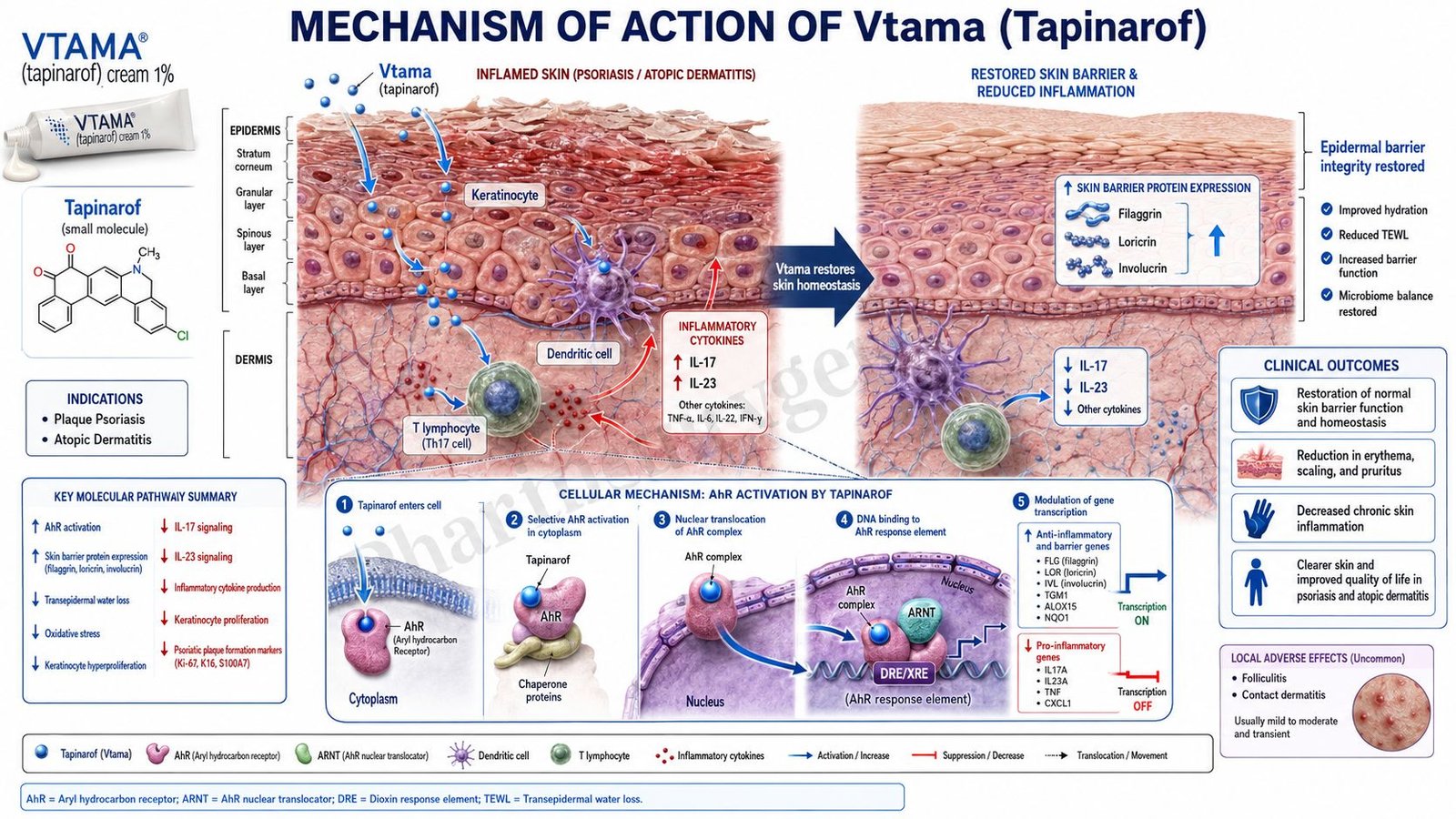
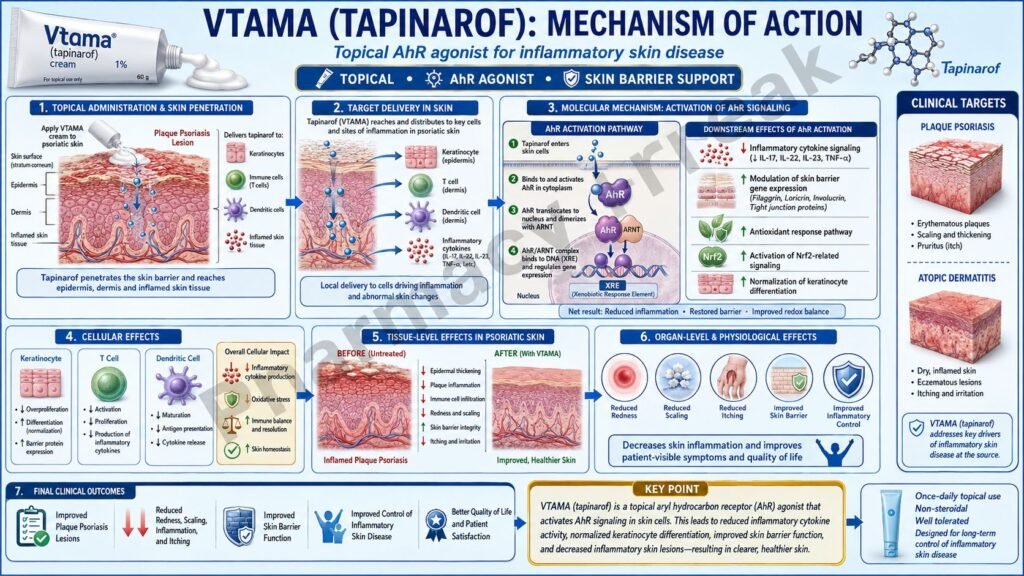
Vtama contains tapinarof, an aryl hydrocarbon receptor agonist. The aryl hydrocarbon receptor is an intracellular ligand-activated transcription factor found in several tissues, including skin cells such as keratinocytes and immune cells.
When activated, AhR can influence gene transcription related to inflammation, epidermal differentiation, oxidative stress response, and barrier repair.
- Tapinarof binds and activates AhR
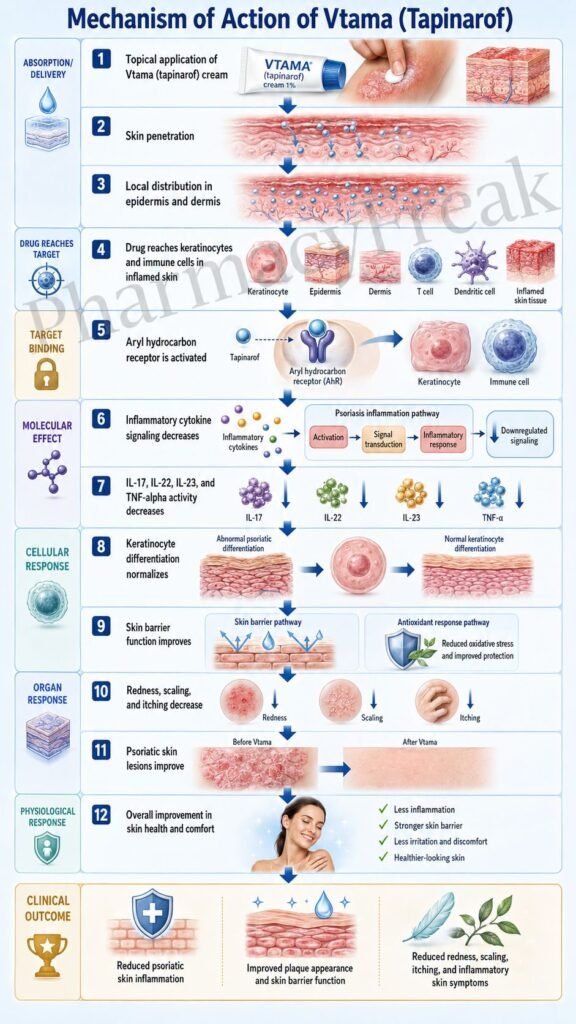
After topical application, tapinarof penetrates the skin and binds to AhR within target cells. This activates AhR and allows it to regulate transcription of genes involved in skin homeostasis and immune balance.
The official prescribing information states that tapinarof is an AhR agonist, but the specific mechanisms by which Vtama exerts its therapeutic actions are unknown.
- Regulation of inflammatory signaling
Activation of AhR may reduce pro-inflammatory signaling pathways involved in psoriasis and atopic dermatitis. In plaque psoriasis, inflammatory pathways involving Th17 cells, IL-17, IL-22, TNF-alpha, and keratinocyte activation contribute to plaque formation, scaling, redness, and thickened skin.
By modulating AhR-dependent pathways, Vtama may reduce inflammatory cytokine activity and help normalize immune signaling in the skin.
- Effect on keratinocyte differentiation
Keratinocytes are the major cells of the epidermis. In psoriasis, keratinocytes proliferate excessively and differentiate abnormally, producing thick, scaly plaques.
AhR activation may help regulate keratinocyte differentiation and reduce abnormal epidermal thickening. This contributes to improvement in plaque thickness, scaling, and erythema.
- Support of skin barrier function
In atopic dermatitis, the skin barrier is impaired, allowing irritants, allergens, and microbes to enter more easily. This contributes to itching, inflammation, dryness, and recurrent flares.
AhR activation may increase expression of genes involved in epidermal barrier formation, including proteins and lipids important for barrier integrity. This may help improve skin barrier function and reduce inflammatory sensitivity.
- Reduction of oxidative stress-related inflammation
Oxidative stress can worsen inflammatory skin diseases. AhR signaling can interact with antioxidant response pathways and may reduce oxidative stress-related skin inflammation.
This effect may help decrease irritation, redness, and inflammatory damage in affected skin.
- Effect in plaque psoriasis
In plaque psoriasis, Vtama helps reduce inflammatory plaques by modulating AhR-mediated pathways involved in keratinocyte proliferation, cytokine signaling, and epidermal differentiation.
The final clinical effect is improvement in plaque thickness, redness, scaling, and overall lesion severity.
- Effect in atopic dermatitis
In atopic dermatitis, Vtama may reduce inflammation and itching by modulating immune pathways and supporting skin barrier repair. It is useful as a non-steroidal topical option for adults and children 2 years of age and older.
- Final therapeutic effect
The final therapeutic effect of Vtama is reduced skin inflammation, improved plaque psoriasis lesions, improved atopic dermatitis lesions, reduced itching and irritation, and better restoration of skin homeostasis in suitable patients.
Pharmacokinetics
Vtama is administered topically as tapinarof cream 1%. Each gram of cream contains 10 mg of tapinarof.
Absorption:
Tapinarof is absorbed through the skin after topical application. Systemic exposure is generally low compared with oral or injectable drugs. In adult plaque psoriasis pharmacokinetic studies, many plasma samples had tapinarof concentrations below the quantifiable limit, and no accumulation was observed with repeat topical application.
Distribution:
Tapinarof is highly protein-bound. Human plasma protein binding is approximately 99% in vitro. Because it is used topically, its main intended action is local activity in affected skin.
Metabolism:
Tapinarof is metabolized in the liver by multiple pathways, including oxidation, glucuronidation, and sulfation. It is not primarily described as being dependent on a single cytochrome P450 enzyme pathway.
Excretion:
Detailed clinical excretion data are limited in routine use, but after systemic absorption, metabolism and elimination occur through normal drug clearance pathways. Because systemic exposure after topical use is low, clinically significant systemic accumulation is not expected with recommended use.
Half-life and duration:
The clinical dosing schedule is once daily. The duration of benefit is related to local skin effects and modulation of inflammatory pathways rather than high systemic drug levels.
Special pharmacokinetic point:
In vitro studies show tapinarof is not an inhibitor of several major CYP enzymes and is not an inducer of CYP1A2, CYP2B6, or CYP3A4. It is also not an inhibitor of several major transporters listed in the prescribing information, suggesting a low potential for common systemic CYP-mediated interactions.
Clinical Uses
- Plaque psoriasis in adults:
Vtama is used for topical treatment of plaque psoriasis in adults. It helps improve psoriatic plaques, scaling, erythema, and lesion severity. - Atopic dermatitis in adults:
Vtama is used for topical treatment of atopic dermatitis in adults. It may help reduce inflammation, itching, and skin-barrier dysfunction. - Atopic dermatitis in pediatric patients:
Vtama is approved for atopic dermatitis in pediatric patients 2 years of age and older. Its safety and efficacy for atopic dermatitis have not been established in children younger than 2 years. - Non-steroidal topical therapy:
Vtama is useful when a non-steroidal topical option is clinically appropriate. - Inflammatory skin disease control:
It is used to reduce chronic inflammatory skin lesions through AhR-mediated modulation of skin immune and barrier pathways. - Once-daily topical treatment:
Vtama is applied once daily, which may support adherence in chronic dermatologic therapy.
Adverse Effects
Common adverse effects of Vtama in plaque psoriasis include:
- Folliculitis
- Nasopharyngitis
- Contact dermatitis
- Headache
- Pruritus
- Influenza
- Application site irritation
- Skin redness
- Burning or stinging sensation
- Peeling or rash
Common adverse effects in atopic dermatitis include:
- Upper and lower respiratory tract infections
- Folliculitis
- Headache
- Vomiting
- Ear infection
- Pain in extremity
- Asthma
- Abdominal pain
- Application site reactions
The prescribing information lists folliculitis, nasopharyngitis, contact dermatitis, headache, pruritus, and influenza among common adverse reactions in plaque psoriasis, while respiratory tract infections, folliculitis, headache, vomiting, ear infection, pain in extremity, asthma, and abdominal pain are listed among common adverse effects in atopic dermatitis.
Clinically important points include:
- Vtama should be used only on affected skin areas.
- It should not be used in the eyes, mouth, or vagina.
- Hands should be washed after application unless the hands are being treated.
- Skin irritation at the application site should be monitored.
- It is a topical non-steroidal treatment and does not have the same classic adverse-effect profile as topical corticosteroids.
The official label lists no contraindications for Vtama.
Comparative Analysis
| Feature | Vtama | Topical Corticosteroids | Roflumilast Cream | Tacrolimus Ointment |
|---|---|---|---|---|
| Generic name | Tapinarof | Hydrocortisone, betamethasone, clobetasol, etc. | Roflumilast | Tacrolimus |
| Drug class | AhR agonist | Glucocorticoid receptor agonists | PDE-4 inhibitor | Calcineurin inhibitor |
| Main target | Aryl hydrocarbon receptor | Glucocorticoid receptor | Phosphodiesterase-4 | Calcineurin |
| Main action | Modulates inflammatory and barrier-related pathways | Broad anti-inflammatory and immunosuppressive effect | Increases cAMP and reduces inflammatory cytokines | Reduces T-cell activation |
| Steroid status | Non-steroidal | Steroidal | Non-steroidal | Non-steroidal |
| Common use | Plaque psoriasis, atopic dermatitis | Many inflammatory skin diseases | Psoriasis, seborrheic dermatitis, atopic dermatitis depending on product | Atopic dermatitis |
| Common adverse effects | Folliculitis, contact dermatitis, application reactions | Skin thinning, striae, telangiectasia, HPA-axis risk with potent/prolonged use | Application site pain, diarrhea, headache | Burning, stinging, infection risk |
| Route | Topical cream | Topical | Topical cream/foam | Topical ointment |
Vtama differs from topical corticosteroids because it does not act through glucocorticoid receptor activation and is considered non-steroidal. It differs from roflumilast because roflumilast inhibits PDE-4, while tapinarof activates AhR. Tacrolimus is also non-steroidal, but it works by inhibiting calcineurin and reducing T-cell activation rather than activating AhR.
MCQs
- Vtama contains which active drug?
a) Roflumilast
b) Tapinarof
c) Tacrolimus
d) Clobetasol
Answer: b) Tapinarof
- Vtama belongs to which drug class?
a) Aryl hydrocarbon receptor agonist
b) Beta-blocker
c) Calcineurin inhibitor
d) Antihistamine
Answer: a) Aryl hydrocarbon receptor agonist
- The main receptor activated by tapinarof is:
a) Aryl hydrocarbon receptor
b) Histamine H1 receptor
c) Beta-2 receptor
d) Dopamine D2 receptor
Answer: a) Aryl hydrocarbon receptor
- Vtama is used topically for plaque psoriasis in:
a) Adults
b) Newborns only
c) Only pregnant women
d) Only elderly men
Answer: a) Adults
- Vtama is approved for atopic dermatitis in adults and children aged:
a) 2 years and older
b) 6 months and older
c) 12 years and older only
d) 18 years and older only
Answer: a) 2 years and older
- Vtama should be applied:
a) Once daily to affected areas
b) Intravenously once weekly
c) Orally twice daily
d) Into the eye at bedtime
Answer: a) Once daily to affected areas
- Vtama is not intended for:
a) Oral, ophthalmic, or intravaginal use
b) Skin application
c) Plaque psoriasis treatment
d) Atopic dermatitis treatment
Answer: a) Oral, ophthalmic, or intravaginal use
- Which adverse effect is common with Vtama in plaque psoriasis?
a) Folliculitis
b) Severe hypoglycemia
c) Ototoxicity
d) Gingival hyperplasia
Answer: a) Folliculitis
- Which condition is treated with Vtama?
a) Atopic dermatitis
b) Acute bacterial meningitis
c) Type 1 diabetes ketoacidosis
d) Hypertensive emergency
Answer: a) Atopic dermatitis
- Vtama differs from topical corticosteroids because it:
a) Is non-steroidal and activates AhR
b) Is a potent glucocorticoid receptor agonist
c) Is an injectable monoclonal antibody
d) Is an oral antibiotic
Answer: a) Is non-steroidal and activates AhR
- AhR activation may influence:
a) Skin inflammation and barrier-related gene expression
b) Insulin secretion only
c) Platelet aggregation only
d) Bacterial cell wall synthesis
Answer: a) Skin inflammation and barrier-related gene expression
- Which of the following is a topical PDE-4 inhibitor, not an AhR agonist?
a) Roflumilast
b) Tapinarof
c) Hydrocortisone
d) Betamethasone
Answer: a) Roflumilast
- Which statement about Vtama is correct?
a) Its exact therapeutic mechanism is not fully known
b) It is a systemic JAK inhibitor
c) It is a rescue bronchodilator
d) It directly replaces insulin
Answer: a) Its exact therapeutic mechanism is not fully known
- After applying Vtama, patients should usually:
a) Wash hands unless treating the hands
b) Cover the entire body with plastic wrap
c) Apply it into eyes
d) Take it orally with milk
Answer: a) Wash hands unless treating the hands
- Which adverse effect may occur at the treatment site?
a) Itching, irritation, pain, redness, burning, or color change
b) Severe ototoxicity
c) Acute renal failure in all patients
d) Bone marrow suppression
Answer: a) Itching, irritation, pain, redness, burning, or color change
FAQs
- What is Vtama used for?
Vtama is used for topical treatment of plaque psoriasis in adults and atopic dermatitis in adults and children 2 years of age and older.
- What is the mechanism of action of Vtama?
Vtama contains tapinarof, an aryl hydrocarbon receptor agonist. It activates AhR and may regulate inflammatory, oxidative stress, keratinocyte differentiation, and skin barrier-related pathways. However, the exact therapeutic mechanism is not fully known.
- Is Vtama a steroid?
No. Vtama is not a topical steroid. It is a non-steroidal topical AhR agonist.
- How does Vtama help psoriasis?
In plaque psoriasis, Vtama may reduce inflammatory signaling and help normalize keratinocyte differentiation, leading to improvement in scaling, redness, plaque thickness, and lesion severity.
- How does Vtama help atopic dermatitis?
In atopic dermatitis, Vtama may reduce skin inflammation and support skin barrier function, helping improve eczema lesions, itching, irritation, and inflammatory skin changes.
- How often is Vtama applied?
Vtama is applied once daily as a thin layer to affected skin areas.
- Can Vtama be used in children?
Vtama is approved for atopic dermatitis in children 2 years of age and older. Its safety and effectiveness for plaque psoriasis have not been established in pediatric patients.
- What are common side effects of Vtama?
Common side effects include folliculitis, contact dermatitis, headache, nasopharyngitis, pruritus, influenza, respiratory tract infections, vomiting, ear infection, and application site irritation.
- Can Vtama be used around the eyes?
Vtama is not for ophthalmic use. It should not be applied into the eyes, mouth, or vagina.
References
Goodman & Gilman’s The Pharmacological Basis of Therapeutics
Katzung Basic & Clinical Pharmacology