Table of Contents
Introduction
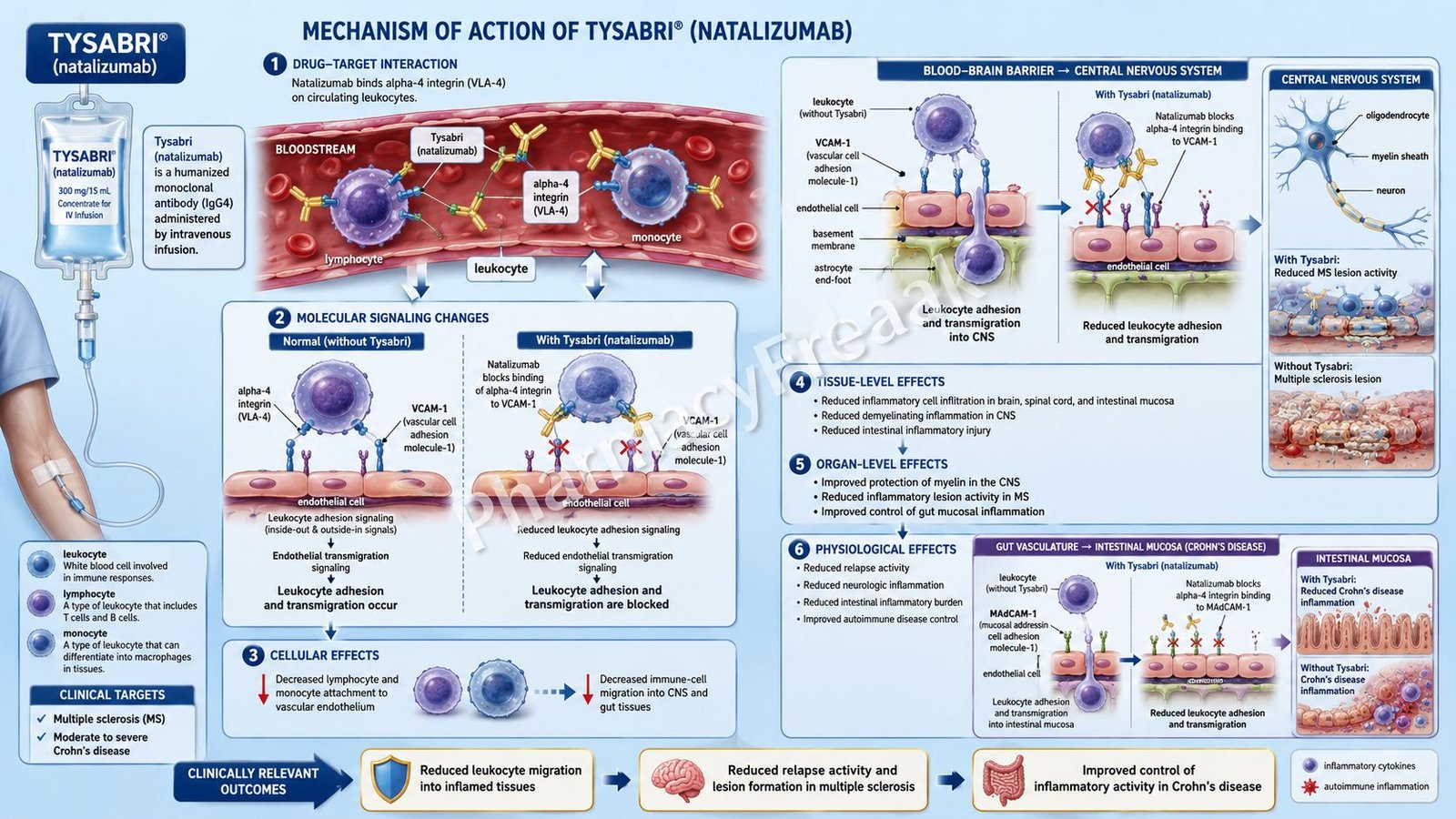
Tysabri is the brand name of natalizumab, a biologic immunomodulator used mainly in multiple sclerosis and Crohn’s disease. Pharmacologically, natalizumab is a recombinant humanized IgG4 monoclonal antibody that targets alpha-4 integrin.
Alpha-4 integrins are adhesion molecules found on the surface of many leukocytes. These molecules help immune cells attach to blood vessel walls and migrate into inflamed tissues. In multiple sclerosis, immune-cell migration into the central nervous system contributes to inflammation, demyelination, plaque formation, and neurological disability. In Crohn’s disease, immune-cell migration into the intestinal mucosa contributes to chronic gut inflammation.
Tysabri works by binding to the alpha-4 subunit of alpha-4 beta-1 and alpha-4 beta-7 integrins. This blocks leukocyte adhesion to counter-receptors such as VCAM-1 and MAdCAM-1, reducing immune-cell movement into inflamed tissues. The official prescribing information states that natalizumab binds alpha-4 integrins on leukocytes except neutrophils and inhibits alpha-4-mediated leukocyte adhesion.
Tysabri is indicated as monotherapy for relapsing forms of multiple sclerosis in adults, including clinically isolated syndrome, relapsing-remitting disease, and active secondary progressive disease. It is also indicated for inducing and maintaining clinical response and remission in selected adults with moderately to severely active Crohn’s disease with evidence of inflammation after inadequate response or intolerance to conventional therapies and TNF-alpha inhibitors.
For exam purposes, Tysabri should be remembered as an anti-alpha-4 integrin monoclonal antibody that prevents leukocyte adhesion and transmigration across endothelium. Its most important safety warning is progressive multifocal leukoencephalopathy, or PML.
Mechanism of Action (Step-wise)
Step 1: Leukocyte migration requires adhesion molecules
For immune cells to enter inflamed tissues, they must first attach to endothelial cells lining blood vessels. This process involves adhesion molecules on leukocytes interacting with counter-receptors on vascular endothelium.
Step 2: Alpha-4 integrins are key leukocyte adhesion molecules
Alpha-4 integrins are expressed on many leukocytes, including lymphocytes and monocytes. The two major alpha-4 integrin complexes relevant to Tysabri are alpha-4 beta-1 integrin and alpha-4 beta-7 integrin.
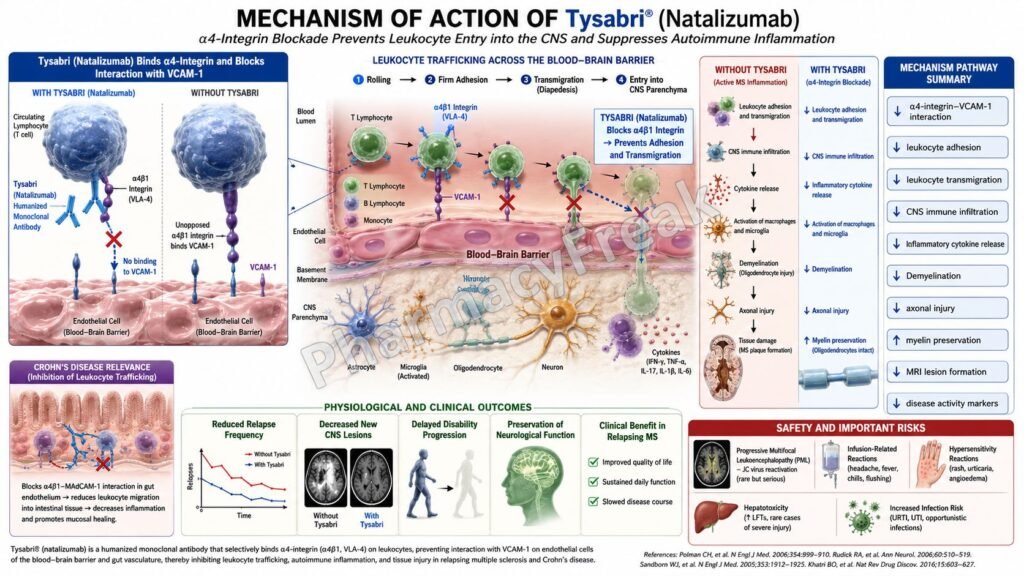
Step 3: Alpha-4 beta-1 binds VCAM-1
Alpha-4 beta-1 integrin interacts with vascular cell adhesion molecule-1, or VCAM-1. VCAM-1 is expressed on activated vascular endothelial cells during inflammation.
Step 4: Alpha-4 beta-7 binds MAdCAM-1
Alpha-4 beta-7 integrin interacts with mucosal addressin cell adhesion molecule-1, or MAdCAM-1. MAdCAM-1 is especially important in the gastrointestinal tract and helps lymphocytes home to gut-associated lymphoid tissue.
Step 5: In multiple sclerosis, immune cells cross the blood-brain barrier
In multiple sclerosis, activated inflammatory cells cross the blood-brain barrier and enter the CNS. These immune cells attack myelin and oligodendrocytes, causing demyelinating lesions, neurological relapses, and progressive neurological impairment.
Step 6: In Crohn’s disease, immune cells enter intestinal tissue
In Crohn’s disease, immune cells migrate into the gut mucosa and amplify intestinal inflammation. This contributes to abdominal pain, diarrhea, ulceration, bleeding, weight loss, and systemic inflammatory symptoms.
Step 7: Tysabri binds the alpha-4 subunit
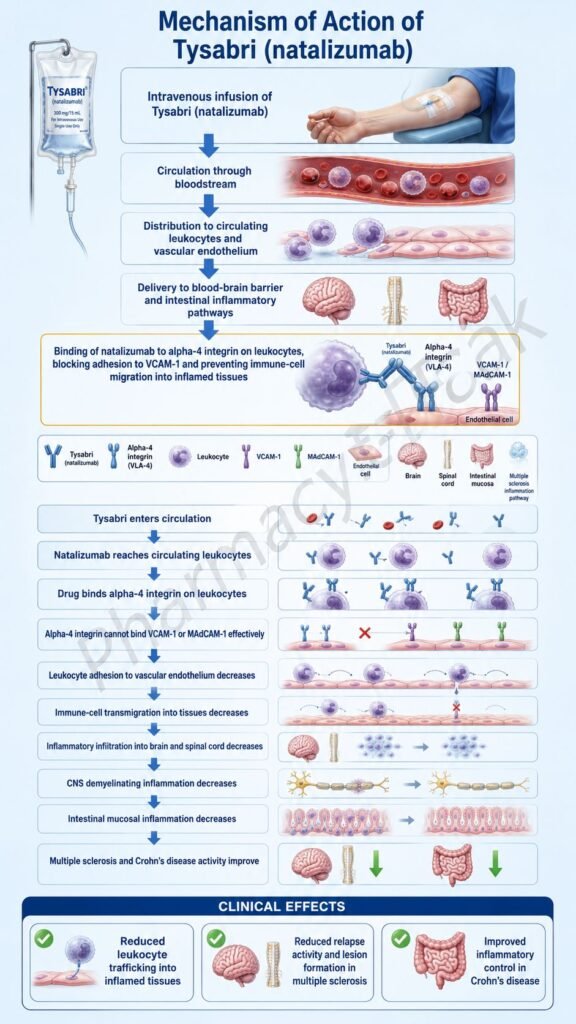
Natalizumab binds to the alpha-4 subunit of alpha-4 beta-1 and alpha-4 beta-7 integrins on leukocytes. This is the central molecular mechanism of Tysabri.
Step 8: Leukocyte adhesion to endothelial receptors is blocked
By binding alpha-4 integrin, Tysabri prevents leukocytes from attaching effectively to VCAM-1 and MAdCAM-1. The label also notes that anti-alpha-4 integrin antibodies can block alpha-4-mediated binding to osteopontin and the CS-1 domain of fibronectin.
Step 9: Transmigration across endothelium decreases
When leukocytes cannot adhere properly to endothelial cells, they cannot efficiently cross the blood vessel wall into inflamed tissue. This reduces leukocyte transmigration into the CNS in multiple sclerosis and into the intestinal mucosa in Crohn’s disease.
Step 10: CNS inflammatory activity decreases in MS
In multiple sclerosis, blockade of alpha-4 beta-1 interaction with VCAM-1 reduces immune-cell entry across the blood-brain barrier. This reduces inflammatory lesion formation, relapse activity, and immune-mediated damage.
Step 11: Gut inflammatory activity decreases in Crohn’s disease
In Crohn’s disease, blockade of alpha-4 beta-7 interaction with MAdCAM-1 reduces lymphocyte trafficking to intestinal inflammatory sites. This can help induce and maintain clinical response and remission in selected patients.
Step 12: Circulating leukocyte counts may increase
Because Tysabri prevents leukocytes from leaving the bloodstream and migrating into tissues, circulating leukocyte counts may increase. The label states that Tysabri increases circulating lymphocytes, monocytes, basophils, and eosinophils due to inhibition of transmigration out of the vascular space, while neutrophil counts are not affected.
Step 13: Tysabri does not directly kill immune cells
Tysabri is not primarily a cytotoxic immune-cell-depleting drug like some anti-CD20 antibodies. It mainly prevents immune-cell trafficking by blocking adhesion and migration.
Step 14: Reduced immune surveillance increases PML risk
Because Tysabri limits immune-cell trafficking into the CNS, immune surveillance against certain viral infections can be reduced. This is the basis for its serious risk of progressive multifocal leukoencephalopathy, a JC virus-related brain infection.
Step 15: Final therapeutic outcome
The final therapeutic outcome is reduced inflammatory immune-cell migration into target tissues. In multiple sclerosis, this decreases CNS inflammatory lesion activity and relapses. In Crohn’s disease, it reduces intestinal inflammatory activity in selected patients.
Pharmacokinetics
Tysabri is administered by intravenous infusion. The recommended dose for multiple sclerosis is 300 mg infused intravenously over one hour every four weeks. Only prescribers registered in the TOUCH Prescribing Program may prescribe it for MS.
For Crohn’s disease, the recommended dose is also 300 mg by intravenous infusion over one hour every four weeks. It should not be used with concomitant immunosuppressants or TNF-alpha inhibitors in Crohn’s disease because of infection and PML risk.
Natalizumab is a monoclonal antibody and is not given orally because it would be degraded in the gastrointestinal tract. As a protein biologic, it is expected to undergo proteolytic catabolism rather than classic hepatic CYP450 metabolism.
In multiple sclerosis patients receiving repeated 300 mg intravenous doses, the mean half-life is about 11 days, the mean volume of distribution is about 5.7 L, and the observed time to steady state is approximately 24 weeks with every-four-week dosing.
In Crohn’s disease patients, the mean half-life is about 10 days, the mean volume of distribution is about 5.2 L, and the estimated time to steady state is about 16 to 24 weeks with every-four-week dosing.
Persistent anti-natalizumab antibodies can increase natalizumab clearance and reduce drug effectiveness. They are also associated with a higher risk of infusion-related reactions.
Pharmacokinetics in patients with renal or hepatic insufficiency have not been studied. Because Tysabri is a biologic, routine CYP-based drug interactions are not the main concern; the main clinical concern is additive immunosuppression and infection risk.
Clinical Uses
Tysabri is used as monotherapy for relapsing forms of multiple sclerosis in adults. These include clinically isolated syndrome, relapsing-remitting multiple sclerosis, and active secondary progressive multiple sclerosis.
In relapsing-remitting MS, Tysabri reduces immune-cell migration into the CNS and helps reduce relapse frequency and MRI lesion activity. It is often considered a high-efficacy disease-modifying therapy, but its use requires careful PML risk assessment.
In clinically isolated syndrome, treatment may be considered when the patient is at high risk of developing definite multiple sclerosis and specialist evaluation supports disease-modifying therapy.
In active secondary progressive MS, Tysabri may be used when there is ongoing inflammatory activity such as relapses or new MRI lesions.
Tysabri is also used in adult patients with moderately to severely active Crohn’s disease with evidence of inflammation who have had inadequate response to or intolerance of conventional Crohn’s disease therapies and TNF-alpha inhibitors.
For Crohn’s disease, if the patient has not experienced therapeutic benefit by 12 weeks of induction therapy, Tysabri should be discontinued. In patients who start therapy while on chronic oral corticosteroids, steroid tapering should begin once therapeutic benefit occurs.
Tysabri is not indicated for pediatric patients. The label states that safety and effectiveness in pediatric patients with MS or Crohn’s disease below 18 years have not been established.
Tysabri is not an acute MS relapse medicine, corticosteroid, TNF inhibitor, anti-CD20 drug, or general immunosuppressant. It is a targeted leukocyte trafficking inhibitor.
Adverse Effects
The most important adverse effect of Tysabri is progressive multifocal leukoencephalopathy. PML is an opportunistic viral infection of the brain caused by JC virus. It can lead to death or severe disability.
The boxed warning states that Tysabri increases the risk of PML and that important risk factors include anti-JCV antibody positivity, longer treatment duration, and prior immunosuppressant use. Because of this risk, Tysabri is available only through a restricted REMS program called the TOUCH Prescribing Program.
Symptoms of PML may include progressive weakness on one side of the body, clumsiness, visual disturbance, memory problems, confusion, personality change, and cognitive decline. Tysabri should be withheld immediately at the first sign or symptom suggestive of PML.
Herpes infections are another serious warning. Tysabri increases the risk of herpes encephalitis, herpes meningitis, and acute retinal necrosis caused by herpes simplex or varicella zoster viruses. These conditions can be fatal or cause serious neurological or visual damage.
Hepatotoxicity can occur. Patients should report symptoms such as fatigue, anorexia, right upper abdominal discomfort, dark urine, or jaundice. Severe liver injury may require discontinuation.
Hypersensitivity reactions can occur during or after infusion. Symptoms may include urticaria, pruritus, flushing, dizziness, headache, rigors, dyspnea, chest discomfort, hypotension, or anaphylaxis-like reactions.
Infection risk is increased because Tysabri alters immune-cell trafficking. Respiratory tract infections, urinary tract infections, gastroenteritis, vaginal infections, herpes infections, and opportunistic infections have been reported. The label warns that concurrent immunosuppressive or immunomodulatory therapy can further increase infection risk.
Laboratory abnormalities can include increased circulating lymphocytes, monocytes, eosinophils, basophils, and nucleated red blood cells. Mild decreases in hemoglobin may also occur.
Hematological abnormalities are important. Tysabri may cause thrombocytopenia, including immune thrombocytopenic purpura. Symptoms such as easy bruising, abnormal bleeding, petechiae, prolonged bleeding, or heavy menstrual bleeding should be evaluated.
Common adverse reactions in multiple sclerosis include headache, fatigue, arthralgia, urinary tract infection, lower respiratory tract infection, gastroenteritis, vaginitis, depression, pain in extremity, abdominal discomfort, diarrhea, and rash. Common adverse reactions in Crohn’s disease include headache, upper respiratory tract infection, nausea, and fatigue.
Pregnancy exposure may cause fetal or neonatal hematologic effects. Neonatal thrombocytopenia and anemia have been reported after in utero exposure, and a complete blood count is recommended in exposed neonates.
Comparative Analysis
Tysabri is commonly compared with ocrelizumab, ofatumumab, fingolimod, dimethyl fumarate, teriflunomide, cladribine, alemtuzumab, interferon beta, glatiramer acetate, vedolizumab, infliximab, and adalimumab.
Compared with ocrelizumab, Tysabri blocks leukocyte trafficking, while ocrelizumab depletes CD20-positive B cells. Ocrelizumab reduces B-cell-mediated immune activity, while Tysabri prevents immune cells from entering inflammatory target tissues.
Compared with fingolimod, Tysabri works at the level of endothelial adhesion and migration. Fingolimod is an S1P receptor modulator that traps lymphocytes in lymph nodes. Tysabri is given by intravenous infusion, while fingolimod is an oral drug.
Compared with dimethyl fumarate, Tysabri has a more direct anti-trafficking mechanism. Dimethyl fumarate activates the Nrf2 antioxidant pathway and has immunomodulatory effects, while Tysabri blocks alpha-4 integrin-mediated leukocyte adhesion.
Compared with interferon beta, Tysabri is generally considered a higher-efficacy biologic therapy but carries a major PML risk. Interferon beta has broader immunomodulatory effects and is usually associated with flu-like symptoms and injection-site reactions.
Compared with glatiramer acetate, Tysabri is more targeted and more potent in limiting immune-cell entry into the CNS. Glatiramer acetate modulates immune responses to myelin-like antigens but does not directly block leukocyte trafficking.
Compared with alemtuzumab, Tysabri does not broadly deplete lymphocytes. Alemtuzumab targets CD52 and causes broad lymphocyte depletion, while Tysabri mainly prevents leukocyte movement into tissues.
Compared with vedolizumab in inflammatory bowel disease, both drugs affect integrin-mediated trafficking, but vedolizumab is more gut-selective because it targets alpha-4 beta-7 integrin. Natalizumab blocks alpha-4 integrins more broadly, including alpha-4 beta-1 and alpha-4 beta-7, which explains its CNS effects and PML concern.
Compared with infliximab or adalimumab in Crohn’s disease, Tysabri does not block TNF-alpha. TNF inhibitors neutralize TNF-driven inflammation, while Tysabri blocks leukocyte migration into intestinal tissue.
Compared with corticosteroids, Tysabri is not a rapid rescue anti-inflammatory drug. Corticosteroids suppress many inflammatory pathways quickly, while Tysabri is a disease-modifying biologic used for longer-term control.
MCQs
- Tysabri contains which active drug?
a) Ocrelizumab
b) Natalizumab
c) Vedolizumab
d) Infliximab
Answer: b) Natalizumab
- Tysabri belongs to which pharmacological class?
a) Anti-alpha-4 integrin monoclonal antibody
b) Anti-CD20 monoclonal antibody
c) S1P receptor modulator
d) TNF-alpha inhibitor
Answer: a) Anti-alpha-4 integrin monoclonal antibody
- Natalizumab is best described as a:
a) Recombinant humanized IgG4 monoclonal antibody
b) Oral small-molecule kinase inhibitor
c) Corticosteroid
d) Purine nucleoside analogue
Answer: a) Recombinant humanized IgG4 monoclonal antibody
- The main molecular target of Tysabri is:
a) Alpha-4 integrin
b) CD20
c) IL-17A
d) TNF-alpha
Answer: a) Alpha-4 integrin
- Natalizumab binds the alpha-4 subunit of:
a) Alpha-4 beta-1 and alpha-4 beta-7 integrins
b) CD4 and CD8 receptors
c) Dopamine D2 receptors
d) VEGFR-1 and VEGFR-2
Answer: a) Alpha-4 beta-1 and alpha-4 beta-7 integrins
- Alpha-4 beta-1 integrin mainly interacts with:
a) VCAM-1
b) Insulin receptor
c) Acetylcholinesterase
d) HER2 receptor
Answer: a) VCAM-1
- Alpha-4 beta-7 integrin mainly interacts with:
a) MAdCAM-1
b) EGFR
c) PD-1
d) CD52
Answer: a) MAdCAM-1
- In multiple sclerosis, Tysabri reduces:
a) Leukocyte migration across the blood-brain barrier
b) Direct myelin synthesis
c) Dopamine degradation
d) Gastric acid secretion
Answer: a) Leukocyte migration across the blood-brain barrier
- In Crohn’s disease, Tysabri reduces:
a) Leukocyte trafficking into intestinal inflammatory tissue
b) Insulin resistance directly
c) Platelet aggregation
d) Bacterial cell wall synthesis
Answer: a) Leukocyte trafficking into intestinal inflammatory tissue
- Tysabri is administered by:
a) Intravenous infusion
b) Oral tablet
c) Inhalation
d) Intrathecal injection only
Answer: a) Intravenous infusion
- The usual Tysabri dose is:
a) 300 mg IV infusion every 4 weeks
b) 5 mg orally twice daily
c) 600 mg subcutaneous daily
d) 1 mg intramuscular monthly
Answer: a) 300 mg IV infusion every 4 weeks
- The boxed warning of Tysabri is mainly for:
a) Progressive multifocal leukoencephalopathy
b) Severe hypoglycemia
c) Thyroid C-cell tumors
d) Ototoxicity
Answer: a) Progressive multifocal leukoencephalopathy
- PML associated with Tysabri is linked to which virus?
a) JC virus
b) Hepatitis A virus
c) Rabies virus
d) Influenza virus only
Answer: a) JC virus
- Tysabri is available only through which restricted program?
a) TOUCH Prescribing Program
b) Clozapine REMS only
c) iPLEDGE only
d) Opioid REMS only
Answer: a) TOUCH Prescribing Program
- Which statement best describes Tysabri?
a) It blocks alpha-4 integrin-mediated leukocyte adhesion and transmigration into inflamed tissue
b) It depletes CD20-positive B cells through complement-mediated lysis
c) It traps lymphocytes in lymph nodes through S1P receptor modulation
d) It inhibits bacterial DNA gyrase
Answer: a) It blocks alpha-4 integrin-mediated leukocyte adhesion and transmigration into inflamed tissue
FAQs
What is the mechanism of action of Tysabri?
Tysabri, or natalizumab, binds to alpha-4 integrins on leukocytes. This blocks leukocyte adhesion to endothelial receptors such as VCAM-1 and MAdCAM-1, reducing leukocyte migration into the CNS in multiple sclerosis and into intestinal tissue in Crohn’s disease.
What is the generic name of Tysabri?
The generic name of Tysabri is natalizumab.
What is Tysabri used for?
Tysabri is used as monotherapy for relapsing forms of multiple sclerosis in adults. It is also used in selected adults with moderately to severely active Crohn’s disease who have evidence of inflammation and inadequate response or intolerance to conventional therapy and TNF-alpha inhibitors.
Is Tysabri an immunosuppressant?
Tysabri is an immunomodulating biologic that blocks immune-cell trafficking. It does not broadly kill immune cells, but it can reduce immune surveillance in certain tissues and increase risk of serious infections, especially PML.
Why does Tysabri cause PML risk?
Tysabri blocks leukocyte migration into the CNS. This can reduce immune surveillance against JC virus in the brain, increasing the risk of progressive multifocal leukoencephalopathy.
What is the TOUCH Prescribing Program?
The TOUCH Prescribing Program is the restricted REMS program required for Tysabri use because of the risk of PML. Prescribers, infusion centers, and patients must follow program requirements.
How is Tysabri different from Ocrevus?
Tysabri blocks alpha-4 integrin-mediated leukocyte migration. Ocrevus, or ocrelizumab, targets CD20-positive B cells and causes B-cell depletion. Both are used in MS but have different mechanisms.
How is Tysabri different from vedolizumab?
Both affect integrin-mediated trafficking, but Tysabri blocks alpha-4 integrins more broadly, including alpha-4 beta-1 and alpha-4 beta-7. Vedolizumab is more gut-selective because it targets alpha-4 beta-7 integrin.
References
Goodman & Gilman’s The Pharmacological Basis of Therapeutics
Katzung Basic & Clinical Pharmacology
K.D. Tripathi Essentials of Medical Pharmacology
Harrison’s Principles of Internal Medicine