Table of Contents
Introduction
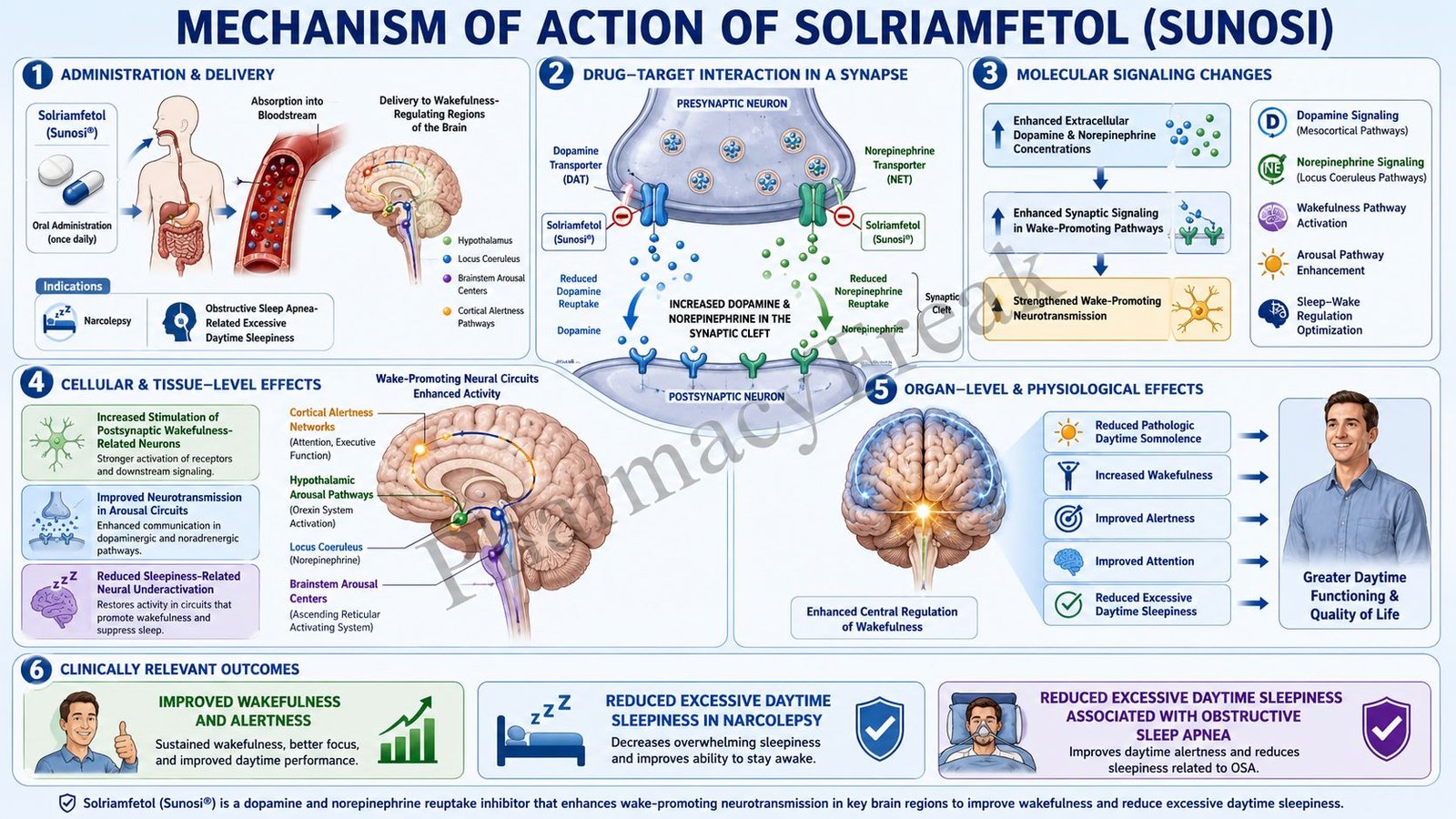
Solriamfetol is an oral wakefulness-promoting drug marketed under the brand name Sunosi. Pharmacologically, solriamfetol is a dopamine and norepinephrine reuptake inhibitor, commonly abbreviated as DNRI.
Excessive daytime sleepiness is a major symptom in narcolepsy and obstructive sleep apnea. In narcolepsy, sleep-wake regulation is disturbed, often due to abnormalities in wake-promoting and REM sleep-regulating pathways. In obstructive sleep apnea, repeated upper-airway obstruction during sleep causes fragmented sleep, intermittent hypoxia, and persistent daytime sleepiness in some patients even after airway therapy is used.
Solriamfetol improves wakefulness by enhancing catecholamine neurotransmission, especially dopamine and norepinephrine signaling. The exact mechanism by which solriamfetol improves wakefulness in narcolepsy and obstructive sleep apnea is not fully understood. However, its clinical effect is believed to be mediated through inhibition of dopamine and norepinephrine reuptake. The official label describes Sunosi as a dopamine and norepinephrine reuptake inhibitor indicated to improve wakefulness in adults with excessive daytime sleepiness associated with narcolepsy or obstructive sleep apnea.
Solriamfetol is not a treatment for the underlying airway obstruction in obstructive sleep apnea. In OSA patients, primary airway therapy such as CPAP should be used before and during solriamfetol treatment. Sunosi is not a substitute for CPAP or other OSA airway treatments.
For exam purposes, solriamfetol should be remembered as an oral DNRI wake-promoting agent used for excessive daytime sleepiness in adult narcolepsy and obstructive sleep apnea. It increases wakefulness mainly by increasing dopamine and norepinephrine signaling, but its exact wake-promoting mechanism is unclear.
Mechanism of Action (Step-wise)
Step 1: Wakefulness depends on multiple neurotransmitter systems
Normal wakefulness is regulated by several brain pathways, including dopamine, norepinephrine, histamine, orexin, acetylcholine, glutamate, and other arousal networks. These pathways help maintain alertness, attention, motivation, and resistance to sleep.
Step 2: Narcolepsy causes abnormal sleep-wake regulation
Narcolepsy is a chronic neurological sleep disorder characterized by excessive daytime sleepiness. Some patients also have cataplexy, sleep paralysis, hallucinations around sleep, and disturbed nighttime sleep. The disorder involves abnormal regulation of wakefulness and REM sleep.
Step 3: Obstructive sleep apnea causes sleep fragmentation
In obstructive sleep apnea, repeated collapse of the upper airway during sleep causes apnea, hypopnea, oxygen desaturation, and repeated arousals. Even after airway therapy, some adults may continue to have excessive daytime sleepiness.
Step 4: Dopamine supports wakefulness and alertness
Dopamine is involved in arousal, motivation, reward, attention, executive function, and motor activation. Increasing dopaminergic signaling in selected CNS pathways can improve alertness and reduce sleepiness.
Step 5: Norepinephrine supports arousal and vigilance
Norepinephrine, especially from the locus coeruleus and related wake-promoting networks, helps maintain vigilance, attention, alertness, and sympathetic arousal. Increased norepinephrine signaling can reduce sleep tendency and improve wakefulness.
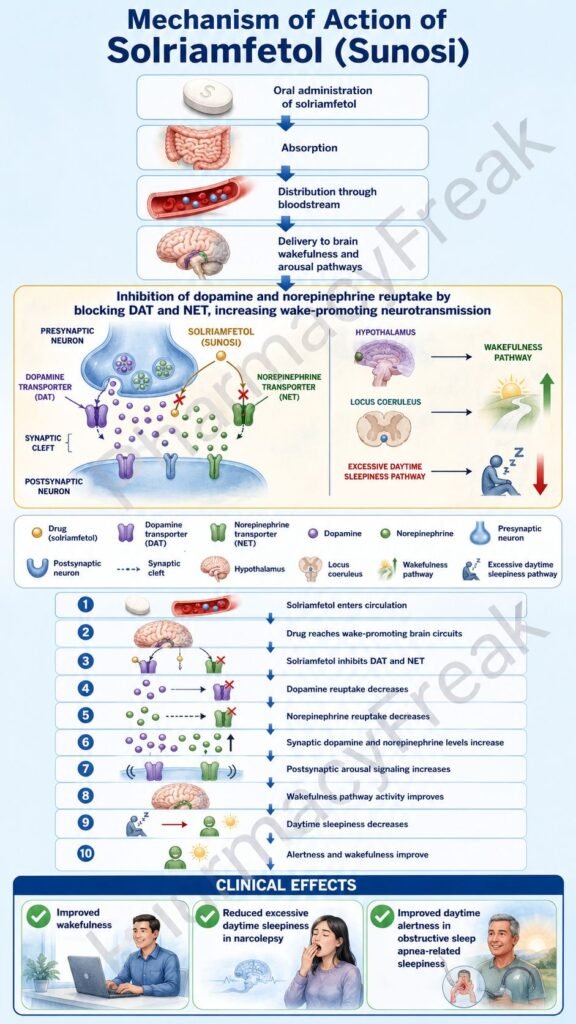
Step 6: Solriamfetol binds dopamine and norepinephrine transporters
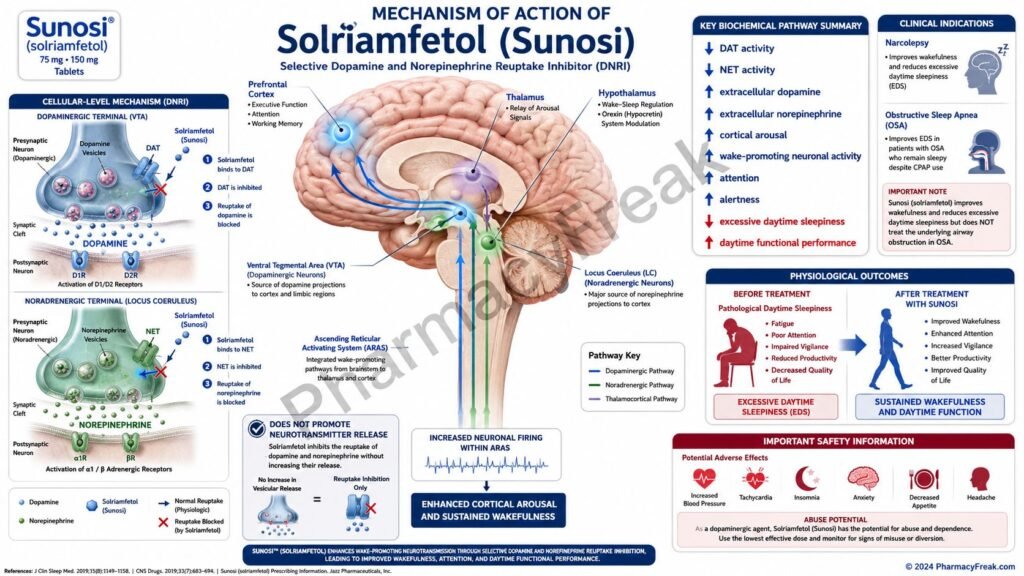
Solriamfetol binds to the dopamine transporter and norepinephrine transporter. These transporters normally remove dopamine and norepinephrine from the synaptic space after neurotransmitter release. Solriamfetol has low-affinity binding to DAT and NET and inhibits dopamine and norepinephrine reuptake with low potency.
Step 7: Reuptake of dopamine and norepinephrine decreases
By inhibiting dopamine and norepinephrine transporters, solriamfetol reduces reuptake of these neurotransmitters back into presynaptic neurons. This increases their availability in the synaptic cleft.
Step 8: Catecholamine signaling increases
With more dopamine and norepinephrine available at synapses, postsynaptic signaling in wake-promoting circuits increases. This helps strengthen arousal and alertness pathways.
Step 9: Wake-promoting CNS networks become more active
Enhanced dopamine and norepinephrine signaling increases activity in neural circuits involved in wakefulness, attention, and vigilance. This helps patients stay awake during the day.
Step 10: Excessive daytime sleepiness decreases
As wake-promoting signaling improves, subjective and objective sleepiness may decrease. Patients may experience improved ability to remain awake during daytime activities.
Step 11: Solriamfetol does not directly activate receptors
Solriamfetol is not primarily a direct agonist at dopamine, norepinephrine, serotonin, GABA, adenosine, histamine, orexin, benzodiazepine, muscarinic, or nicotinic receptors. The label notes no appreciable binding affinity for these receptor families.
Step 12: Serotonin transporter activity is minimal
Solriamfetol has no appreciable binding affinity for the serotonin transporter and does not significantly inhibit serotonin reuptake. This distinguishes it from serotonin-based antidepressants.
Step 13: Sympathetic cardiovascular effects may occur
Because dopamine and norepinephrine signaling can increase sympathetic tone, solriamfetol can increase blood pressure and heart rate. This mechanism-related effect is important clinically and must be monitored.
Step 14: Psychiatric symptoms may occur
Increased catecholamine activity may contribute to anxiety, insomnia, irritability, agitation, or worsening of psychiatric symptoms in susceptible patients. Caution is needed in patients with a history of psychosis or bipolar disorder.
Step 15: Final therapeutic outcome
The final therapeutic outcome is improved wakefulness in adults with excessive daytime sleepiness associated with narcolepsy or obstructive sleep apnea. Solriamfetol improves alertness but does not cure narcolepsy and does not treat the airway obstruction of OSA.
Pharmacokinetics
Solriamfetol is administered orally as Sunosi tablets. It is taken once daily upon awakening, with or without food. It should not be taken within 9 hours of planned bedtime because late dosing may interfere with nighttime sleep.
For narcolepsy, the recommended starting dose is 75 mg once daily. The dose may be doubled at intervals of at least 3 days based on response and tolerability. The maximum recommended dose is 150 mg once daily.
For obstructive sleep apnea, the recommended starting dose is 37.5 mg once daily. The dose may be increased at intervals of at least 3 days, up to a maximum of 150 mg once daily. Doses above 150 mg daily do not provide enough additional benefit to outweigh dose-related adverse reactions.
Sunosi tablets are available as 75 mg and 150 mg film-coated tablets. The 75 mg tablet is functionally scored and can be split to provide a 37.5 mg dose.
Solriamfetol has approximately 95% oral bioavailability. Peak plasma concentration occurs at a median of about 2 hours after dosing under fasting conditions. A high-fat meal produces minimal change in total exposure but delays peak concentration by about 1 hour.
Solriamfetol reaches steady state in about 3 days and shows minimal accumulation with once-daily dosing. It has an apparent volume of distribution of about 199 L and low plasma protein binding, around 13.3% to 19.4%.
The apparent mean elimination half-life is about 7.1 hours. Solriamfetol is minimally metabolized in humans and is eliminated mainly through the kidney. Approximately 95% of the dose is recovered in urine as unchanged solriamfetol.
Renal function is important for dosing. No dosage adjustment is required in mild renal impairment. In moderate renal impairment, the starting dose is 37.5 mg once daily and may be increased to a maximum of 75 mg once daily after at least 7 days. In severe renal impairment, the maximum recommended dose is 37.5 mg once daily. Sunosi is not recommended in end-stage renal disease.
Solriamfetol is a Schedule IV controlled substance because it has potential for abuse. Patients with a history of stimulant, alcohol, or substance abuse should be evaluated carefully and monitored for misuse or dose escalation.
Clinical Uses
Solriamfetol is used to improve wakefulness in adults with excessive daytime sleepiness associated with narcolepsy. It helps reduce daytime sleepiness but does not treat all symptoms of narcolepsy, such as cataplexy, sleep paralysis, or hallucinations.
Solriamfetol is also used to improve wakefulness in adults with excessive daytime sleepiness associated with obstructive sleep apnea. It is used when sleepiness persists despite appropriate management of the underlying airway obstruction.
In obstructive sleep apnea, solriamfetol should not replace primary OSA therapy. The airway obstruction should be treated for at least one month before starting Sunosi, and therapies such as CPAP should continue during Sunosi treatment.
Solriamfetol is not approved for pediatric patients. The label states that safety and effectiveness in pediatric patients have not been established.
Solriamfetol is not an antidepressant, antipsychotic, sedative, respiratory stimulant for acute apnea, or cure for sleep disorders. It is a wakefulness-promoting agent used for symptom control in selected adult patients.
Solriamfetol is not used to treat the underlying cause of narcolepsy or obstructive sleep apnea. In narcolepsy, it improves wakefulness but does not restore normal hypocretin or orexin signaling. In OSA, it improves daytime alertness but does not open the airway or prevent apneic episodes.
Adverse Effects
The adverse effects of solriamfetol are mainly related to catecholamine reuptake inhibition, CNS stimulation, cardiovascular effects, psychiatric symptoms, and its controlled-substance status.
The most important warning is increased blood pressure and heart rate. Sunosi increases systolic blood pressure, diastolic blood pressure, and heart rate in a dose-dependent manner. Blood pressure should be controlled before treatment and monitored regularly during therapy.
Cardiovascular caution is important because many patients with narcolepsy or obstructive sleep apnea already have risk factors such as hypertension, diabetes, hyperlipidemia, obesity, cardiovascular disease, or cerebrovascular disease. Chronic blood pressure elevation increases the risk of major adverse cardiovascular events.
Sunosi should be used cautiously with other drugs that increase blood pressure or heart rate. If blood pressure or heart rate increases cannot be managed by dose reduction or appropriate treatment, discontinuation should be considered.
Psychiatric symptoms can occur. Anxiety, insomnia, and irritability were observed in clinical trials. Patients with a history of psychosis or bipolar disorder require caution because solriamfetol has not been evaluated in these populations. If psychiatric symptoms develop, dose reduction or discontinuation may be needed.
The most common adverse reactions reported more often with Sunosi than placebo were headache, nausea, decreased appetite, anxiety, and insomnia. Other adverse reactions included dry mouth, constipation, palpitations, dizziness, irritability, diarrhea, abdominal pain, feeling jittery, and chest discomfort.
Insomnia is exam-relevant because solriamfetol promotes wakefulness. It should be taken upon awakening and avoided within 9 hours of planned bedtime.
Decreased appetite and weight-related changes may occur because catecholamine-enhancing drugs can reduce appetite. Patients with clinically significant weight loss or poor nutrition should be monitored.
Palpitations and chest discomfort may occur due to increased heart rate and sympathetic activation. Patients with serious cardiovascular disease, unstable cardiovascular disease, serious arrhythmias, or other serious heart problems require caution or avoidance according to clinical judgment.
Solriamfetol is contraindicated with monoamine oxidase inhibitors or within 14 days after stopping an MAOI because of the risk of hypertensive reaction.
Renal impairment increases exposure and half-life, which may increase the risk of blood pressure, heart rate, and psychiatric adverse effects. Dose adjustment is required in moderate and severe renal impairment.
Solriamfetol is present in human milk. Breastfed infants exposed to Sunosi should be monitored for agitation, insomnia, and reduced weight gain.
Comparative Analysis
Solriamfetol is commonly compared with modafinil, armodafinil, pitolisant, methylphenidate, amphetamines, sodium oxybate, low-sodium oxybate, caffeine, and atomoxetine.
Compared with modafinil, solriamfetol has a clearer labeled DNRI mechanism. Modafinil also promotes wakefulness, but its mechanism is complex and not completely understood. Solriamfetol is specifically described as inhibiting dopamine and norepinephrine reuptake.
Compared with armodafinil, solriamfetol is also a wake-promoting drug used for excessive sleepiness in narcolepsy and OSA. Armodafinil is the R-enantiomer of modafinil, while solriamfetol is a phenylalanine derivative DNRI.
Compared with pitolisant, solriamfetol works through dopamine and norepinephrine reuptake inhibition, while pitolisant is a histamine H3 receptor antagonist/inverse agonist that increases histaminergic wake-promoting signaling. Pitolisant is especially relevant in narcolepsy, including cataplexy in some settings.
Compared with methylphenidate, solriamfetol also affects catecholamine transporters but is generally classified as a wakefulness-promoting DNRI rather than a classic ADHD stimulant. Both may increase blood pressure, heart rate, anxiety, insomnia, and abuse-related concerns.
Compared with amphetamines, solriamfetol primarily inhibits dopamine and norepinephrine reuptake rather than acting as a strong releasing agent. Amphetamines increase catecholamine release and have stronger stimulant effects and higher abuse concerns.
Compared with sodium oxybate or low-sodium oxybate, solriamfetol is a daytime wakefulness-promoting drug. Oxybate products are usually taken at night and improve sleep architecture, cataplexy, and daytime sleepiness through a different mechanism.
Compared with caffeine, solriamfetol is a prescription controlled medication with specific indications, dosing, and monitoring. Caffeine is an adenosine receptor antagonist and has weaker, shorter, and less disease-specific wake-promoting effects.
Compared with atomoxetine, solriamfetol affects both dopamine and norepinephrine reuptake, while atomoxetine is mainly a selective norepinephrine reuptake inhibitor used primarily for ADHD.
Compared with antidepressant SNRIs such as venlafaxine or duloxetine, solriamfetol is not used as an antidepressant. It does not meaningfully inhibit serotonin reuptake and is approved for excessive daytime sleepiness rather than mood disorders.
MCQs
- Solriamfetol is marketed under which brand name?
a) Sunosi
b) Provigil
c) Nuvigil
d) Wakix
Answer: a) Sunosi
- Solriamfetol belongs to which pharmacological class?
a) Dopamine and norepinephrine reuptake inhibitor
b) Histamine H3 receptor antagonist
c) Benzodiazepine receptor agonist
d) Serotonin reuptake inhibitor only
Answer: a) Dopamine and norepinephrine reuptake inhibitor
- Solriamfetol is used to improve wakefulness in adults with excessive daytime sleepiness associated with:
a) Narcolepsy and obstructive sleep apnea
b) Parkinson’s disease and epilepsy
c) Asthma and COPD
d) Migraine and hypertension
Answer: a) Narcolepsy and obstructive sleep apnea
- The exact mechanism of solriamfetol for improving wakefulness is:
a) Unclear, but may involve dopamine and norepinephrine reuptake inhibition
b) Fully explained by GABA-A activation
c) Direct orexin receptor replacement
d) Irreversible MAO inhibition
Answer: a) Unclear, but may involve dopamine and norepinephrine reuptake inhibition
- Solriamfetol inhibits reuptake of:
a) Dopamine and norepinephrine
b) Serotonin only
c) GABA only
d) Acetylcholine only
Answer: a) Dopamine and norepinephrine
- Solriamfetol has no appreciable inhibition of:
a) Serotonin reuptake
b) Dopamine reuptake
c) Norepinephrine reuptake
d) Renal elimination
Answer: a) Serotonin reuptake
- Solriamfetol should usually be taken:
a) Once daily upon awakening
b) At bedtime only
c) Every 2 hours at night
d) Only after dinner
Answer: a) Once daily upon awakening
- Solriamfetol should be avoided within how many hours of planned bedtime?
a) 9 hours
b) 1 hour
c) 24 hours
d) 30 minutes
Answer: a) 9 hours
- The maximum recommended daily dose of Sunosi is:
a) 150 mg once daily
b) 500 mg twice daily
c) 10 mg once weekly
d) 1 mg monthly
Answer: a) 150 mg once daily
- Sunosi is not indicated to treat:
a) Underlying airway obstruction in OSA
b) Excessive daytime sleepiness in adults with narcolepsy
c) Wakefulness problems in approved adults
d) Daytime sleepiness symptoms in OSA
Answer: a) Underlying airway obstruction in OSA
- Which cardiovascular effect is important with solriamfetol?
a) Increased blood pressure and heart rate
b) Complete prevention of hypertension
c) Severe bradycardia in every patient
d) Permanent QT shortening
Answer: a) Increased blood pressure and heart rate
- Solriamfetol is contraindicated with:
a) Monoamine oxidase inhibitors
b) Paracetamol only
c) Inhaled saline only
d) Topical antifungals
Answer: a) Monoamine oxidase inhibitors
- Which adverse reaction is common with solriamfetol?
a) Headache
b) Severe ototoxicity
c) Gingival hyperplasia
d) Mandatory hypoglycemia
Answer: a) Headache
- Solriamfetol is mainly eliminated:
a) In urine as unchanged drug
b) Through bile as inactive metabolites only
c) By CYP3A4 metabolism only
d) Through lungs
Answer: a) In urine as unchanged drug
- Which statement best describes solriamfetol?
a) It is an oral DNRI that improves wakefulness in adult narcolepsy and OSA-related excessive daytime sleepiness
b) It is an orexin replacement therapy that cures narcolepsy
c) It is a CPAP substitute for obstructive sleep apnea
d) It is a benzodiazepine used for insomnia
Answer: a) It is an oral DNRI that improves wakefulness in adult narcolepsy and OSA-related excessive daytime sleepiness
FAQs
What is the mechanism of action of solriamfetol?
Solriamfetol’s exact wake-promoting mechanism is not fully known. It is believed to improve wakefulness mainly by inhibiting dopamine and norepinephrine reuptake, which increases catecholamine signaling in wake-promoting CNS pathways.
What is the brand name of solriamfetol?
The brand name of solriamfetol is Sunosi.
What is solriamfetol used for?
Solriamfetol is used to improve wakefulness in adults with excessive daytime sleepiness associated with narcolepsy or obstructive sleep apnea.
Is solriamfetol a stimulant?
Solriamfetol is a wakefulness-promoting dopamine and norepinephrine reuptake inhibitor and is a Schedule IV controlled substance. It has stimulant-like effects such as increased alertness, increased blood pressure, increased heart rate, insomnia, and abuse potential.
Does solriamfetol treat obstructive sleep apnea?
No. Solriamfetol does not treat the underlying airway obstruction in OSA. Patients should continue CPAP or other prescribed OSA therapy while using solriamfetol for residual excessive daytime sleepiness.
Why should solriamfetol not be taken near bedtime?
Solriamfetol promotes wakefulness and can cause insomnia. It should be taken upon awakening and avoided within 9 hours of planned bedtime.
What are common adverse effects of solriamfetol?
Common adverse effects include headache, nausea, decreased appetite, anxiety, insomnia, dry mouth, palpitations, dizziness, irritability, diarrhea, abdominal pain, and feeling jittery.
Why is blood pressure monitoring important with solriamfetol?
Solriamfetol can increase systolic blood pressure, diastolic blood pressure, and heart rate in a dose-dependent manner. Blood pressure should be controlled before treatment and monitored during therapy.
References
Goodman & Gilman’s The Pharmacological Basis of Therapeutics
Katzung Basic & Clinical Pharmacology