Table of Contents
Introduction
Sotorasib is an oral targeted anticancer drug marketed under the brand name Lumakras. Pharmacologically, sotorasib is a KRAS G12C inhibitor and belongs to the class of RAS GTPase inhibitors.
KRAS is an important intracellular signaling protein involved in cell growth, proliferation, differentiation, survival, and apoptosis regulation. Normally, KRAS works like a molecular switch. It cycles between an inactive GDP-bound state and an active GTP-bound state. When active, KRAS stimulates downstream signaling pathways such as RAF-MEK-ERK and PI3K-AKT-mTOR, which promote cell proliferation and survival.
In some cancers, a specific mutation called KRAS G12C changes glycine at position 12 to cysteine. This mutation keeps KRAS signaling abnormally active and drives uncontrolled tumor growth. KRAS mutations are especially important in non-small cell lung cancer and colorectal cancer.
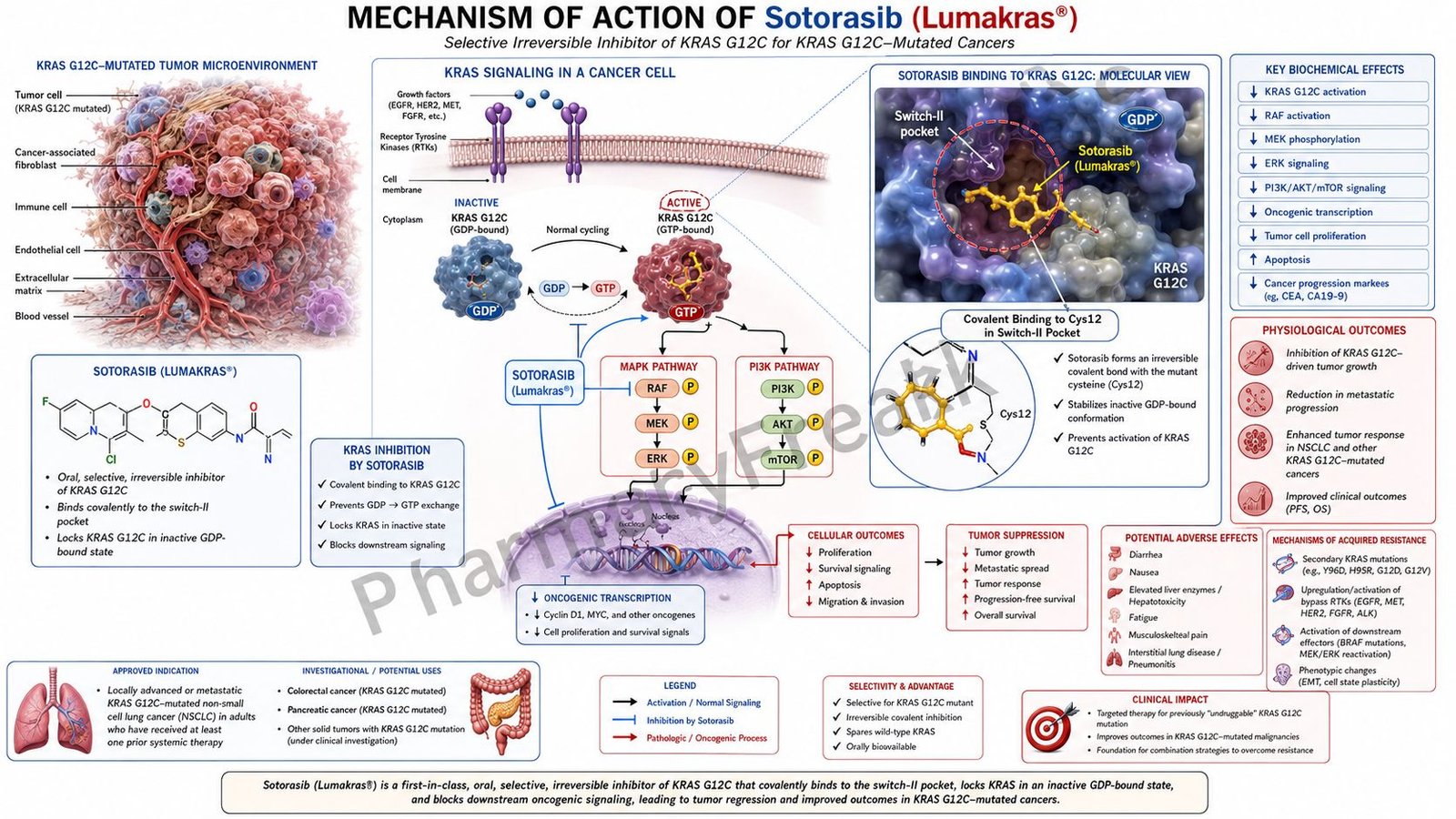
Sotorasib works by forming an irreversible covalent bond with the unique cysteine residue in KRAS G12C. This locks mutant KRAS G12C in an inactive state, prevents downstream oncogenic signaling, inhibits tumor cell growth, and promotes apoptosis in KRAS G12C-mutated tumor cells. The official label describes sotorasib as an inhibitor of KRAS G12C that locks the mutant protein in an inactive state without affecting wild-type KRAS.
Lumakras is indicated as a single agent for adult patients with KRAS G12C-mutated locally advanced or metastatic non-small cell lung cancer who have received at least one prior systemic therapy. It is also indicated in combination with panitumumab for adult patients with KRAS G12C-mutated metastatic colorectal cancer who have received prior fluoropyrimidine-, oxaliplatin-, and irinotecan-based chemotherapy. Patient selection requires detection of KRAS G12C mutation using an FDA-approved test.
For exam purposes, sotorasib should be remembered as an oral irreversible covalent KRAS G12C inhibitor that blocks RAS-RAF-MEK-ERK signaling and is used in KRAS G12C-mutated NSCLC and, with panitumumab, KRAS G12C-mutated metastatic colorectal cancer.
Mechanism of Action (Step-wise)
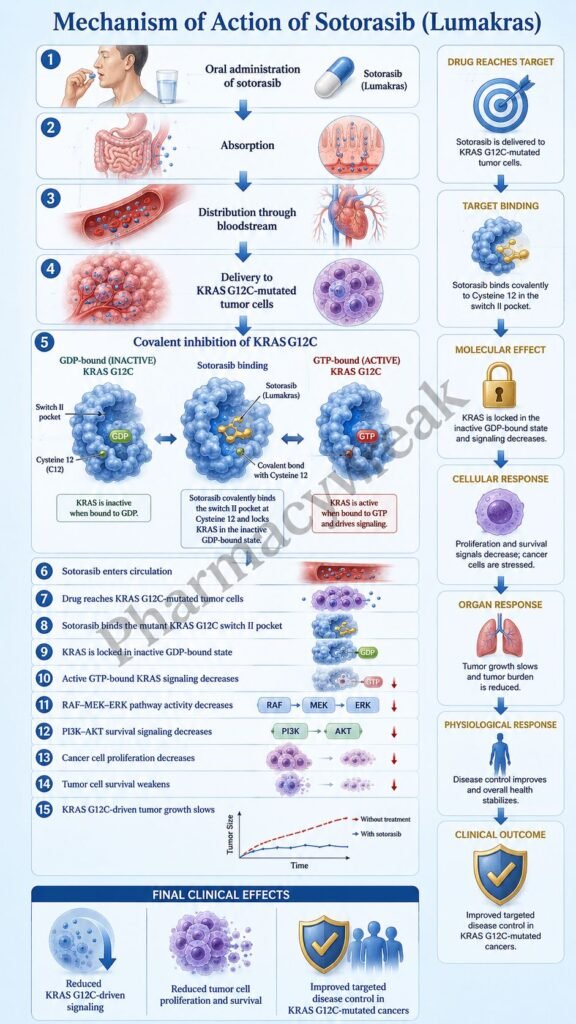
Step 1: KRAS normally works as a molecular switch
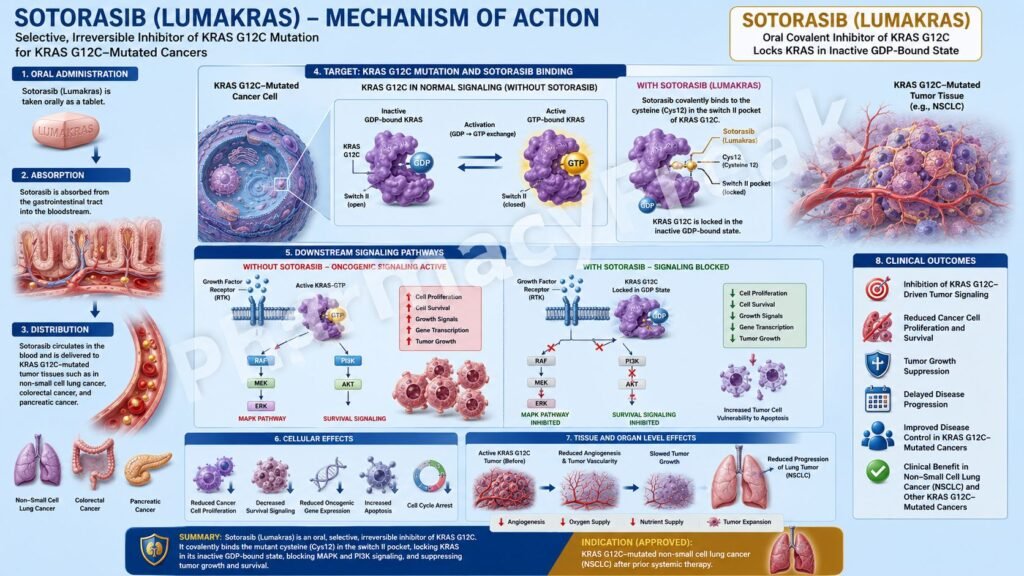
KRAS is a small GTPase protein. In its inactive state, KRAS is bound to GDP. In its active state, KRAS is bound to GTP. This GDP-GTP cycling allows KRAS to transmit growth-factor signals from cell-surface receptors to intracellular pathways.
Step 2: Active KRAS stimulates growth pathways
When KRAS is activated, it stimulates downstream signaling pathways such as RAF, MEK, ERK, PI3K, AKT, and mTOR. These pathways promote gene transcription, cell-cycle progression, protein synthesis, survival, and proliferation.
Step 3: KRAS G12C mutation creates abnormal signaling
In KRAS G12C mutation, glycine at codon 12 is replaced by cysteine. This mutation makes KRAS more likely to remain in a signaling-active oncogenic state. The result is persistent growth signaling even without normal regulatory control.
Step 4: KRAS G12C drives tumor cell proliferation
KRAS G12C-mutated cancer cells depend on abnormal KRAS pathway signaling for survival and proliferation. This is called oncogene addiction. Blocking the mutant driver pathway can therefore suppress tumor growth.
Step 5: Sotorasib selectively targets mutant KRAS G12C
Sotorasib is designed to target the mutant KRAS G12C protein. It uses the unique cysteine residue created by the G12C mutation as a binding site. This allows selective targeting of mutant KRAS G12C rather than normal wild-type KRAS.
Step 6: Sotorasib forms an irreversible covalent bond
Sotorasib forms a covalent bond with the cysteine residue of KRAS G12C. Because the bond is irreversible, the targeted mutant KRAS protein remains inhibited for its functional lifetime. This is the central molecular mechanism of sotorasib.
Step 7: KRAS G12C is locked in an inactive state
After covalent binding, sotorasib locks KRAS G12C in an inactive state. This prevents the mutant KRAS protein from transmitting downstream growth and survival signals. The label states that sotorasib prevents downstream signaling by locking KRAS G12C in an inactive state.
Step 8: RAF-MEK-ERK signaling decreases
When KRAS G12C is inhibited, activation of the RAF-MEK-ERK pathway decreases. This pathway normally supports transcription of genes involved in proliferation, cell-cycle progression, and tumor survival.
Step 9: PI3K-AKT-mTOR signaling may decrease
KRAS also interacts with survival pathways such as PI3K-AKT-mTOR. By blocking KRAS G12C, sotorasib can reduce pro-survival signaling and make tumor cells less able to grow and resist apoptosis.
Step 10: Tumor-cell proliferation slows
With less KRAS-driven signaling, tumor cells lose key proliferative signals. This reduces cancer-cell growth and may lead to tumor shrinkage in responsive KRAS G12C-mutated cancers.
Step 11: Apoptosis increases in sensitive tumor cells
In KRAS G12C-dependent tumor cells, blocking mutant KRAS signaling can promote apoptosis. The official pharmacology section states that sotorasib blocked KRAS signaling, inhibited cell growth, and promoted apoptosis in KRAS G12C tumor cell lines.
Step 12: Wild-type KRAS is not the intended target
Sotorasib is designed to target the tumor-restricted mutant KRAS G12C protein. It does not broadly inhibit all RAS proteins or wild-type KRAS in the same way. This selectivity is important because normal KRAS signaling is required in healthy cells.
Step 13: EGFR feedback can cause resistance in colorectal cancer
In KRAS G12C-mutated colorectal cancer, EGFR activation can act as a resistance mechanism to KRAS G12C inhibition. This is why sotorasib is combined with panitumumab, an EGFR antagonist, in metastatic colorectal cancer. The label notes increased antitumor activity with sotorasib plus panitumumab compared with either drug alone in a colorectal tumor model.
Step 14: Combination with panitumumab blocks feedback signaling
Panitumumab blocks EGFR-mediated upstream signaling. When used with sotorasib, it helps reduce EGFR-driven pathway reactivation, making KRAS G12C inhibition more effective in colorectal cancer.
Step 15: Final therapeutic outcome
The final therapeutic outcome is suppression of KRAS G12C-driven oncogenic signaling. This decreases tumor cell growth, promotes apoptosis in sensitive cancer cells, and helps control KRAS G12C-mutated non-small cell lung cancer and metastatic colorectal cancer in approved treatment settings.
Pharmacokinetics
Sotorasib is administered orally as Lumakras tablets. The recommended dosage is 960 mg orally once daily. Lumakras may be taken with or without food, and tablets should be swallowed whole unless dispersed in water according to product instructions. Available tablet strengths include 320 mg, 240 mg, and 120 mg.
For NSCLC, Lumakras is used as a single agent at 960 mg once daily until disease progression or unacceptable toxicity. For metastatic colorectal cancer, Lumakras is used at 960 mg once daily in combination with panitumumab until disease progression or unacceptable toxicity.
If a dose is missed by more than 6 hours, the missed dose should be skipped and the next dose should be taken the next day as prescribed. If vomiting occurs after taking Lumakras, an additional dose should not be taken.
Sotorasib reaches median peak plasma concentration in approximately 1 hour. Plasma concentrations reach steady state within about 22 days. The mean terminal half-life is approximately 5 hours.
Sotorasib shows non-linear, time-dependent pharmacokinetics. Its mean volume of distribution at steady state is about 211 L, and plasma protein binding is approximately 89%.
Sotorasib is metabolized mainly through non-enzymatic conjugation and oxidative metabolism involving CYP3A enzymes. After a radiolabeled dose, most drug-related material is recovered in feces, with a smaller portion recovered in urine.
Acid-reducing agents are clinically important because sotorasib solubility decreases as pH rises. Proton pump inhibitors and H2 receptor antagonists can reduce sotorasib exposure, so they should generally be avoided. If an acid-reducing agent is necessary, product-specific timing instructions should be followed.
Strong CYP3A inducers can reduce sotorasib exposure and may decrease effectiveness. Sotorasib can also affect other drugs because it is a CYP3A4 inducer and can inhibit P-glycoprotein and BCRP substrates. These interactions are important for exam and clinical practice.
No dosage modification is recommended in mild or moderate hepatic impairment, but patients with hepatic impairment should be monitored carefully because hepatotoxicity is an important adverse effect. The safety impact of severe hepatic impairment is less well established.
Clinical Uses
Sotorasib is used as Lumakras for KRAS G12C-mutated locally advanced or metastatic non-small cell lung cancer in adults who have received at least one prior systemic therapy. This makes it an important targeted therapy after previous treatment in biomarker-selected NSCLC.
The mutation must be detected before treatment. For NSCLC, patients are selected based on KRAS G12C mutation in tumor or plasma specimens. If plasma testing does not detect the mutation, tumor tissue testing is recommended.
Sotorasib is also used with panitumumab for KRAS G12C-mutated metastatic colorectal cancer in adults who have previously received fluoropyrimidine-, oxaliplatin-, and irinotecan-based chemotherapy. This combination is important because EGFR feedback activation can reduce the effectiveness of KRAS G12C inhibition in colorectal cancer.
Sotorasib is not used for all KRAS mutations. It specifically targets KRAS G12C. It is not designed for KRAS G12D, KRAS G12V, NRAS mutations, BRAF mutations, EGFR mutations, ALK rearrangements, or other molecular drivers.
Sotorasib is not traditional chemotherapy. It does not directly damage DNA like platinum agents. It is not an immune checkpoint inhibitor like pembrolizumab, nivolumab, or atezolizumab. It is a targeted small-molecule inhibitor of mutant KRAS G12C.
Sotorasib is not approved for pediatric patients. The label states that safety and effectiveness have not been established in pediatric patients.
Adverse Effects
The adverse effects of sotorasib include gastrointestinal toxicity, musculoskeletal symptoms, liver toxicity, pulmonary toxicity, laboratory abnormalities, and drug-interaction-related risks.
Hepatotoxicity is one of the most important warnings. Liver enzyme elevations can occur, including increased ALT and AST. Liver function tests should be monitored before starting treatment, every 3 weeks for the first 3 months, then monthly or as clinically indicated. Dose interruption, reduction, or discontinuation may be required depending on severity.
Hepatotoxicity may be more common in patients who recently received immunotherapy before starting sotorasib. This is clinically important in NSCLC because many patients receive immune checkpoint inhibitors before targeted therapy.
Interstitial lung disease and pneumonitis are serious warnings. Patients should be monitored for new or worsening dyspnea, cough, or fever. Lumakras should be withheld if ILD or pneumonitis is suspected and permanently discontinued if no other cause is identified. The label reports ILD/pneumonitis in patients receiving sotorasib, including serious and fatal cases.
Common adverse reactions in KRAS G12C-mutated NSCLC include diarrhea, musculoskeletal pain, nausea, fatigue, hepatotoxicity, and cough. Common laboratory abnormalities include decreased lymphocytes, decreased hemoglobin, increased AST, increased ALT, decreased calcium, increased alkaline phosphatase, increased urine protein, and decreased sodium.
Diarrhea is clinically important because it may lead to dehydration, electrolyte imbalance, treatment interruption, or dose modification. Supportive care and monitoring are important.
Musculoskeletal pain may include back pain, arthralgia, myalgia, limb pain, or generalized body pain. This can affect quality of life and adherence.
Nausea, vomiting, decreased appetite, and fatigue can occur during therapy. These effects may overlap with cancer-related symptoms and previous anticancer therapy effects.
When sotorasib is combined with panitumumab for metastatic colorectal cancer, EGFR inhibitor-related adverse effects must also be considered. These may include acneiform rash, dry skin, paronychia, hypomagnesemia, and infusion-related effects related to panitumumab.
Drug interactions can increase toxicity or reduce efficacy. Acid-reducing agents may lower sotorasib exposure. Strong CYP3A inducers may reduce drug levels. Sotorasib may decrease exposure of sensitive CYP3A substrates and increase exposure of P-gp or BCRP substrates.
Pregnancy data are limited. Because sotorasib is an anticancer drug and targeted pathway inhibitor, pregnancy risk should be assessed carefully. Breastfeeding is not recommended during Lumakras treatment and for 1 week after the last dose.
Comparative Analysis
Sotorasib is commonly compared with adagrasib, EGFR inhibitors, ALK inhibitors, BRAF inhibitors, MEK inhibitors, chemotherapy, immune checkpoint inhibitors, and panitumumab-based combinations.
Compared with adagrasib, sotorasib has the same broad target class: both are KRAS G12C inhibitors. Both bind mutant KRAS G12C and suppress downstream oncogenic signaling. They differ in pharmacokinetics, dosing schedule, clinical trial data, adverse effect patterns, drug interactions, and approved treatment settings.
Compared with chemotherapy such as docetaxel, pemetrexed, or platinum agents, sotorasib is more molecularly targeted. Chemotherapy attacks rapidly dividing cells more broadly, while sotorasib targets tumors with a specific KRAS G12C mutation.
Compared with immune checkpoint inhibitors such as pembrolizumab, nivolumab, and atezolizumab, sotorasib does not primarily activate T cells. Checkpoint inhibitors enhance antitumor immunity, while sotorasib directly blocks mutant KRAS signaling inside tumor cells.
Compared with EGFR inhibitors such as osimertinib, erlotinib, and gefitinib, sotorasib targets a downstream RAS mutation rather than EGFR receptor tyrosine kinase activity. EGFR inhibitors are used in EGFR-mutated NSCLC, while sotorasib is used in KRAS G12C-mutated tumors.
Compared with ALK inhibitors such as alectinib, brigatinib, and lorlatinib, sotorasib targets a different molecular driver. ALK inhibitors are used in ALK-rearranged tumors, while sotorasib requires KRAS G12C mutation.
Compared with BRAF inhibitors such as vemurafenib and dabrafenib, sotorasib acts upstream of RAF in the RAS pathway. BRAF inhibitors target mutant BRAF, especially BRAF V600E, while sotorasib targets mutant KRAS G12C.
Compared with MEK inhibitors such as trametinib, sotorasib targets the upstream driver mutation. MEK inhibitors block downstream MAPK pathway signaling more broadly, while sotorasib directly inhibits mutant KRAS G12C.
Compared with panitumumab alone in colorectal cancer, sotorasib plus panitumumab provides dual pathway targeting. Sotorasib blocks mutant KRAS G12C, while panitumumab blocks EGFR-mediated feedback activation that can reactivate downstream signaling.
Compared with older teaching that KRAS was “undruggable,” sotorasib is important because it proved that a specific mutant KRAS protein can be targeted with a small molecule through covalent binding to the G12C cysteine pocket.
MCQs
- Sotorasib is marketed under which brand name?
a) Lumakras
b) Tagrisso
c) Keytruda
d) Vectibix
Answer: a) Lumakras
- Sotorasib belongs to which pharmacological class?
a) KRAS G12C inhibitor
b) EGFR tyrosine kinase inhibitor
c) PD-1 inhibitor
d) ALK inhibitor
Answer: a) KRAS G12C inhibitor
- Sotorasib specifically targets which mutation?
a) KRAS G12C
b) EGFR L858R
c) ALK fusion
d) BRAF V600E
Answer: a) KRAS G12C
- KRAS normally functions as a:
a) Small GTPase molecular switch
b) Nuclear hormone receptor
c) Ion channel
d) DNA polymerase
Answer: a) Small GTPase molecular switch
- Sotorasib binds covalently to which residue created by the G12C mutation?
a) Cysteine
b) Glycine
c) Lysine
d) Methionine
Answer: a) Cysteine
- The binding of sotorasib to KRAS G12C is best described as:
a) Irreversible covalent inhibition
b) Reversible competitive beta blockade
c) Allosteric estrogen receptor activation
d) Direct DNA alkylation
Answer: a) Irreversible covalent inhibition
- Sotorasib locks KRAS G12C mainly in which state?
a) Inactive state
b) Permanently active state
c) Ionized calcium-bound state
d) Acetylcholine-bound state
Answer: a) Inactive state
- Which downstream pathway is reduced by KRAS G12C inhibition?
a) RAF-MEK-ERK pathway
b) Renin-angiotensin pathway only
c) Cholinergic neuromuscular pathway
d) Coagulation cascade only
Answer: a) RAF-MEK-ERK pathway
- Sotorasib is used as a single agent in which cancer setting?
a) KRAS G12C-mutated locally advanced or metastatic NSCLC after at least one prior systemic therapy
b) EGFR-mutated breast cancer first line
c) ALK-positive leukemia
d) HER2-positive gastric cancer only
Answer: a) KRAS G12C-mutated locally advanced or metastatic NSCLC after at least one prior systemic therapy
- In metastatic colorectal cancer, sotorasib is used in combination with:
a) Panitumumab
b) Insulin
c) Levodopa
d) Methotrexate only
Answer: a) Panitumumab
- Panitumumab is combined with sotorasib in mCRC because it blocks:
a) EGFR feedback signaling
b) Dopamine D2 signaling
c) Histamine H1 signaling
d) GABA-A signaling
Answer: a) EGFR feedback signaling
- The recommended Lumakras dose is:
a) 960 mg orally once daily
b) 5 mg orally twice daily
c) 120 mg subcutaneously once weekly
d) 1 mg intravenously monthly
Answer: a) 960 mg orally once daily
- Which adverse effect is an important warning with sotorasib?
a) Hepatotoxicity
b) Severe hypoglycemia in every patient
c) Ototoxicity
d) Gingival hyperplasia
Answer: a) Hepatotoxicity
- Which pulmonary toxicity is important with sotorasib?
a) Interstitial lung disease or pneumonitis
b) Asthma cure
c) Pulmonary hypertension reversal
d) Mandatory tuberculosis in every patient
Answer: a) Interstitial lung disease or pneumonitis
- Which statement best describes sotorasib?
a) It irreversibly inhibits mutant KRAS G12C and blocks downstream oncogenic signaling
b) It blocks PD-1 on T cells
c) It inhibits bacterial cell wall synthesis
d) It depletes CD20-positive B cells
Answer: a) It irreversibly inhibits mutant KRAS G12C and blocks downstream oncogenic signaling
FAQs
What is the mechanism of action of sotorasib?
Sotorasib irreversibly binds to the cysteine residue of mutant KRAS G12C. This locks KRAS G12C in an inactive state, blocks downstream RAF-MEK-ERK and related signaling, inhibits tumor cell growth, and promotes apoptosis in sensitive KRAS G12C-mutated cancer cells.
What is the brand name of sotorasib?
The brand name of sotorasib is Lumakras.
What mutation does sotorasib target?
Sotorasib specifically targets KRAS G12C. It is not used for all KRAS mutations.
Is sotorasib chemotherapy?
No. Sotorasib is not traditional cytotoxic chemotherapy. It is an oral targeted therapy that inhibits mutant KRAS G12C signaling.
What cancers is sotorasib used for?
Sotorasib is used for adult patients with KRAS G12C-mutated locally advanced or metastatic non-small cell lung cancer after at least one prior systemic therapy. It is also used with panitumumab for adult patients with KRAS G12C-mutated metastatic colorectal cancer after prior fluoropyrimidine-, oxaliplatin-, and irinotecan-based chemotherapy.
Why is panitumumab combined with sotorasib in colorectal cancer?
In KRAS G12C-mutated colorectal cancer, EGFR activation can reactivate downstream signaling and reduce response to KRAS G12C inhibition. Panitumumab blocks EGFR, helping prevent this feedback resistance mechanism.
What are important adverse effects of sotorasib?
Important adverse effects include diarrhea, musculoskeletal pain, nausea, fatigue, cough, hepatotoxicity, increased liver enzymes, and interstitial lung disease or pneumonitis.
Why should liver function be monitored with sotorasib?
Sotorasib can cause hepatotoxicity and elevated ALT or AST. Liver function tests should be checked before treatment, frequently during the first 3 months, and then periodically during therapy.
References
Goodman & Gilman’s The Pharmacological Basis of Therapeutics
Katzung Basic & Clinical Pharmacology