Table of Contents
Introduction
Palbociclib is an oral targeted anticancer drug marketed under the brand name Ibrance. Pharmacologically, palbociclib is a cyclin-dependent kinase 4 and 6 inhibitor, commonly called a CDK4/6 inhibitor.
Cell-cycle control is one of the most important concepts in cancer pharmacology. Normal cells divide only after receiving controlled growth signals. Cancer cells often escape these checkpoints and continue dividing abnormally. In hormone receptor-positive breast cancer, estrogen receptor signaling increases cyclin D activity, which activates CDK4 and CDK6. This promotes progression from the G1 phase to the S phase of the cell cycle, where DNA synthesis occurs.
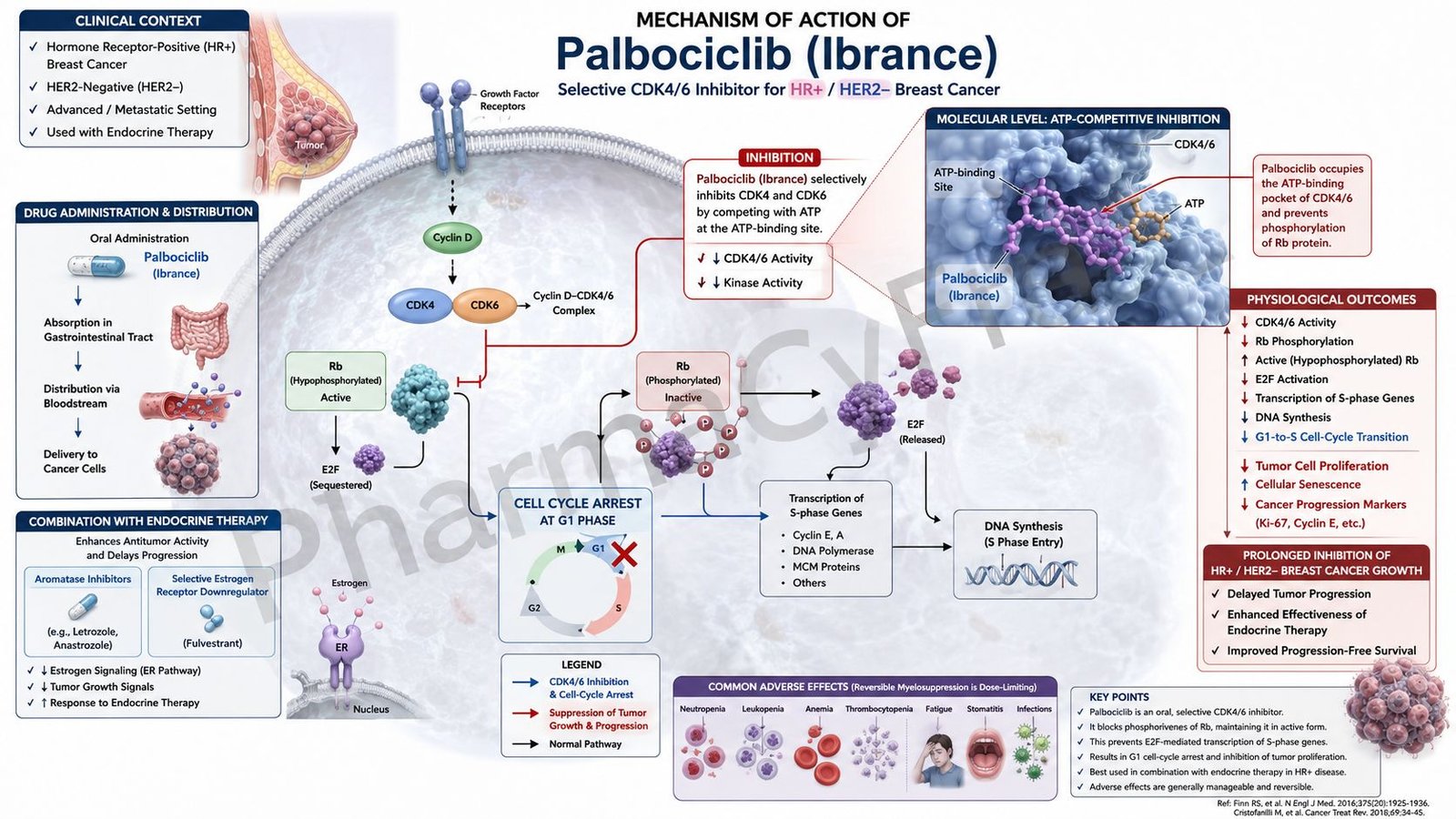
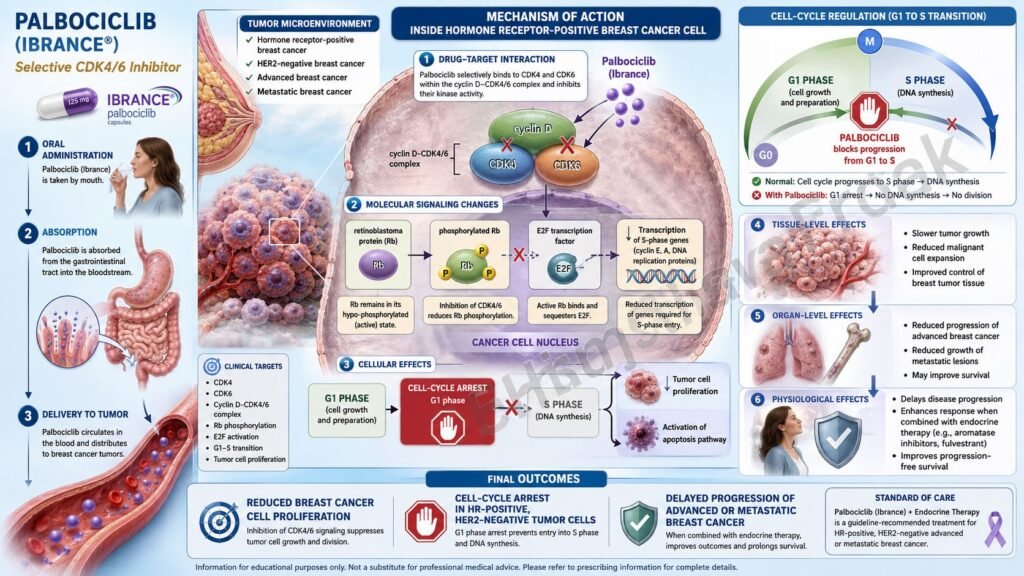
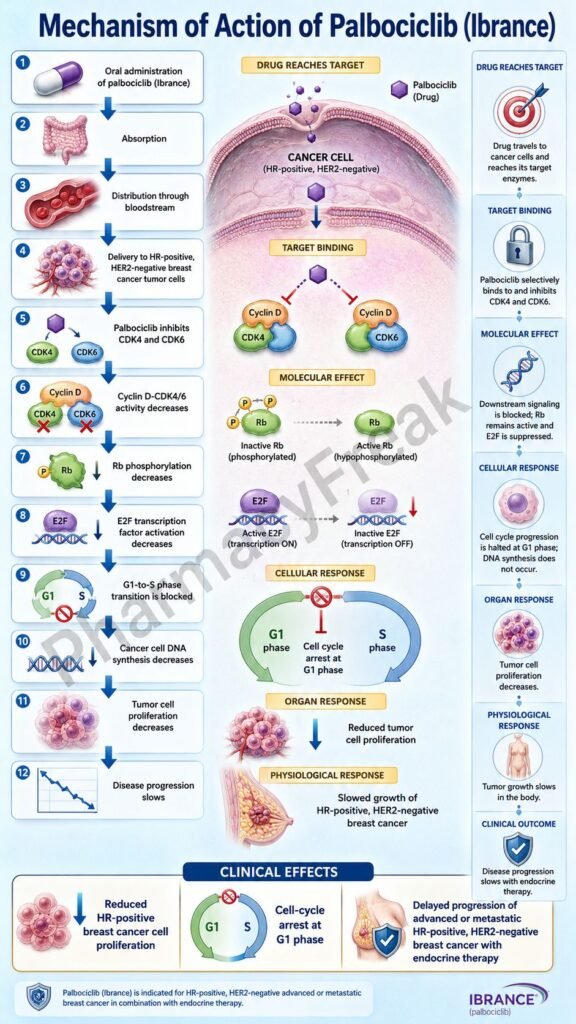
Palbociclib works by inhibiting CDK4 and CDK6. This prevents phosphorylation of retinoblastoma protein, keeps E2F transcription factors suppressed, blocks G1-to-S phase progression, and reduces cancer cell proliferation. The official Ibrance label describes palbociclib as a CDK4/6 inhibitor that reduces proliferation of estrogen receptor-positive breast cancer cell lines by blocking progression from G1 into S phase.
Palbociclib is mainly used in selected adult patients with advanced or metastatic breast cancer, especially hormone receptor-positive breast cancer. Current labeling includes HR-positive, HER2-negative advanced or metastatic breast cancer in combination with endocrine-based therapy, endocrine-resistant PIK3CA-mutated HR-positive HER2-negative disease in combination with inavolisib and fulvestrant, and a newer HR-positive HER2-positive metastatic maintenance setting in combination with trastuzumab, with or without pertuzumab, and endocrine therapy after induction treatment.
For exam purposes, palbociclib should be remembered as an oral CDK4/6 inhibitor that blocks the cyclin D-CDK4/6-Rb-E2F pathway and causes G1 cell-cycle arrest in breast cancer cells.
Mechanism of Action (Step-wise)
Step 1: Cell-cycle progression depends on checkpoints
The cell cycle has several phases, including G1, S, G2, and M phases. The G1 phase is a growth and preparation phase. The S phase is the DNA synthesis phase. Cells must pass through the G1 restriction point before entering S phase.
Step 2: Cyclin D activates CDK4 and CDK6
Cyclin D forms active complexes with CDK4 and CDK6. These cyclin D-CDK4/6 complexes are major regulators of the G1-to-S phase transition. In breast cancer, especially hormone receptor-positive disease, estrogen receptor signaling can increase cyclin D activity and drive cell proliferation.
Step 3: CDK4/6 phosphorylates retinoblastoma protein
Retinoblastoma protein, commonly called Rb, is a tumor suppressor protein. In its active hypophosphorylated state, Rb binds E2F transcription factors and prevents transcription of genes needed for DNA synthesis.
Step 4: Rb phosphorylation releases E2F
When CDK4 and CDK6 phosphorylate Rb, Rb becomes functionally inactive. E2F transcription factors are released and become active. E2F then promotes transcription of genes needed for DNA replication and S-phase entry.
Step 5: Cancer cells enter S phase and proliferate
Once E2F becomes active, cancer cells cross the G1 restriction point and enter S phase. This allows DNA replication, cell division, and tumor growth.
Step 6: Palbociclib inhibits CDK4 and CDK6
Palbociclib selectively inhibits CDK4 and CDK6. By blocking these kinases, it prevents Rb phosphorylation. This is the central molecular mechanism of palbociclib.
Step 7: Rb remains active
When Rb is not phosphorylated, it remains active and continues to suppress E2F transcription factors. This prevents expression of genes required for DNA synthesis.
Step 8: G1-to-S phase transition is blocked
Because E2F remains inhibited, cells cannot efficiently move from G1 phase into S phase. This produces G1 phase cell-cycle arrest.
Step 9: Tumor cell proliferation decreases
The final cellular effect is reduced cancer cell proliferation. Palbociclib does not primarily act like traditional cytotoxic chemotherapy. It does not directly damage DNA like alkylating agents or platinum drugs. Instead, it blocks a specific cell-cycle signaling pathway.
Step 10: Combination with endocrine therapy improves effect
In HR-positive breast cancer, estrogen receptor signaling is an upstream driver of cyclin D production. Endocrine therapies such as aromatase inhibitors or fulvestrant reduce estrogen receptor signaling. When palbociclib is combined with endocrine therapy, both estrogen-driven signaling and downstream CDK4/6-mediated cell-cycle progression are inhibited.
Step 11: Rb phosphorylation and E2F signaling decrease
The Ibrance label states that treatment of breast cancer cell lines with palbociclib and antiestrogens decreases Rb phosphorylation, reduces E2F expression and signaling, and increases growth arrest compared with either drug alone.
Step 12: Tumor growth slows
As cancer cells remain arrested in G1 phase, tumor growth slows. Clinically, this can delay disease progression in selected breast cancer patients.
Step 13: Functional Rb pathway is important
CDK4/6 inhibitors depend on an intact Rb pathway. If tumor cells lose functional Rb, blocking CDK4/6 may be less effective because the downstream tumor-suppressor checkpoint is already defective.
Step 14: Final therapeutic outcome
The final therapeutic outcome is suppression of abnormal breast cancer cell proliferation. In appropriate patients, palbociclib improves disease control when used with endocrine therapy or other approved breast cancer combinations.
Pharmacokinetics
Palbociclib is administered orally. Ibrance is available as tablets and capsules in 125 mg, 100 mg, and 75 mg strengths. The recommended starting dose is 125 mg once daily for 21 consecutive days, followed by 7 days off treatment, making a 28-day cycle. Ibrance tablets may be taken with or without food.
The 21-days-on and 7-days-off schedule is important because palbociclib commonly causes neutropenia. The break period allows bone marrow recovery before the next cycle begins.
Palbociclib is absorbed after oral administration and reaches systemic circulation. Tablets should be swallowed whole and should not be chewed, crushed, or split. If a dose is missed or vomited, an additional dose should not be taken; the next dose should be taken at the usual time.
Palbociclib is metabolized mainly by CYP3A and sulfotransferase pathways. This makes drug interactions important. Strong CYP3A inhibitors can increase palbociclib exposure and toxicity, while strong CYP3A inducers can reduce exposure and decrease effectiveness.
Examples of strong CYP3A inhibitors include clarithromycin, itraconazole, ketoconazole, posaconazole, voriconazole, and some HIV protease inhibitors. Examples of strong CYP3A inducers include rifampin, carbamazepine, phenytoin, and St. John’s wort. Grapefruit products are generally avoided because they may increase palbociclib exposure.
Palbociclib is also a weak time-dependent CYP3A inhibitor. This means it can increase exposure of some sensitive CYP3A substrates, especially drugs with narrow therapeutic indices.
Dose modification is required for toxicity. The usual dose reduction steps are 125 mg daily, then 100 mg daily, then 75 mg daily. If further reduction below 75 mg daily is needed, treatment is usually discontinued.
No dose adjustment is required for mild or moderate hepatic impairment, but severe hepatic impairment requires dose reduction to 75 mg once daily for 21 days followed by 7 days off.
Clinical Uses
Palbociclib is used in adult patients with hormone receptor-positive, HER2-negative advanced or metastatic breast cancer in combination with an aromatase inhibitor as initial endocrine-based therapy. Aromatase inhibitors include letrozole, anastrozole, and exemestane.
Palbociclib is also used with fulvestrant in adult patients with HR-positive, HER2-negative advanced or metastatic breast cancer whose disease has progressed after endocrine therapy. Fulvestrant is a selective estrogen receptor degrader that reduces estrogen receptor signaling.
Another current use is in combination with inavolisib and fulvestrant for adults with endocrine-resistant, PIK3CA-mutated, HR-positive, HER2-negative locally advanced or metastatic breast cancer following recurrence on or after completing adjuvant endocrine therapy. Mutation testing with an FDA-authorized test is required for this setting.
A newer approved setting is HR-positive, HER2-positive locally advanced or metastatic breast cancer. In this setting, palbociclib is used with trastuzumab, with or without pertuzumab, and endocrine therapy as maintenance treatment after induction treatment. The FDA approved this use on June 24, 2026, following induction treatment with taxane plus trastuzumab, with or without pertuzumab.
In premenopausal or perimenopausal women receiving palbociclib with endocrine therapy combinations, ovarian suppression with an LHRH agonist is used according to clinical practice standards. In men receiving certain endocrine combinations, LHRH agonist treatment may also be considered.
Palbociclib is not a general treatment for all breast cancers. It is not used for triple-negative breast cancer unless part of a specific trial or future approved indication. It is not standard monotherapy for early-stage breast cancer. It is also not known to be safe and effective in children.
Adverse Effects
The most important adverse effect of palbociclib is neutropenia. Because CDK4/6 signaling is important for cell-cycle progression in dividing cells, bone marrow suppression can occur. Complete blood count monitoring is required before starting treatment, at the beginning of each cycle, on Day 15 of the first two cycles, and as clinically indicated.
Neutropenia with palbociclib is usually cytostatic rather than directly marrow-destructive, but it can still be clinically significant. Severe neutropenia may require dose interruption, dose reduction, or treatment delay. Febrile neutropenia can occur and requires urgent medical evaluation.
Other hematologic adverse effects include leukopenia, anemia, thrombocytopenia, and lymphopenia. Infection risk can increase, especially when neutrophil counts are low.
Common adverse reactions and laboratory abnormalities include decreased white blood cells, decreased neutrophils, increased creatinine, decreased hemoglobin, decreased platelets, infections, increased AST, increased ALT, fatigue, nausea, stomatitis, diarrhea, and alopecia. These are listed among common reactions in combination with letrozole or fulvestrant.
Stomatitis is clinically important. Patients may develop mouth sores, oral pain, mucosal inflammation, or difficulty eating. Good oral hygiene and early supportive care are useful.
Fatigue is common and may be related to anemia, cancer burden, endocrine therapy, or the drug itself. Patients should be monitored for worsening tiredness, dizziness, weakness, or shortness of breath.
Gastrointestinal adverse effects include nausea, diarrhea, vomiting, decreased appetite, and abdominal discomfort. These are usually manageable but may require supportive care.
Alopecia can occur, although it is often less severe than with traditional cytotoxic chemotherapy. Hair thinning rather than complete hair loss is more typical.
Interstitial lung disease and pneumonitis are important warnings. Severe and fatal cases have been reported. Patients should be monitored for new or worsening cough, dyspnea, hypoxia, or other pulmonary symptoms. Palbociclib should be interrupted if ILD or pneumonitis is suspected and permanently discontinued if severe ILD or pneumonitis occurs.
Embryo-fetal toxicity is another major warning. Palbociclib can cause fetal harm. Females of reproductive potential should use effective contraception during treatment and for the recommended period after the last dose. Males with female partners of reproductive potential should also follow contraception guidance.
Breastfeeding is not recommended during palbociclib therapy because of the potential for serious adverse reactions in the breastfed child.
Comparative Analysis
Palbociclib is commonly compared with other CDK4/6 inhibitors such as ribociclib and abemaciclib.
All three drugs inhibit CDK4 and CDK6, reduce Rb phosphorylation, suppress E2F signaling, block G1-to-S phase progression, and reduce tumor cell proliferation. They are especially important in hormone receptor-positive breast cancer because estrogen receptor signaling drives cyclin D-CDK4/6 pathway activity.
Compared with ribociclib, palbociclib has similar cell-cycle mechanism but different monitoring emphasis. Ribociclib is especially associated with QT prolongation and liver enzyme monitoring. Palbociclib is especially known for neutropenia monitoring.
Compared with abemaciclib, palbociclib is more strongly associated with neutropenia, while abemaciclib is especially associated with diarrhea. Abemaciclib is commonly given continuously, while palbociclib is given for 21 days followed by 7 days off.
Compared with endocrine therapy alone, palbociclib plus endocrine therapy blocks both upstream hormonal signaling and downstream cell-cycle progression. Endocrine therapy reduces estrogen receptor activation, while palbociclib blocks CDK4/6-mediated Rb phosphorylation.
Compared with inavolisib, palbociclib targets the cell-cycle pathway, while inavolisib targets the PI3K alpha pathway. In PIK3CA-mutated HR-positive HER2-negative breast cancer, combining pathway-directed drugs can provide broader inhibition of tumor growth signaling.
Compared with trastuzumab and pertuzumab, palbociclib has a different target. Trastuzumab and pertuzumab target HER2 receptor signaling, while palbociclib targets CDK4/6 cell-cycle machinery. In HR-positive HER2-positive maintenance therapy, these approaches may be combined with endocrine therapy.
Compared with traditional cytotoxic chemotherapy, palbociclib is a targeted therapy. It does not directly kill all rapidly dividing cells in the same way as taxanes or anthracyclines. However, targeted therapy can still cause serious toxicity, especially neutropenia and ILD or pneumonitis.
Compared with PARP inhibitors such as olaparib and talazoparib, palbociclib does not target DNA repair. PARP inhibitors are used in selected BRCA-mutated cancers, while palbociclib targets CDK4/6-driven cell-cycle progression.
MCQs
- Palbociclib is marketed under which brand name?
a) Verzenio
b) Ibrance
c) Kisqali
d) Lynparza
Answer: b) Ibrance
- Palbociclib belongs to which pharmacological class?
a) CDK4/6 inhibitor
b) PARP inhibitor
c) HER2 monoclonal antibody
d) Aromatase inhibitor
Answer: a) CDK4/6 inhibitor
- Palbociclib mainly inhibits:
a) CDK4 and CDK6
b) EGFR and MET
c) PARP1 and PARP2
d) VEGF and PDGF
Answer: a) CDK4 and CDK6
- CDK4/6 normally promotes progression from:
a) G1 phase to S phase
b) M phase to G0 phase
c) S phase to apoptosis only
d) G2 phase to protein digestion
Answer: a) G1 phase to S phase
- The main tumor suppressor protein affected downstream of CDK4/6 is:
a) Retinoblastoma protein
b) Albumin
c) Hemoglobin
d) Acetylcholinesterase
Answer: a) Retinoblastoma protein
- When Rb is phosphorylated, which transcription factor is released?
a) E2F
b) TNF-alpha
c) VEGF
d) HER2
Answer: a) E2F
- Palbociclib causes cancer cell-cycle arrest mainly in:
a) G1 phase
b) M phase only
c) G2 phase only
d) S phase after DNA duplication only
Answer: a) G1 phase
- Palbociclib is commonly combined with endocrine therapy because:
a) Estrogen receptor signaling drives cyclin D-CDK4/6 activity
b) It directly stimulates estrogen receptors
c) It blocks bacterial DNA gyrase
d) It replaces all endocrine therapy
Answer: a) Estrogen receptor signaling drives cyclin D-CDK4/6 activity
- The usual starting dose of Ibrance is:
a) 125 mg once daily for 21 days followed by 7 days off
b) 500 mg twice daily continuously
c) 10 mg once weekly
d) 1 mg monthly injection
Answer: a) 125 mg once daily for 21 days followed by 7 days off
- Which adverse effect is most characteristic of palbociclib?
a) Neutropenia
b) Severe ototoxicity
c) Gingival hyperplasia
d) Severe hypoglycemia
Answer: a) Neutropenia
- Which monitoring is especially important during palbociclib therapy?
a) Complete blood count
b) Audiometry only
c) Serum amylase every hour
d) Blood group testing only
Answer: a) Complete blood count
- Which serious lung toxicity is an important warning with palbociclib?
a) Interstitial lung disease or pneumonitis
b) Acute asthma cure
c) Mandatory tuberculosis
d) Complete bronchodilation only
Answer: a) Interstitial lung disease or pneumonitis
- Palbociclib is metabolized mainly by:
a) CYP3A
b) CYP2D6 only
c) Acetylcholinesterase
d) Renal filtration unchanged only
Answer: a) CYP3A
- Strong CYP3A inducers may:
a) Reduce palbociclib exposure and decrease effectiveness
b) Permanently increase palbociclib activity in all patients
c) Eliminate neutropenia risk completely
d) Convert palbociclib into trastuzumab
Answer: a) Reduce palbociclib exposure and decrease effectiveness
- Which statement best describes palbociclib?
a) It inhibits CDK4/6, prevents Rb phosphorylation, suppresses E2F signaling, and blocks G1-to-S phase progression
b) It directly blocks dopamine D2 receptors
c) It inhibits bacterial cell wall synthesis
d) It stimulates soluble guanylate cyclase
Answer: a) It inhibits CDK4/6, prevents Rb phosphorylation, suppresses E2F signaling, and blocks G1-to-S phase progression
FAQs
What is the mechanism of action of palbociclib?
Palbociclib inhibits CDK4 and CDK6. This prevents phosphorylation of retinoblastoma protein, keeps E2F transcription factors suppressed, blocks G1-to-S phase cell-cycle progression, and reduces breast cancer cell proliferation.
What is the brand name of palbociclib?
The brand name of palbociclib is Ibrance.
What type of cancer is palbociclib used for?
Palbociclib is used in selected adult patients with advanced, metastatic, or locally advanced breast cancer. It is especially important in hormone receptor-positive breast cancer, including HR-positive HER2-negative disease and specific HR-positive HER2-positive maintenance settings.
Why is palbociclib combined with endocrine therapy?
Hormone receptor-positive breast cancer depends partly on estrogen receptor signaling, which increases cyclin D and activates CDK4/6. Endocrine therapy reduces estrogen signaling, while palbociclib blocks downstream CDK4/6-mediated cell-cycle progression.
What is the most important adverse effect of palbociclib?
Neutropenia is the most important and characteristic adverse effect. Complete blood counts must be monitored, and dose interruption or dose reduction may be required.
How is palbociclib different from abemaciclib?
Both are CDK4/6 inhibitors. Palbociclib is commonly given for 21 days followed by 7 days off and is especially associated with neutropenia. Abemaciclib is commonly given continuously and is especially associated with diarrhea.
How is palbociclib different from ribociclib?
Both inhibit CDK4/6, but ribociclib has stronger emphasis on QT interval and liver enzyme monitoring. Palbociclib is especially known for neutropenia monitoring.
Can palbociclib be used during pregnancy?
No. Palbociclib can cause fetal harm. Effective contraception is required according to product guidance, and breastfeeding is not recommended during treatment.
References
Goodman & Gilman’s The Pharmacological Basis of Therapeutics
Katzung Basic & Clinical Pharmacology