Table of Contents
Introduction
Ocrelizumab is a monoclonal antibody used in multiple sclerosis. It is marketed as Ocrevus for intravenous infusion. Ocrelizumab is also the active anti-CD20 antibody component in Ocrevus Zunovo, a subcutaneous formulation that contains ocrelizumab with hyaluronidase.
Pharmacologically, ocrelizumab is a CD20-directed cytolytic monoclonal antibody. It is designed to target CD20-positive B lymphocytes, which are important immune cells involved in multiple sclerosis inflammation.
Multiple sclerosis is a chronic immune-mediated disease of the central nervous system. In MS, immune cells attack myelin, oligodendrocytes, and axons, causing inflammation, demyelinating plaques, neurological relapses, and progressive disability. Although T cells are very important in MS, B cells also play a major role by presenting antigens, producing inflammatory cytokines, activating autoreactive T cells, and contributing to chronic CNS inflammation.
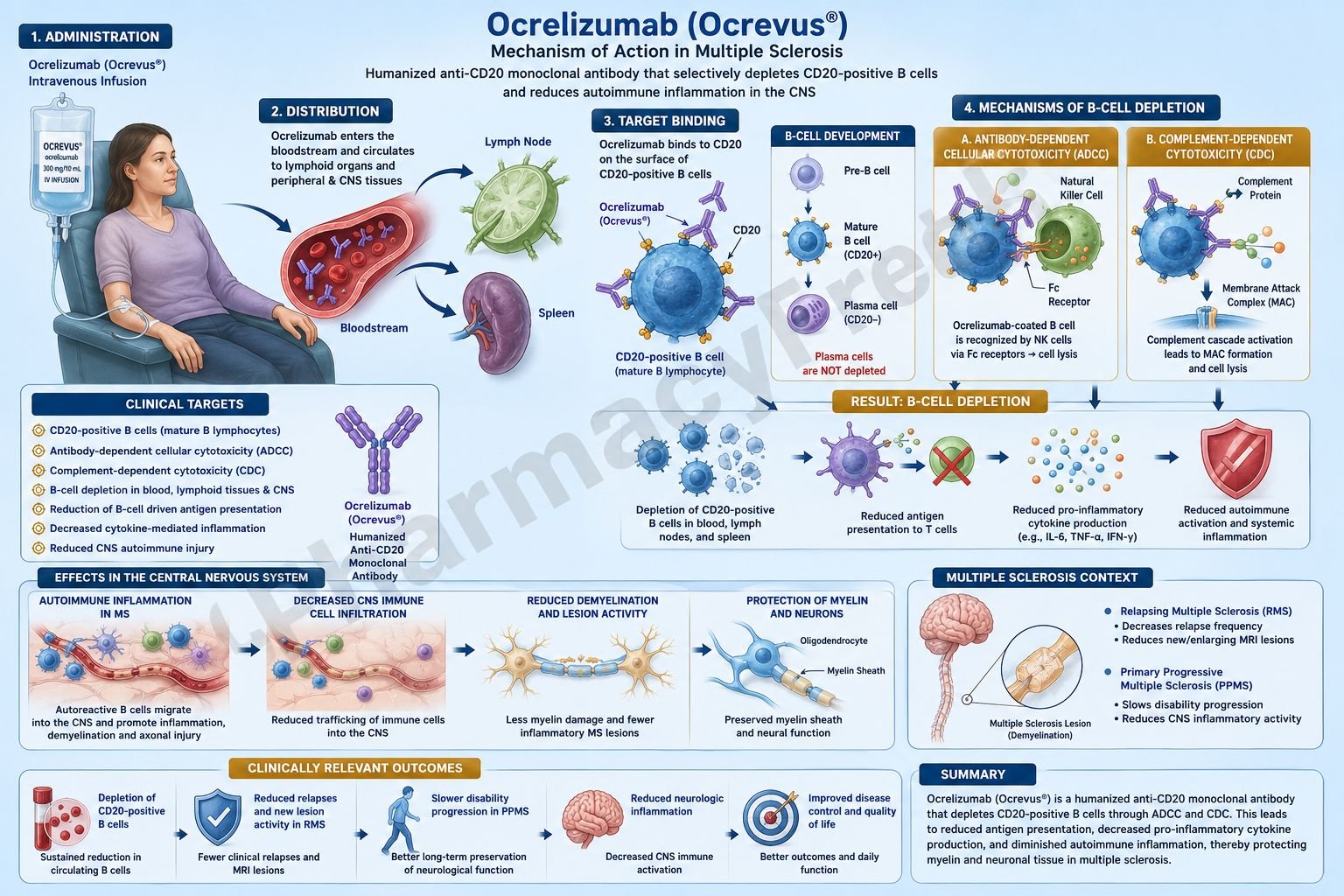
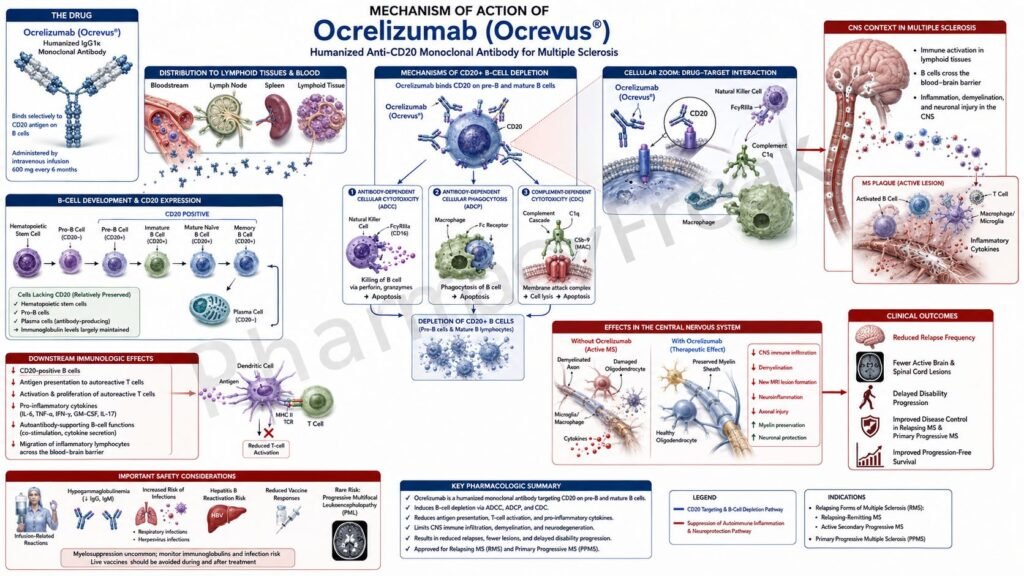
Ocrelizumab works by binding to CD20 on pre-B and mature B lymphocytes. After binding, it causes B-cell depletion mainly through antibody-dependent cellular cytolysis and complement-mediated lysis. The exact therapeutic mechanism in multiple sclerosis is not fully known, but the official label states that its effect is presumed to involve CD20 binding followed by B-cell depletion.
For exam purposes, ocrelizumab should be remembered as an anti-CD20 monoclonal antibody used in relapsing forms of multiple sclerosis and primary progressive multiple sclerosis. It reduces CD20-positive B cells and thereby decreases B-cell-mediated autoimmune inflammation.

Mechanism of Action (Step-wise)
Step 1: Multiple sclerosis involves autoimmune CNS inflammation
In multiple sclerosis, immune cells cross the blood-brain barrier and enter the central nervous system. These immune cells attack myelin and oligodendrocytes, causing demyelination, axonal injury, gliosis, and neurological symptoms.
Step 2: B cells contribute to MS pathogenesis
B cells are not only antibody-producing cells. They also act as antigen-presenting cells, produce pro-inflammatory cytokines, organize immune responses, and interact with autoreactive T cells. These functions contribute to relapse formation, MRI lesion activity, and chronic inflammation in MS.
Step 3: CD20 is expressed on selected B-cell stages
CD20 is a surface antigen found mainly on pre-B cells, mature B cells, and memory B cells. It is not significantly expressed on early hematopoietic stem cells or fully differentiated plasma cells. This allows ocrelizumab to reduce many pathogenic B-cell populations while leaving stem-cell regeneration and existing plasma-cell antibody production less directly affected.
Step 4: Ocrelizumab binds to CD20 on B lymphocytes
Ocrelizumab selectively binds CD20 on B lymphocytes. This binding identifies the B cell as a target for immune-mediated destruction. The label describes CD20 as a surface antigen present on pre-B and mature B lymphocytes.
Step 5: Antibody-dependent cellular cytolysis occurs
After ocrelizumab binds CD20, the Fc portion of the antibody can interact with Fc receptors on immune effector cells such as natural killer cells and macrophages. These immune cells then attack and destroy the antibody-coated B cell. This process is called antibody-dependent cellular cytolysis or antibody-dependent cellular cytotoxicity.
Step 6: Complement-mediated lysis occurs
Ocrelizumab can also activate the complement system on the surface of CD20-positive B cells. Complement activation can lead to membrane attack complex formation, cell membrane disruption, and B-cell lysis. This is called complement-mediated lysis or complement-dependent cytotoxicity.
Step 7: CD20-positive B cells are depleted
The combined effect of antibody-dependent cellular cytolysis and complement-mediated lysis is depletion of CD20-positive B cells. Because ocrelizumab interferes with CD20-based assays, CD19-positive B-cell counts are commonly used to monitor B-cell depletion. The label states that treatment reduces CD19-positive B-cell counts in blood by 14 days after infusion in adult and pediatric patients.
Step 8: Antigen presentation decreases
With fewer pathogenic B cells available, antigen presentation to autoreactive T cells decreases. This lowers activation of immune cells that would otherwise contribute to CNS demyelination.
Step 9: Pro-inflammatory cytokine signaling decreases
B cells can release cytokines that support inflammation. By reducing CD20-positive B-cell populations, ocrelizumab reduces inflammatory signaling that contributes to MS lesion activity.
Step 10: Formation of new inflammatory lesions decreases
When B-cell-mediated immune activation is reduced, fewer inflammatory immune cells enter the CNS and fewer new demyelinating lesions are formed. This contributes to reduced MRI activity in relapsing MS.
Step 11: Relapse activity decreases
In relapsing forms of MS, ocrelizumab reduces immune inflammatory activity and helps decrease relapse frequency. This is clinically important because relapses can cause new neurological symptoms and incomplete recovery in some patients.
Step 12: Progression in primary progressive MS may slow
Primary progressive MS involves gradual neurological worsening from disease onset, with inflammatory and neurodegenerative mechanisms. Ocrelizumab is important because it is approved for primary progressive MS in adults, where treatment options are more limited.
Step 13: B-cell recovery is delayed after discontinuation
After stopping ocrelizumab, B-cell recovery occurs gradually. The label reports that in one adult study, the median time for B-cell counts to return to baseline or the lower limit of normal was 72 weeks after the last infusion. This prolonged effect matters for infection risk, vaccine planning, pregnancy planning, and switching therapies.
Step 14: Ocrelizumab does not directly repair myelin
Ocrelizumab does not directly regenerate damaged myelin. Its benefit comes from reducing immune-mediated injury. Any neurological improvement depends on reduced inflammation, prevention of new injury, and the body’s limited repair capacity.
Step 15: Final therapeutic outcome
The final therapeutic effect is reduction of B-cell-mediated autoimmune activity in multiple sclerosis. This reduces relapse activity, lowers inflammatory lesion formation, and helps slow disability progression in appropriate MS populations.
Pharmacokinetics
Ocrevus is administered by intravenous infusion. It is not given orally because ocrelizumab is a large monoclonal antibody protein that would be degraded in the gastrointestinal tract.
In adults, the initial Ocrevus dose is given as two 300 mg intravenous infusions separated by 2 weeks. Subsequent adult doses are given as a single 600 mg intravenous infusion every 6 months. The label also describes pediatric weight-based dosing for patients 10 years and older with relapsing-remitting MS who weigh 25 kg or more.
Ocrevus must be given under supervision of a healthcare professional with access to medical support for serious infusion reactions. Patients are observed during the infusion and for at least one hour after completion.
Premedication is used to reduce infusion reactions. This usually includes intravenous methylprednisolone or an equivalent corticosteroid before each infusion and an antihistamine before each infusion. An antipyretic such as acetaminophen may also be considered.
Ocrelizumab is a monoclonal antibody and is not primarily metabolized by hepatic cytochrome P450 enzymes. Like other IgG antibodies, it is expected to be broken down into small peptides and amino acids by proteolytic catabolic pathways. Therefore, classic CYP-mediated drug interactions are not the main pharmacokinetic concern.
The most important pharmacological concerns are immune effects rather than CYP interactions. Before starting therapy, patients should undergo hepatitis B virus screening, quantitative serum immunoglobulin testing, vaccination review, and liver function testing. The current label specifically recommends HBV screening, serum immunoglobulins, vaccination planning, and liver function tests before treatment.
Live or live-attenuated vaccines should be completed at least 4 weeks before starting ocrelizumab, and non-live vaccines should be given whenever possible at least 2 weeks before starting therapy. Live vaccines are not recommended during treatment and after discontinuation until B-cell repletion.
Because B-cell depletion can persist for months after the last dose, immune monitoring may remain important even after therapy is stopped.
Clinical Uses
Ocrelizumab is used for relapsing forms of multiple sclerosis in adults. These relapsing forms include clinically isolated syndrome, relapsing-remitting disease, and active secondary progressive disease.
Clinically isolated syndrome refers to a first neurological episode suggestive of demyelination. In high-risk patients, treatment may reduce future inflammatory disease activity.
Relapsing-remitting multiple sclerosis is characterized by relapses followed by periods of partial or complete recovery. Ocrelizumab reduces relapse activity by depleting CD20-positive B cells involved in MS inflammation.
Active secondary progressive MS refers to a progressive phase of MS with continued inflammatory activity, such as relapses or new MRI lesions. Ocrelizumab may be used when the disease fits the relapsing MS indication.
Ocrelizumab is also used for primary progressive multiple sclerosis in adults. This is clinically important because primary progressive MS has fewer approved treatment options than relapsing MS.
Current Ocrevus labeling also includes relapsing-remitting MS in pediatric patients 10 years of age and older who weigh 25 kg or more. This pediatric indication is important for updated exam-oriented content because it reflects recent labeling changes.
Ocrelizumab is not a corticosteroid, interferon, S1P receptor modulator, or acute relapse medicine. Acute MS relapses are usually treated with high-dose corticosteroids or other specialist-directed interventions. Ocrelizumab is a long-term disease-modifying therapy.
Adverse Effects
The most important adverse effects of ocrelizumab are related to infusion reactions, infection risk, B-cell depletion, immunoglobulin reduction, progressive multifocal leukoencephalopathy, malignancy risk, immune-mediated colitis, liver injury, and fetal risk.
Infusion reactions are common and can be serious. Symptoms may include itching, rash, urticaria, redness, bronchospasm, throat irritation, dyspnea, swelling of the throat or larynx, flushing, hypotension, fever, fatigue, headache, dizziness, nausea, tachycardia, and anaphylaxis. The label states that infusion reactions are more common with the first infusion and that patients should be observed during infusion and for at least one hour afterward.
Infections are an important warning. Ocrelizumab increases the risk of respiratory tract infections, skin infections, and herpes-related infections. Serious bacterial, viral, fungal, and parasitic infections have been reported with ocrelizumab and other anti-CD20 B-cell-depleting therapies.
Hepatitis B virus reactivation is a major safety issue. Ocrelizumab is contraindicated in active HBV infection. HBV screening must be performed before treatment, and patients with evidence of prior HBV exposure require specialist evaluation and monitoring.
Progressive multifocal leukoencephalopathy, or PML, has been reported with ocrelizumab. PML is a rare but serious JC virus-related brain infection that can lead to death or severe disability. Symptoms may include progressive weakness, visual changes, cognitive decline, personality change, clumsiness, and speech difficulty.
Reduction in immunoglobulins can occur. Serum immunoglobulin levels should be monitored before treatment, during therapy, and after discontinuation until B-cell repletion, especially if recurrent serious infections occur. The label advises considering discontinuation in patients with serious opportunistic infections, recurrent serious infections, or prolonged hypogammaglobulinemia requiring intravenous immunoglobulin.
Malignancy risk is another warning. The label states that an increased risk of malignancy, including breast cancer, may exist with Ocrevus. Patients should follow standard breast cancer screening guidelines.
Immune-mediated colitis has been reported in the postmarketing setting. Patients should report persistent diarrhea, abdominal pain, or blood in the stool. Evaluation is needed if colitis is suspected.
Liver injury is an important updated warning. Clinically significant liver injury has occurred with anti-CD20 B-cell-depleting therapies, including Ocrevus. Liver function tests should be obtained before treatment and during therapy as clinically indicated. Symptoms such as fatigue, anorexia, nausea, vomiting, right upper abdominal discomfort, dark urine, or jaundice require evaluation.
Common adverse reactions in adult relapsing MS include upper respiratory tract infections and infusion reactions. In primary progressive MS, common adverse reactions include upper respiratory tract infections, infusion reactions, skin infections, and lower respiratory tract infections. In pediatric RRMS, adverse reactions were consistent with adult RMS experience.
Ocrelizumab may cause fetal harm based on animal data. Females of childbearing potential should use effective contraception during treatment and for 6 months after the last infusion.
Comparative Analysis
Ocrelizumab is commonly compared with ofatumumab, rituximab, ublituximab, natalizumab, fingolimod, dimethyl fumarate, teriflunomide, cladribine, alemtuzumab, interferon beta, and glatiramer acetate.
Compared with ofatumumab, ocrelizumab also targets CD20-positive B cells. Ocrelizumab is given as an intravenous infusion every 6 months, while ofatumumab is given as a subcutaneous injection once monthly after initial loading. Both deplete CD20-positive B cells, but administration route and dosing schedule differ.
Compared with rituximab, ocrelizumab is a humanized anti-CD20 monoclonal antibody, while rituximab is a chimeric anti-CD20 monoclonal antibody. Rituximab is used off-label for MS in some settings, while ocrelizumab has formal MS indications.
Compared with ublituximab, ocrelizumab shares the anti-CD20 B-cell-depleting strategy. Both target CD20-positive B cells, but they differ in antibody structure, infusion schedule, clinical trial data, and approved use details.
Compared with natalizumab, ocrelizumab targets B cells, while natalizumab blocks alpha-4 integrin and prevents immune-cell migration across the blood-brain barrier. Both reduce CNS inflammation, but they act at different stages of immune pathology.
Compared with fingolimod, ocrelizumab depletes CD20-positive B cells, while fingolimod traps lymphocytes in lymph nodes through S1P receptor modulation. Fingolimod is an oral daily drug, while ocrelizumab is an intermittent biologic infusion.
Compared with cladribine, ocrelizumab has a more selective B-cell-directed biologic mechanism. Cladribine is a purine nucleoside analogue that causes broader lymphocyte depletion through intracellular DNA damage.
Compared with interferon beta, ocrelizumab has a more targeted B-cell-depleting mechanism. Interferon beta modulates cytokine signaling, antigen presentation, and immune-cell migration more broadly.
Compared with glatiramer acetate, ocrelizumab produces stronger immune-cell depletion. Glatiramer acetate modulates immune responses to myelin-like antigens but does not directly deplete B cells.
Compared with alemtuzumab, ocrelizumab is more selective. Alemtuzumab targets CD52 and causes broad lymphocyte depletion, while ocrelizumab targets CD20-positive B cells.
MCQs
- Ocrelizumab is marketed mainly under which brand name?
a) Kesimpta
b) Ocrevus
c) Tysabri
d) Gilenya
Answer: b) Ocrevus
- Ocrelizumab belongs to which pharmacological class?
a) CD20-directed cytolytic monoclonal antibody
b) S1P receptor modulator
c) Integrin receptor antagonist
d) Purine nucleoside analogue
Answer: a) CD20-directed cytolytic monoclonal antibody
- The main molecular target of ocrelizumab is:
a) CD20
b) CD52
c) S1P1
d) Alpha-4 integrin
Answer: a) CD20
- CD20 is mainly expressed on:
a) Pre-B cells and mature B lymphocytes
b) Red blood cells only
c) Platelets only
d) Hepatocytes only
Answer: a) Pre-B cells and mature B lymphocytes
- The exact therapeutic mechanism of ocrelizumab in MS is:
a) Fully explained by direct myelin regeneration
b) Unknown, but presumed to involve CD20 binding and B-cell depletion
c) Direct acetylcholinesterase inhibition
d) Direct dopamine receptor blockade
Answer: b) Unknown, but presumed to involve CD20 binding and B-cell depletion
- After binding CD20, ocrelizumab causes B-cell depletion through:
a) Antibody-dependent cellular cytolysis and complement-mediated lysis
b) Direct sodium channel blockade
c) Cyclooxygenase inhibition
d) Bacterial ribosome inhibition
Answer: a) Antibody-dependent cellular cytolysis and complement-mediated lysis
- Which marker is commonly used to monitor B-cell counts during ocrelizumab therapy?
a) CD19-positive B cells
b) Serum troponin
c) Hemoglobin A1c
d) Platelet factor 4
Answer: a) CD19-positive B cells
- Ocrelizumab is approved for which adult MS type?
a) Primary progressive multiple sclerosis
b) Parkinson’s disease
c) Myasthenia gravis
d) Acute bacterial meningitis
Answer: a) Primary progressive multiple sclerosis
- Ocrelizumab is administered mainly by:
a) Intravenous infusion
b) Oral tablet
c) Inhalation
d) Intrathecal injection only
Answer: a) Intravenous infusion
- The usual adult initial Ocrevus dose is:
a) Two 300 mg infusions separated by 2 weeks
b) 10 mg orally every day
c) 600 mg orally every morning
d) 1 mg subcutaneous injection daily
Answer: a) Two 300 mg infusions separated by 2 weeks
- The usual adult maintenance schedule of Ocrevus is:
a) 600 mg intravenous infusion every 6 months
b) 5 mg every night
c) 100 mg every 2 hours
d) 20 mg once weekly orally
Answer: a) 600 mg intravenous infusion every 6 months
- Which screening is required before starting ocrelizumab?
a) Hepatitis B virus screening
b) Blood group only
c) Audiometry only
d) Serum uric acid only
Answer: a) Hepatitis B virus screening
- Which serious brain infection has been reported with ocrelizumab?
a) Progressive multifocal leukoencephalopathy
b) Acute migraine aura
c) Benign positional vertigo
d) Essential tremor
Answer: a) Progressive multifocal leukoencephalopathy
- Which vaccine type should generally be avoided during ocrelizumab treatment until B-cell repletion?
a) Live or live-attenuated vaccines
b) Inactivated influenza vaccine only
c) Recombinant vaccines only
d) Toxoid vaccines only
Answer: a) Live or live-attenuated vaccines
- Which statement best describes ocrelizumab?
a) It binds CD20-positive B cells and causes B-cell depletion through immune-mediated cytolysis
b) It traps lymphocytes in lymph nodes through S1P receptor modulation
c) It blocks alpha-4 integrin migration across the blood-brain barrier
d) It directly regenerates damaged myelin
Answer: a) It binds CD20-positive B cells and causes B-cell depletion through immune-mediated cytolysis
FAQs
What is the mechanism of action of ocrelizumab?
Ocrelizumab binds to CD20 on pre-B and mature B lymphocytes. After binding, it causes B-cell depletion through antibody-dependent cellular cytolysis and complement-mediated lysis. This reduces B-cell-mediated autoimmune inflammation in multiple sclerosis.
What is the brand name of ocrelizumab?
The main brand name of ocrelizumab is Ocrevus. Ocrevus is given by intravenous infusion. Ocrevus Zunovo is a subcutaneous formulation containing ocrelizumab with hyaluronidase.
What is ocrelizumab used for?
Ocrelizumab is used for relapsing forms of multiple sclerosis in adults, primary progressive multiple sclerosis in adults, and relapsing-remitting multiple sclerosis in pediatric patients 10 years and older who weigh 25 kg or more.
Is ocrelizumab the same as ofatumumab?
No. Both are anti-CD20 monoclonal antibodies used in MS, but they are different drugs. Ocrelizumab is given as an intravenous infusion every 6 months, while ofatumumab is given as a subcutaneous injection once monthly after loading.
Does ocrelizumab cure multiple sclerosis?
No. Ocrelizumab does not cure MS. It reduces immune-mediated inflammatory activity and helps reduce relapses, MRI lesion activity, and disease progression in appropriate MS patients.
Why does ocrelizumab increase infection risk?
Ocrelizumab depletes CD20-positive B cells, which are part of immune defense. This can increase the risk of respiratory tract infections, skin infections, herpes infections, and serious infections in some patients.
Why is hepatitis B screening needed before ocrelizumab?
Ocrelizumab can reactivate hepatitis B infection. Active HBV infection is a contraindication, and patients with evidence of prior HBV exposure require specialist evaluation and monitoring.
Can live vaccines be given during ocrelizumab therapy?
Live or live-attenuated vaccines are not recommended during ocrelizumab therapy and after discontinuation until B-cell repletion. Required live vaccines should be given at least 4 weeks before starting therapy whenever possible.
References
Goodman & Gilman’s The Pharmacological Basis of Therapeutics
Katzung Basic & Clinical Pharmacology