Table of Contents
Introduction
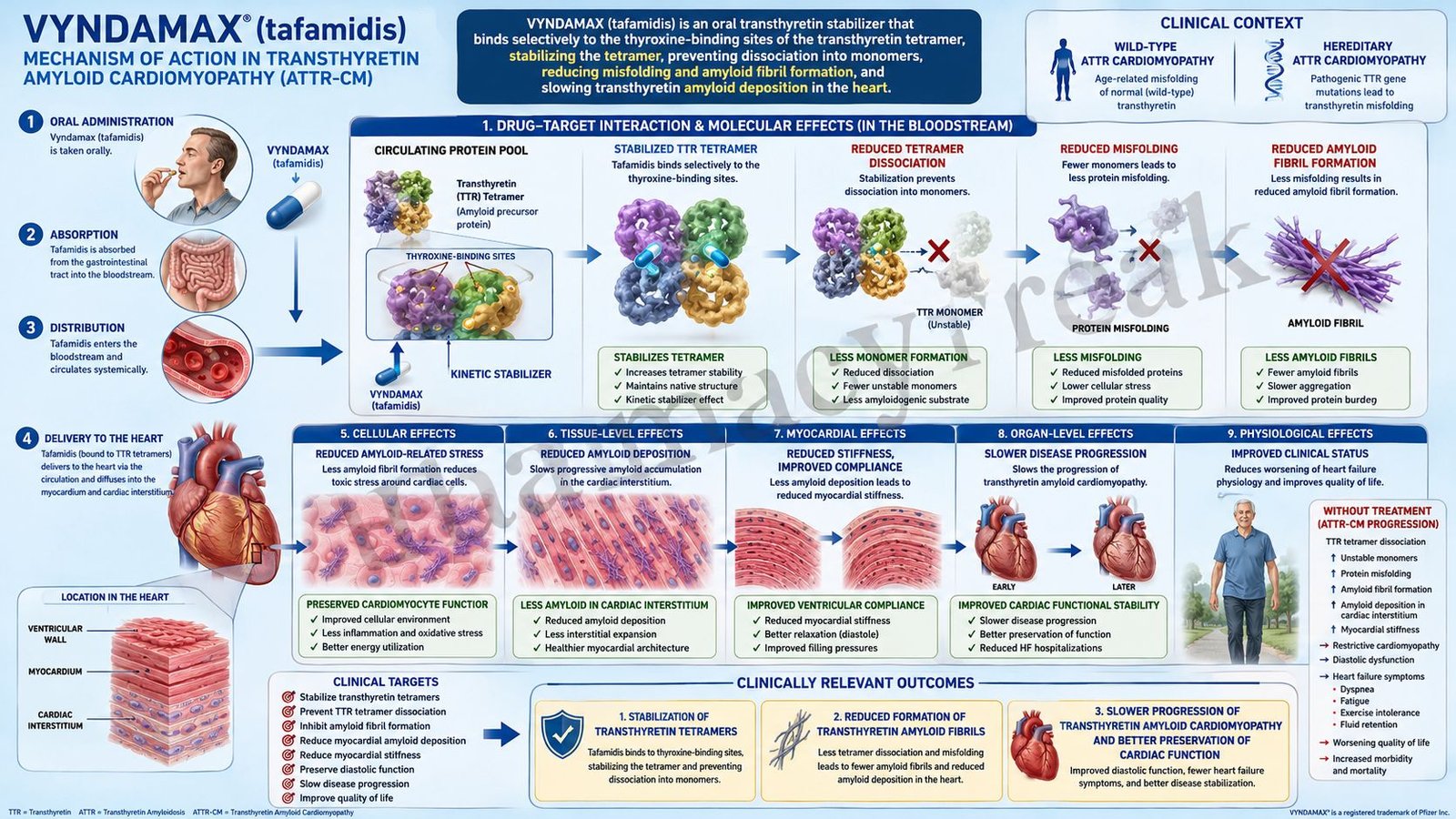
Vyndamax is the brand name of tafamidis, an oral drug used in transthyretin amyloid cardiomyopathy, commonly called ATTR-CM. Pharmacologically, tafamidis is a selective stabilizer of transthyretin, or TTR.
ATTR-CM occurs when transthyretin protein becomes unstable, dissociates from its normal tetrameric structure into monomers, misfolds, and forms amyloid fibrils. These amyloid deposits can accumulate in the myocardium, making the heart stiff and progressively impairing cardiac filling and function.
There are two main forms of ATTR-CM. Wild-type ATTR-CM occurs without a pathogenic TTR mutation and is often associated with aging. Hereditary ATTR-CM occurs due to variants in the TTR gene, causing unstable transthyretin protein and amyloid deposition.
Vyndamax does not remove existing amyloid deposits directly. It works earlier in the amyloid-forming pathway by stabilizing the transthyretin tetramer. The current prescribing information describes Vyndamax and Vyndaqel as transthyretin stabilizers indicated for adults with cardiomyopathy of wild-type or hereditary transthyretin-mediated amyloidosis to reduce cardiovascular mortality and cardiovascular-related hospitalization.
Tafamidis binds to transthyretin at the thyroxine-binding sites. This stabilizes the TTR tetramer and slows dissociation into monomers, which is the rate-limiting step in the amyloidogenic process.
For exam use, remember Vyndamax as a TTR tetramer stabilizer. It slows ATTR-CM progression by preventing transthyretin tetramer breakdown, thereby reducing formation of misfolded monomers and downstream amyloid fibrils.
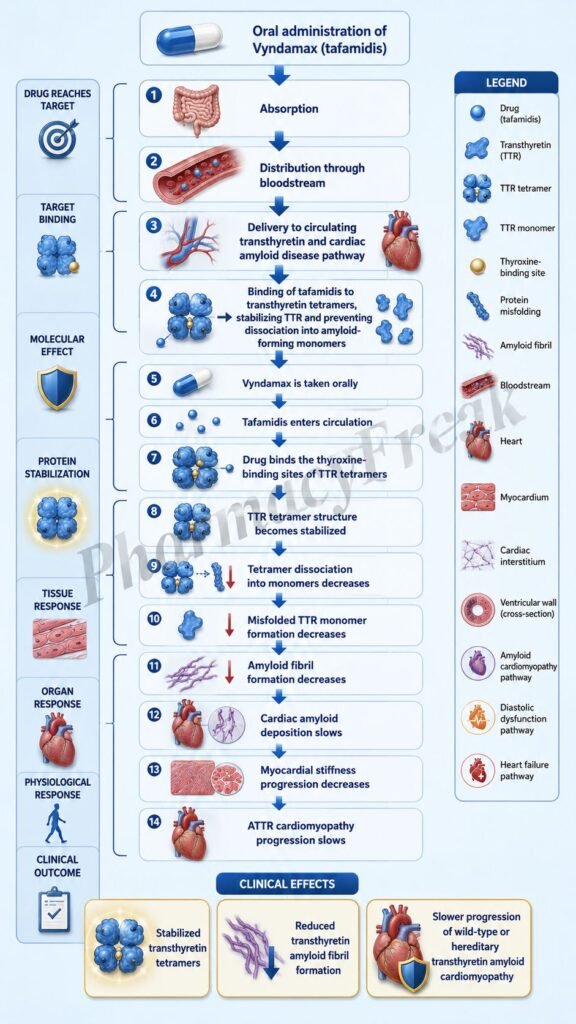
Mechanism of Action (Step-wise)
Step 1: Transthyretin normally circulates as a tetramer
Transthyretin is a transport protein made mainly by the liver. In normal physiology, it circulates as a tetramer, meaning four identical subunits remain assembled together.
Step 2: TTR helps transport thyroxine and retinol-binding protein
TTR participates in transport of thyroxine and retinol-binding protein-vitamin A complex. Its thyroxine-binding sites are also the pharmacological binding site for tafamidis.
Step 3: TTR tetramer instability starts amyloid formation
In ATTR amyloidosis, the TTR tetramer becomes unstable. Once the tetramer dissociates into monomers, these monomers can misfold and aggregate.
Step 4: Tetramer dissociation is the rate-limiting step
The label states that TTR tetramer dissociation into monomers is the rate-limiting step in the amyloidogenic process. This is the key reason stabilizing the tetramer is therapeutically useful.
Step 5: Misfolded monomers form amyloid fibrils
After dissociation, unstable TTR monomers misfold and assemble into amyloid fibrils. These fibrils can deposit in tissues, especially the heart in ATTR-CM.
Step 6: Amyloid deposits stiffen the myocardium
Cardiac amyloid deposition makes the ventricular wall stiff. This reduces diastolic filling, increases filling pressures, and contributes to heart failure symptoms such as fatigue, dyspnea, edema, exercise intolerance, and arrhythmia risk.
Step 7: Tafamidis binds the TTR thyroxine-binding sites
Tafamidis, the active drug in Vyndamax, binds to transthyretin at the thyroxine-binding sites. This binding is central to its mechanism of action.
Step 8: The TTR tetramer becomes more stable
Once tafamidis binds TTR, the tetramer is stabilized. A stabilized tetramer is less likely to split apart into amyloid-forming monomers.
Step 9: Monomer formation slows
By slowing tetramer dissociation, tafamidis reduces the supply of unstable monomers. Fewer monomers means less substrate for misfolding and aggregation.
Step 10: Amyloidogenic pathway slows down
Tafamidis does not act like chemotherapy or an enzyme inhibitor. It acts as a kinetic stabilizer of TTR, reducing progression through the amyloid-forming pathway.
Step 11: New amyloid fibril formation may decrease
When fewer TTR monomers are available to misfold, formation of new amyloid fibrils may slow. This can help reduce further amyloid deposition in the heart.
Step 12: Cardiac disease progression slows
In ATTR-CM, the goal is to slow progressive myocardial amyloid deposition and cardiac decline. Vyndamax is used to reduce cardiovascular mortality and cardiovascular-related hospitalization in adults with wild-type or hereditary ATTR-CM.
Step 13: Existing amyloid is not rapidly dissolved
Tafamidis is best understood as a stabilizer, not an amyloid-clearing drug. It does not directly dissolve established amyloid deposits.
Step 14: Clinical benefit depends on earlier pathway control
Because tafamidis works by stabilizing circulating TTR, the benefit comes from slowing ongoing amyloid formation rather than producing immediate symptomatic reversal.
Step 15: Final therapeutic outcome
The final therapeutic effect of Vyndamax is stabilization of transthyretin tetramers, slowing of TTR amyloid formation, and reduced clinical progression of transthyretin amyloid cardiomyopathy.
Pharmacokinetics
Vyndamax is taken orally as one 61 mg tafamidis capsule once daily. Vyndaqel is the tafamidis meglumine formulation and is taken as four 20 mg capsules once daily. These two regimens provide comparable tafamidis exposure, but Vyndamax and Vyndaqel are not substitutable on a milligram-to-milligram basis.
The capsules should be swallowed whole and should not be crushed or cut. If a dose is missed, the patient should take it as soon as remembered or skip it and take the next dose at the regular time. The dose should not be doubled.
Food does not produce clinically significant changes in tafamidis pharmacokinetics. This allows Vyndamax to be taken with or without food.
After oral administration of Vyndamax, peak concentration occurs at a median time of about 4 hours in the fasted state. Tafamidis accumulation at steady state after repeated daily dosing is about 2.5-fold greater than after a single dose.
Tafamidis is highly protein bound, with plasma protein binding greater than 99% in vitro. Its apparent steady-state volume of distribution is about 18.5 L for tafamidis.
The mean half-life of tafamidis is approximately 49 hours, supporting once-daily dosing.
Tafamidis metabolism has not been fully characterized. After a single oral dose of tafamidis meglumine 20 mg, about 59% of the dose was recovered in feces, mostly unchanged, and about 22% was recovered in urine, mostly as the glucuronide metabolite.
A key interaction point is breast cancer resistance protein, or BCRP. Tafamidis inhibits BCRP in humans. Exposure to the BCRP substrate rosuvastatin increased when given with repeated Vyndamax dosing, so monitoring may be needed with BCRP substrates where increased exposure matters clinically.
Clinical Uses
Vyndamax is used for the treatment of cardiomyopathy caused by wild-type or hereditary transthyretin-mediated amyloidosis in adults. The clinical goal is reduction of cardiovascular mortality and cardiovascular-related hospitalization.
In wild-type ATTR-CM, tafamidis stabilizes normal-sequence transthyretin tetramers that have become unstable with age or disease biology.
In hereditary ATTR-CM, tafamidis stabilizes variant transthyretin tetramers caused by pathogenic TTR gene mutations.
Vyndamax is not a diuretic. It does not directly remove excess fluid, so patients with heart failure symptoms may still need diuretics or other supportive heart-failure care.
Vyndamax is not an anticoagulant, beta-blocker, ACE inhibitor, ARB, ARNI, mineralocorticoid receptor antagonist, SGLT2 inhibitor, or antiarrhythmic drug. It targets the amyloid-forming TTR protein pathway.
Vyndamax is not a gene silencer. It does not reduce hepatic production of TTR like TTR-directed RNA therapies. It stabilizes circulating TTR protein after it is made.
Vyndamax is not an amyloid fibril remover. It slows the upstream process that produces amyloid-forming TTR monomers.
Adverse Effects
Vyndamax is generally notable for having adverse-event rates similar to placebo in ATTR-CM clinical trials. In the 30-month placebo-controlled trial, adverse-event frequency in patients treated with tafamidis meglumine 20 mg or 80 mg was similar to placebo. Discontinuation because of adverse events was also similar across tafamidis and placebo groups.
The U.S. prescribing information lists no contraindications for Vyndamax or Vyndaqel.
Pregnancy is a safety concern. Based on animal studies, Vyndamax may cause fetal harm when given during pregnancy. Patients should inform their healthcare provider about known or suspected pregnancy.
Breastfeeding is not recommended during treatment with Vyndamax or Vyndaqel. The label notes that there are no available data on tafamidis in human milk, but animal findings suggest potential for serious adverse reactions in the breastfed infant.
Tafamidis can reduce total thyroxine values, probably by reducing thyroxine binding to TTR or displacing thyroxine from TTR. The label notes this was not accompanied by corresponding clinical findings consistent with thyroid dysfunction.
Drug interactions matter mainly through BCRP inhibition. Tafamidis may increase exposure to BCRP substrates such as rosuvastatin. This does not mean tafamidis is broadly toxic, but it means interacting drugs should be reviewed carefully.
Comparative Analysis
Vyndamax is commonly compared with Vyndaqel, diflunisal, patisiran, vutrisiran, inotersen, eplontersen, acoramidis, heart-failure drugs, and supportive cardiac therapy.
Compared with Vyndaqel, Vyndamax contains tafamidis free acid, while Vyndaqel contains tafamidis meglumine. Vyndamax 61 mg once daily gives comparable exposure to Vyndaqel 80 mg once daily, given as four 20 mg capsules, but they are not interchangeable on a per-milligram basis.
Compared with diflunisal, tafamidis is a purpose-developed TTR stabilizer. Diflunisal can also stabilize TTR but is an NSAID, so its use may be limited by renal, gastrointestinal, bleeding, and heart-failure concerns.
Compared with patisiran and vutrisiran, tafamidis has a different strategy. RNA-based therapies reduce production of TTR, while tafamidis stabilizes circulating TTR tetramers.
Compared with inotersen and eplontersen, tafamidis does not work through antisense inhibition of TTR synthesis. It binds the protein after synthesis and reduces tetramer dissociation.
Compared with acoramidis, tafamidis belongs to the same broad TTR stabilizer concept, but the drugs differ in molecular structure, dosing, trial data, regulatory status, and labeling.
Compared with standard heart-failure medicines, tafamidis is disease-specific for ATTR-CM. Diuretics relieve congestion. SGLT2 inhibitors, beta-blockers, RAAS inhibitors, and other heart-failure therapies act on hemodynamics, neurohormonal systems, or renal-glucose pathways. Tafamidis targets TTR amyloid formation.
Compared with amyloid-removal approaches, tafamidis does not directly clear deposits. Its main value is stabilizing TTR before it can dissociate and misfold.
MCQs
- Vyndamax contains which active drug?
a) Tafamidis
b) Patisiran
c) Inotersen
d) Diflunisal
Answer: a) Tafamidis
- Vyndamax belongs to which pharmacological class?
a) Transthyretin stabilizer
b) SGLT2 inhibitor
c) Beta-blocker
d) Loop diuretic
Answer: a) Transthyretin stabilizer
- Vyndamax is mainly used for:
a) ATTR cardiomyopathy
b) Acute bacterial endocarditis
c) Hypertensive emergency
d) Acute myocardial infarction thrombolysis
Answer: a) ATTR cardiomyopathy
- Tafamidis binds to TTR at which sites?
a) Thyroxine-binding sites
b) ATP-binding sites
c) Calcium channels
d) Beta-1 receptors
Answer: a) Thyroxine-binding sites
- The rate-limiting step in the amyloidogenic process is:
a) TTR tetramer dissociation into monomers
b) Sodium reabsorption in the kidney
c) Platelet ADP activation
d) Beta-receptor blockade
Answer: a) TTR tetramer dissociation into monomers
- Tafamidis stabilizes the:
a) TTR tetramer
b) Fibrin clot
c) LDL receptor
d) Dopamine transporter
Answer: a) TTR tetramer
- The recommended Vyndamax dose is:
a) 61 mg orally once daily
b) 20 mg orally four times daily
c) 5 mg orally twice daily
d) 100 mg intravenously once monthly
Answer: a) 61 mg orally once daily
- Vyndaqel 80 mg once daily is given as:
a) Four 20 mg tafamidis meglumine capsules
b) One 80 mg tafamidis capsule
c) Two 40 mg tablets
d) One subcutaneous injection
Answer: a) Four 20 mg tafamidis meglumine capsules
- Vyndamax and Vyndaqel are:
a) Not substitutable on a per mg basis
b) Always identical mg-for-mg
c) The same as digoxin
d) Injectable biologics
Answer: a) Not substitutable on a per mg basis
- Vyndamax capsules should be:
a) Swallowed whole, not crushed or cut
b) Crushed before every dose
c) Dissolved in alcohol
d) Chewed for faster action
Answer: a) Swallowed whole, not crushed or cut
- Tafamidis plasma protein binding is:
a) Greater than 99%
b) Less than 5%
c) Exactly 20%
d) Not measurable
Answer: a) Greater than 99%
- The mean half-life of tafamidis is approximately:
a) 49 hours
b) 30 minutes
c) 4 hours
d) 7 days
Answer: a) 49 hours
- Tafamidis inhibits which transporter in humans?
a) BCRP
b) SGLT2
c) NET
d) DAT
Answer: a) BCRP
- Breastfeeding during Vyndamax treatment is:
a) Not recommended
b) Required
c) Proven completely safe
d) Used to improve drug clearance
Answer: a) Not recommended
- Which statement best describes Vyndamax?
a) It stabilizes transthyretin tetramers and slows dissociation into amyloid-forming monomers
b) It removes existing amyloid deposits directly
c) It blocks beta-1 receptors to reduce heart rate
d) It inhibits renal sodium-glucose cotransport
Answer: a) It stabilizes transthyretin tetramers and slows dissociation into amyloid-forming monomers
FAQs
What is the mechanism of action of Vyndamax?
Vyndamax contains tafamidis. Tafamidis binds transthyretin at the thyroxine-binding sites, stabilizes the TTR tetramer, and slows dissociation into monomers. This slows the amyloid-forming process in ATTR-CM.
What is Vyndamax used for?
Vyndamax is used in adults with cardiomyopathy of wild-type or hereditary transthyretin-mediated amyloidosis to reduce cardiovascular mortality and cardiovascular-related hospitalization.
Is Vyndamax the same as Vyndaqel?
No. Both contain tafamidis as the active moiety, but Vyndamax contains tafamidis 61 mg, while Vyndaqel contains tafamidis meglumine 20 mg capsules. Vyndamax 61 mg once daily is comparable to Vyndaqel 80 mg once daily, but they are not interchangeable milligram-for-milligram.
Does Vyndamax remove amyloid deposits?
No. Vyndamax does not directly dissolve existing amyloid deposits. It stabilizes transthyretin tetramers and slows further amyloid formation.
Is Vyndamax a heart-failure drug?
Vyndamax treats the underlying transthyretin amyloid process in ATTR-CM. It is different from standard heart-failure drugs such as diuretics, beta-blockers, ACE inhibitors, ARBs, ARNIs, MRAs, and SGLT2 inhibitors.
Can Vyndamax be taken with food?
Yes. Food does not cause clinically significant changes in tafamidis pharmacokinetics, so Vyndamax may be taken with or without food.
What is the major drug interaction concern with Vyndamax?
Tafamidis inhibits BCRP. This may increase exposure to BCRP substrates such as rosuvastatin, so interacting medicines should be reviewed.
Is Vyndamax safe in pregnancy?
Based on animal studies, Vyndamax may cause fetal harm. Patients should tell their healthcare provider if they are pregnant or planning pregnancy.
References
Goodman & Gilman’s The Pharmacological Basis of Therapeutics
Katzung Basic & Clinical Pharmacology