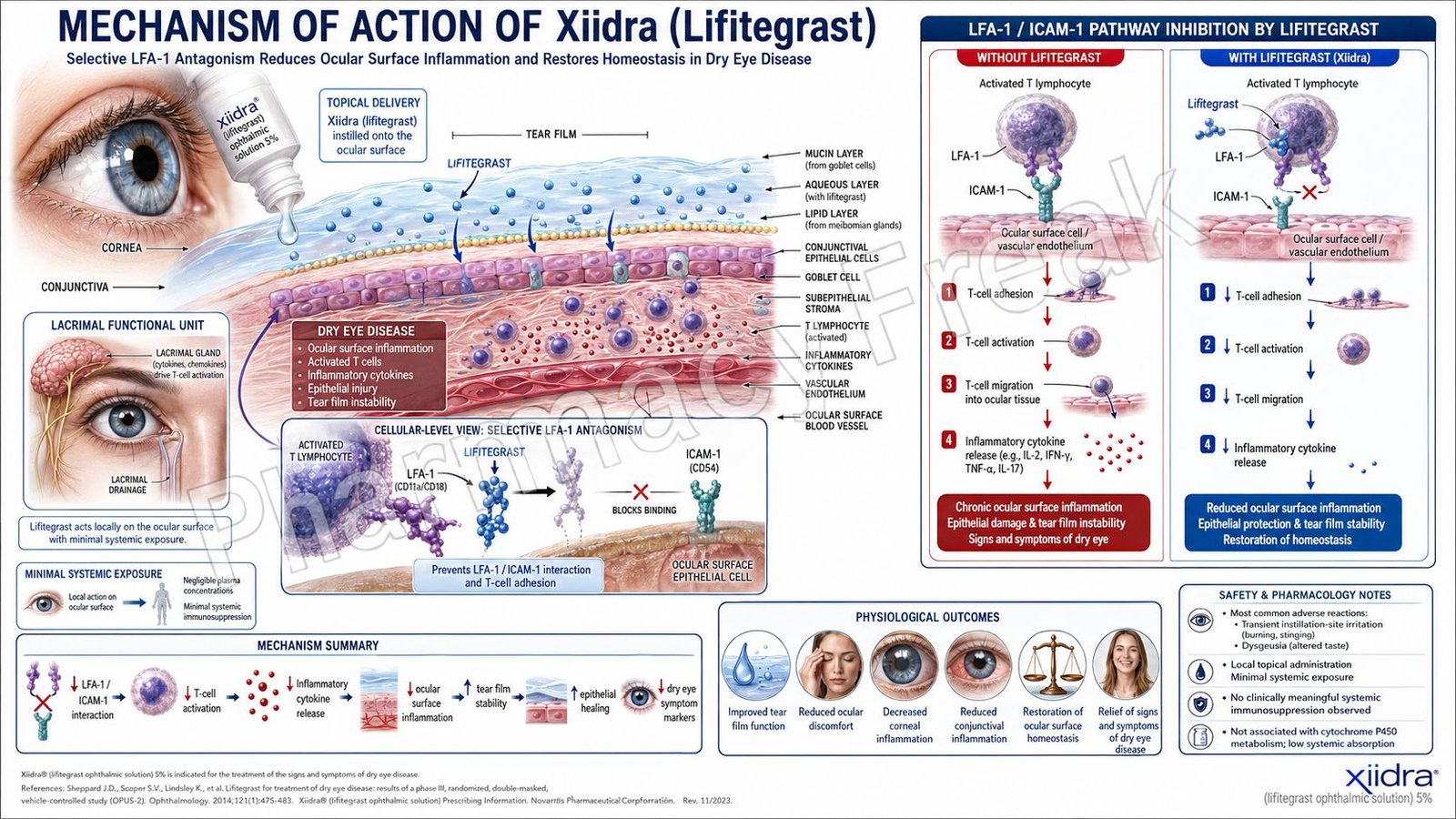
Table of Contents
Introduction
Xiidra is the brand name of lifitegrast ophthalmic solution 5%, a prescription eye drop used for the treatment of signs and symptoms of dry eye disease. Dry eye disease is a chronic inflammatory condition of the ocular surface in which tear film instability, inflammation, epithelial stress, and immune-cell activation contribute to dryness, burning, irritation, foreign body sensation, redness, and visual discomfort.
Xiidra is pharmacologically important because it is not an artificial tear, steroid, antibiotic, antihistamine, or lubricating agent. It is an anti-inflammatory ophthalmic drug that targets a specific immune-cell adhesion pathway involved in dry eye disease. The key target of lifitegrast is lymphocyte function-associated antigen-1, commonly called LFA-1, which is an integrin found on leukocytes. By blocking the interaction between LFA-1 and intercellular adhesion molecule-1, or ICAM-1, Xiidra reduces T-cell activation, migration, and inflammatory signaling on the ocular surface.
For pharmacy, medical, nursing, and competitive exam students, Xiidra is important because it represents targeted immunomodulatory therapy for dry eye disease. Its mechanism is different from cyclosporine ophthalmic emulsion, which acts mainly by inhibiting calcineurin-dependent T-cell activation. Xiidra instead works by blocking LFA-1/ICAM-1 interaction, which is involved in immune synapse formation and T-cell-mediated inflammation.
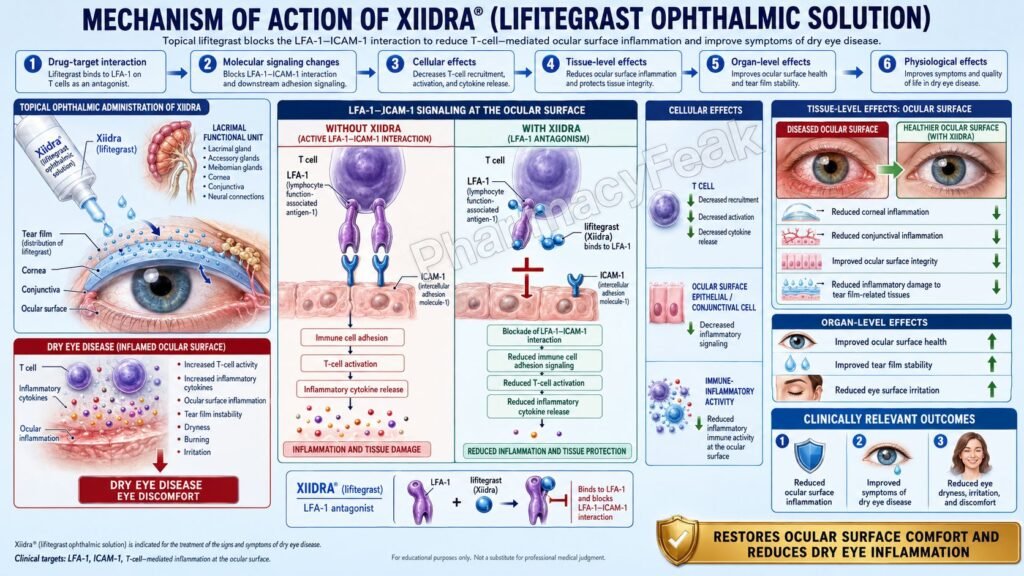
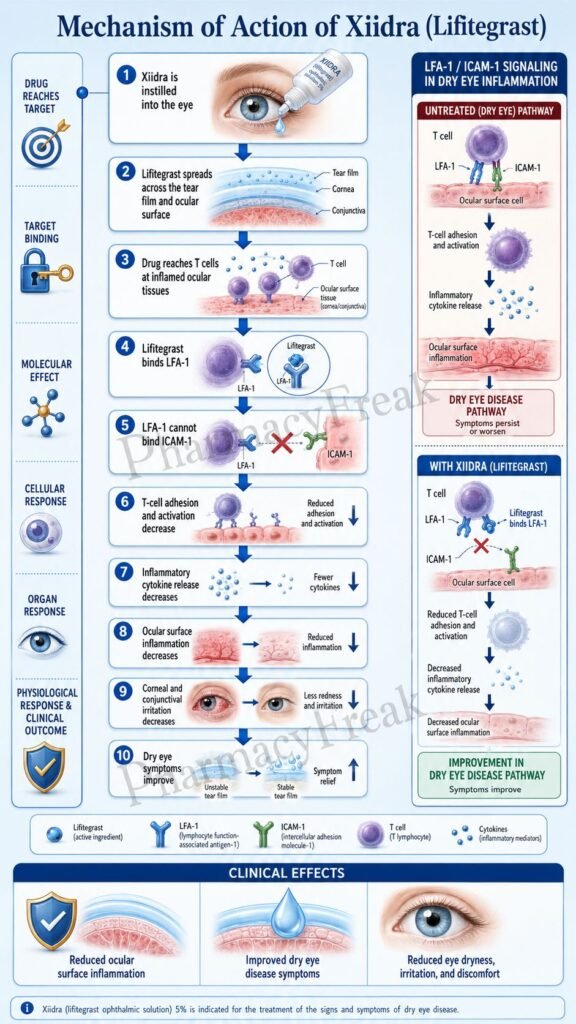
Mechanism of Action (Step-wise)
- Primary target: LFA-1 integrin
Xiidra contains lifitegrast, which binds to lymphocyte function-associated antigen-1, also known as LFA-1. LFA-1 is a cell-surface integrin found on leukocytes, especially T lymphocytes.
LFA-1 normally helps immune cells adhere to other cells and migrate into inflamed tissues. This is important in immune surveillance, but in dry eye disease, excessive ocular surface inflammation can worsen symptoms and tissue damage.
- ICAM-1 expression on ocular surface tissues
Intercellular adhesion molecule-1, or ICAM-1, is the natural binding partner of LFA-1. ICAM-1 may be overexpressed in corneal and conjunctival tissues in dry eye disease.
When ICAM-1 expression increases, it promotes leukocyte adhesion, T-cell activation, and inflammatory cell recruitment to ocular surface tissues.
- Blocking LFA-1/ICAM-1 interaction
Lifitegrast binds to LFA-1 and blocks its interaction with ICAM-1. This prevents a key adhesion and signaling step between immune cells and ocular surface tissues.
This is the central mechanism of Xiidra: inhibition of LFA-1/ICAM-1-mediated inflammatory signaling.
- Inhibition of immunological synapse formation
The LFA-1/ICAM-1 interaction contributes to formation of an immunological synapse. An immunological synapse is a structured contact point between immune cells and target cells that supports T-cell activation and immune signaling.
By blocking this interaction, lifitegrast reduces T-cell activation and inflammatory immune communication.
- Reduced T-cell activation
T cells are important drivers of chronic ocular surface inflammation in dry eye disease. Activated T cells release inflammatory cytokines and recruit additional immune cells.
By preventing LFA-1/ICAM-1 binding, Xiidra reduces T-cell activation and helps interrupt the inflammatory cycle on the ocular surface.
- Reduced T-cell migration to ocular tissues
LFA-1 also helps T cells adhere to and migrate into inflamed tissues. By blocking LFA-1, lifitegrast can reduce migration of inflammatory T cells into corneal and conjunctival tissues.
This helps decrease inflammation affecting the tear film and ocular surface.
- Reduced inflammatory mediator release
Activated T cells release cytokines and inflammatory mediators that can damage ocular surface epithelial cells, destabilize the tear film, and increase symptoms of dryness and irritation.
By decreasing T-cell activation and recruitment, Xiidra reduces inflammatory mediator activity and helps improve the inflammatory component of dry eye disease.
- Improvement in signs and symptoms of dry eye disease
Dry eye disease includes both symptoms and clinical signs. Symptoms include dryness, burning, irritation, grittiness, and visual fluctuation. Signs may include corneal staining, conjunctival inflammation, and tear film abnormalities.
Xiidra is indicated for treatment of both signs and symptoms of dry eye disease.
- Final therapeutic effect
The final therapeutic effect of Xiidra is reduced LFA-1/ICAM-1-mediated T-cell activation, decreased ocular surface inflammation, improved tear film environment, and improvement in signs and symptoms of dry eye disease.
Pharmacokinetics
Xiidra is administered topically to the eye as lifitegrast ophthalmic solution 5%. It is usually dosed as one drop in each eye twice daily, approximately 12 hours apart.
Absorption:
After ophthalmic administration, lifitegrast acts mainly on the ocular surface. Systemic absorption is low. In a subset of patients from a phase 3 trial, trough plasma concentrations were measured after 180 and 360 days of twice-daily topical ocular dosing, and only a minority of patients had quantifiable plasma concentrations above the assay limit.
Distribution:
The main site of action is the ocular surface, including the cornea and conjunctiva. Because Xiidra is an eye drop, its therapeutic effect is intended to be local rather than systemic.
Metabolism:
Detailed systemic metabolism is less clinically emphasized because systemic exposure after topical ophthalmic use is low. Lifitegrast does not require systemic immunosuppression to produce its ocular anti-inflammatory effect.
Excretion:
Because systemic exposure is limited, systemic elimination is not a major clinical focus in routine use. Any absorbed drug is cleared through normal systemic elimination pathways.
Half-life and duration:
Xiidra is dosed twice daily. The pharmacodynamic effect depends on repeated local blockade of the LFA-1/ICAM-1 inflammatory pathway on the ocular surface.
Special administration points:
Single-use containers should be used immediately after opening and then discarded. Contact lenses should be removed before administration and may be reinserted after 15 minutes.
Clinical Uses
- Dry eye disease:
Xiidra is used for the treatment of signs and symptoms of dry eye disease. - Inflammatory dry eye:
It is especially relevant when ocular surface inflammation contributes to symptoms such as dryness, burning, irritation, and discomfort. - T-cell-mediated ocular surface inflammation:
Xiidra targets LFA-1/ICAM-1 interaction, which contributes to T-cell activation and migration in dry eye disease. - Patients needing prescription dry eye therapy:
Xiidra may be used when artificial tears alone are inadequate or when an anti-inflammatory approach is needed. - Non-steroidal dry eye therapy:
Xiidra is not a corticosteroid, so it does not carry the classic steroid eye-drop risks such as steroid-induced intraocular pressure elevation or cataract risk with prolonged use. - Long-term dry eye management:
Dry eye disease is often chronic, and Xiidra may be used as part of a longer-term management plan under medical supervision.
Adverse Effects
Common adverse effects of Xiidra include:
- Instillation-site irritation
- Eye discomfort
- Burning or stinging sensation
- Blurred vision after application
- Reduced visual acuity
- Dysgeusia, or unusual taste sensation
- Conjunctival hyperemia
- Eye irritation
- Headache
- Increased lacrimation
- Eye discharge
- Eye pruritus
- Sinusitis
The most common adverse reactions reported in 5% to 25% of patients include instillation-site irritation, dysgeusia, and reduced visual acuity. Other adverse reactions reported in 1% to 5% of patients include blurred vision, conjunctival hyperemia, eye irritation, headache, increased lacrimation, eye discharge, eye discomfort, eye pruritus, and sinusitis.
Important safety points include:
- Xiidra is contraindicated in patients with known hypersensitivity to lifitegrast or any ingredient in the formulation.
- Patients should seek medical help if symptoms of allergic reaction occur, such as wheezing, breathing difficulty, or swelling of the tongue.
- Temporary blurred vision may occur after administration, so patients should use caution with activities requiring clear vision until vision normalizes.
- Xiidra is for ophthalmic use only and should not be swallowed or used by any other route.
- Contact lenses should be removed before use and reinserted only after the recommended waiting period.
Dysgeusia is a classic exam point for Xiidra. Patients may notice a strange, metallic, or unusual taste after using the eye drops because ophthalmic solutions can drain through the nasolacrimal duct into the nasal cavity and throat.
Comparative Analysis
| Feature | Xiidra | Restasis | Artificial Tears | Topical Corticosteroid Eye Drops |
|---|---|---|---|---|
| Generic name | Lifitegrast | Cyclosporine | Lubricant combinations | Loteprednol, prednisolone, fluorometholone, etc. |
| Drug class | LFA-1 antagonist / integrin antagonist | Calcineurin inhibitor | Ocular lubricant | Glucocorticoid receptor agonist |
| Main target | LFA-1/ICAM-1 interaction | Calcineurin-mediated T-cell activation | Tear film lubrication | Broad inflammatory gene regulation |
| Main action | Reduces T-cell adhesion, activation, and migration | Reduces T-cell activation and inflammation | Moisturizes ocular surface | Broad anti-inflammatory effect |
| Steroid status | Non-steroidal | Non-steroidal | Non-steroidal | Steroidal |
| Main use | Signs and symptoms of dry eye disease | Dry eye disease with tear production/inflammation component | Symptomatic lubrication | Short-term inflammation control |
| Common adverse effects | Irritation, dysgeusia, reduced visual acuity | Burning, irritation | Temporary blurred vision | Increased intraocular pressure, cataract risk with prolonged use |
| Route | Ophthalmic drops | Ophthalmic drops | Ophthalmic drops | Ophthalmic drops |
Xiidra differs from Restasis because Xiidra blocks LFA-1/ICAM-1 interaction, while cyclosporine inhibits calcineurin-mediated T-cell activation. Artificial tears mainly provide lubrication and do not directly target immune inflammation. Topical corticosteroids provide strong anti-inflammatory effects but are usually used carefully because prolonged use can increase intraocular pressure and cataract risk.
MCQs
- Xiidra contains which active drug?
a) Cyclosporine
b) Lifitegrast
c) Prednisolone
d) Olopatadine
Answer: b) Lifitegrast
- Xiidra is mainly used for:
a) Dry eye disease
b) Glaucoma
c) Bacterial conjunctivitis
d) Cataract removal
Answer: a) Dry eye disease
- The main molecular target of lifitegrast is:
a) LFA-1
b) Beta-2 receptor
c) Histamine H1 receptor
d) COX-2
Answer: a) LFA-1
- LFA-1 is found mainly on:
a) Leukocytes
b) Red blood cells only
c) Platelets only
d) Corneal collagen only
Answer: a) Leukocytes
- Xiidra blocks the interaction between LFA-1 and:
a) ICAM-1
b) TNF-alpha
c) IL-5
d) VEGF
Answer: a) ICAM-1
- ICAM-1 may be overexpressed in which tissues in dry eye disease?
a) Corneal and conjunctival tissues
b) Renal tubules only
c) Liver sinusoids only
d) Pancreatic beta cells only
Answer: a) Corneal and conjunctival tissues
- Blocking LFA-1/ICAM-1 interaction reduces:
a) T-cell activation and migration
b) Insulin secretion
c) Platelet aggregation
d) Bacterial cell wall synthesis
Answer: a) T-cell activation and migration
- Xiidra is administered by which route?
a) Ophthalmic
b) Oral
c) Intravenous
d) Intramuscular
Answer: a) Ophthalmic
- Xiidra is commonly dosed:
a) One drop in each eye twice daily
b) One tablet once daily
c) One injection monthly
d) One inhalation every morning
Answer: a) One drop in each eye twice daily
- Which adverse effect is strongly associated with Xiidra?
a) Dysgeusia
b) Ototoxicity
c) Gingival hyperplasia
d) Severe hypoglycemia
Answer: a) Dysgeusia
- Which common adverse effect may occur immediately after Xiidra application?
a) Instillation-site irritation
b) Bone marrow suppression
c) Severe nephrotoxicity
d) Hypertension crisis
Answer: a) Instillation-site irritation
- Xiidra is contraindicated in patients with:
a) Hypersensitivity to lifitegrast or formulation ingredients
b) Mild seasonal allergy only
c) Hypertension
d) Iron deficiency anemia
Answer: a) Hypersensitivity to lifitegrast or formulation ingredients
- Contact lenses should be removed before Xiidra use and reinserted after approximately:
a) 15 minutes
b) 1 minute
c) 2 hours
d) 24 hours
Answer: a) 15 minutes
- Xiidra differs from artificial tears because Xiidra:
a) Targets inflammatory LFA-1/ICAM-1 signaling
b) Only lubricates the eye surface
c) Is a surgical device
d) Directly lowers intraocular pressure
Answer: a) Targets inflammatory LFA-1/ICAM-1 signaling
- Which statement about Xiidra is correct?
a) It blocks LFA-1/ICAM-1 interaction and reduces T-cell-mediated ocular surface inflammation
b) It is an oral antibiotic for eye infection
c) It directly dissolves cataracts
d) It increases aqueous humor outflow for glaucoma
Answer: a) It blocks LFA-1/ICAM-1 interaction and reduces T-cell-mediated ocular surface inflammation
FAQs
- What is Xiidra used for?
Xiidra is used for the treatment of signs and symptoms of dry eye disease. It helps reduce the inflammatory component of dry eye disease.
- What is the mechanism of action of Xiidra?
Xiidra contains lifitegrast, which binds to LFA-1 on leukocytes and blocks its interaction with ICAM-1. This reduces immunological synapse formation, T-cell activation, T-cell migration, and inflammatory signaling on the ocular surface.
- Is Xiidra a steroid?
No. Xiidra is not a corticosteroid. It is a non-steroidal ophthalmic anti-inflammatory drug that blocks LFA-1/ICAM-1 interaction.
- How does Xiidra help dry eye disease?
Dry eye disease often involves inflammation of the ocular surface. Xiidra reduces T-cell-mediated inflammation, which helps improve both symptoms and signs of dry eye disease.
- How is Xiidra different from artificial tears?
Artificial tears mainly lubricate the eye surface. Xiidra targets immune inflammation by blocking the LFA-1/ICAM-1 pathway.
- What are common side effects of Xiidra?
Common side effects include eye irritation, discomfort, blurred vision, reduced visual acuity, and dysgeusia or unusual taste sensation.
- Why does Xiidra cause an unusual taste?
Eye drops can drain through the nasolacrimal duct into the nose and throat. This can produce dysgeusia, or an unusual taste sensation.
- Can Xiidra be used with contact lenses?
Contact lenses should be removed before using Xiidra. They may be reinserted after about 15 minutes.
- Is Xiidra used for eye infection?
No. Xiidra is not an antibiotic. It is used for dry eye disease, not bacterial eye infection.
References
Goodman & Gilman’s The Pharmacological Basis of Therapeutics
Katzung Basic & Clinical Pharmacology