Table of Contents
Introduction
Vraylar is the brand name of cariprazine, an oral atypical antipsychotic used in schizophrenia, bipolar I disorder, and major depressive disorder as adjunctive therapy. Current prescribing information lists Vraylar for schizophrenia in adults and pediatric patients 13 years and older, acute manic or mixed episodes associated with bipolar I disorder in adults and pediatric patients 10 years and older, depressive episodes associated with bipolar I disorder in adults, and adjunctive therapy with antidepressants for major depressive disorder in adults.
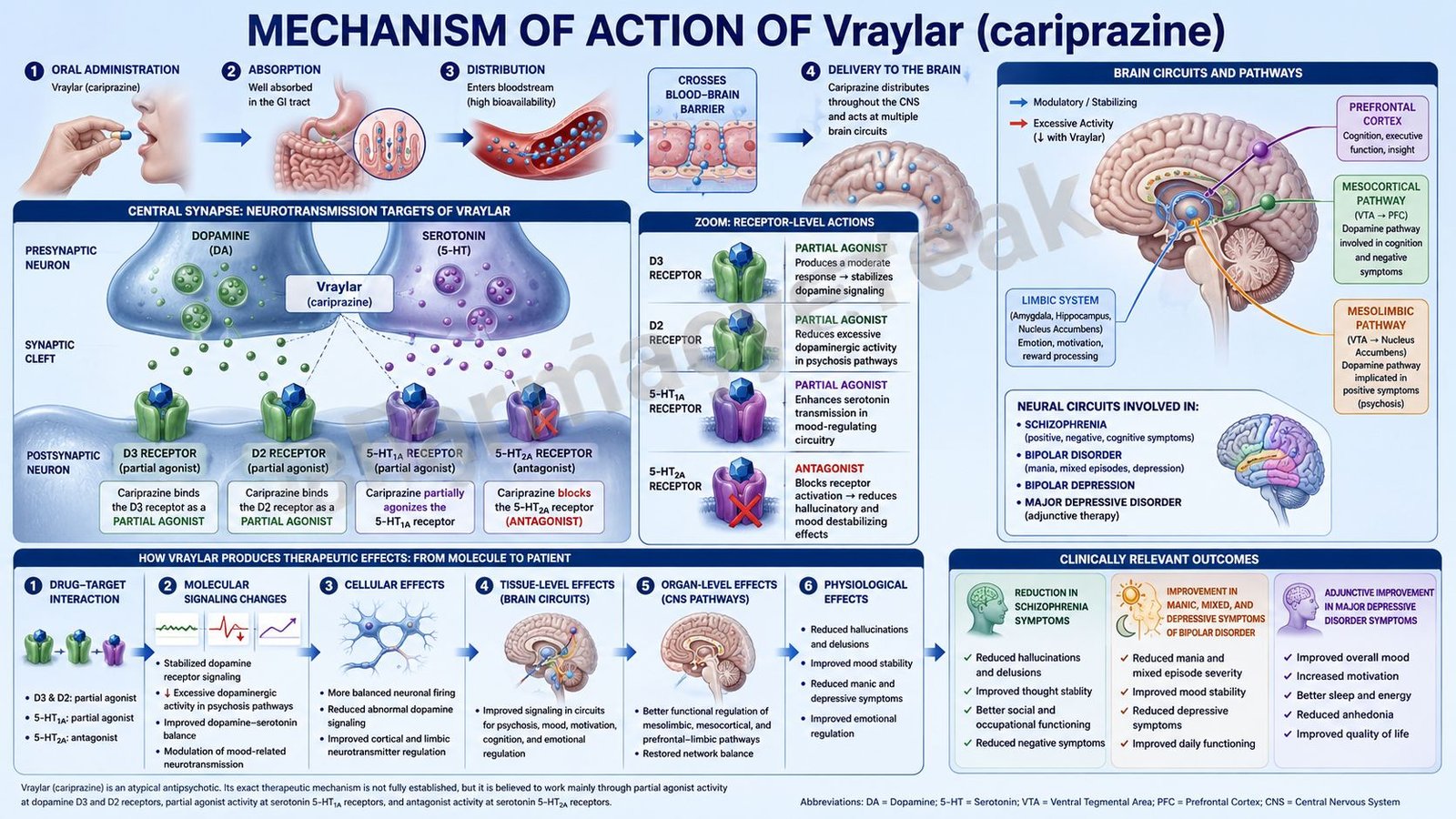
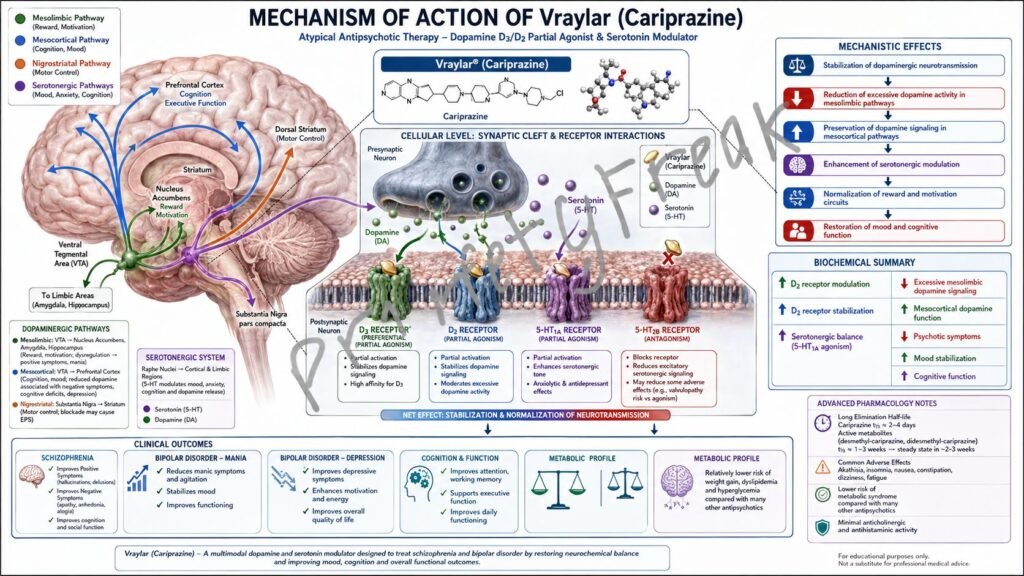
Vraylar is important in pharmacology because it acts differently from typical antipsychotics that mainly block dopamine D2 receptors strongly. Cariprazine is considered a dopamine-serotonin modulator with partial agonist activity at dopamine D3 and D2 receptors and serotonin 5-HT1A receptors, along with antagonist activity at serotonin 5-HT2A receptors. The exact mechanism of action is not fully known, but its efficacy is thought to be related to these dopamine and serotonin receptor effects.
For pharmacy, medical, nursing, and competitive exam students, Vraylar is important because it is commonly tested under atypical antipsychotics, dopamine partial agonists, and drugs used in schizophrenia and bipolar disorder. Its high affinity for dopamine D3 receptors makes it clinically interesting in mood, motivation, cognition, and reward-related pathways.
Vraylar is not a benzodiazepine, antidepressant, mood stabilizer like lithium, or typical dopamine blocker. It is an atypical antipsychotic with activity across dopamine and serotonin pathways involved in psychosis, mania, bipolar depression, and adjunctive treatment of major depressive disorder.
Mechanism of Action (Step-wise)
- Primary pharmacological action: Dopamine-serotonin receptor modulation
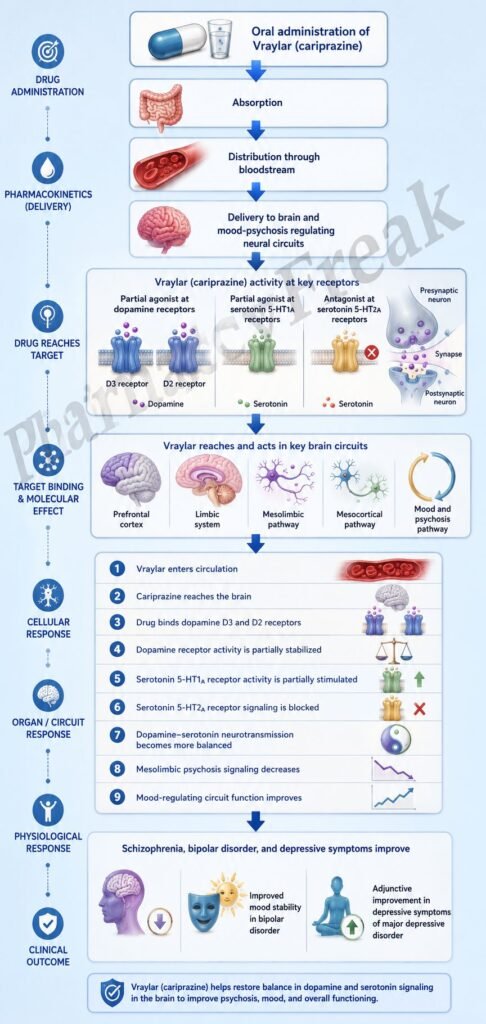
Vraylar contains cariprazine, an atypical antipsychotic that modulates dopamine and serotonin receptors. Its exact therapeutic mechanism is unknown, but its efficacy is thought to be mediated by partial agonist activity at central dopamine D2 receptors and serotonin 5-HT1A receptors, and antagonist activity at serotonin 5-HT2A receptors.
- Partial agonist activity at dopamine D3 receptors
Cariprazine has high binding affinity for dopamine D3 receptors. Dopamine D3 receptors are found in brain regions related to emotion, motivation, reward, cognition, and mood regulation.
Partial agonism means that cariprazine does not fully block the receptor like a pure antagonist. Instead, it stabilizes dopamine signaling by producing a moderate receptor response. In areas with excessive dopamine activity, it can reduce overstimulation. In areas with low dopamine activity, it may provide some receptor activation.
- Partial agonist activity at dopamine D2 receptors
Dopamine D2 receptors are strongly involved in schizophrenia and antipsychotic pharmacology. Excess dopaminergic activity in the mesolimbic pathway is associated with positive symptoms of schizophrenia, such as hallucinations and delusions.
By acting as a partial agonist at D2 receptors, Vraylar helps regulate dopaminergic activity rather than completely blocking dopamine transmission. This helps reduce psychotic symptoms while potentially lowering the risk of some adverse effects associated with strong D2 blockade, although extrapyramidal symptoms and akathisia can still occur.
- Effect on mesolimbic dopamine pathway
In the mesolimbic pathway, excessive dopamine activity contributes to psychosis, mania, agitation, and abnormal reward processing. Vraylar’s dopamine D2/D3 partial agonism helps dampen excessive dopaminergic signaling.
This contributes to improvement in hallucinations, delusions, manic symptoms, irritability, impulsivity, and disorganized behavior in suitable patients.
- Effect on mesocortical dopamine pathway
The mesocortical dopamine pathway is involved in cognition, motivation, emotional regulation, and negative symptoms of schizophrenia. Too little dopamine activity in this pathway may contribute to apathy, reduced motivation, poor social engagement, and cognitive symptoms.
Because cariprazine acts as a partial agonist rather than a pure antagonist, it may help stabilize dopamine signaling in cortical pathways. This is one reason D3/D2 partial agonists are clinically important in psychiatric pharmacology.
- Partial agonist activity at serotonin 5-HT1A receptors
Vraylar also has partial agonist activity at serotonin 5-HT1A receptors. These receptors are involved in mood regulation, anxiety control, emotional processing, and modulation of dopamine release in certain brain regions.
5-HT1A partial agonism may contribute to antidepressant and anxiolytic-like effects, especially in bipolar depression and adjunctive major depressive disorder therapy.
- Antagonist activity at serotonin 5-HT2A receptors
Cariprazine acts as an antagonist at serotonin 5-HT2A receptors. 5-HT2A receptor antagonism is a key feature of many atypical antipsychotics.
Blocking 5-HT2A receptors may increase dopamine release in the nigrostriatal and mesocortical pathways, which can help reduce extrapyramidal symptoms compared with typical antipsychotics and may support mood and cognitive effects.
- Neurotransmitter balance in mood and psychosis circuits
Through combined D3, D2, 5-HT1A, and 5-HT2A receptor effects, Vraylar modulates neurotransmission in brain circuits involved in schizophrenia, bipolar mania, bipolar depression, and major depressive disorder.
The goal is not complete dopamine suppression. The goal is dopamine-serotonin stabilization in pathways related to psychosis, mood, reward, motivation, cognition, and emotional regulation.
- Final therapeutic effect
The final therapeutic effect of Vraylar is reduction of psychotic symptoms, control of manic or mixed episodes, improvement of bipolar depressive symptoms, and additional antidepressant benefit when used with antidepressants in adults with major depressive disorder.
Pharmacokinetics
Vraylar is administered orally as cariprazine capsules. It is usually taken once daily, with or without food.
Absorption:
Cariprazine is absorbed after oral administration. Food does not produce a clinically significant effect on overall exposure, so Vraylar may be taken with or without food.
Distribution:
Cariprazine and its active metabolites are highly protein-bound and distribute into tissues, including the central nervous system, where they act on dopamine and serotonin receptors.
Metabolism:
Cariprazine is extensively metabolized in the liver. CYP3A4 is the major enzyme responsible for metabolism, while CYP2D6 plays a smaller role. This is clinically important because strong CYP3A4 inhibitors can increase exposure, while CYP3A4 inducers may reduce effectiveness.
Active metabolites:
Cariprazine has two major active metabolites: desmethyl cariprazine and didesmethyl cariprazine. These metabolites contribute significantly to clinical activity.
Excretion:
Cariprazine and its metabolites are eliminated mainly after hepatic metabolism. Excretion occurs through fecal and urinary routes, mostly as metabolites.
Half-life and duration:
Cariprazine has a long effective duration because of its active metabolites, especially didesmethyl cariprazine. The long half-life means dose changes may take several weeks to fully reflect in clinical response and adverse effects.
Special pharmacokinetic point:
Because of the long half-life and active metabolites, adverse reactions may appear or persist after dose changes. This is important in clinical monitoring, dose titration, and drug interaction management.
Clinical Uses
- Schizophrenia:
Vraylar is used for the treatment of schizophrenia in adults and pediatric patients 13 years and older. It helps reduce hallucinations, delusions, disorganized thinking, and other psychotic symptoms. - Acute manic or mixed episodes of bipolar I disorder:
Vraylar is used for acute manic or mixed episodes associated with bipolar I disorder in adults and pediatric patients 10 years and older. - Bipolar depression:
Vraylar is used in adults for depressive episodes associated with bipolar I disorder. - Adjunctive treatment of major depressive disorder:
Vraylar is used with antidepressants for the treatment of major depressive disorder in adults when additional therapy is needed. - Mood and psychosis stabilization:
Through dopamine-serotonin modulation, Vraylar helps stabilize pathways involved in psychosis, mood elevation, irritability, impulsivity, and depressive symptoms. - Alternative atypical antipsychotic option:
Vraylar may be considered when a dopamine partial agonist-type antipsychotic is clinically appropriate.
Adverse Effects
Common adverse effects of Vraylar include:
- Akathisia
- Extrapyramidal symptoms
- Restlessness
- Tremor
- Nausea
- Vomiting
- Dyspepsia
- Constipation
- Somnolence
- Insomnia
- Dizziness
- Fatigue
- Increased appetite
- Weight gain
- Anxiety or agitation
Important serious adverse effects include:
- Increased mortality in elderly patients with dementia-related psychosis
- Suicidal thoughts and behaviors in young patients when used with antidepressant therapy
- Neuroleptic malignant syndrome
- Tardive dyskinesia
- Metabolic changes, including hyperglycemia, dyslipidemia, and weight gain
- Leukopenia, neutropenia, and agranulocytosis
- Orthostatic hypotension and syncope
- Falls
- Seizures
- Cognitive and motor impairment
- Body temperature dysregulation
- Dysphagia
Akathisia is one of the most exam-important adverse effects of Vraylar. Patients may describe inner restlessness, inability to sit still, pacing, anxiety-like discomfort, or agitation.
Like other antipsychotics, Vraylar is not approved for elderly patients with dementia-related psychosis because antipsychotic drugs increase mortality risk in this population. It also carries warning concerns related to suicidal thoughts and behaviors when used as part of antidepressant treatment in susceptible age groups.
Because cariprazine has a long half-life and active metabolites, adverse effects may take time to appear and may persist after dose adjustment or discontinuation.
Comparative Analysis
| Feature | Vraylar | Aripiprazole | Risperidone | Quetiapine |
|---|---|---|---|---|
| Generic name | Cariprazine | Aripiprazole | Risperidone | Quetiapine |
| Drug class | Atypical antipsychotic | Atypical antipsychotic | Atypical antipsychotic | Atypical antipsychotic |
| Main dopamine action | D3/D2 partial agonist | D2 partial agonist | D2 antagonist | D2 antagonist |
| Serotonin action | 5-HT1A partial agonist, 5-HT2A antagonist | 5-HT1A partial agonist, 5-HT2A antagonist | 5-HT2A antagonist | 5-HT2A antagonist |
| Important receptor feature | High D3 affinity | D2 partial agonism | Stronger D2 blockade | Strong H1-related sedation |
| Main uses | Schizophrenia, bipolar I disorder, adjunctive MDD | Schizophrenia, bipolar disorder, adjunctive MDD | Schizophrenia, bipolar disorder | Schizophrenia, bipolar disorder, depression-related uses |
| Sedation tendency | Usually moderate/variable | Usually lower | Moderate | Higher |
| Prolactin risk | Usually lower than strong D2 blockers | Usually low | Higher | Usually low |
| Common concern | Akathisia, EPS, insomnia | Akathisia, insomnia | Prolactin elevation, EPS | Sedation, metabolic effects |
Vraylar and aripiprazole are both dopamine partial agonist antipsychotics, but Vraylar has notable dopamine D3 receptor affinity. Risperidone is different because it acts more as a dopamine D2 antagonist and is more likely to increase prolactin. Quetiapine is generally more sedating because of stronger histamine H1 receptor-related effects.
MCQs
- Vraylar contains which active drug?
a) Aripiprazole
b) Cariprazine
c) Risperidone
d) Quetiapine
Answer: b) Cariprazine
- Vraylar belongs to which drug class?
a) Typical antipsychotic
b) Atypical antipsychotic
c) Benzodiazepine
d) SSRI
Answer: b) Atypical antipsychotic
- The main dopamine receptor action of Vraylar is:
a) D3/D2 partial agonism
b) Complete dopamine depletion
c) Dopamine synthesis inhibition
d) Dopamine transporter destruction
Answer: a) D3/D2 partial agonism
- Vraylar has high affinity for which dopamine receptor subtype?
a) D3 receptor
b) D5 receptor only
c) D1 receptor only
d) D4 receptor only
Answer: a) D3 receptor
- Vraylar acts as a partial agonist at which serotonin receptor?
a) 5-HT1A receptor
b) 5-HT3 receptor
c) 5-HT7 receptor only
d) 5-HT4 receptor only
Answer: a) 5-HT1A receptor
- Vraylar acts as an antagonist at which serotonin receptor?
a) 5-HT2A receptor
b) 5-HT1A receptor only
c) 5-HT4 receptor
d) 5-HT6 receptor only
Answer: a) 5-HT2A receptor
- Vraylar is used in schizophrenia mainly to improve:
a) Psychotic symptoms
b) Bacterial infection
c) Blood glucose only
d) Acute bronchospasm
Answer: a) Psychotic symptoms
- Vraylar may be used in bipolar I disorder for:
a) Manic, mixed, and depressive episodes
b) Only bacterial complications
c) Only hypertension
d) Only seizure prevention
Answer: a) Manic, mixed, and depressive episodes
- Vraylar is used in major depressive disorder as:
a) Adjunctive therapy with antidepressants
b) First-line antibiotic therapy
c) Insulin replacement
d) A rescue sedative only
Answer: a) Adjunctive therapy with antidepressants
- Which adverse effect is commonly associated with Vraylar?
a) Akathisia
b) Ototoxicity
c) Severe hypoglycemia
d) Gingival hyperplasia
Answer: a) Akathisia
- The main enzyme involved in cariprazine metabolism is:
a) CYP3A4
b) Acetylcholinesterase
c) Monoamine oxidase-B only
d) Xanthine oxidase
Answer: a) CYP3A4
- Which active metabolite contributes to Vraylar’s long duration?
a) Didesmethyl cariprazine
b) Morphine glucuronide
c) Norfluoxetine only
d) Salicylic acid
Answer: a) Didesmethyl cariprazine
- Vraylar is not approved for:
a) Dementia-related psychosis in elderly patients
b) Schizophrenia
c) Bipolar I mania
d) Bipolar depression in adults
Answer: a) Dementia-related psychosis in elderly patients
- Compared with risperidone, Vraylar generally has:
a) Dopamine partial agonist activity
b) No dopamine receptor activity
c) Direct antibiotic activity
d) Pure muscarinic agonist action
Answer: a) Dopamine partial agonist activity
- Which statement about Vraylar is correct?
a) It modulates dopamine and serotonin receptors through D3/D2 partial agonism, 5-HT1A partial agonism, and 5-HT2A antagonism
b) It is a beta-lactam antibiotic
c) It is an insulin analog
d) It directly blocks bacterial folate synthesis
Answer: a) It modulates dopamine and serotonin receptors through D3/D2 partial agonism, 5-HT1A partial agonism, and 5-HT2A antagonism
FAQs
- What is Vraylar used for?
Vraylar is used for schizophrenia, acute manic or mixed episodes associated with bipolar I disorder, depressive episodes associated with bipolar I disorder, and adjunctive treatment of major depressive disorder in adults.
- What is the mechanism of action of Vraylar?
The exact mechanism is not fully known. Vraylar acts mainly as a partial agonist at dopamine D3 and D2 receptors and serotonin 5-HT1A receptors, and as an antagonist at serotonin 5-HT2A receptors.
- Is Vraylar a typical or atypical antipsychotic?
Vraylar is an atypical antipsychotic. It has dopamine-serotonin receptor modulation rather than simple strong dopamine D2 blockade alone.
- Is Vraylar a dopamine blocker?
Vraylar is not just a dopamine blocker. It is a dopamine D3/D2 partial agonist, meaning it stabilizes dopamine signaling instead of fully blocking dopamine receptors in all brain pathways.
- Why is dopamine D3 receptor activity important?
Dopamine D3 receptors are involved in reward, motivation, cognition, and mood-related pathways. Vraylar’s high affinity for D3 receptors may contribute to its effects in mood and psychosis circuits.
- Can Vraylar cause akathisia?
Yes. Akathisia is a common and clinically important adverse effect. Patients may feel restless, unable to sit still, or internally agitated.
- Why do Vraylar dose changes take time to show full effect?
Vraylar has active metabolites with long half-lives, especially didesmethyl cariprazine. Because of this, changes in dose may take several weeks to fully affect blood levels, response, and adverse effects.
- Is Vraylar used for major depressive disorder alone?
Vraylar is used as adjunctive therapy with antidepressants for major depressive disorder in adults. It is not used as a stand-alone first-line antidepressant in this indication.
- Which enzyme metabolizes Vraylar?
Cariprazine is mainly metabolized by CYP3A4, with a minor contribution from CYP2D6. Drug interactions with CYP3A4 inhibitors or inducers are clinically important.
References
Goodman & Gilman’s The Pharmacological Basis of Therapeutics
Katzung Basic & Clinical Pharmacology