Table of Contents
Introduction
Defibrotide is an intravenous drug marketed under the brand name Defitelio. Pharmacologically, defibrotide sodium is an oligonucleotide mixture with profibrinolytic, endothelial-protective, and antithrombotic-regulating properties.
Defitelio is indicated for the treatment of adult and pediatric patients with hepatic veno-occlusive disease, also called VOD or sinusoidal obstruction syndrome, with renal or pulmonary dysfunction after hematopoietic stem-cell transplantation.
Hepatic VOD/SOS is a serious post-transplant complication. It begins with injury to hepatic sinusoidal endothelial cells. Damaged endothelial cells become swollen and activated, sinusoidal blood flow becomes obstructed, and the liver develops congestion, hepatomegaly, weight gain, ascites, jaundice, and multi-organ dysfunction in severe cases.
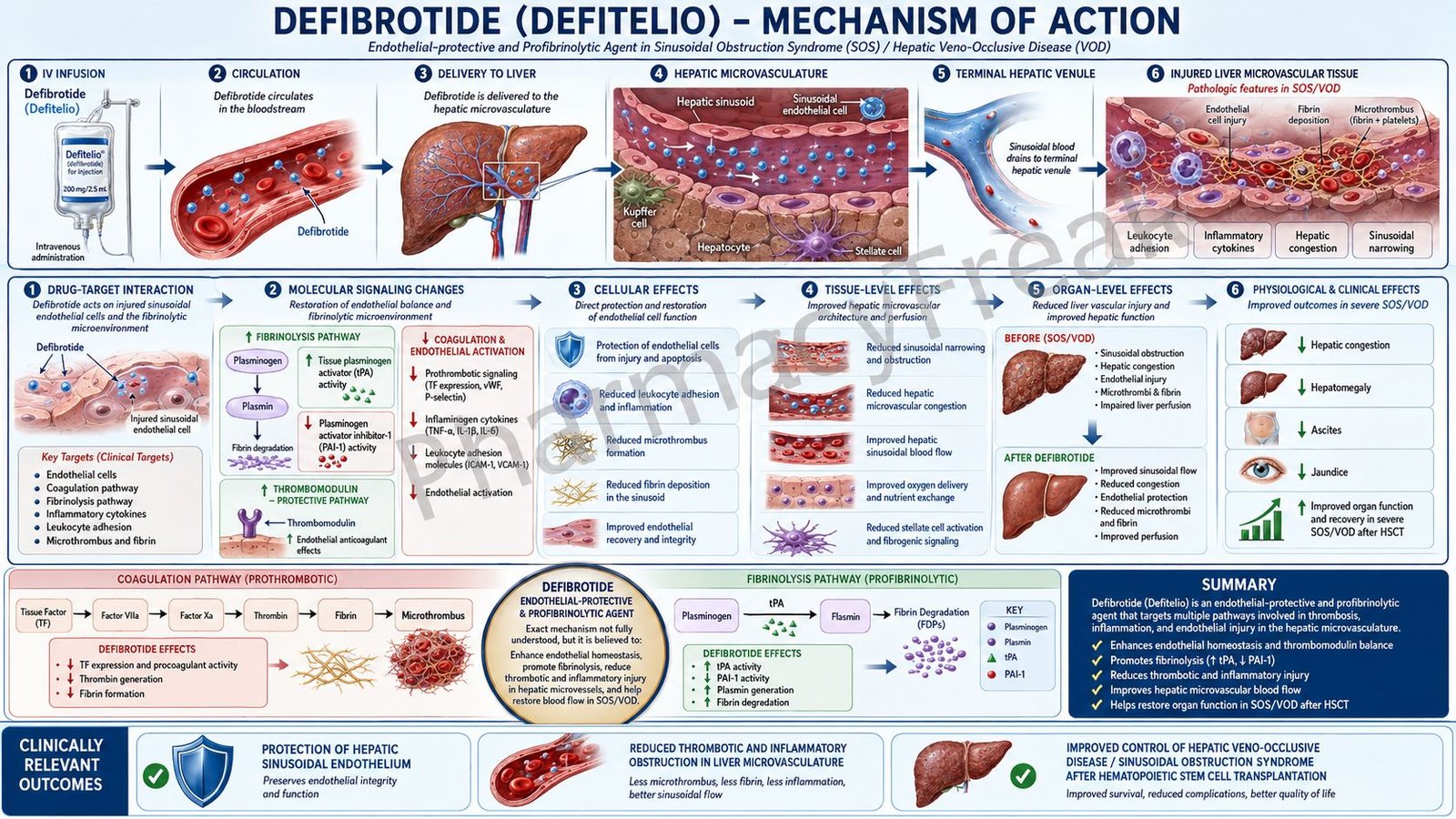
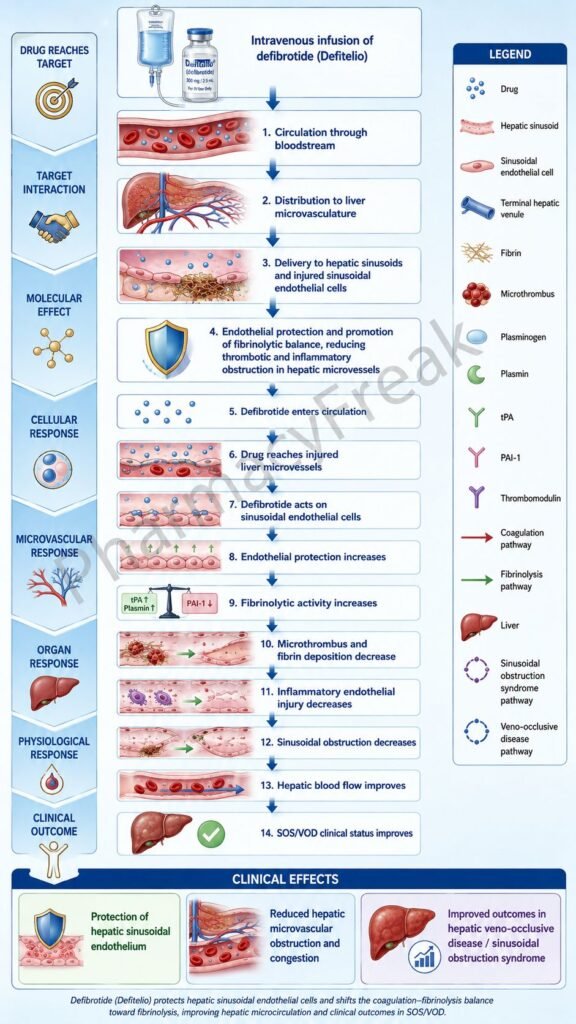
The exact mechanism of action of defibrotide sodium has not been fully elucidated. The label describes several important in vitro effects: defibrotide enhances plasmin activity to hydrolyze fibrin clots, increases tissue plasminogen activator and thrombomodulin expression, decreases von Willebrand factor and PAI-1 expression, reduces endothelial-cell activation, increases endothelial-mediated fibrinolysis, and protects endothelial cells from injury caused by chemotherapy, TNF-alpha, serum starvation, and perfusion.
For exam purposes, defibrotide should be remembered as an endothelial-protective and profibrinolytic drug used for severe post-HSCT hepatic VOD/SOS with renal or pulmonary dysfunction. It helps restore a healthier endothelial-thrombotic balance rather than acting as a standard anticoagulant.
Mechanism of Action (Step-wise)
Step 1: HSCT conditioning injures hepatic sinusoidal endothelium
Before hematopoietic stem-cell transplantation, patients receive chemotherapy and/or radiation-based conditioning. These treatments can injure hepatic sinusoidal endothelial cells. Once damaged, the endothelium becomes pro-inflammatory, procoagulant, and less able to maintain normal microvascular blood flow.
Step 2: Endothelial injury triggers VOD/SOS
In hepatic VOD/SOS, damaged endothelial cells and sinusoidal obstruction impair hepatic microcirculation. Blood flow through the liver becomes congested, causing hepatomegaly, ascites, bilirubin elevation, fluid retention, and sometimes renal or pulmonary dysfunction.
Step 3: The coagulation-fibrinolysis balance shifts toward obstruction
Endothelial activation promotes clot formation and reduces normal fibrinolysis. Fibrin deposition and microvascular obstruction worsen sinusoidal blood flow and contribute to liver dysfunction.
Step 4: Defibrotide acts on endothelial-cell biology
Defibrotide’s pharmacological effects were studied mainly in human microvascular endothelial cells. This fits the disease process because VOD/SOS begins with endothelial injury and sinusoidal microvascular dysfunction.
Step 5: Defibrotide enhances plasmin activity
In vitro, defibrotide sodium enhances the enzymatic activity of plasmin to hydrolyze fibrin clots. Plasmin is the main enzyme responsible for breaking down fibrin.
Step 6: Fibrin breakdown may improve microvascular flow
By supporting fibrin breakdown, defibrotide may help reduce microvascular fibrin burden in the damaged hepatic sinusoidal circulation. This is one reason it is described as having profibrinolytic properties.
Step 7: Defibrotide increases tissue plasminogen activator expression
Defibrotide increases expression of tissue plasminogen activator, or t-PA, in vitro. t-PA converts plasminogen into plasmin, supporting fibrinolysis.
Step 8: Defibrotide decreases PAI-1 expression
Defibrotide decreases plasminogen activator inhibitor-1, or PAI-1, expression in vitro. PAI-1 normally inhibits t-PA, so lowering PAI-1 can favor fibrinolysis.
Step 9: Endothelial-mediated fibrinolysis increases
By increasing t-PA and reducing PAI-1, defibrotide shifts endothelial-cell activity toward fibrin breakdown. The label describes this as increasing endothelial-cell-mediated fibrinolysis.
Step 10: Defibrotide increases thrombomodulin expression
Defibrotide increases thrombomodulin expression in vitro. Thrombomodulin is an endothelial surface protein involved in anticoagulant regulation, especially through the protein C pathway.
Step 11: Defibrotide decreases von Willebrand factor expression
Defibrotide decreases von Willebrand factor, or vWF, expression in vitro. vWF supports platelet adhesion, so reduced vWF expression may help reduce endothelial activation and platelet-driven microvascular thrombosis.
Step 12: Endothelial activation decreases
The combined effects on t-PA, PAI-1, thrombomodulin, and vWF reduce endothelial-cell activation. This is central to defibrotide’s proposed benefit in VOD/SOS.
Step 13: Defibrotide protects endothelial cells from injury
In vitro, defibrotide protected endothelial cells from damage caused by chemotherapy, TNF-alpha, serum starvation, and perfusion. This endothelial protection is clinically relevant because VOD/SOS is driven by endothelial injury after HSCT.
Step 14: Sinusoidal microcirculation may improve
As endothelial activation and fibrin-related obstruction decrease, hepatic sinusoidal microcirculation may improve. Better sinusoidal flow may help reduce liver congestion and support recovery from VOD/SOS.
Step 15: Final therapeutic outcome
The final therapeutic effect of defibrotide is improved endothelial and fibrinolytic balance in hepatic VOD/SOS after HSCT. It does not work by replacing a missing clotting factor or directly suppressing the immune system. Its main role is to protect activated endothelium and support fibrinolysis in the damaged hepatic microvasculature.
Pharmacokinetics
Defitelio is administered by intravenous infusion. The recommended dosage for adult and pediatric patients is 6.25 mg/kg every 6 hours, given as a 2-hour intravenous infusion. The dose is based on the patient’s baseline body weight before the preparative regimen for HSCT.
Treatment should continue for a minimum of 21 days. If signs and symptoms of hepatic VOD have not resolved after 21 days, treatment may continue until VOD resolution or up to a maximum of 60 days.
Before administration, the patient should not have clinically significant bleeding and should be hemodynamically stable on no more than one vasopressor. Defitelio must be diluted before infusion and administered over 2 hours using an infusion set with a 0.2-micron in-line filter. It should not be co-administered with other intravenous drugs in the same line.
Defitelio is supplied as a 200 mg/2.5 mL vial, equal to 80 mg/mL. The solution is sterile, preservative-free, and intended for intravenous use.
After intravenous administration, peak plasma concentrations occur approximately at the end of each infusion. Defibrotide sodium is highly bound to human plasma proteins, with average binding of about 93%, and its volume of distribution is about 8.1 to 9.1 L.
Metabolism followed by urinary excretion is likely the main elimination route. The estimated total clearance is 3.4 to 6.1 L/hour, and the elimination half-life is less than 2 hours. Similar plasma concentration profiles were seen after initial and multiple dosing, so accumulation is not expected with repeated dosing.
The precise in vivo degradation pathway is not fully known. Polynucleotides are thought to be progressively metabolized by enzymes such as nucleases, nucleotidases, nucleosidases, deaminases, and phosphorylases into oligonucleotides, nucleotides, nucleosides, sugars, and nucleic acid bases.
Defibrotide does not undergo appreciable metabolism by human hepatocyte cells in vitro. Pharmacokinetic drug interactions are unlikely at therapeutic doses because defibrotide does not meaningfully induce or inhibit major CYP enzymes, UGT enzymes, or major uptake and efflux transporters tested in vitro.
In severe renal impairment or end-stage renal disease, defibrotide exposure was higher than in matched healthy subjects, but defibrotide was not removed by hemodialysis and repeated dosing did not produce accumulation.
Clinical Uses
Defibrotide is used for hepatic veno-occlusive disease, also called sinusoidal obstruction syndrome, in adult and pediatric patients after hematopoietic stem-cell transplantation when renal or pulmonary dysfunction is present.
The drug is not used for ordinary venous thromboembolism, deep vein thrombosis, pulmonary embolism, atrial fibrillation anticoagulation, ischemic stroke prevention, or routine liver disease. Its labeled role is specific: post-HSCT hepatic VOD/SOS with renal or pulmonary dysfunction.
Defibrotide is not a conventional anticoagulant like heparin, warfarin, apixaban, or rivaroxaban. It also is not a thrombolytic drug like alteplase. Although it has profibrinolytic effects, it is used in a specific endothelial-injury syndrome rather than as a general clot-dissolving agent.
In clinical studies, Defitelio was evaluated in adult and pediatric patients with hepatic VOD and multi-organ dysfunction after HSCT. The efficacy evaluation included Day +100 survival after transplantation.
Adverse Effects
The most important safety concern with defibrotide is bleeding. Defitelio increased the activity of fibrinolytic enzymes in vitro and may increase bleeding risk in patients with VOD after HSCT. It should not be started in patients with active bleeding, and patients should be monitored for bleeding during therapy.
If bleeding occurs, Defitelio should be withheld or discontinued depending on severity. For persistent, severe, or potentially life-threatening bleeding, treatment should be withheld, the cause should be treated, and supportive care should be given. For recurrent significant bleeding, Defitelio should be permanently discontinued.
There is no known reversal agent for the profibrinolytic effects of Defitelio. Before an invasive procedure, Defitelio should be discontinued at least 2 hours before the procedure and resumed only after procedure-related bleeding risk has resolved.
Defitelio is contraindicated with systemic anticoagulant or fibrinolytic therapy. Antithrombotic or fibrinolytic drugs such as heparin or alteplase may have enhanced pharmacodynamic activity when combined with Defitelio, increasing hemorrhage risk.
Defitelio is also contraindicated in patients with known hypersensitivity to defibrotide or any excipient. Hypersensitivity reactions reported with Defitelio include rash, urticaria, angioedema, and one anaphylactic reaction in a patient who had previously received defibrotide. Severe or life-threatening hypersensitivity requires permanent discontinuation.
The most common adverse reactions reported with Defitelio were hypotension, diarrhea, vomiting, nausea, and epistaxis. Serious adverse reactions included hypotension and pulmonary alveolar hemorrhage. Hemorrhage events of any type were reported in 59% of patients in the safety population, with grade 4–5 hemorrhage events in 20%.
Pregnancy is a concern. There are no available data on Defitelio use in pregnant women, and animal data showed decreased implantations and viable fetuses at doses comparable to the recommended human dose by body surface area. The label advises pregnant women about the potential risk of miscarriage. Breastfeeding is not recommended during treatment because of the potential for serious adverse reactions, including bleeding, in a breastfed infant.
Comparative Analysis
Defibrotide is commonly compared with heparin, alteplase, ursodiol, supportive care, corticosteroids, anticoagulants, and fresh frozen plasma, but its clinical role is distinct.
Compared with heparin, defibrotide is not used as a standard anticoagulant. Heparin enhances antithrombin activity and inhibits thrombin and Factor Xa. Defibrotide mainly acts through endothelial protection and profibrinolytic modulation in VOD/SOS.
Compared with alteplase, defibrotide is not a standard thrombolytic used for acute ischemic stroke, pulmonary embolism, or catheter-directed clot lysis. Alteplase directly converts plasminogen to plasmin. Defibrotide has in vitro profibrinolytic effects but is used for hepatic VOD/SOS after HSCT.
Compared with ursodiol, defibrotide has a different role. Ursodiol is used in some transplant settings to reduce cholestasis-related complications, while defibrotide treats established hepatic VOD/SOS with renal or pulmonary dysfunction.
Compared with corticosteroids, defibrotide is not a broad anti-inflammatory immunosuppressant. Corticosteroids suppress inflammatory gene expression widely. Defibrotide works more specifically through endothelial protection and fibrinolytic balance.
Compared with fresh frozen plasma, defibrotide is not a clotting factor replacement product. Plasma replaces multiple coagulation factors, while defibrotide modulates endothelial-cell activation and fibrinolysis.
Compared with direct oral anticoagulants, defibrotide has a different purpose and safety concern. DOACs are used to prevent or treat thrombosis. Defibrotide is used in post-HSCT VOD/SOS and is contraindicated with systemic anticoagulant or fibrinolytic therapy because of bleeding risk.
MCQs
- Defibrotide is marketed under which brand name?
a) Kcentra
b) Defitelio
c) Opdivo
d) Kevzara
Answer: b) Defitelio
- Defibrotide is indicated for hepatic VOD/SOS following:
a) Hematopoietic stem-cell transplantation
b) Acute myocardial infarction
c) Routine appendectomy
d) Chronic hypertension
Answer: a) Hematopoietic stem-cell transplantation
- The labeled indication requires VOD/SOS with:
a) Renal or pulmonary dysfunction
b) Only mild headache
c) Isolated skin rash
d) Simple nausea without organ dysfunction
Answer: a) Renal or pulmonary dysfunction
- The exact mechanism of defibrotide sodium is:
a) Fully explained by beta-blockade
b) Not fully elucidated
c) Only direct thrombin inhibition
d) Only Factor Xa inhibition
Answer: b) Not fully elucidated
- In vitro, defibrotide enhances the enzymatic activity of:
a) Plasmin
b) Acetylcholinesterase
c) DPP-4
d) HMG-CoA reductase
Answer: a) Plasmin
- Defibrotide increases expression of:
a) Tissue plasminogen activator and thrombomodulin
b) Dopamine D2 receptor and beta-1 receptor
c) COX-1 and COX-2 only
d) EGFR and HER2 only
Answer: a) Tissue plasminogen activator and thrombomodulin
- Defibrotide decreases expression of:
a) von Willebrand factor and PAI-1
b) Hemoglobin and albumin
c) Insulin and glucagon
d) Sodium and potassium channels
Answer: a) von Willebrand factor and PAI-1
- Defibrotide’s proposed benefit in VOD/SOS is mainly related to:
a) Endothelial protection and enhanced fibrinolytic balance
b) Gastric acid suppression
c) Dopamine replacement
d) Prostate relaxation
Answer: a) Endothelial protection and enhanced fibrinolytic balance
- The recommended Defitelio dose is:
a) 6.25 mg/kg every 6 hours as a 2-hour IV infusion
b) 10 mg orally once daily
c) 100 mg subcutaneously once monthly
d) 40 mg orally twice daily
Answer: a) 6.25 mg/kg every 6 hours as a 2-hour IV infusion
- Minimum recommended treatment duration is:
a) 21 days
b) 2 days
c) 5 hours
d) 6 months fixed for everyone
Answer: a) 21 days
- Defitelio is contraindicated with:
a) Systemic anticoagulant or fibrinolytic therapy
b) Oral vitamins only
c) Normal saline only
d) Paracetamol only
Answer: a) Systemic anticoagulant or fibrinolytic therapy
- The most important adverse risk with defibrotide is:
a) Hemorrhage
b) Severe hypoglycemia in every patient
c) Ototoxicity
d) Thyroid C-cell tumor
Answer: a) Hemorrhage
- Which hypersensitivity reaction has been reported with defibrotide?
a) Angioedema
b) Mandatory anaphylaxis in every patient
c) Stevens-Johnson syndrome as the main boxed warning
d) Permanent skin pigmentation only
Answer: a) Angioedema
- Common adverse reactions of Defitelio include:
a) Hypotension, diarrhea, vomiting, nausea, and epistaxis
b) Severe hyperkalemia only
c) Permanent alopecia only
d) Bradycardia and bronchospasm only
Answer: a) Hypotension, diarrhea, vomiting, nausea, and epistaxis
- Which statement best describes defibrotide?
a) It is an endothelial-protective, profibrinolytic drug used for post-HSCT hepatic VOD/SOS with renal or pulmonary dysfunction
b) It is a direct oral Factor Xa inhibitor
c) It is a monoclonal antibody against PD-1
d) It is a beta-3 agonist for overactive bladder
Answer: a) It is an endothelial-protective, profibrinolytic drug used for post-HSCT hepatic VOD/SOS with renal or pulmonary dysfunction
FAQs
What is the mechanism of action of defibrotide?
The exact mechanism is not fully elucidated. Defibrotide has endothelial-protective and profibrinolytic effects. In vitro, it enhances plasmin activity, increases t-PA and thrombomodulin expression, decreases vWF and PAI-1 expression, reduces endothelial-cell activation, increases endothelial-mediated fibrinolysis, and protects endothelial cells from injury.
What is the brand name of defibrotide?
The brand name of defibrotide is Defitelio.
What is defibrotide used for?
Defibrotide is used for adult and pediatric patients with hepatic veno-occlusive disease, also called sinusoidal obstruction syndrome, with renal or pulmonary dysfunction after hematopoietic stem-cell transplantation.
Is defibrotide an anticoagulant?
Defibrotide is not used like a standard anticoagulant. It has profibrinolytic and endothelial-protective properties, but it is specifically used for post-HSCT hepatic VOD/SOS. It is contraindicated with systemic anticoagulant or fibrinolytic therapy because of bleeding risk.
Why can defibrotide cause bleeding?
Defibrotide can increase fibrinolytic activity and may increase bleeding risk. Patients should be monitored closely, and treatment should be withheld or discontinued if significant bleeding occurs.
How is Defitelio administered?
Defitelio is given as an intravenous infusion. The recommended dose is 6.25 mg/kg every 6 hours, infused over 2 hours.
How long is defibrotide treatment given?
Treatment is given for at least 21 days. If VOD/SOS symptoms have not resolved after 21 days, treatment may continue until resolution or up to a maximum of 60 days.
What are common adverse effects of defibrotide?
Common adverse reactions include hypotension, diarrhea, vomiting, nausea, and epistaxis. Important serious risks include hemorrhage and hypersensitivity reactions.
References
Goodman & Gilman’s The Pharmacological Basis of Therapeutics
Katzung Basic & Clinical Pharmacology