Table of Contents
Introduction
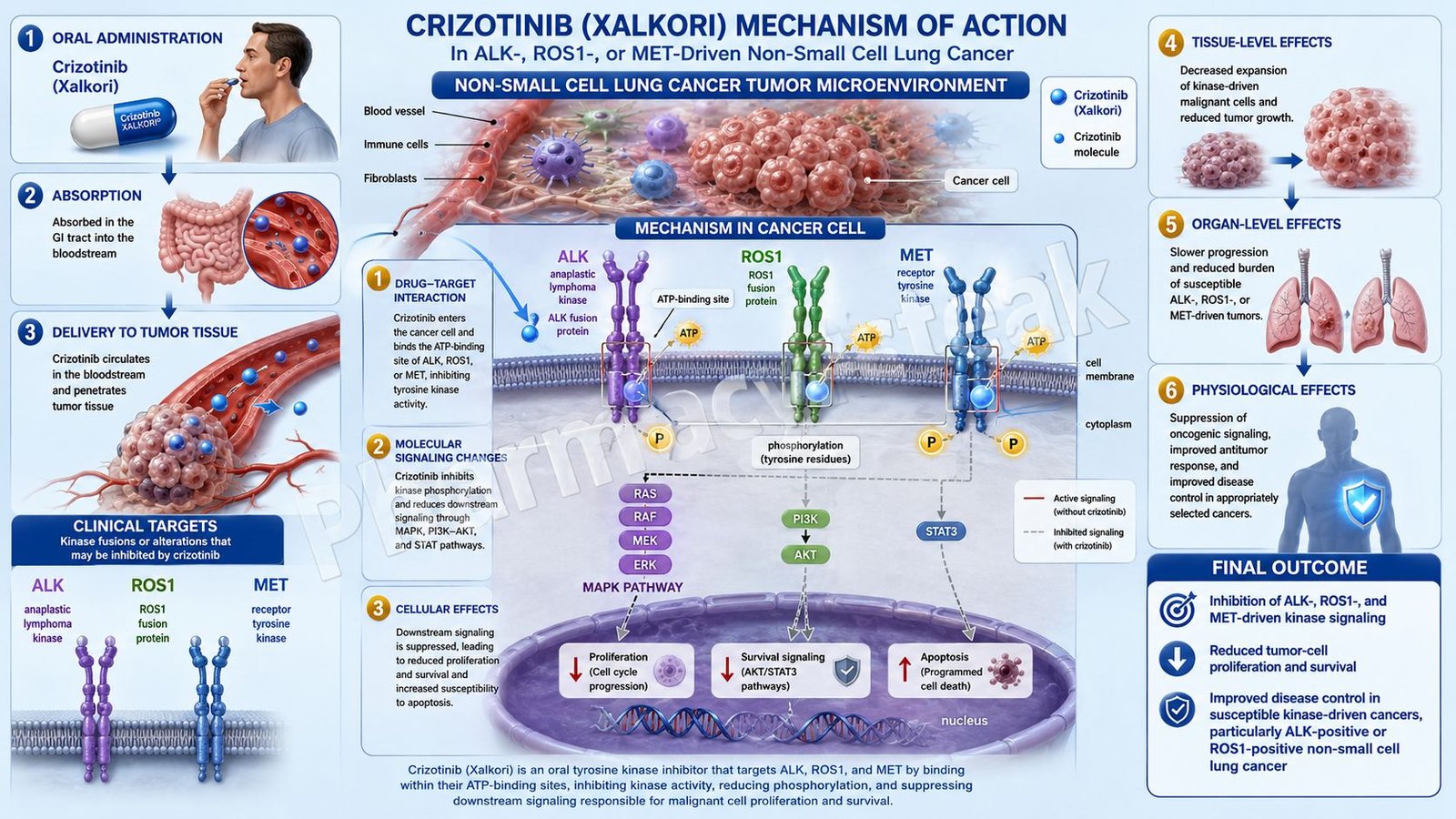
Crizotinib is an oral targeted anticancer drug marketed under the brand name Xalkori. It belongs to the receptor tyrosine kinase inhibitor (TKI) class.
Its major molecular targets are ALK (anaplastic lymphoma kinase), ROS1, and MET (c-Met/HGFR). The current Xalkori prescribing information also identifies RON (Recepteur d’Origine Nantais) among the receptor tyrosine kinases inhibited by crizotinib.
Crizotinib is particularly important in cancers driven by abnormal ALK or ROS1 signaling. Genetic rearrangements can create oncogenic fusion proteins that keep these kinases abnormally active. The result is persistent signaling for tumor-cell proliferation and survival.
Crizotinib suppresses this signaling by inhibiting kinase activity. In cellular studies, it produces concentration-dependent inhibition of ALK, ROS1, and c-Met phosphorylation, reducing oncogenic signaling and tumor-cell growth.
For quick revision:
Crizotinib → ALK + ROS1 + MET inhibition → ↓ kinase phosphorylation → ↓ oncogenic growth and survival signaling → ↓ proliferation + ↑ apoptosis → antitumor effect.
Mechanism of Action (Step-wise)
Step 1: Oncogenic kinase alterations develop
Certain tumors contain genetic alterations involving receptor tyrosine kinases such as ALK or ROS1.
ALK translocations can produce abnormal fusion proteins. A classic example is the EML4-ALK fusion protein found in a subset of non-small cell lung cancers.
Step 2: ALK fusion proteins become oncogenic drivers
The abnormal ALK fusion protein has dysregulated kinase activity.
Instead of responding normally to controlled cellular signals, the kinase remains active and promotes pathways involved in tumor-cell proliferation and survival.
Step 3: ROS1 rearrangements can produce similar signaling
ROS1 rearrangements can also create oncogenic fusion proteins with constitutive tyrosine kinase activity.
These abnormal proteins can become the primary molecular driver of tumor growth.
Step 4: MET can promote tumor growth and survival
MET, also called hepatocyte growth factor receptor or c-Met, is another receptor tyrosine kinase inhibited by crizotinib.
Abnormal MET signaling can support cellular proliferation, survival, migration, and invasive behavior.
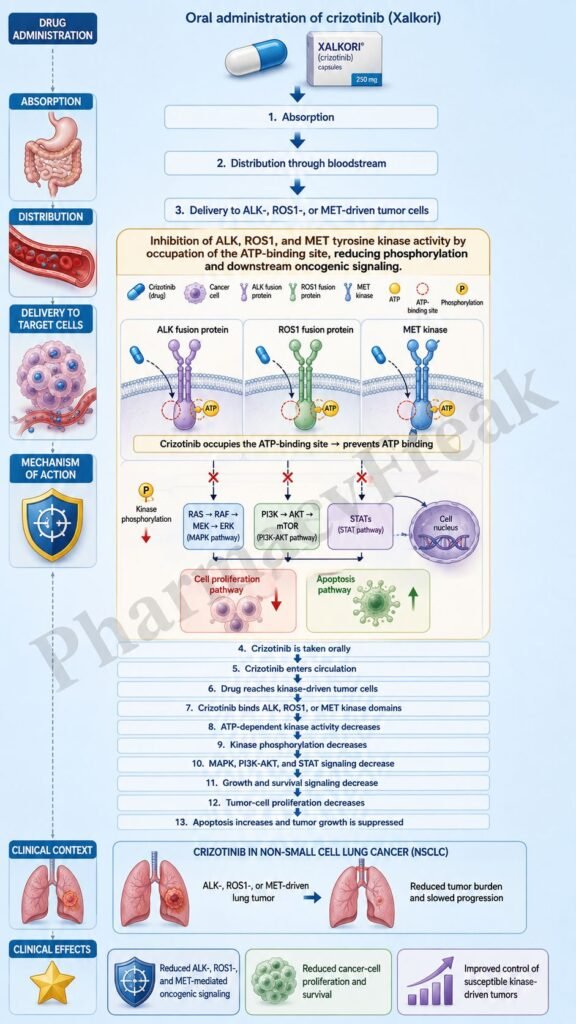
Step 5: Crizotinib reaches tumor cells
After oral administration and absorption, crizotinib reaches systemic circulation and distributes into tissues.
As a small-molecule kinase inhibitor, it can access intracellular kinase domains.
Step 6: Crizotinib inhibits ALK kinase activity
Crizotinib suppresses ALK phosphorylation and ALK-mediated signaling.
The FDA prescribing information reports concentration-dependent inhibition of ALK phosphorylation in tumor-cell assays.
Step 7: Crizotinib inhibits ROS1
Crizotinib also produces concentration-dependent inhibition of ROS1 phosphorylation.
In ROS1-driven tumor cells, this interrupts the abnormal signaling required for continued proliferation and survival.
Step 8: Crizotinib inhibits MET
Crizotinib inhibits phosphorylation of c-Met/HGFR.
This adds MET inhibition to its broader antitumor kinase profile.
Step 9: RON is another kinase target
Crizotinib also inhibits the receptor tyrosine kinase RON according to the prescribing information.
Step 10: Downstream oncogenic signaling falls
Blocking the driver kinase reduces intracellular signals responsible for maintaining malignant-cell growth and survival.
Important pathways downstream of oncogenic receptor tyrosine kinases can include:
RAS → RAF → MEK → ERK
PI3K → AKT → mTOR
JAK → STAT
The precise contribution of each pathway varies with the tumor and molecular alteration.
Step 11: Tumor-cell proliferation decreases
Without sustained oncogenic kinase signaling, susceptible tumor cells receive fewer proliferative signals.
Cell growth and proliferation therefore decline.
Step 12: Survival signaling decreases
Loss of ALK- or ROS1-dependent signaling also removes survival signals on which kinase-driven cancer cells may depend.
Step 13: Apoptosis increases
In ALK-positive ALCL-derived cell lines containing NPM-ALK, crizotinib induced apoptosis and inhibited proliferation and ALK-mediated signaling at clinically achievable exposures.
Step 14: Tumor growth is suppressed
Crizotinib demonstrated antitumor activity in experimental tumor models expressing EML4-ALK, NPM-ALK, or c-Met.
Step 15: Final therapeutic effect
The final result is suppression of kinase-dependent tumor growth.
ALK/ROS1 oncogenic signaling → crizotinib → kinase inhibition → reduced phosphorylation → reduced proliferation and survival → increased apoptosis → antitumor activity.
Pharmacokinetics
Crizotinib is administered orally. For adults with ALK- or ROS1-positive metastatic NSCLC, the labeled dose is 250 mg orally twice daily, with or without food, until disease progression or unacceptable toxicity.
After a single capsule dose, median time to maximum plasma concentration is approximately 4–6 hours. Mean absolute oral bioavailability is about 43%.
Steady state is reached within approximately 15 days with 250 mg twice-daily dosing. The median accumulation ratio is approximately 4.8.
Crizotinib is about 91% protein bound in vitro. Its apparent volume of distribution is large, approximately 1772 L following a single intravenous dose, indicating extensive tissue distribution.
The mean apparent terminal half-life following a single dose is approximately 42 hours.
Crizotinib is predominantly metabolized by CYP3A. Strong CYP3A inhibitors can increase crizotinib concentrations, while strong CYP3A inducers can markedly decrease exposure and potentially reduce efficacy.
Following a radiolabeled oral dose, approximately 63% was recovered in feces and 22% in urine.
Clinical Uses
The current U.S. Xalkori label includes treatment of adults with metastatic NSCLC whose tumors are ALK-positive or ROS1-positive, as detected by an FDA-approved test.
Crizotinib is also indicated for pediatric patients aged 1 year and older and young adults with relapsed or refractory systemic ALK-positive anaplastic large-cell lymphoma (ALCL).
Another indication is unresectable, recurrent, or refractory ALK-positive inflammatory myofibroblastic tumor (IMT) in appropriate adult and pediatric patients aged 1 year and older.
Crizotinib is therefore a good example of precision oncology. The presence of a specific molecular alteration helps determine whether a patient is likely to benefit from treatment.
It is not conventional cytotoxic chemotherapy. Rather than nonspecifically damaging rapidly dividing cells, crizotinib targets oncogenic kinase signaling.
Adverse Effects
Common adverse reactions in patients with NSCLC include vision disorders, nausea, diarrhea, vomiting, edema, constipation, elevated transaminases, fatigue, decreased appetite, upper respiratory infection, dizziness, and neuropathy.
One important toxicity is hepatotoxicity. Liver enzymes should be monitored according to the prescribing information.
Another serious toxicity is interstitial lung disease/pneumonitis. New or worsening respiratory symptoms during therapy require evaluation.
Crizotinib can also cause QT interval prolongation. Its effect on QTc increases with plasma concentration, making interacting medications and patient-specific cardiac risk important.
Bradycardia can occur, particularly when crizotinib is combined with other medications that lower heart rate.
Visual disorders are especially characteristic. Patients can experience blurred vision, flashes of light, floaters, photophobia, or other changes in visual perception.
The prescribing information requires particular ophthalmologic monitoring in pediatric and young adult ALCL populations and pediatric IMT patients because severe visual loss has been reported.
Comparative Analysis
Crizotinib belongs to the ALK-targeted therapy family but differs from later-generation ALK inhibitors.
Compared with alectinib, crizotinib has broader ALK/ROS1/MET activity, while alectinib is a later-generation ALK inhibitor with stronger CNS activity.
Compared with ceritinib, crizotinib was an earlier-generation ALK inhibitor. Ceritinib was developed with activity against ALK, including some settings involving resistance to earlier ALK inhibition.
Compared with brigatinib, crizotinib generally has less CNS activity and a different resistance profile.
Compared with lorlatinib, crizotinib is an earlier-generation agent. Lorlatinib was designed for potent ALK/ROS1 inhibition, CNS penetration, and activity against multiple ALK resistance mutations.
Crizotinib nevertheless remains pharmacologically distinctive because its clinically important kinase profile can be remembered as:
ALK + ROS1 + MET
MCQs
1. Crizotinib is marketed under which brand name?
A. Xalkori
B. Alecensa
C. Lorbrena
D. Zykadia
Answer: A. Xalkori
2. Crizotinib belongs to which pharmacological class?
A. Tyrosine kinase inhibitor
B. Monoclonal antibody
C. Alkylating agent
D. Antimetabolite
Answer: A. Tyrosine kinase inhibitor
3. The most important kinase targets of crizotinib include:
A. ALK, ROS1, and MET
B. BRAF, MEK, and ERK only
C. CD20 and CD38
D. VEGF only
Answer: A. ALK, ROS1, and MET
4. EML4-ALK is an example of a:
A. Oncogenic fusion protein
B. Tumor-suppressor phosphatase
C. DNA-repair enzyme
D. Cytokine receptor antagonist
Answer: A. Oncogenic fusion protein
5. Crizotinib inhibits:
A. ALK phosphorylation
B. DNA synthesis directly
C. Folate metabolism
D. Microtubule polymerization
Answer: A. ALK phosphorylation
6. Crizotinib is useful in molecularly selected NSCLC involving:
A. ALK or ROS1
B. BRCA only
C. HER2 only
D. CD20 only
Answer: A. ALK or ROS1
7. Crizotinib can inhibit which hepatocyte growth factor receptor?
A. c-Met
B. EGFR only
C. HER2 only
D. FGFR only
Answer: A. c-Met
8. Crizotinib can induce which effect in susceptible ALK-driven tumor cells?
A. Apoptosis
B. Increased proliferation
C. Increased ALK phosphorylation
D. Increased oncogenic signaling
Answer: A. Apoptosis
9. Crizotinib is predominantly metabolized by:
A. CYP3A
B. CYP2C9 only
C. CYP1A2 only
D. MAO-B
Answer: A. CYP3A
10. The approximate terminal half-life of crizotinib is:
A. 42 hours
B. 30 minutes
C. 2 hours
D. 10 minutes
Answer: A. 42 hours
11. A characteristic adverse effect of crizotinib is:
A. Visual disturbance
B. Gingival hyperplasia
C. Red-man syndrome
D. Permanent hypoglycemia
Answer: A. Visual disturbance
12. A serious pulmonary toxicity of crizotinib is:
A. Interstitial lung disease/pneumonitis
B. Asthma in every patient
C. Pulmonary edema from beta-blockade
D. Isolated allergic rhinitis
Answer: A. Interstitial lung disease/pneumonitis
13. Crizotinib may cause which cardiac effect?
A. QT prolongation
B. Mandatory QT shortening
C. Increased AV conduction in every patient
D. Complete prevention of arrhythmias
Answer: A. QT prolongation
14. Strong CYP3A inducers generally:
A. Decrease crizotinib exposure
B. Increase crizotinib exposure
C. Prevent renal elimination completely
D. Convert crizotinib into an antibody
Answer: A. Decrease crizotinib exposure
15. Which statement best describes crizotinib?
A. It inhibits ALK, ROS1, and MET signaling and suppresses kinase-dependent tumor growth
B. It directly cross-links DNA
C. It blocks PD-1 on T lymphocytes
D. It inhibits estrogen synthesis
Answer: A. It inhibits ALK, ROS1, and MET signaling and suppresses kinase-dependent tumor growth
FAQs
What is the mechanism of action of crizotinib?
Crizotinib inhibits receptor tyrosine kinases including ALK, ROS1, MET/c-Met, and RON. In susceptible tumors, this reduces oncogenic kinase phosphorylation and signaling, decreasing tumor-cell proliferation and survival.
What is the brand name of crizotinib?
Crizotinib is marketed as Xalkori.
What are the main targets of crizotinib?
The most important targets to remember are ALK, ROS1, and MET. The prescribing information also identifies RON as a kinase inhibited by crizotinib.
Is crizotinib chemotherapy?
Crizotinib is not conventional cytotoxic chemotherapy. It is a small-molecule targeted tyrosine kinase inhibitor.
Why is ALK testing important before crizotinib?
Crizotinib works particularly well when the tumor depends on abnormal ALK signaling. The current U.S. label therefore requires an FDA-approved test to identify ALK-positive metastatic NSCLC before treatment.
Does crizotinib inhibit ROS1?
Yes. ROS1 is an important crizotinib target, and Xalkori is indicated for adults with ROS1-positive metastatic NSCLC.
What are the major adverse effects of crizotinib?
Important effects include visual disorders, gastrointestinal symptoms, edema, hepatotoxicity, QT prolongation, bradycardia, and potentially serious interstitial lung disease/pneumonitis.
How is crizotinib administered?
Crizotinib is administered orally. The labeled adult dosage for ALK- or ROS1-positive metastatic NSCLC is 250 mg twice daily, with or without food.
References
DailyMed — Xalkori Prescribing Information
FDA — Xalkori Prescribing Information
Goodman & Gilman’s The Pharmacological Basis of Therapeutics
Katzung’s Basic & Clinical Pharmacology
K.D. Tripathi’s Essentials of Medical Pharmacology