Table of Contents
Introduction
Verzenio is the brand name of abemaciclib, an oral targeted anticancer drug used in selected patients with hormone receptor-positive, human epidermal growth factor receptor 2-negative breast cancer. Pharmacologically, Verzenio belongs to the cyclin-dependent kinase 4 and 6 inhibitor class, commonly called CDK4/6 inhibitors.
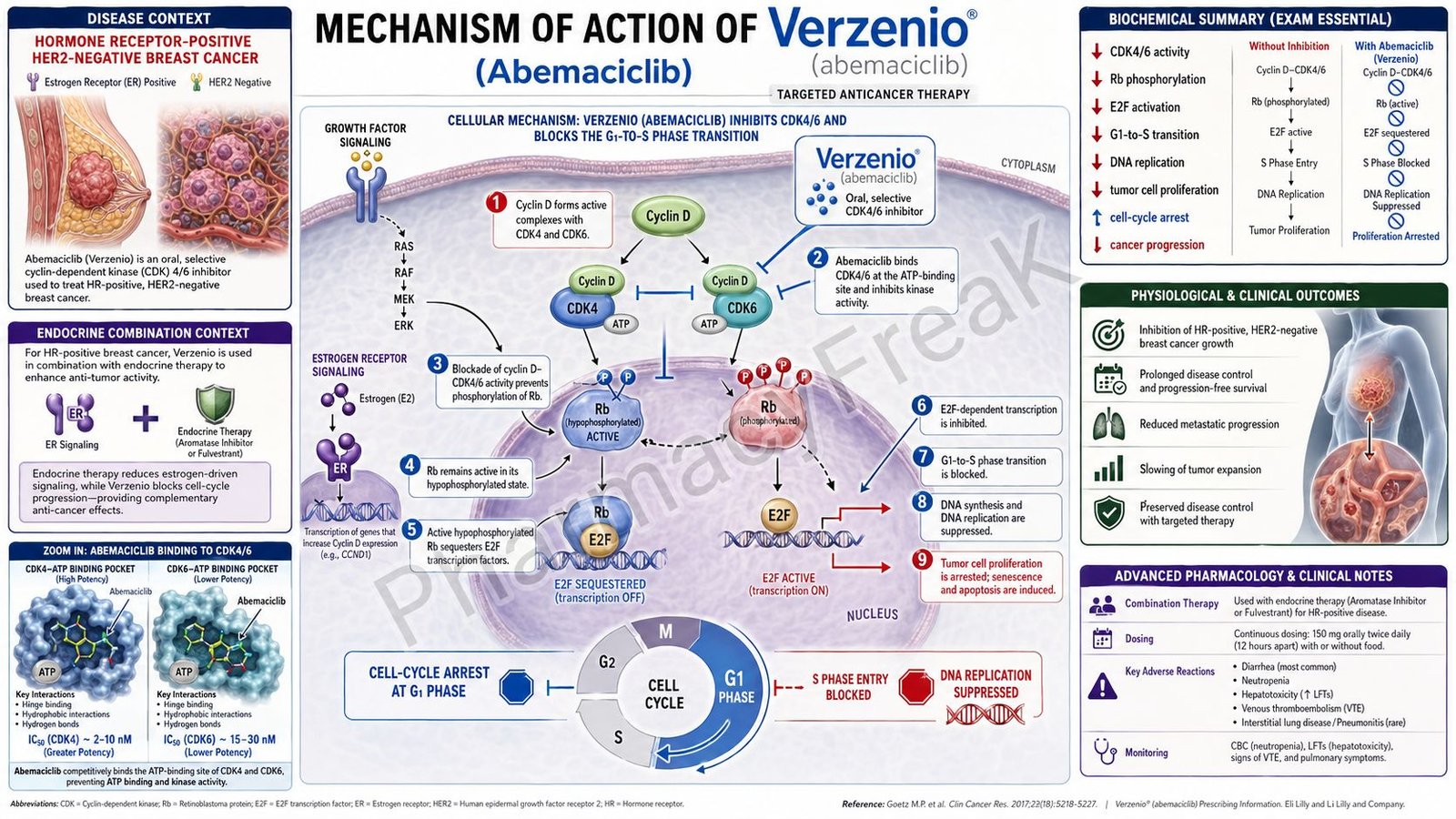
CDK4 and CDK6 are key enzymes that regulate progression of cells from the G1 phase to the S phase of the cell cycle. This transition is essential because S phase is where DNA synthesis occurs. In many hormone receptor-positive breast cancers, estrogen receptor signaling increases cyclin D activity, which activates CDK4 and CDK6. This drives uncontrolled cell-cycle progression and tumor growth.
Verzenio works by inhibiting CDK4 and CDK6. This prevents phosphorylation of the retinoblastoma protein, keeps E2F transcription factors suppressed, blocks G1-to-S phase cell-cycle progression, and reduces cancer cell proliferation.
For exam purposes, Verzenio should be remembered as an oral CDK4/6 inhibitor used in HR-positive, HER2-negative breast cancer, commonly in combination with endocrine therapy. Current clinical use includes selected high-risk early breast cancer and advanced or metastatic breast cancer settings.
Mechanism of Action (Step-wise)
Step 1: Breast cancer cell growth depends on cell-cycle control
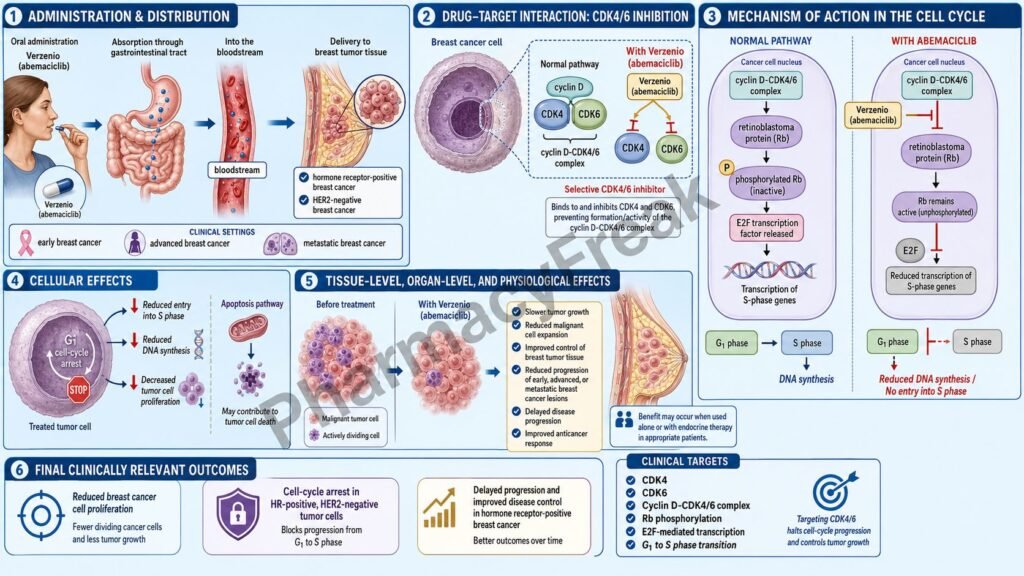
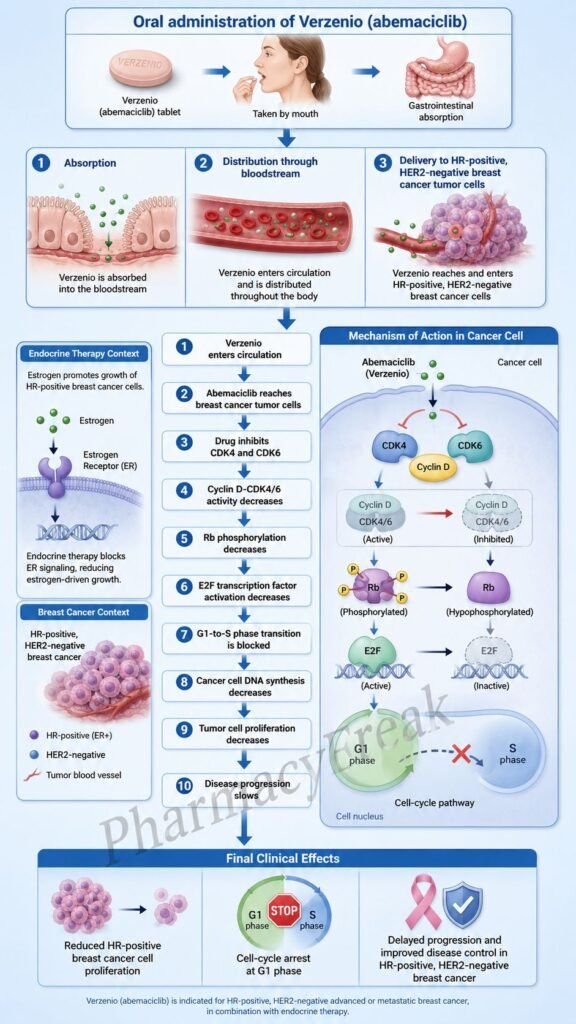
Cancer cells grow by escaping normal cell-cycle checkpoints. In hormone receptor-positive breast cancer, estrogen receptor signaling promotes expression of cyclin D, which activates CDK4 and CDK6. This pushes tumor cells toward continuous division.
Step 2: Cyclin D activates CDK4 and CDK6
Cyclin D forms a complex with CDK4 and CDK6. This cyclin D-CDK4/6 complex acts as a major regulator of the G1 phase of the cell cycle. When this pathway is overactive, cells are more likely to enter DNA synthesis and divide.
Step 3: CDK4/6 phosphorylates retinoblastoma protein
The retinoblastoma protein, commonly called Rb, is a tumor suppressor protein. In its active hypophosphorylated state, Rb binds and suppresses E2F transcription factors. This prevents unnecessary transcription of genes required for DNA replication.
Step 4: Rb phosphorylation releases E2F
When CDK4 and CDK6 phosphorylate Rb, Rb becomes functionally inactive. This releases E2F transcription factors. Free E2F then activates genes needed for DNA synthesis, S-phase entry, and cell division.
Step 5: Cancer cells move from G1 phase to S phase
Once E2F is released, the cell passes the G1 restriction point and enters S phase. In S phase, DNA replication begins. This process allows cancer cells to multiply and tumor burden to increase.
Step 6: Verzenio inhibits CDK4 and CDK6
Verzenio, or abemaciclib, selectively inhibits CDK4 and CDK6. By blocking these kinases, it prevents phosphorylation of the retinoblastoma protein. This is the central molecular mechanism of Verzenio.
Step 7: Rb remains active
When Rb is not phosphorylated, it remains active and continues to bind E2F transcription factors. This prevents E2F from activating genes required for DNA synthesis.
Step 8: G1-to-S phase transition is blocked
Because E2F remains suppressed, cancer cells cannot efficiently move from the G1 phase into the S phase. This produces G1 phase cell-cycle arrest.
Step 9: Tumor cell proliferation decreases
The final cellular effect is reduced tumor cell proliferation. Verzenio does not directly kill cancer cells in the same broad way as traditional cytotoxic chemotherapy. Instead, it slows cancer growth by blocking a key cell-cycle pathway.
Step 10: Endocrine therapy strengthens the effect
In HR-positive breast cancer, estrogen receptor signaling is an upstream driver of cyclin D production. Endocrine therapies such as aromatase inhibitors, tamoxifen, or fulvestrant reduce estrogen receptor signaling. When Verzenio is combined with endocrine therapy, both estrogen-driven signaling and downstream CDK4/6 cell-cycle signaling are inhibited.
Step 11: Functional Rb pathway is important
CDK4/6 inhibitors depend on an intact retinoblastoma pathway. If a tumor cell lacks functional Rb, CDK4/6 inhibition may be less effective because the main downstream checkpoint is already lost.
Step 12: Final therapeutic outcome
The therapeutic outcome is delayed tumor progression, reduced recurrence risk in selected high-risk early breast cancer, and improved disease control in selected advanced or metastatic HR-positive, HER2-negative breast cancer.
Pharmacokinetics
Verzenio is administered orally as tablets. It is usually taken twice daily and may be taken with or without food. The tablet should be swallowed whole and should not be chewed, crushed, or split.
When Verzenio is used in combination with endocrine therapy, the commonly recommended dose is 150 mg twice daily. When used as monotherapy in advanced or metastatic breast cancer after prior endocrine therapy and chemotherapy, the recommended dose is commonly 200 mg twice daily. Dose reductions may be required for toxicity, drug interactions, or hepatic impairment.
After oral administration, abemaciclib is absorbed systemically. It is highly protein bound and distributes into body tissues. It has active metabolites that contribute to its overall pharmacological effect.
Abemaciclib is metabolized mainly by CYP3A4. This is an important exam point because strong CYP3A inhibitors can increase abemaciclib exposure and toxicity. Examples include clarithromycin, ketoconazole, itraconazole, ritonavir, and some other azole antifungals or antiviral drugs.
Strong CYP3A inducers can reduce abemaciclib exposure and may decrease effectiveness. Examples include rifampin, carbamazepine, phenytoin, and St. John’s wort. Grapefruit products are commonly avoided because they may increase CYP3A substrate exposure.
Abemaciclib is eliminated mainly through feces, with a smaller renal contribution. It can increase serum creatinine by inhibiting renal tubular secretion of creatinine, but this does not necessarily represent true reduction in glomerular filtration rate.
The terminal half-life supports twice-daily dosing. Regular adherence is important because Verzenio is used as continuous targeted therapy rather than short-cycle chemotherapy in many regimens.
Clinical Uses
Verzenio is used in adults with HR-positive, HER2-negative breast cancer. Its approved clinical role depends on disease stage, recurrence risk, prior therapy, and whether it is used alone or with endocrine therapy.
In early breast cancer, Verzenio is used in combination with endocrine therapy, such as tamoxifen or an aromatase inhibitor, for adults with HR-positive, HER2-negative, node-positive early breast cancer at high risk of recurrence. High-risk features include factors such as nodal involvement, tumor size, and tumor grade, as determined clinically.
In advanced or metastatic breast cancer, Verzenio may be used with an aromatase inhibitor as initial endocrine-based therapy for adults with HR-positive, HER2-negative disease.
Verzenio may also be used with fulvestrant in adults with HR-positive, HER2-negative advanced or metastatic breast cancer whose disease has progressed after endocrine therapy.
Verzenio can also be used as monotherapy in adults with HR-positive, HER2-negative advanced or metastatic breast cancer whose disease has progressed after endocrine therapy and prior chemotherapy in the metastatic setting.
Verzenio is not used for every type of breast cancer. It is specifically relevant to HR-positive, HER2-negative disease. It is not a general treatment for HER2-positive breast cancer, triple-negative breast cancer, or benign breast disease.
Adverse Effects
The most characteristic adverse effect of Verzenio is diarrhea. Diarrhea often occurs early during treatment and may become severe if not treated promptly. Patients are commonly advised to begin antidiarrheal therapy, increase oral fluids, and contact their healthcare provider at the first sign of loose stools.
Neutropenia is another important adverse effect. Although abemaciclib is often associated with less severe neutropenia than palbociclib and ribociclib, clinically significant neutropenia can still occur. Complete blood counts should be monitored before and during treatment.
Other hematologic adverse effects include anemia, leukopenia, lymphopenia, and thrombocytopenia. Infection risk can increase, especially when neutropenia is present.
Hepatotoxicity can occur with Verzenio. Liver function tests should be monitored before therapy and periodically during treatment. Elevations in ALT, AST, and bilirubin may require dose interruption, dose reduction, or discontinuation.
Interstitial lung disease and pneumonitis are serious warnings with CDK4/6 inhibitors, including Verzenio. New or worsening cough, dyspnea, fever, or hypoxia should be evaluated promptly.
Venous thromboembolism is another important safety warning. Deep vein thrombosis and pulmonary embolism may occur, especially when Verzenio is used with endocrine therapy. Symptoms such as leg swelling, chest pain, sudden shortness of breath, or unexplained hypoxia require urgent evaluation.
Other common adverse effects include nausea, vomiting, fatigue, abdominal pain, decreased appetite, headache, dizziness, stomatitis, alopecia, rash, infections, and weight loss.
Verzenio can cause embryo-fetal toxicity. Females of reproductive potential should use effective contraception during treatment and for the recommended period after the last dose. It should generally be avoided during pregnancy unless the potential benefit clearly justifies the risk.
Comparative Analysis
Verzenio is commonly compared with palbociclib and ribociclib, the other major CDK4/6 inhibitors used in HR-positive, HER2-negative breast cancer.
All three drugs inhibit CDK4 and CDK6, reduce Rb phosphorylation, block G1-to-S phase progression, and reduce cancer cell proliferation. They are frequently combined with endocrine therapy because HR-positive breast cancer is strongly connected to estrogen receptor and cyclin D-CDK4/6 signaling.
Compared with palbociclib, Verzenio is commonly given continuously twice daily, while palbociclib is often given on a 21-days-on, 7-days-off schedule. Palbociclib is strongly associated with neutropenia, while Verzenio is especially associated with diarrhea.
Compared with ribociclib, Verzenio has less emphasis on QT interval monitoring, while ribociclib has important QT prolongation and liver toxicity monitoring requirements. However, Verzenio still requires careful monitoring for diarrhea, blood counts, liver toxicity, venous thromboembolism, and lung toxicity.
Compared with endocrine therapy alone, Verzenio plus endocrine therapy provides stronger blockade of tumor growth signaling in selected HR-positive, HER2-negative breast cancer. Endocrine therapy reduces estrogen receptor-driven signaling, while Verzenio blocks downstream cell-cycle progression.
Compared with traditional cytotoxic chemotherapy, Verzenio is a targeted therapy. It does not primarily work by directly damaging DNA or killing all rapidly dividing cells. Instead, it blocks a specific cell-cycle checkpoint. However, targeted therapy does not mean toxicity-free; Verzenio can still cause serious adverse effects.
Compared with HER2-targeted drugs such as trastuzumab, Verzenio is used in HER2-negative breast cancer. Trastuzumab targets HER2 receptor signaling, while Verzenio targets CDK4/6-mediated cell-cycle progression.
MCQs
- Verzenio contains which active drug?
a) Palbociclib
b) Ribociclib
c) Abemaciclib
d) Olaparib
Answer: c) Abemaciclib
- Verzenio belongs to which pharmacological class?
a) CDK4/6 inhibitor
b) PARP inhibitor
c) HER2 monoclonal antibody
d) Aromatase inhibitor
Answer: a) CDK4/6 inhibitor
- Verzenio is mainly used in which breast cancer subtype?
a) Triple-negative breast cancer only
b) HER2-positive breast cancer only
c) HR-positive, HER2-negative breast cancer
d) Small-cell lung cancer
Answer: c) HR-positive, HER2-negative breast cancer
- CDK4 and CDK6 normally help cells progress from:
a) M phase to G0 phase
b) G1 phase to S phase
c) S phase to immediate apoptosis
d) G2 phase to protein digestion
Answer: b) G1 phase to S phase
- The main tumor suppressor protein affected downstream of CDK4/6 is:
a) Albumin
b) Hemoglobin
c) Retinoblastoma protein
d) Acetylcholinesterase
Answer: c) Retinoblastoma protein
- When Rb is phosphorylated, which transcription factor is released?
a) E2F
b) TNF-alpha
c) VEGF
d) HER2
Answer: a) E2F
- Verzenio reduces tumor proliferation mainly by:
a) Blocking HER2 receptor dimerization
b) Inhibiting aromatase enzyme directly
c) Causing direct DNA cross-linking
d) Preventing Rb phosphorylation and causing G1 arrest
Answer: d) Preventing Rb phosphorylation and causing G1 arrest
- Which adverse effect is most characteristic of Verzenio?
a) Diarrhea
b) Ototoxicity
c) Gingival hyperplasia
d) Severe hypoglycemia
Answer: a) Diarrhea
- Verzenio is metabolized mainly by:
a) CYP2D6
b) CYP3A4
c) Monoamine oxidase
d) Xanthine oxidase
Answer: b) CYP3A4
- Which drug interaction may reduce Verzenio effectiveness?
a) Strong CYP3A inducer
b) Mild topical antibiotic
c) Plain paracetamol only
d) Oral rehydration solution
Answer: a) Strong CYP3A inducer
- Which monitoring is important during Verzenio therapy?
a) Complete blood counts and liver function tests
b) Only hearing test every 5 years
c) No monitoring is needed
d) Blood group testing only
Answer: a) Complete blood counts and liver function tests
- Which serious pulmonary adverse effect has been reported with Verzenio?
a) Interstitial lung disease or pneumonitis
b) Acute asthma cure
c) Mandatory pulmonary tuberculosis
d) Complete lung fibrosis in every patient
Answer: a) Interstitial lung disease or pneumonitis
- Which thrombotic adverse event is an important warning with Verzenio?
a) Venous thromboembolism
b) Hemophilia A
c) Platelet donation reaction
d) Vitamin K deficiency only
Answer: a) Venous thromboembolism
- Which drug is another CDK4/6 inhibitor?
a) Palbociclib
b) Trastuzumab
c) Cisplatin
d) Methotrexate
Answer: a) Palbociclib
- Which statement best describes Verzenio?
a) It is a CDK4/6 inhibitor that blocks G1-to-S phase cell-cycle progression
b) It is a beta-blocker used for hypertension
c) It is an antibiotic used for pneumonia
d) It is a dopamine agonist used for Parkinson’s disease
Answer: a) It is a CDK4/6 inhibitor that blocks G1-to-S phase cell-cycle progression
FAQs
What is the mechanism of action of Verzenio?
Verzenio inhibits CDK4 and CDK6. This prevents phosphorylation of retinoblastoma protein, keeps E2F transcription factors suppressed, blocks G1-to-S phase progression, and reduces breast cancer cell proliferation.
What is the generic name of Verzenio?
The generic name of Verzenio is abemaciclib.
What type of cancer is Verzenio used for?
Verzenio is used in selected adults with hormone receptor-positive, HER2-negative breast cancer. It may be used in high-risk early breast cancer and in advanced or metastatic breast cancer settings.
Why is Verzenio combined with endocrine therapy?
HR-positive breast cancer is driven partly by estrogen receptor signaling, which increases cyclin D and activates CDK4/6. Endocrine therapy reduces estrogen signaling, while Verzenio blocks downstream CDK4/6-mediated cell-cycle progression.
What is the most important adverse effect of Verzenio?
Diarrhea is the most characteristic adverse effect. It can occur early and may become severe if not treated promptly. Hydration, antidiarrheal therapy, and dose adjustment may be needed.
Does Verzenio cause neutropenia?
Yes. Verzenio can cause neutropenia, leukopenia, anemia, lymphopenia, and thrombocytopenia. Complete blood count monitoring is required during treatment.
How is Verzenio different from palbociclib?
Both are CDK4/6 inhibitors, but Verzenio is commonly given continuously and is especially associated with diarrhea. Palbociclib is commonly given in cycles and is more strongly associated with neutropenia.
Can Verzenio be used during pregnancy?
Verzenio can cause fetal harm and should generally be avoided during pregnancy. Females of reproductive potential should use effective contraception according to product guidance.
References
Goodman & Gilman’s The Pharmacological Basis of Therapeutics
Katzung Basic & Clinical Pharmacology