Table of Contents
Introduction
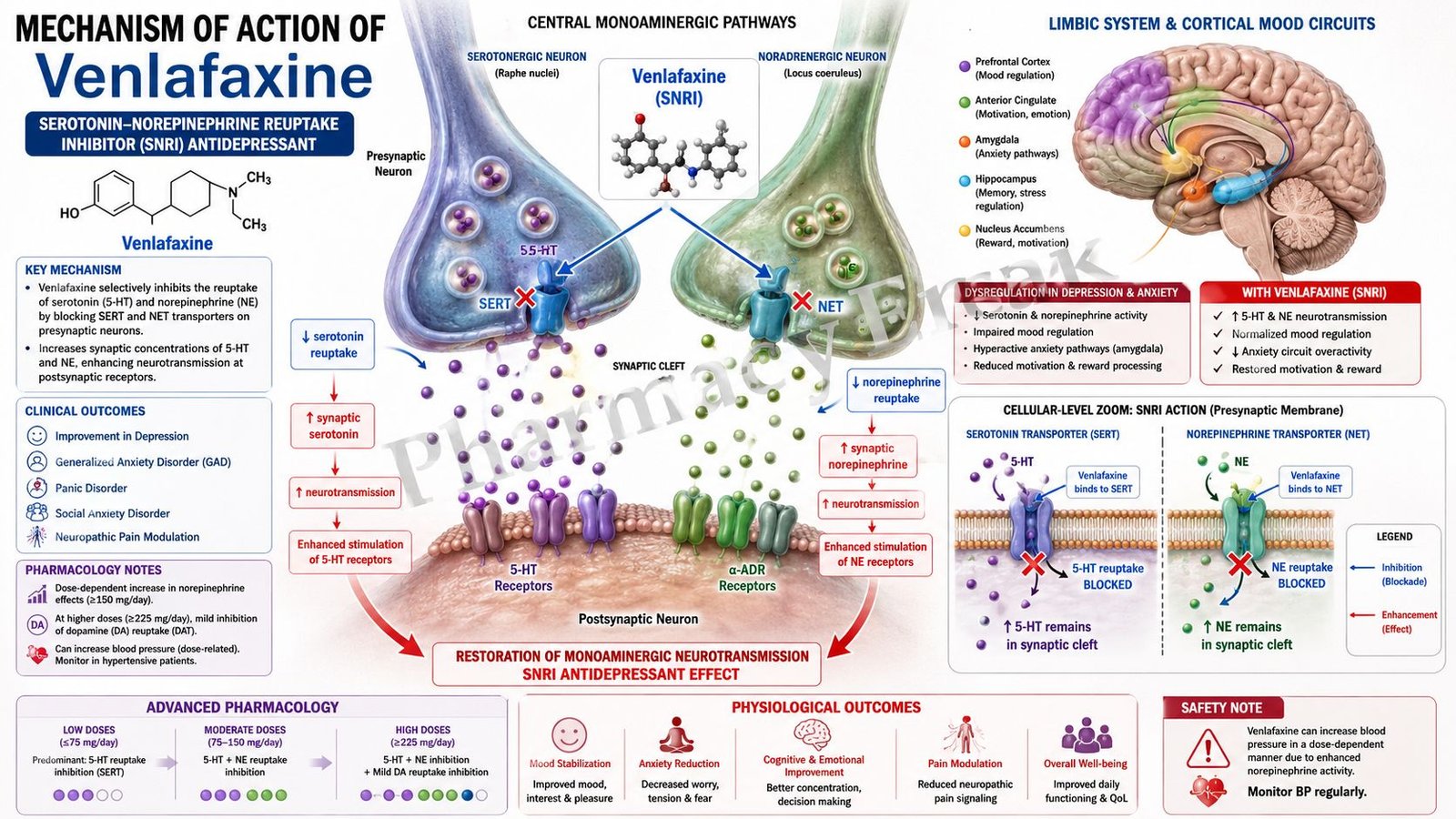
Venlafaxine is a serotonin-norepinephrine reuptake inhibitor (SNRI) antidepressant widely used in the treatment of major depressive disorder, generalized anxiety disorder, social anxiety disorder, and panic disorder. Unlike selective serotonin reuptake inhibitors (SSRIs), venlafaxine enhances both serotonergic and noradrenergic neurotransmission, providing broader modulation of mood-regulating pathways.
Venlafaxine is often considered a dual-action antidepressant because its effects on serotonin and norepinephrine vary with dosage. At lower doses, it predominantly affects serotonin reuptake, while at higher doses it additionally inhibits norepinephrine reuptake. This mechanism improves mood, reduces anxiety symptoms, and helps restore normal emotional functioning.
Mechanism of Action (Step-wise)
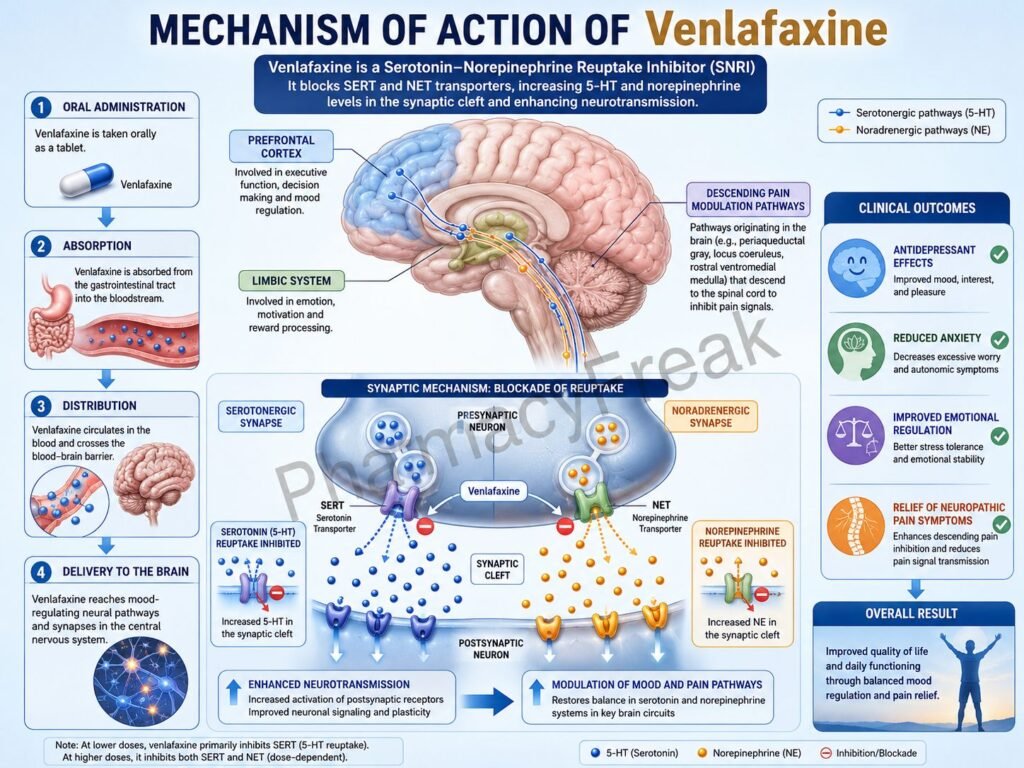
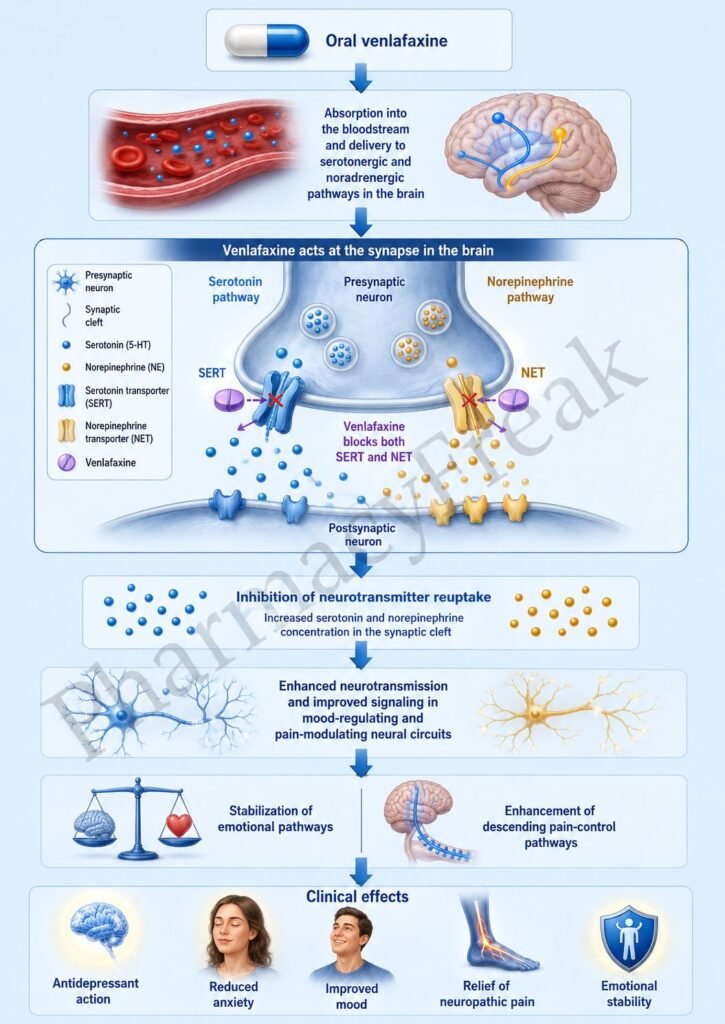
Venlafaxine exerts its therapeutic effects primarily by inhibiting the reuptake of serotonin and norepinephrine in the central nervous system.
1. Oral Administration and Absorption
Following oral administration, venlafaxine is absorbed from the gastrointestinal tract and enters systemic circulation.
The drug readily crosses the blood-brain barrier and reaches neurons within mood-regulating regions of the brain, including the prefrontal cortex, limbic system, and brainstem.
2. Inhibition of Serotonin Reuptake Transporters (SERT)
Serotonin released into the synaptic cleft normally undergoes reuptake through serotonin transporters (SERT) located on presynaptic neurons.
Venlafaxine blocks SERT, preventing serotonin reabsorption.
This results in:
- Increased serotonin concentration within the synaptic cleft
- Prolonged stimulation of postsynaptic serotonin receptors
- Enhanced serotonergic neurotransmission
Improved serotonin signaling contributes to antidepressant and anxiolytic effects.
3. Inhibition of Norepinephrine Reuptake Transporters (NET)
At moderate to higher doses, venlafaxine inhibits norepinephrine transporters (NET).
Blocking NET prevents norepinephrine reuptake into presynaptic neurons.
This produces:
- Increased synaptic norepinephrine levels
- Enhanced adrenergic neurotransmission
- Improved alertness, energy, concentration, and mood
The noradrenergic effect contributes significantly to its efficacy in moderate-to-severe depression.
4. Minimal Effect on Dopamine Reuptake
At very high doses, venlafaxine may weakly inhibit dopamine reuptake in certain brain regions.
However, dopamine reuptake inhibition is relatively minor and is not considered a major contributor to its clinical effects.
5. Adaptive Receptor Changes
Chronic administration causes neuroadaptive changes including:
- Downregulation of certain serotonin receptors
- Improved neuronal signaling efficiency
- Enhanced neuroplasticity
- Increased expression of neurotrophic factors such as brain-derived neurotrophic factor (BDNF)
These long-term adaptations are believed to contribute to sustained antidepressant effects.
6. Improvement in Mood and Anxiety Symptoms
Through enhanced serotonergic and noradrenergic neurotransmission, venlafaxine helps:
- Improve mood
- Reduce anxiety
- Decrease panic symptoms
- Enhance emotional stability
- Improve concentration and motivation
7. Final Therapeutic Effect
The overall effect is restoration of neurotransmitter balance within mood-regulating pathways, leading to relief of depressive and anxiety symptoms.
Pharmacokinetics
Venlafaxine is well absorbed following oral administration.
- Oral bioavailability is approximately 45% due to first-pass metabolism.
- Peak plasma concentrations are reached within several hours.
- It undergoes extensive hepatic metabolism.
- The primary active metabolite is O-desmethylvenlafaxine (ODV), also known as desvenlafaxine.
- Metabolism primarily occurs through CYP2D6.
- Venlafaxine and ODV are excreted mainly through the kidneys.
- The elimination half-life of venlafaxine is approximately 5 hours.
- The elimination half-life of desvenlafaxine is approximately 11 hours.
Extended-release formulations allow once-daily dosing and improve patient adherence.
Clinical Uses
Major Depressive Disorder (MDD)
Venlafaxine is commonly prescribed for mild-to-severe depression.
Generalized Anxiety Disorder (GAD)
It effectively reduces excessive worry, tension, and anxiety symptoms.
Social Anxiety Disorder
Venlafaxine helps reduce fear and avoidance of social situations.
Panic Disorder
It decreases the frequency and severity of panic attacks.
Treatment-Resistant Depression
Because of its dual serotonergic and noradrenergic activity, venlafaxine is often considered when SSRIs fail to provide adequate response.
Off-Label Uses
- Neuropathic pain
- Menopausal vasomotor symptoms
- Certain chronic pain syndromes
Adverse Effects
Common adverse effects include:
- Nausea
- Dry mouth
- Headache
- Insomnia
- Dizziness
- Sweating
- Constipation
- Fatigue
- Decreased appetite
Important adverse effects include:
- Hypertension (dose-dependent)
- Increased heart rate
- Sexual dysfunction
- Withdrawal symptoms upon abrupt discontinuation
- Serotonin syndrome
- Suicidal thoughts in younger patients
- Hyponatremia
- Increased risk of bleeding when combined with anticoagulants or antiplatelet agents
Gradual dose tapering is recommended to minimize discontinuation symptoms.
Comparative Analysis
| Drug | Drug Class | Primary Neurotransmitter Effect | Key Advantage | Important Limitation |
|---|---|---|---|---|
| Venlafaxine | SNRI | Serotonin and norepinephrine | Dual-action antidepressant | Dose-dependent hypertension |
| Fluoxetine | SSRI | Serotonin | Long half-life | Sexual dysfunction |
| Sertraline | SSRI | Serotonin | Effective in anxiety disorders | Gastrointestinal effects |
| Duloxetine | SNRI | Serotonin and norepinephrine | Also useful in neuropathic pain | Hepatotoxicity risk |
| Bupropion | NDRI | Norepinephrine and dopamine | Lower sexual dysfunction risk | Seizure risk |
Venlafaxine differs from SSRIs because it enhances both serotonin and norepinephrine neurotransmission. Compared with duloxetine, venlafaxine has similar SNRI activity but is more commonly associated with dose-dependent increases in blood pressure. Bupropion primarily affects dopamine and norepinephrine and generally causes fewer sexual side effects.
MCQs
1. Venlafaxine belongs to which drug class?
a) SSRI
b) SNRI
c) MAOI
d) Tricyclic antidepressant
Answer: b) SNRI
2. The primary mechanism of venlafaxine is:
a) Dopamine receptor blockade
b) Serotonin and norepinephrine reuptake inhibition
c) GABA receptor activation
d) Acetylcholine receptor blockade
Answer: b) Serotonin and norepinephrine reuptake inhibition
3. Which transporter is inhibited at lower doses of venlafaxine?
a) NET
b) DAT
c) SERT
d) GAT
Answer: c) SERT
4. The major active metabolite of venlafaxine is:
a) Fluoxetine
b) Desvenlafaxine
c) Duloxetine
d) Nortriptyline
Answer: b) Desvenlafaxine
5. Venlafaxine is primarily metabolized by:
a) CYP3A4
b) CYP2C9
c) CYP2D6
d) CYP1A2
Answer: c) CYP2D6
6. Which neurotransmitter effect becomes more significant at higher doses?
a) Acetylcholine enhancement
b) Histamine blockade
c) Norepinephrine reuptake inhibition
d) GABA activation
Answer: c) Norepinephrine reuptake inhibition
7. A common dose-related adverse effect of venlafaxine is:
a) Bradycardia
b) Hypertension
c) Hypoglycemia
d) Neutropenia
Answer: b) Hypertension
8. Venlafaxine is approved for treatment of:
a) Parkinson disease
b) Generalized anxiety disorder
c) Epilepsy
d) Tuberculosis
Answer: b) Generalized anxiety disorder
9. Abrupt discontinuation of venlafaxine may cause:
a) Renal failure
b) Withdrawal symptoms
c) Hepatic necrosis
d) Agranulocytosis
Answer: b) Withdrawal symptoms
10. Excessive serotonergic activity can lead to:
a) Serotonin syndrome
b) Addison disease
c) Hyperthyroidism
d) Gout
Answer: a) Serotonin syndrome
FAQs
What is the mechanism of action of venlafaxine?
Venlafaxine inhibits the reuptake of serotonin and norepinephrine, increasing their concentrations within the synaptic cleft and enhancing neurotransmission.
Is venlafaxine an SSRI or SNRI?
Venlafaxine is classified as an SNRI because it inhibits the reuptake of both serotonin and norepinephrine.
How does venlafaxine improve depression?
It increases serotonergic and noradrenergic neurotransmission, helping restore neurotransmitter balance in mood-regulating pathways.
Why can venlafaxine increase blood pressure?
At higher doses, increased norepinephrine activity may cause dose-dependent elevations in blood pressure and heart rate.
What is desvenlafaxine?
Desvenlafaxine is the major active metabolite of venlafaxine and contributes significantly to its therapeutic effects.
Can venlafaxine cause withdrawal symptoms?
Yes. Abrupt discontinuation may cause dizziness, irritability, headache, nausea, sensory disturbances, and anxiety. Gradual tapering is recommended.
Is venlafaxine useful for anxiety disorders?
Yes. Venlafaxine is approved for generalized anxiety disorder, social anxiety disorder, and panic disorder.
References
Goodman & Gilman’s The Pharmacological Basis of Therapeutics
Katzung Basic & Clinical Pharmacology