Table of Contents
Introduction
Qelbree is the brand name of viloxazine extended-release, a non-stimulant drug used for the treatment of attention-deficit/hyperactivity disorder, commonly called ADHD. It is indicated for ADHD in adults and pediatric patients 6 years of age and older.
Qelbree is pharmacologically important because it is different from stimulant ADHD medicines such as methylphenidate and amphetamine derivatives. Stimulants mainly increase catecholamine signaling by blocking reuptake and/or increasing release of dopamine and norepinephrine. Qelbree is classified as a selective norepinephrine reuptake inhibitor, and its therapeutic effect in ADHD is thought to be mainly related to increased norepinephrine activity in brain regions involved in attention, impulse control, and executive function.
For pharmacy, medical, nursing, and competitive exam students, Qelbree is important because it represents a non-stimulant option for ADHD. Its mechanism is clinically useful in patients where stimulant therapy is unsuitable, poorly tolerated, contraindicated, or associated with concern about misuse. Unlike stimulant drugs, Qelbree is not a controlled stimulant medication.
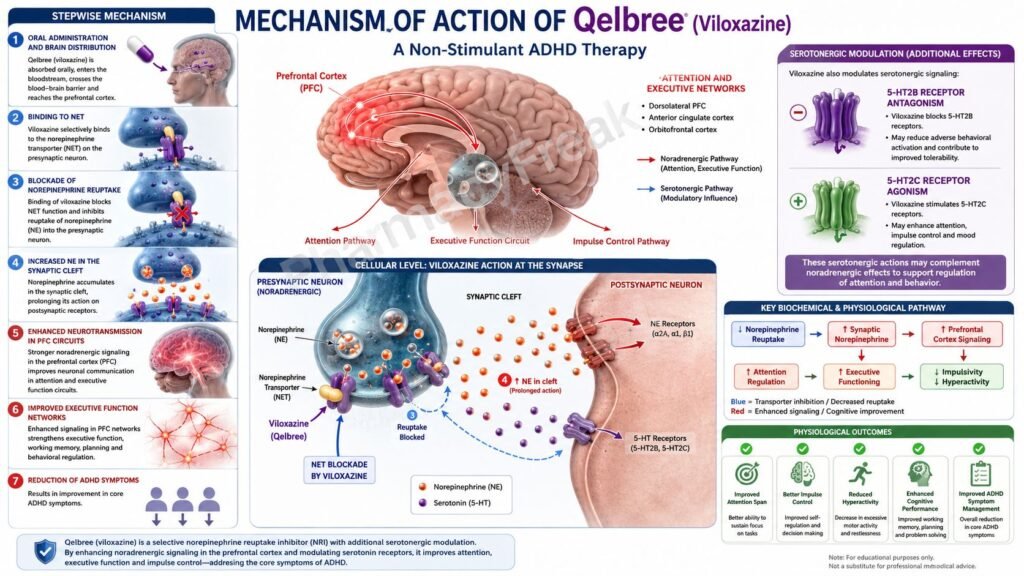
The exact mechanism by which viloxazine improves ADHD symptoms is not completely understood. However, current clinical pharmacology information states that viloxazine inhibits the norepinephrine transporter and also shows partial agonist activity at the serotonin 5-HT2C receptor.
Mechanism of Action (Step-wise)
- Primary pharmacological action: Inhibition of norepinephrine reuptake
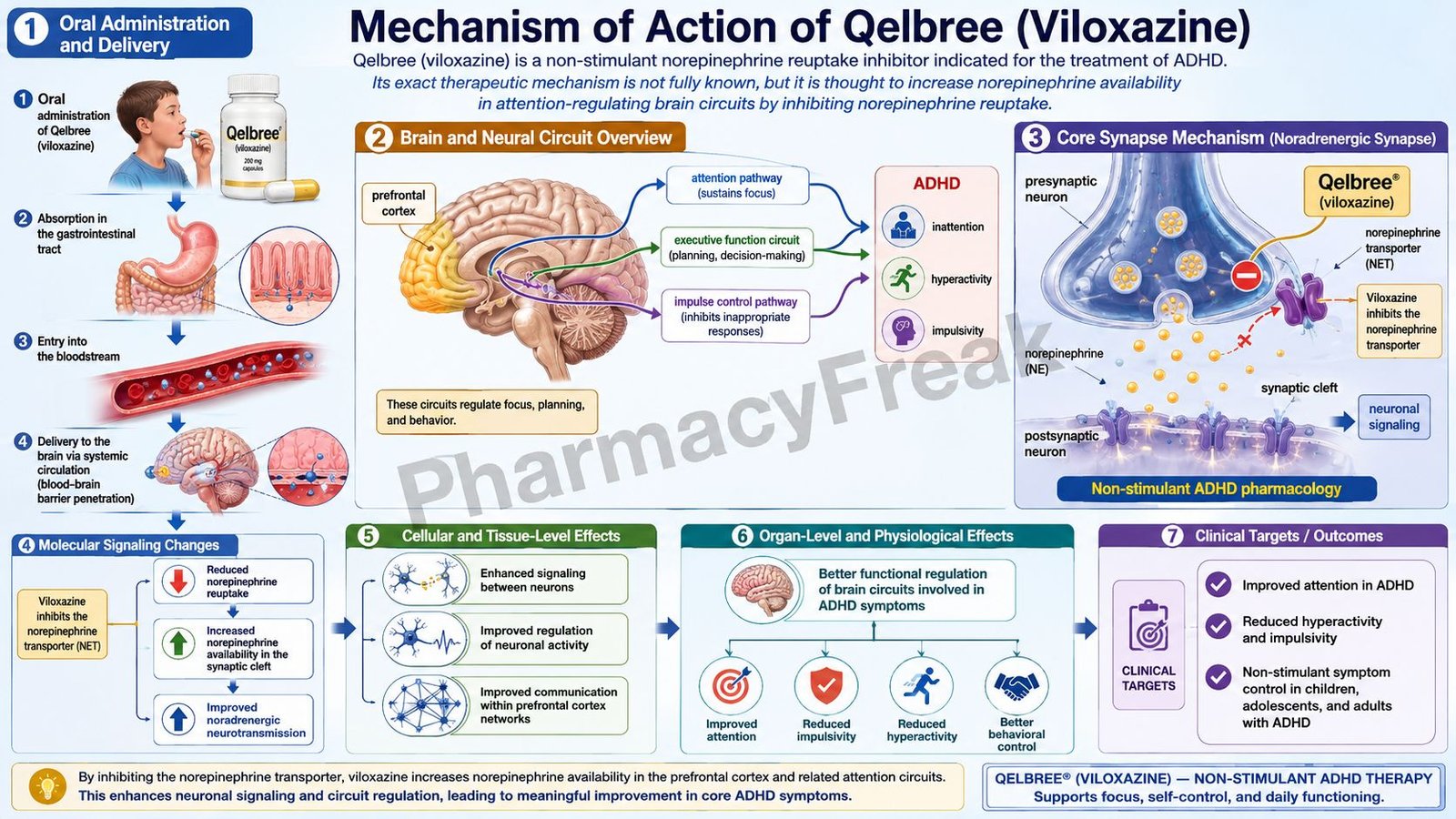
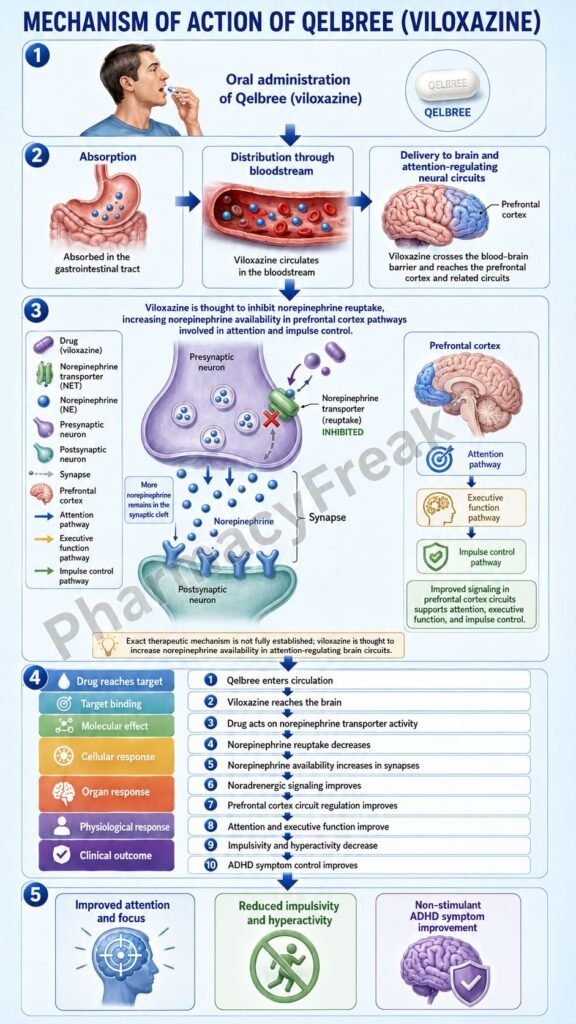
Qelbree contains viloxazine, which inhibits the norepinephrine transporter. The norepinephrine transporter is responsible for reuptake of norepinephrine from the synaptic cleft back into presynaptic neurons.
By blocking this transporter, viloxazine increases norepinephrine availability in synaptic spaces. This enhances noradrenergic neurotransmission in areas of the brain involved in attention, alertness, working memory, and behavioral regulation.
- Effect on prefrontal cortex function
The prefrontal cortex is important for attention, planning, impulse control, working memory, and executive function. Dysregulation of norepinephrine and dopamine signaling in prefrontal circuits is strongly associated with ADHD symptoms.
By increasing norepinephrine signaling, Qelbree may help improve prefrontal cortical regulation. This can reduce inattentiveness, impulsivity, and hyperactivity in suitable patients.
- Indirect effect on attention and impulse control
Improved norepinephrine signaling can enhance signal transmission in neuronal circuits responsible for focus and behavioral inhibition. This helps the patient maintain attention, reduce distractibility, and improve task completion.
The effect is gradual and does not produce immediate stimulation like some stimulant drugs. Clinical benefit usually appears with regular daily use.
- Serotonin 5-HT2C receptor activity
Viloxazine also binds to the serotonin 5-HT2C receptor and exhibits partial agonist activity. The clinical significance of this activity is not fully established, but it may contribute to modulation of mood, impulse control, and cortical neurotransmitter balance.
- No direct stimulant release of dopamine
Qelbree is not considered a stimulant. It does not primarily act by directly increasing dopamine release like amphetamine-type stimulants. This makes it useful as a non-stimulant alternative in ADHD treatment.
- Final therapeutic effect
The final therapeutic effect of Qelbree is improvement in ADHD symptoms such as inattention, hyperactivity, impulsivity, poor task persistence, and executive dysfunction. Its benefit is mainly related to enhanced norepinephrine signaling and possible serotonin receptor modulation.
Pharmacokinetics
Qelbree is administered orally as an extended-release capsule. It is taken once daily, with or without food. The capsule should not be cut, crushed, or chewed, but it may be opened and sprinkled over applesauce or pudding if swallowing is difficult.
Absorption:
Viloxazine is absorbed after oral administration. The relative bioavailability of viloxazine extended-release compared with an immediate-release formulation is approximately 88%. The median time to peak plasma concentration is about 5 hours, with a range of 3 to 9 hours after a single 200 mg dose.
Effect of food:
A high-fat meal slightly decreases viloxazine exposure and delays the time to peak concentration by about 2 hours. The effect is not usually considered clinically significant, so Qelbree can be administered with or without food.
Distribution:
Viloxazine is approximately 76% to 82% bound to human plasma proteins. This moderate-to-high protein binding affects its distribution in the systemic circulation.
Metabolism:
Viloxazine is primarily metabolized by CYP2D6, UGT1A9, and UGT2B15. The major metabolite detected in plasma is 5-hydroxy-viloxazine glucuronide.
Excretion:
Renal excretion is the primary route of elimination. After radiolabeled viloxazine administration, about 90% of the dose is recovered in urine within 24 hours, while less than 1% is recovered in feces.
Half-life and duration:
The mean half-life of viloxazine is approximately 7 hours. Steady state is reached after about 2 days of once-daily administration, and no significant accumulation is observed.
Special pharmacokinetic point:
In severe renal impairment, the starting dose and maximum dose are reduced because renal excretion is the primary elimination pathway.
Clinical Uses
- Attention-deficit/hyperactivity disorder:
Qelbree is used for the treatment of ADHD in adults and children 6 years of age and older. - Non-stimulant ADHD therapy:
It is useful when a non-stimulant option is preferred, such as in patients with stimulant intolerance, concern about misuse, or inadequate response to stimulant treatment. - Inattention symptoms:
By increasing norepinephrine signaling in attention-related brain circuits, Qelbree may help reduce distractibility and improve focus. - Hyperactivity and impulsivity symptoms:
Improved prefrontal control may help reduce impulsive behavior, excessive activity, and difficulty waiting or staying organized. - Long-term ADHD management:
ADHD often requires long-term treatment. Qelbree may be used as part of a broader management plan that includes behavioral strategies, academic support, counseling, and monitoring.
Adverse Effects
Common adverse effects of Qelbree include:
- Somnolence
- Fatigue
- Decreased appetite
- Nausea
- Vomiting
- Insomnia
- Irritability
- Headache
- Dry mouth
- Constipation
- Abdominal discomfort
- Dizziness
In pediatric patients, common adverse reactions include somnolence, decreased appetite, fatigue, nausea, vomiting, insomnia, and irritability. In adults, common adverse reactions include insomnia, headache, somnolence, fatigue, nausea, decreased appetite, dry mouth, and constipation.
Important serious or clinically significant adverse effects include:
- Suicidal thoughts and behaviors
- Increased blood pressure
- Increased heart rate
- Activation of mania or hypomania
- Somnolence and fatigue affecting driving or machinery use
- Potential drug interactions through CYP1A2 inhibition
- Possible maternal harm during pregnancy
Qelbree has a boxed warning for suicidal thoughts and behaviors. Patients should be monitored for clinical worsening, mood changes, new depression, agitation, irritability, behavioral changes, or suicidal ideation, especially during the first months of therapy or after dose changes.
Qelbree can increase blood pressure and heart rate. Blood pressure and pulse should be assessed before starting treatment, after dosage increases, and periodically during therapy.
Qelbree is contraindicated with monoamine oxidase inhibitors and with certain CYP1A2-sensitive substrates such as alosetron, duloxetine, ramelteon, tasimelteon, tizanidine, and theophylline.
Comparative Analysis
| Feature | Qelbree | Atomoxetine | Methylphenidate | Guanfacine |
|---|---|---|---|---|
| Generic name | Viloxazine ER | Atomoxetine | Methylphenidate | Guanfacine ER |
| Drug class | Selective norepinephrine reuptake inhibitor | Selective norepinephrine reuptake inhibitor | CNS stimulant | Alpha-2A adrenergic agonist |
| Main target | Norepinephrine transporter; partial 5-HT2C activity | Norepinephrine transporter | Dopamine and norepinephrine transporters | Alpha-2A receptors |
| Main action | Increases norepinephrine signaling | Increases norepinephrine signaling | Increases dopamine and norepinephrine signaling | Improves prefrontal cortical regulation |
| Controlled substance | No | No | Yes | No |
| Main use | ADHD | ADHD | ADHD | ADHD |
| Common adverse effects | Somnolence, appetite decrease, nausea, insomnia | GI upset, appetite decrease, somnolence | Insomnia, appetite loss, increased heart rate | Sedation, hypotension, fatigue |
| Important warning | Suicidal thoughts, BP/HR increase | Suicidal thoughts, liver injury warning | Misuse, dependence, cardiovascular effects | Hypotension, bradycardia |
Qelbree and atomoxetine are both non-stimulant norepinephrine reuptake inhibitors used in ADHD, but Qelbree is an extended-release viloxazine formulation and also has serotonin 5-HT2C partial agonist activity. Methylphenidate is different because it is a stimulant and controlled substance that increases dopamine and norepinephrine signaling. Guanfacine works through alpha-2A adrenergic receptor stimulation rather than norepinephrine transporter inhibition.
MCQs
- Qelbree contains which active drug?
a) Atomoxetine
b) Viloxazine
c) Methylphenidate
d) Guanfacine
Answer: b) Viloxazine
- Qelbree is mainly used for the treatment of:
a) Hypertension
b) ADHD
c) Epilepsy
d) Parkinson’s disease
Answer: b) ADHD
- Qelbree belongs to which pharmacological class?
a) CNS stimulant
b) Selective norepinephrine reuptake inhibitor
c) Benzodiazepine
d) Antipsychotic
Answer: b) Selective norepinephrine reuptake inhibitor
- The primary transporter inhibited by viloxazine is:
a) Serotonin transporter only
b) Norepinephrine transporter
c) GABA transporter
d) Choline transporter
Answer: b) Norepinephrine transporter
- Inhibition of norepinephrine reuptake mainly increases:
a) Acetylcholine degradation
b) Norepinephrine availability in synapses
c) Insulin secretion
d) Gastric acid secretion
Answer: b) Norepinephrine availability in synapses
- Qelbree is classified as:
a) A controlled stimulant
b) A non-stimulant ADHD medication
c) An opioid analgesic
d) A sedative hypnotic only
Answer: b) A non-stimulant ADHD medication
- Viloxazine also shows partial agonist activity at which receptor?
a) 5-HT2C receptor
b) Beta-2 receptor
c) D2 receptor
d) H1 receptor
Answer: a) 5-HT2C receptor
- Which adverse effect is common with Qelbree?
a) Somnolence
b) Ototoxicity
c) Gingival hyperplasia
d) Severe hypoglycemia
Answer: a) Somnolence
- Which warning is important with Qelbree?
a) Suicidal thoughts and behaviors
b) Severe ototoxicity
c) Pulmonary fibrosis only
d) Thyroid storm
Answer: a) Suicidal thoughts and behaviors
- Qelbree may increase:
a) Blood pressure and heart rate
b) Platelet destruction
c) Gastric acid secretion only
d) Bone resorption only
Answer: a) Blood pressure and heart rate
- Qelbree is contraindicated with:
a) Monoamine oxidase inhibitors
b) Paracetamol only
c) Oral rehydration solution
d) Vitamin C
Answer: a) Monoamine oxidase inhibitors
- The main route of viloxazine excretion is:
a) Renal excretion
b) Pulmonary excretion
c) Sweat only
d) Biliary excretion only
Answer: a) Renal excretion
- Which drug is a stimulant ADHD medication?
a) Qelbree
b) Atomoxetine
c) Methylphenidate
d) Guanfacine
Answer: c) Methylphenidate
- Qelbree capsules should not be:
a) Taken once daily
b) Crushed or chewed
c) Taken with food
d) Used for ADHD
Answer: b) Crushed or chewed
- Which statement about Qelbree is correct?
a) It improves ADHD symptoms mainly by enhancing norepinephrine signaling
b) It is an insulin analog
c) It directly blocks bacterial ribosomes
d) It is a rescue drug for asthma
Answer: a) It improves ADHD symptoms mainly by enhancing norepinephrine signaling
FAQs
- What is Qelbree used for?
Qelbree is used for the treatment of attention-deficit/hyperactivity disorder in adults and children 6 years of age and older.
- What is the mechanism of action of Qelbree?
Qelbree contains viloxazine, which inhibits norepinephrine reuptake by blocking the norepinephrine transporter. It also has partial agonist activity at the serotonin 5-HT2C receptor. The exact mechanism in ADHD is not fully understood.
- Is Qelbree a stimulant?
No. Qelbree is a non-stimulant ADHD medication. It is not a controlled stimulant like methylphenidate or amphetamine derivatives.
- How does Qelbree help ADHD symptoms?
Qelbree increases norepinephrine signaling in brain regions involved in attention, impulse control, and executive function. This may help reduce inattention, hyperactivity, and impulsivity.
- Can Qelbree cause sleepiness?
Yes. Somnolence and fatigue are common adverse effects. Patients should be cautious with driving or operating machinery until they know how the medicine affects them.
- Can Qelbree increase blood pressure?
Yes. Qelbree can increase blood pressure and heart rate. Blood pressure and pulse should be checked before and during treatment.
- What is the major warning for Qelbree?
Qelbree has a boxed warning for suicidal thoughts and behaviors. Patients should be monitored for mood changes, depression, agitation, irritability, or suicidal thoughts.
- Can Qelbree be used with MAO inhibitors?
No. Qelbree is contraindicated with monoamine oxidase inhibitors and should not be used within the required washout period.
- Can Qelbree capsules be opened?
Yes. The capsule may be opened and sprinkled over applesauce or pudding, but the contents should not be chewed, crushed, or stored for later use.
References
Goodman & Gilman’s The Pharmacological Basis of Therapeutics
Katzung Basic & Clinical Pharmacology