Table of Contents
Introduction
Zeposia is the brand name of ozanimod, an oral immunomodulatory drug used mainly in relapsing forms of multiple sclerosis and moderately to severely active ulcerative colitis. It belongs to the class of sphingosine-1-phosphate receptor modulators, commonly called S1P receptor modulators.
Zeposia is important in pharmacology because it does not act like a conventional anti-inflammatory drug or steroid. Instead, it modifies immune cell movement by affecting lymphocyte trafficking. This makes it useful in diseases where abnormal immune cell migration contributes to inflammation and tissue damage.
In multiple sclerosis, autoreactive lymphocytes enter the central nervous system and contribute to demyelination, inflammation, and neurological relapse. In ulcerative colitis, immune-mediated inflammation damages the colonic mucosa. By reducing the movement of lymphocytes from lymphoid tissues into circulation and target organs, Zeposia helps decrease inflammatory activity.
For pharmacy, medical, nursing, and competitive exam students, Zeposia is an important example of targeted immunomodulation. Its mechanism is commonly tested because it involves S1P receptor modulation, lymphocyte sequestration, reduced circulating lymphocytes, and decreased immune-mediated tissue injury.
Mechanism of Action (Step-wise)
- Primary target: S1P receptors
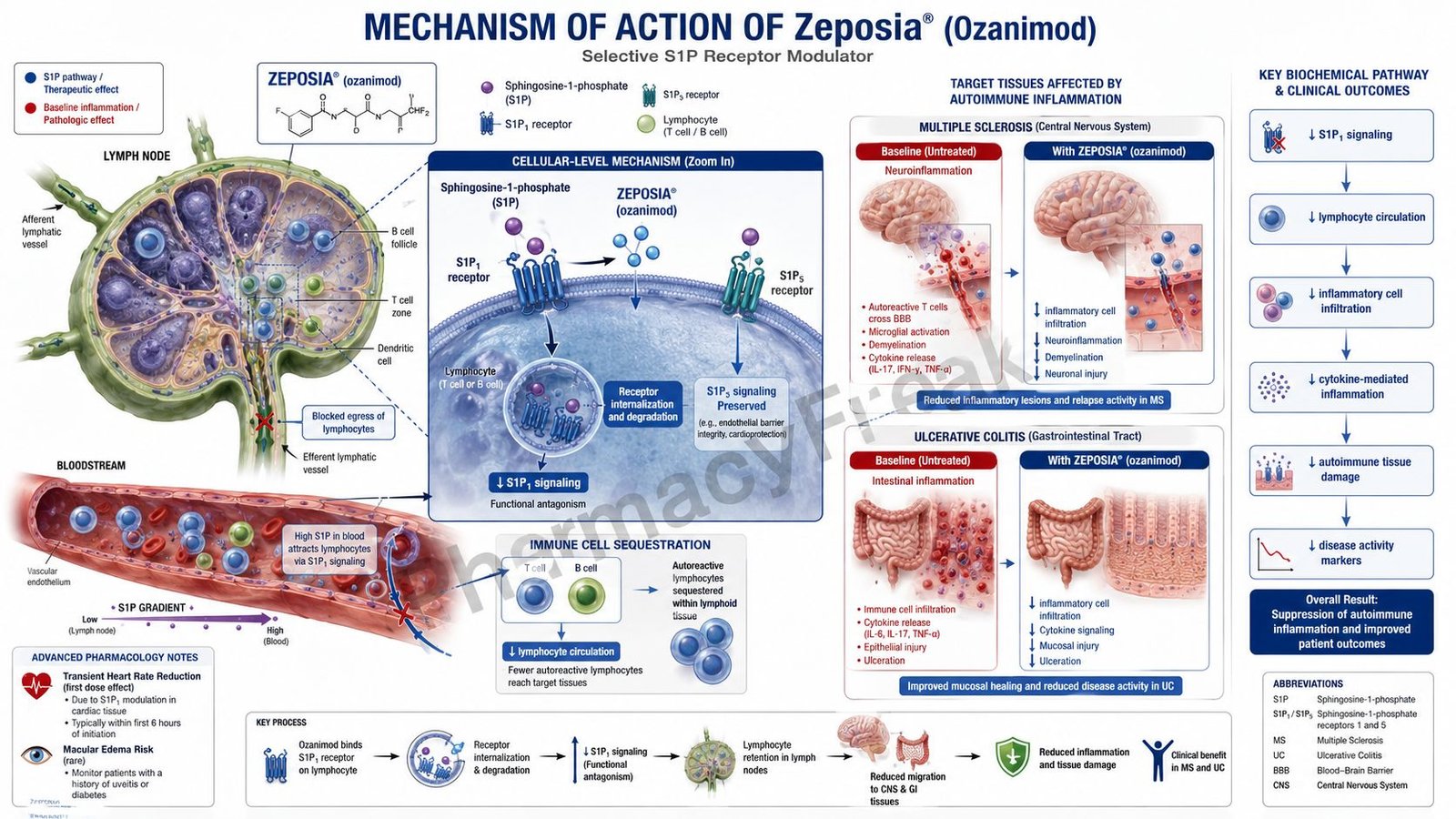
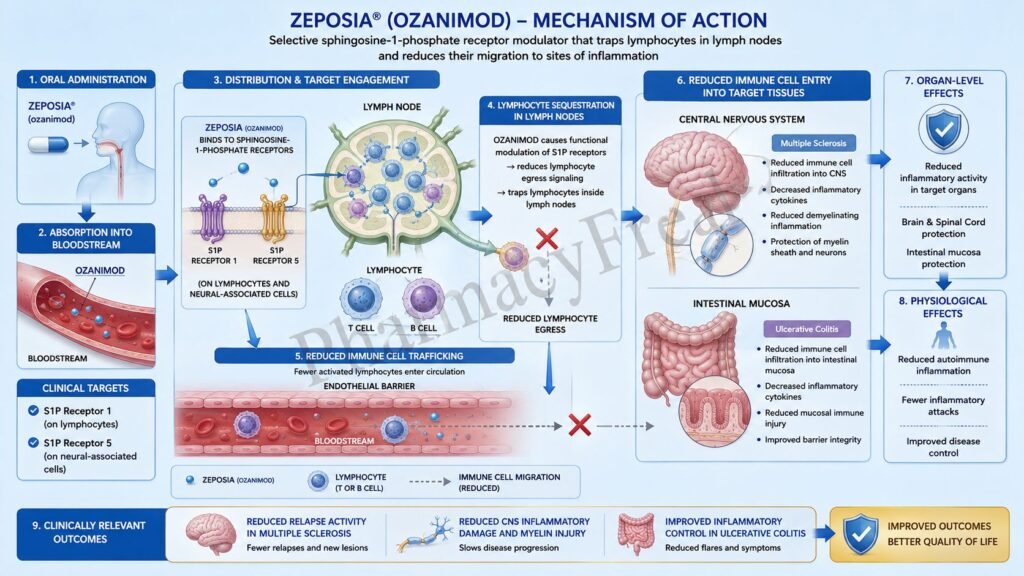
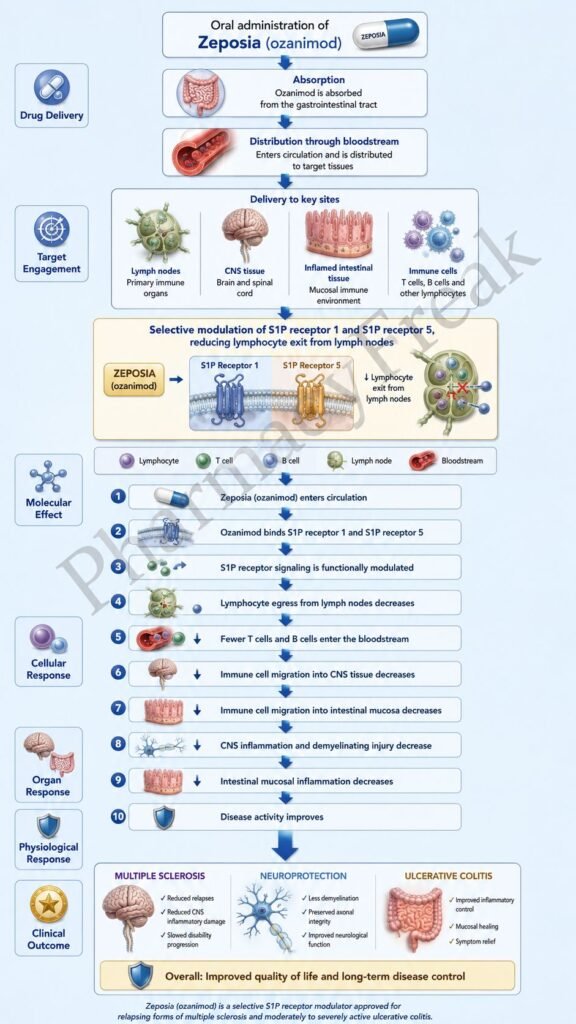
Zeposia contains ozanimod, which acts as a sphingosine-1-phosphate receptor modulator. It has activity mainly at S1P1 and S1P5 receptors.
- Functional antagonism of S1P1 receptors
Although ozanimod binds to S1P receptors, its clinically important effect is functional antagonism of S1P1 receptors on lymphocytes. After receptor binding, S1P1 receptors are internalized and become less available on the lymphocyte surface.
- Prevention of lymphocyte exit from lymph nodes
Normally, S1P signaling helps lymphocytes exit lymph nodes and enter the bloodstream. When S1P1 receptor function is reduced, lymphocytes are retained within lymphoid tissues.
- Reduction in circulating lymphocytes
Because lymphocytes remain trapped in lymph nodes, the number of circulating lymphocytes decreases. This reduces the availability of inflammatory T cells and B cells that can migrate into target tissues.
- Effect in multiple sclerosis
In multiple sclerosis, reduced lymphocyte migration into the central nervous system decreases immune-mediated attack on myelin. This helps reduce inflammation, demyelination, relapse frequency, and disease activity.
- Effect in ulcerative colitis
In ulcerative colitis, decreased trafficking of lymphocytes to the intestinal mucosa reduces immune-mediated colonic inflammation. This can help improve symptoms, promote mucosal healing, and maintain remission in suitable patients.
- Role of S1P5 receptor activity
Ozanimod also interacts with S1P5 receptors, which are present in some cells of the nervous system such as oligodendrocytes. The exact clinical importance of S1P5 modulation is less clearly established than S1P1-mediated lymphocyte sequestration.
- Final therapeutic effect
The final therapeutic effect of Zeposia is reduced immune cell migration, decreased inflammatory activity, reduced relapse frequency in multiple sclerosis, and improved inflammatory control in ulcerative colitis.
Pharmacokinetics
Zeposia is administered orally as ozanimod capsules. It is given once daily after dose titration to reduce the risk of cardiac effects such as bradycardia.
Absorption:
Ozanimod is absorbed after oral administration. It can be taken with or without food. A gradual dose escalation schedule is used during initiation.
Distribution:
Ozanimod and its major active metabolites are highly protein-bound. The drug distributes into body tissues and exerts systemic immunomodulatory effects.
Metabolism:
Ozanimod undergoes extensive metabolism through multiple enzymatic pathways. It forms active metabolites, including CC112273 and CC1084037, which contribute significantly to its clinical activity. Its metabolism involves several enzymes, including alcohol dehydrogenase, aldehyde dehydrogenase, CYP enzymes, and other metabolic pathways.
Excretion:
Ozanimod is eliminated mainly as metabolites. Excretion occurs through both fecal and urinary routes, with inactive metabolites forming the major eliminated products.
Half-life and duration:
The plasma half-life of ozanimod is approximately 21 hours. However, its major active metabolites have a much longer effective half-life of around 11 days. Because of this, the immunological effect may persist even after stopping the drug.
Special pharmacokinetic point:
The prolonged activity of active metabolites is important when switching from Zeposia to other immunosuppressive or immune-modifying therapies, because overlapping immunosuppression may increase infection risk.
Clinical Uses
- Relapsing forms of multiple sclerosis:
Zeposia is used in adults with relapsing forms of multiple sclerosis, including clinically isolated syndrome, relapsing-remitting disease, and active secondary progressive disease. - Reduction of MS relapse activity:
By decreasing lymphocyte migration into the central nervous system, Zeposia helps reduce inflammatory disease activity and relapse frequency. - Moderately to severely active ulcerative colitis:
Zeposia is used in adults with moderately to severely active ulcerative colitis. It helps reduce immune-mediated inflammation in the colonic mucosa. - Maintenance of remission in ulcerative colitis:
In suitable patients, Zeposia can help maintain disease control by reducing ongoing lymphocyte-driven inflammation. - Steroid-sparing strategy in inflammatory disease:
Although not a corticosteroid itself, Zeposia may help reduce reliance on repeated corticosteroid use in some patients with chronic inflammatory disease when clinically appropriate.
Adverse Effects
Common and important adverse effects of Zeposia include:
- Upper respiratory tract infection
- Headache
- Increased liver enzymes
- Hypertension
- Bradycardia, especially during initiation
- Orthostatic hypotension
- Dizziness
- Back pain
- Urinary tract infection
- Lymphopenia
- Herpes viral infections
- Macular edema
- Reduced pulmonary function in susceptible patients
Serious or clinically important adverse effects include severe infections, cardiac conduction abnormalities, significant liver injury, macular edema, hypertension, and rare serious opportunistic infections. Because Zeposia reduces circulating lymphocytes, patients may have increased susceptibility to infections.
Before starting therapy, clinicians commonly assess cardiac history, liver function, complete blood count, varicella-zoster virus immunity, ophthalmic risk factors, and current medications. Live vaccines are generally avoided during treatment and for a period after discontinuation due to immunosuppressive effects.
Zeposia should be used cautiously in patients with significant cardiac disease, conduction abnormalities, active infections, hepatic impairment, macular edema risk, or interacting medications.
Comparative Analysis
| Feature | Zeposia | Fingolimod | Siponimod | Natalizumab |
|---|---|---|---|---|
| Generic name | Ozanimod | Fingolimod | Siponimod | Natalizumab |
| Drug class | S1P receptor modulator | S1P receptor modulator | S1P receptor modulator | Integrin antagonist monoclonal antibody |
| Main target | S1P1 and S1P5 receptors | Multiple S1P receptors | S1P1 and S1P5 receptors | Alpha-4 integrin |
| Main action | Retains lymphocytes in lymph nodes | Retains lymphocytes in lymph nodes | Retains lymphocytes in lymph nodes | Blocks leukocyte migration across endothelium |
| Common use | Relapsing MS, ulcerative colitis | Relapsing MS | Secondary progressive MS with activity, relapsing MS | Relapsing MS, Crohn’s disease in some settings |
| Route | Oral | Oral | Oral | Intravenous |
| Key concern | Infection, bradycardia, liver enzymes, macular edema | Infection, bradycardia, macular edema | Infection, bradycardia, liver enzymes | PML risk |
| Dose titration | Required | First-dose monitoring often important | Required | Not applicable |
Zeposia is similar to fingolimod and siponimod because all three affect S1P signaling and reduce lymphocyte egress from lymph nodes. However, Zeposia is more selective for S1P1 and S1P5 compared with fingolimod. Natalizumab is different because it is a monoclonal antibody that blocks leukocyte adhesion and migration rather than trapping lymphocytes in lymphoid tissue.
MCQs
- Zeposia contains which active drug?
a) Fingolimod
b) Ozanimod
c) Natalizumab
d) Teriflunomide
Answer: b) Ozanimod
- Zeposia belongs to which drug class?
a) TNF-alpha inhibitor
b) Calcineurin inhibitor
c) S1P receptor modulator
d) JAK inhibitor
Answer: c) S1P receptor modulator
- The most important receptor involved in lymphocyte sequestration by Zeposia is:
a) S1P1 receptor
b) Beta-1 receptor
c) H1 receptor
d) NMDA receptor
Answer: a) S1P1 receptor
- Zeposia reduces inflammation mainly by:
a) Directly killing bacteria
b) Inhibiting prostaglandin synthesis
c) Retaining lymphocytes in lymph nodes
d) Blocking histamine release
Answer: c) Retaining lymphocytes in lymph nodes
- Which disease is treated with Zeposia?
a) Relapsing multiple sclerosis
b) Acute bacterial meningitis
c) Myocardial infarction
d) Type 1 diabetes emergency
Answer: a) Relapsing multiple sclerosis
- Zeposia is also used in adults with:
a) Ulcerative colitis
b) Peptic ulcer caused by H. pylori
c) Acute appendicitis
d) Viral hepatitis A
Answer: a) Ulcerative colitis
- The main final effect of Zeposia in multiple sclerosis is:
a) Increased lymphocyte entry into CNS
b) Reduced immune-mediated demyelination
c) Increased acetylcholine release
d) Increased gastric acid secretion
Answer: b) Reduced immune-mediated demyelination
- Which adverse effect is clinically important during Zeposia initiation?
a) Bradycardia
b) Hypercalcemia
c) Severe hypoglycemia
d) Ototoxicity
Answer: a) Bradycardia
- Zeposia is administered by which route?
a) Intravenous
b) Subcutaneous
c) Oral
d) Intramuscular
Answer: c) Oral
- Which of the following is a serious concern with Zeposia therapy?
a) Increased infection risk
b) Immediate bronchodilation
c) Severe dehydration due to diuresis
d) Increased insulin secretion
Answer: a) Increased infection risk
- Ozanimod mainly affects lymphocyte movement by altering signaling through:
a) Dopamine receptors
b) Sphingosine-1-phosphate receptors
c) Opioid receptors
d) GABA receptors
Answer: b) Sphingosine-1-phosphate receptors
- Which monitoring parameter is important during Zeposia therapy?
a) Liver enzymes
b) Serum uric acid only
c) Bone mineral density only
d) Serum amylase only
Answer: a) Liver enzymes
- Zeposia differs from natalizumab because natalizumab:
a) Blocks alpha-4 integrin
b) Blocks S1P1 receptors
c) Inhibits cyclooxygenase
d) Stimulates beta-2 receptors
Answer: a) Blocks alpha-4 integrin
- Why is dose titration used when starting Zeposia?
a) To reduce risk of cardiac effects such as bradycardia
b) To prevent gastric ulceration
c) To increase antibiotic activity
d) To prevent hypokalemia
Answer: a) To reduce risk of cardiac effects such as bradycardia
- Which statement about Zeposia is correct?
a) It is a corticosteroid
b) It is used for immediate pain relief
c) It reduces circulating lymphocytes by affecting S1P signaling
d) It directly destroys myelin
Answer: c) It reduces circulating lymphocytes by affecting S1P signaling
FAQs
- What is Zeposia used for?
Zeposia is used in adults with relapsing forms of multiple sclerosis and moderately to severely active ulcerative colitis.
- What is the mechanism of action of Zeposia?
Zeposia modulates sphingosine-1-phosphate receptors, mainly S1P1 and S1P5. It causes functional antagonism of S1P1 receptors on lymphocytes, trapping them in lymph nodes and reducing their migration into inflamed tissues.
- Is Zeposia a steroid?
No. Zeposia is not a steroid. It is an oral S1P receptor modulator that works by changing lymphocyte trafficking.
- Why does Zeposia reduce lymphocyte count?
Zeposia prevents lymphocytes from leaving lymph nodes. As a result, fewer lymphocytes circulate in the blood and fewer immune cells reach inflammatory target tissues.
- Why is Zeposia useful in multiple sclerosis?
In multiple sclerosis, immune cells attack myelin in the central nervous system. Zeposia reduces lymphocyte entry into the CNS, helping reduce inflammation and relapse activity.
- Why is Zeposia used in ulcerative colitis?
In ulcerative colitis, immune cells contribute to inflammation of the colonic mucosa. Zeposia reduces lymphocyte migration to the gut, helping control inflammation.
- What are common side effects of Zeposia?
Common side effects include upper respiratory infection, headache, increased liver enzymes, hypertension, dizziness, and urinary tract infection.
- What is an important cardiac side effect of Zeposia?
Zeposia may cause bradycardia or conduction delay, especially when treatment is started. This is why dose titration is required.
- Can live vaccines be given during Zeposia therapy?
Live vaccines are generally avoided during Zeposia therapy and for a period after stopping treatment because of reduced immune function.
References
Goodman & Gilman’s The Pharmacological Basis of Therapeutics
Katzung Basic & Clinical Pharmacology
K.D. Tripathi Essentials of Medical Pharmacology
Harrison’s Principles of Internal Medicine