Table of Contents
Introduction
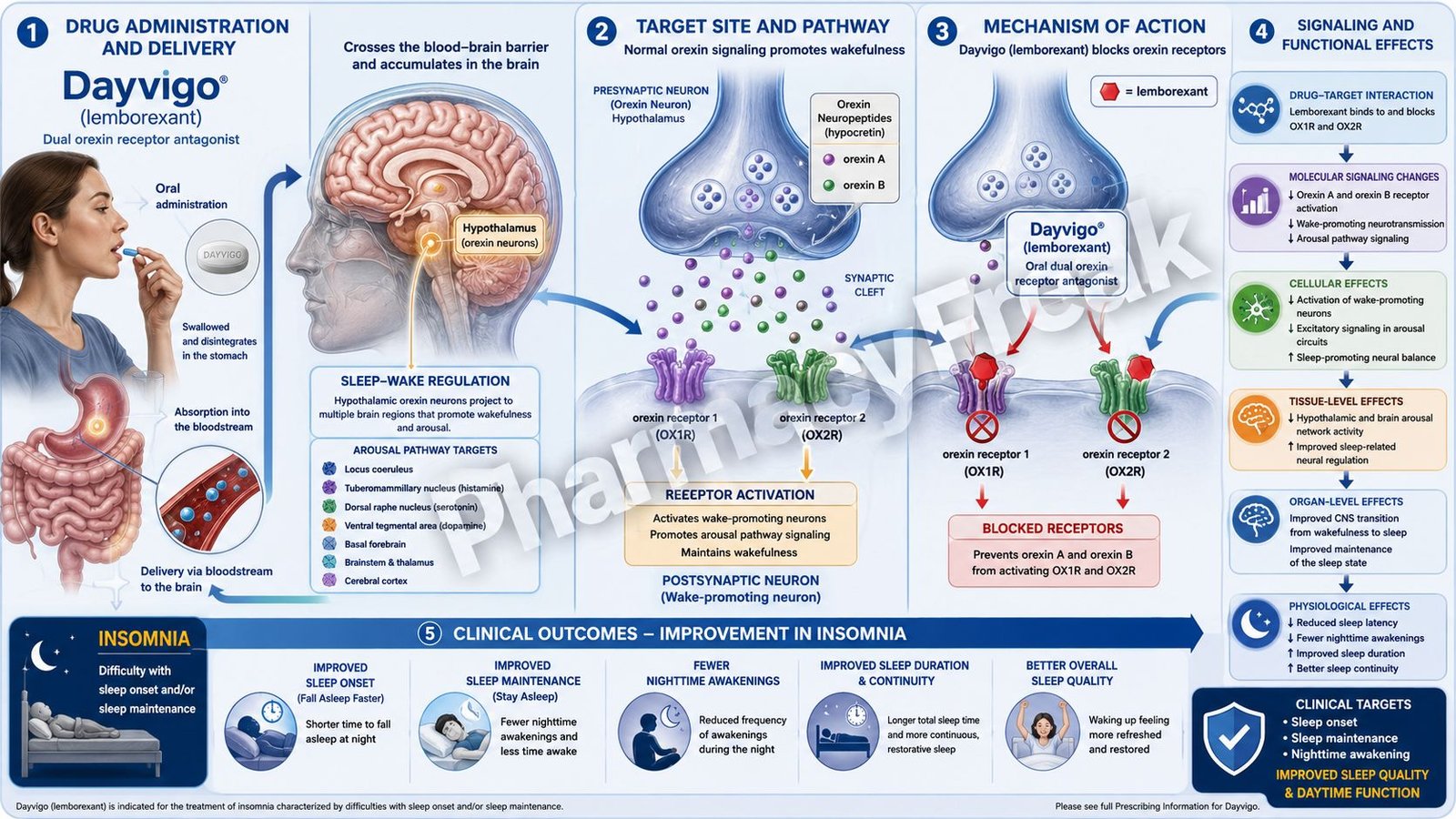
Dayvigo is the brand name of lemborexant, an oral hypnotic drug used in adults with insomnia. Pharmacologically, lemborexant is an orexin receptor antagonist and belongs to the class of dual orexin receptor antagonists, commonly abbreviated as DORAs.
Insomnia is characterized by difficulty falling asleep, difficulty staying asleep, or both. Many older hypnotic drugs promote sleep by enhancing GABAergic inhibition and broadly depressing central nervous system activity. Dayvigo works differently. It reduces wakefulness by blocking orexin signaling, a major wake-promoting system in the brain.
Orexins, also called hypocretins, are neuropeptides produced mainly in the lateral hypothalamus. Orexin A and orexin B activate two receptors: orexin receptor type 1, or OX1R, and orexin receptor type 2, or OX2R. These receptors help maintain wakefulness, arousal, alertness, and sleep-wake stability.
Lemborexant binds to OX1R and OX2R and acts as a competitive antagonist. By blocking orexin A and orexin B from activating these receptors, Dayvigo suppresses wake drive and helps improve sleep onset and sleep maintenance. The official label states that Dayvigo is indicated for adult patients with insomnia characterized by difficulties with sleep onset and/or sleep maintenance.
For exam purposes, Dayvigo should be remembered as a dual orexin receptor antagonist used for insomnia. Its mechanism is orexin receptor blockade, not direct GABA-A receptor activation.
Mechanism of Action (Step-wise)
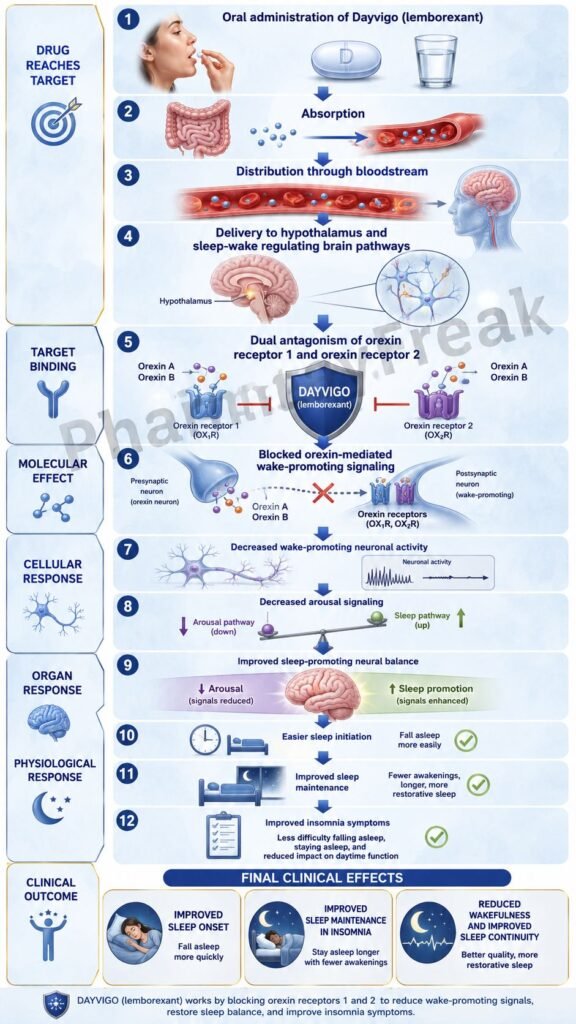
Step 1: Wakefulness is controlled by arousal pathways
Wakefulness depends on several brain systems, including orexin, histamine, dopamine, norepinephrine, serotonin, acetylcholine, glutamate, and other arousal networks. These systems help maintain alertness and prevent unwanted sleep during the day.
Step 2: Orexin neurons promote stable wakefulness
Orexin neurons are located mainly in the lateral hypothalamus. They project widely to wake-promoting brain regions and help stabilize the transition between wakefulness, non-REM sleep, and REM sleep.
Step 3: Orexin A and orexin B activate orexin receptors
Orexin A and orexin B activate OX1R and OX2R. These receptors are G-protein-coupled receptors involved in arousal, vigilance, attention, motivation, sympathetic activation, and sleep-wake regulation.
Step 4: Orexin signaling increases wake drive
When orexin signaling is active, wake-promoting brain centers remain stimulated. This helps the person stay awake, alert, and mentally responsive.
Step 5: Excess wake drive contributes to insomnia
In insomnia, patients may have persistent arousal and difficulty switching into sleep. Increased wake drive can cause difficulty falling asleep, frequent nocturnal awakenings, or early morning awakening.
Step 6: Dayvigo binds OX1R and OX2R
Lemborexant binds to both orexin receptors, OX1R and OX2R. The label describes lemborexant as a competitive antagonist of OX1R and OX2R, with IC50 values of 6.1 nM and 2.6 nM, respectively.
Step 7: Orexin receptor activation is blocked
Because lemborexant occupies orexin receptors, orexin A and orexin B cannot activate them effectively. This reduces orexin-mediated stimulation of wake-promoting neural circuits.
Step 8: Wake-promoting neurotransmission decreases
When orexin receptor signaling decreases, downstream arousal systems become less active. This reduces wakefulness and supports the natural transition into sleep.
Step 9: Sleep onset improves
By reducing wake drive, Dayvigo can help patients fall asleep more easily. This explains its role in insomnia with difficulty initiating sleep.
Step 10: Sleep maintenance improves
Orexin signaling also helps maintain wakefulness after nighttime arousals. Blocking orexin receptors can reduce nighttime wakefulness and help patients stay asleep longer.
Step 11: Dayvigo does not directly activate GABA-A receptors
Dayvigo is not a benzodiazepine, barbiturate, or Z-drug. It does not primarily cause sleep by directly enhancing GABA-A receptor activity. Its key mechanism is suppression of wake drive through orexin receptor antagonism.
Step 12: REM-related effects may occur
Because orexin signaling stabilizes sleep-wake and REM transitions, blocking orexin receptors may cause sleep paralysis, hypnagogic hallucinations, hypnopompic hallucinations, or cataplexy-like symptoms in some patients. These events are specifically listed in the Dayvigo warnings.
Step 13: Daytime impairment may occur
If the sedative effect persists into the next day, patients may experience somnolence, impaired alertness, poor motor coordination, or impaired driving ability. This risk increases with higher dose, inadequate sleep time, and use with other CNS depressants.
Step 14: Narcolepsy is a contraindication
Dayvigo is contraindicated in patients with narcolepsy. This is pharmacologically logical because narcolepsy is linked to impaired orexin signaling, and further blocking orexin receptors can worsen narcolepsy-like symptoms.
Step 15: Final therapeutic outcome
The final therapeutic outcome is improved sleep onset and/or sleep maintenance by reducing orexin-mediated wake drive. Dayvigo treats insomnia symptoms but does not cure underlying psychiatric, neurological, respiratory, or circadian causes of sleep disturbance.
Pharmacokinetics
Dayvigo is administered orally as lemborexant tablets. The recommended dose is 5 mg taken no more than once per night, immediately before going to bed, with at least 7 hours remaining before planned awakening. The dose may be increased to 10 mg based on clinical response and tolerability. The maximum recommended dose is 10 mg once daily.
Dayvigo tablets are available as 5 mg and 10 mg strengths. The tablet should be taken only when the patient can stay in bed for a full night. Taking it without enough sleep time increases the risk of next-day impairment.
Food can delay the onset of action. The label states that time to sleep onset may be delayed if Dayvigo is taken with or soon after a meal. A high-fat, high-calorie meal reduces peak concentration and delays time to peak concentration.
Lemborexant reaches peak plasma concentration in about 1 to 3 hours. Its effective half-life is about 17 hours for the 5 mg dose and 19 hours for the 10 mg dose. This relatively long half-life explains why next-day sleepiness can occur in some patients.
Lemborexant is highly distributed in the body, with a volume of distribution of approximately 1970 L. Plasma protein binding is approximately 88% in vitro and 94% in clinical samples.
Lemborexant is primarily metabolized by CYP3A4 and to a lesser extent by CYP3A5. Its major circulating metabolite is M10, which also binds orexin receptors with affinity comparable to the parent drug.
Elimination occurs mainly through feces, with a smaller portion eliminated in urine. After oral dosing, about 57.4% of the dose is recovered in feces and 29.1% in urine, with less than 1% excreted unchanged.
Drug interactions are clinically important. Strong or moderate CYP3A inhibitors should be avoided because they can increase lemborexant exposure and adverse effects. Strong or moderate CYP3A inducers should also be avoided because they can reduce drug exposure and effectiveness. When used with weak CYP3A inhibitors, the maximum recommended Dayvigo dose is 5 mg once nightly.
In moderate hepatic impairment, the maximum recommended dose is 5 mg once nightly. Dayvigo is not recommended in severe hepatic impairment. No clinically significant pharmacokinetic differences were observed based on age, sex, race, ethnicity, or body mass index.
Dayvigo is a Schedule IV controlled substance. Abuse potential exists, especially in patients with a history of substance misuse. The label reports that lemborexant produced subjective drug-liking responses similar to zolpidem and suvorexant in a human abuse potential study.
Clinical Uses
Dayvigo is used for the treatment of adult patients with insomnia characterized by difficulties with sleep onset and/or sleep maintenance.
It may help patients who have difficulty falling asleep, staying asleep, or returning to sleep after nighttime awakening. Its mechanism makes it especially important as a non-GABAergic hypnotic option.
Dayvigo is not used for narcolepsy. It is contraindicated in narcolepsy because orexin receptor blockade may worsen narcolepsy-related sleep-wake instability.
Dayvigo is not an antidepressant, antipsychotic, benzodiazepine, Z-drug, barbiturate, antihistamine, melatonin receptor agonist, or muscle relaxant. It is a dual orexin receptor antagonist.
Dayvigo should not be used as a substitute for evaluating underlying causes of insomnia. The label recommends reevaluation if insomnia does not improve after 7 to 10 days of treatment because persistent insomnia may reflect another physical or psychiatric condition.
Dayvigo is not approved for pediatric patients. Pediatric pharmacokinetics have not been studied, and safety and effectiveness in children have not been established.
Adverse Effects
The adverse effects of Dayvigo are mainly related to CNS depression, persistent sleepiness, abnormal sleep-wake transitions, psychiatric symptoms, respiratory caution, and drug interactions.
The most important warning is CNS depressant effect and daytime impairment. Dayvigo can impair alertness and motor coordination, including morning impairment. The risk increases with higher dose, use with other CNS depressants, and inadequate sleep time after dosing. Patients taking Dayvigo 10 mg should be cautioned about next-day driving and activities requiring full mental alertness.
Driving impairment is an important exam point. The label reports that driving ability was impaired in some subjects taking Dayvigo 10 mg. Patients should avoid driving if they feel sleepy or less alert after taking the drug.
Somnolence is the most common adverse reaction. In clinical studies, somnolence occurred in 10% of patients receiving Dayvigo 10 mg, 7% receiving Dayvigo 5 mg, and 1% receiving placebo.
Sleep paralysis, hypnagogic hallucinations, hypnopompic hallucinations, and cataplexy-like symptoms may occur. These effects are mechanistically related to orexin receptor blockade and altered sleep-wake transition control.
Complex sleep behaviors can occur. These may include sleep-walking, sleep-driving, preparing or eating food, making phone calls, or other activities while not fully awake. Dayvigo should be discontinued immediately if complex sleep behavior occurs.
Worsening depression and suicidal ideation may occur. Patients with depression, suicidal thoughts, or unusual behavioral changes should be monitored carefully. The lowest feasible number of tablets should be prescribed to reduce overdose risk.
Respiratory caution is important. The effect of Dayvigo on respiratory function should be considered in patients with compromised respiratory function. Clinically meaningful respiratory effects cannot be excluded in such patients.
Alcohol should be avoided with Dayvigo. Co-administration with alcohol can produce greater negative effects on postural stability and memory compared with alcohol alone. Other CNS depressants such as benzodiazepines, opioids, sedating antihistamines, antipsychotics, sedating antidepressants, or other hypnotics can increase sedation and impairment.
Nightmares and palpitations have been reported as reasons for discontinuation in clinical studies. Other possible adverse effects include headache, fatigue, dizziness, abnormal dreams, sleepiness, and impaired coordination.
Dayvigo is a Schedule IV controlled substance. Patients with a history of alcohol or drug abuse should be monitored carefully for misuse, abuse, or dose escalation.
Comparative Analysis
Dayvigo is commonly compared with suvorexant, daridorexant, zolpidem, zaleplon, eszopiclone, benzodiazepines, ramelteon, melatonin, doxepin, trazodone, and sedating antihistamines.
Compared with suvorexant, Dayvigo belongs to the same broad class of dual orexin receptor antagonists. Both block OX1R and OX2R and reduce wake drive. They differ in pharmacokinetics, dosing, receptor binding profile, next-day impairment risk, and clinical response.
Compared with daridorexant, Dayvigo also blocks dual orexin receptors. Daridorexant is another DORA used for insomnia. Both reduce wakefulness through orexin receptor antagonism, but they differ in half-life, dosing, and next-day effect considerations.
Compared with zolpidem, Dayvigo has a different mechanism. Zolpidem is a Z-drug that enhances GABA-A receptor activity at the benzodiazepine receptor site. Dayvigo does not directly activate GABA-A receptors; it blocks orexin-mediated wakefulness.
Compared with benzodiazepines such as temazepam, diazepam, or lorazepam, Dayvigo is less broadly CNS depressant in mechanism. Benzodiazepines enhance GABA-A receptor activity and may cause sedation, muscle relaxation, anxiolysis, anticonvulsant effects, tolerance, dependence, and withdrawal. Dayvigo targets orexin receptors.
Compared with ramelteon, Dayvigo works through orexin receptor antagonism, while ramelteon is a melatonin MT1/MT2 receptor agonist. Ramelteon mainly helps sleep onset and is not a controlled substance, while Dayvigo is Schedule IV.
Compared with low-dose doxepin, Dayvigo has a different target. Low-dose doxepin helps sleep maintenance mainly through histamine H1 receptor antagonism. Dayvigo improves sleep by suppressing orexin-driven wakefulness.
Compared with sedating antihistamines such as diphenhydramine or doxylamine, Dayvigo is more specific to the sleep-wake system. Antihistamines block H1 receptors and may cause anticholinergic adverse effects such as dry mouth, constipation, urinary retention, confusion, and next-day sedation.
Compared with trazodone, Dayvigo is an approved insomnia medication with a defined orexin receptor mechanism. Trazodone is an antidepressant often used off-label for insomnia and acts through serotonergic, histaminergic, and adrenergic mechanisms.
Compared with melatonin, Dayvigo does not primarily shift circadian rhythm. Melatonin supports circadian signaling, while Dayvigo suppresses wake drive by blocking orexin receptors.
MCQs
- Dayvigo contains which active drug?
a) Suvorexant
b) Lemborexant
c) Daridorexant
d) Ramelteon
Answer: b) Lemborexant
- Dayvigo belongs to which pharmacological class?
a) Dual orexin receptor antagonist
b) Benzodiazepine receptor agonist
c) Melatonin receptor agonist
d) Histamine H1 antagonist
Answer: a) Dual orexin receptor antagonist
- The main receptors blocked by lemborexant are:
a) OX1R and OX2R
b) GABA-A and GABA-B
c) MT1 and MT2
d) Dopamine D2 and D3
Answer: a) OX1R and OX2R
- Orexin A and orexin B normally promote:
a) Wakefulness and arousal
b) Platelet aggregation
c) Gastric acid secretion only
d) Insulin release only
Answer: a) Wakefulness and arousal
- Dayvigo improves insomnia mainly by:
a) Suppressing orexin-mediated wake drive
b) Stimulating dopamine release
c) Blocking bacterial ribosomes
d) Activating beta-1 receptors
Answer: a) Suppressing orexin-mediated wake drive
- Dayvigo is indicated for insomnia characterized by:
a) Sleep onset and/or sleep maintenance difficulty
b) Acute psychosis
c) Narcolepsy with cataplexy
d) Epilepsy
Answer: a) Sleep onset and/or sleep maintenance difficulty
- Dayvigo is contraindicated in patients with:
a) Narcolepsy
b) Migraine
c) Hypothyroidism
d) Hypertension only
Answer: a) Narcolepsy
- The recommended starting dose of Dayvigo is:
a) 5 mg once nightly
b) 100 mg twice daily
c) 40 mg every morning
d) 300 mg intravenously monthly
Answer: a) 5 mg once nightly
- The maximum recommended Dayvigo dose is:
a) 10 mg once nightly
b) 20 mg twice daily
c) 80 mg once nightly
d) 150 mg once daily
Answer: a) 10 mg once nightly
- Dayvigo should be taken when the patient has at least:
a) 7 hours before planned awakening
b) 1 hour before planned awakening
c) 24 hours before planned awakening
d) 30 minutes before daytime work
Answer: a) 7 hours before planned awakening
- Dayvigo is mainly metabolized by:
a) CYP3A4
b) Acetylcholinesterase
c) DPP-4
d) Monoamine oxidase-B
Answer: a) CYP3A4
- Strong or moderate CYP3A inhibitors should generally be:
a) Avoided with Dayvigo
b) Used to reduce sedation
c) Used to improve metabolism
d) Required with every dose
Answer: a) Avoided with Dayvigo
- The most common adverse reaction with Dayvigo is:
a) Somnolence
b) Severe hypoglycemia
c) Ototoxicity
d) Gingival hyperplasia
Answer: a) Somnolence
- Which sleep-related adverse effect may occur with Dayvigo?
a) Sleep paralysis and hypnagogic/hypnopompic hallucinations
b) Permanent REM sleep elimination
c) Forced daytime wakefulness
d) Complete prevention of dreams
Answer: a) Sleep paralysis and hypnagogic/hypnopompic hallucinations
- Which statement best describes Dayvigo?
a) It competitively blocks OX1R and OX2R, reducing orexin-mediated wake drive in insomnia
b) It directly activates GABA-A receptors like benzodiazepines
c) It stimulates melatonin receptors only
d) It inhibits acetylcholinesterase to improve cognition
Answer: a) It competitively blocks OX1R and OX2R, reducing orexin-mediated wake drive in insomnia
FAQs
What is the mechanism of action of Dayvigo?
Dayvigo, or lemborexant, blocks orexin receptors OX1R and OX2R. By preventing orexin A and orexin B from activating these receptors, it suppresses wake drive and helps improve sleep onset and sleep maintenance.
What is the generic name of Dayvigo?
The generic name of Dayvigo is lemborexant.
What is Dayvigo used for?
Dayvigo is used in adults for insomnia characterized by difficulty falling asleep, difficulty staying asleep, or both.
Is Dayvigo a benzodiazepine?
No. Dayvigo is not a benzodiazepine. It is a dual orexin receptor antagonist. Benzodiazepines enhance GABA-A receptor activity, while Dayvigo blocks orexin-mediated wakefulness.
Why is Dayvigo contraindicated in narcolepsy?
Narcolepsy is linked to impaired orexin signaling. Since Dayvigo blocks orexin receptors, it can worsen narcolepsy-like symptoms and is contraindicated in patients with narcolepsy.
Can Dayvigo cause next-day sleepiness?
Yes. Dayvigo can cause next-day drowsiness, impaired alertness, poor coordination, and impaired driving, especially at higher doses or when taken without enough time for sleep.
Why should alcohol be avoided with Dayvigo?
Alcohol can add to Dayvigo’s CNS depressant effects and worsen psychomotor impairment, memory impairment, sedation, poor balance, and accident risk.
What are common adverse effects of Dayvigo?
Common adverse effects include somnolence, nightmares, fatigue, headache, dizziness, abnormal dreams, palpitations, sleep paralysis, hallucinations around sleep, and next-day impairment.
References
Goodman & Gilman’s The Pharmacological Basis of Therapeutics
Katzung Basic & Clinical Pharmacology