Table of Contents
Introduction
Fasenra is the brand name of benralizumab, a humanized monoclonal antibody used mainly in the management of severe eosinophilic asthma. It belongs to the class of biologic anti-eosinophilic therapies and is especially important in patients whose asthma remains uncontrolled despite standard inhaled corticosteroid and long-acting bronchodilator therapy.
Unlike conventional asthma medicines such as beta-2 agonists or corticosteroids, Fasenra does not provide immediate bronchodilation. Instead, it works by targeting eosinophils, which are inflammatory cells strongly involved in airway inflammation, mucus production, bronchial hyperresponsiveness, and recurrent asthma exacerbations.
For pharmacy, medical, nursing, and competitive exam students, Fasenra is important because it represents a modern biologic approach in asthma therapy. Its mechanism is different from drugs that block interleukin-5 itself, because Fasenra binds to the interleukin-5 receptor alpha subunit on eosinophils and basophils and promotes antibody-dependent cellular cytotoxicity.
Mechanism of Action (Step-wise)
- Binding to IL-5 receptor alpha
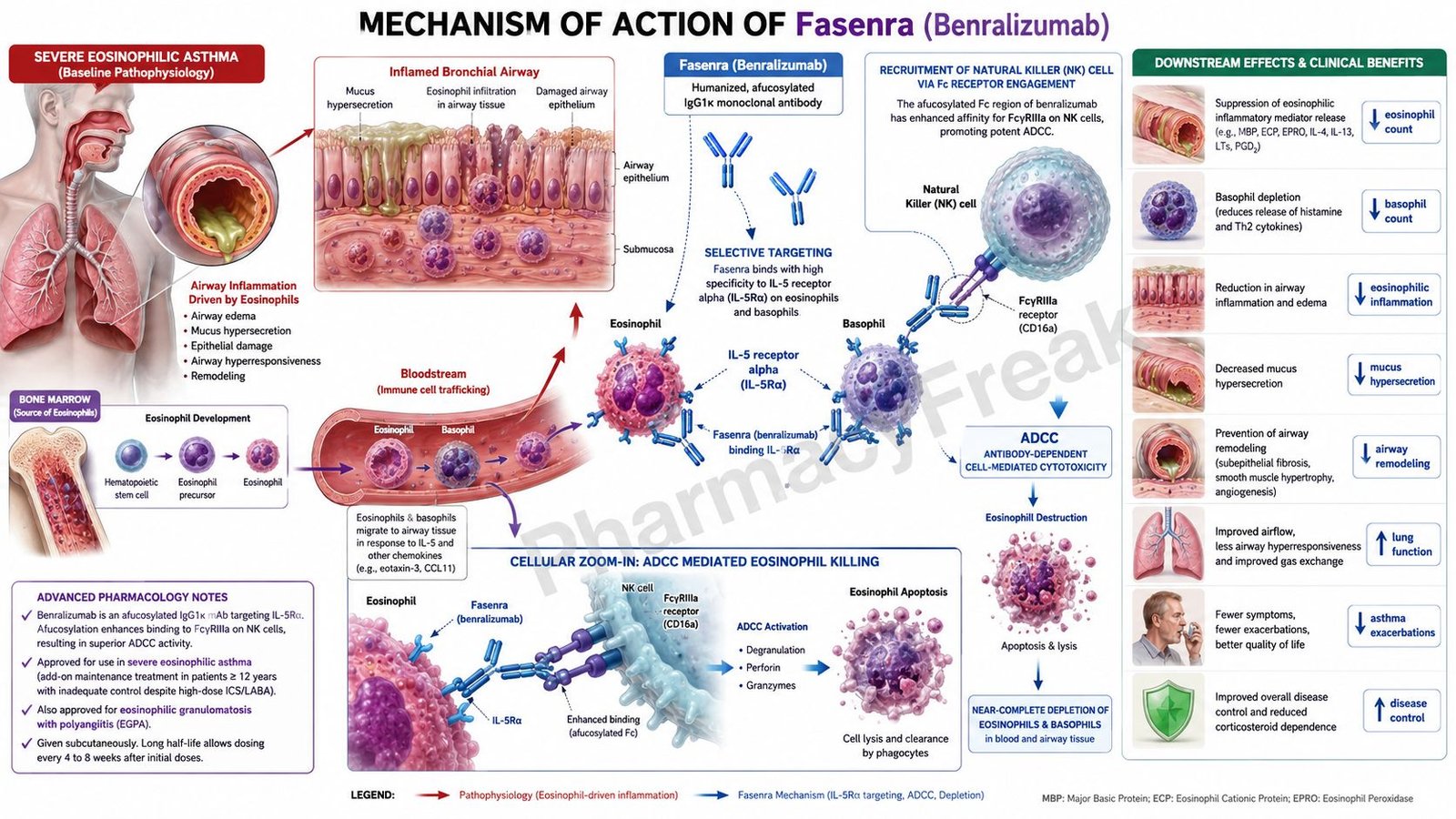
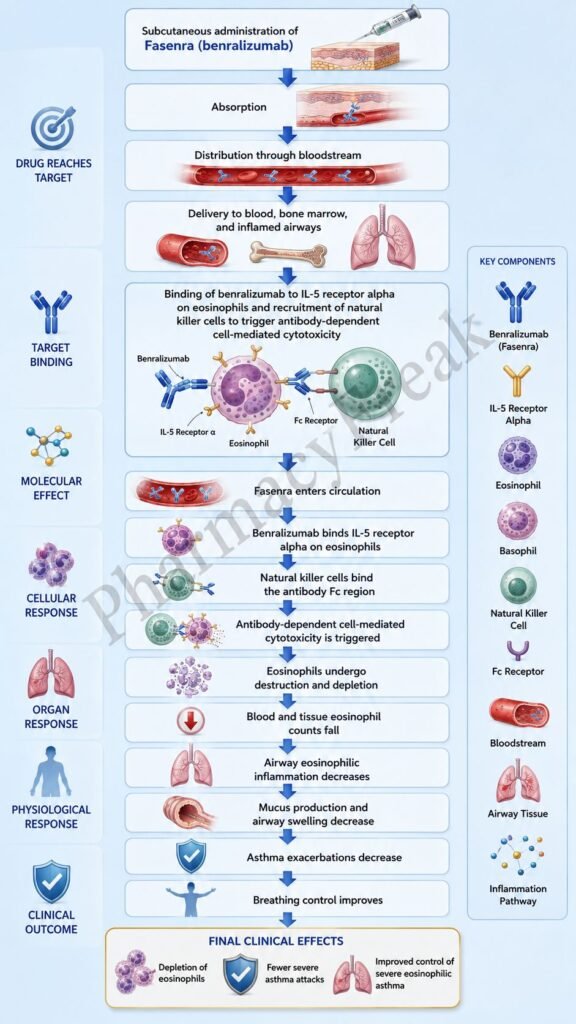
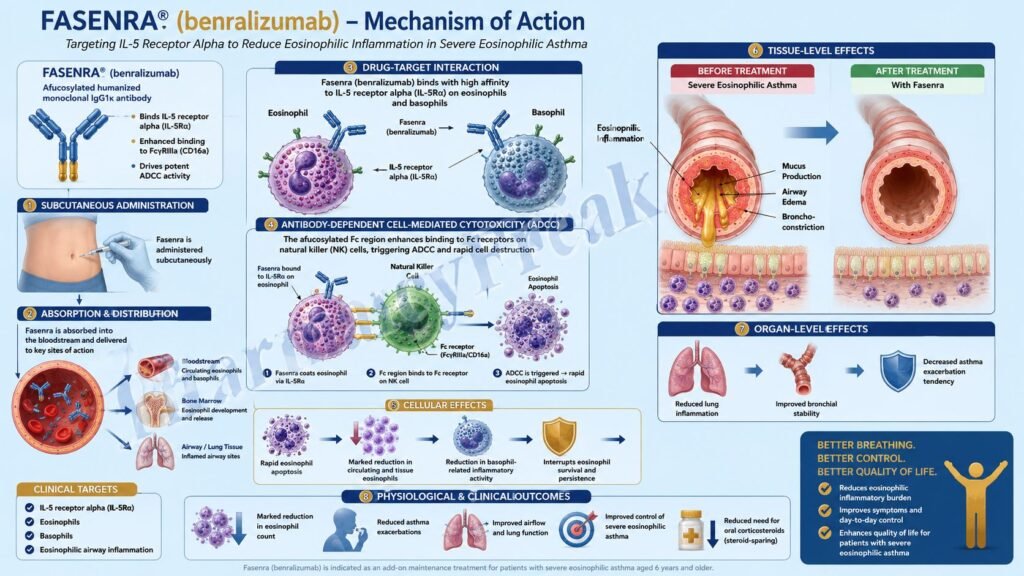
Fasenra contains benralizumab, a monoclonal antibody that selectively binds to the alpha subunit of the interleukin-5 receptor, known as IL-5Rα. This receptor is mainly expressed on eosinophils and basophils.
- Interference with IL-5 signaling
Interleukin-5 is an important cytokine responsible for eosinophil growth, maturation, activation, survival, and recruitment into inflamed tissues. By binding to IL-5Rα, Fasenra interferes with IL-5-mediated eosinophil activity.
- Recruitment of natural killer cells
Benralizumab has an Fc region that enhances interaction with Fc gamma receptor IIIa on natural killer cells. This helps natural killer cells recognize antibody-coated eosinophils.
- Antibody-dependent cellular cytotoxicity
After Fasenra binds to IL-5Rα on eosinophils, natural killer cells attach to the Fc portion of the antibody. This triggers antibody-dependent cellular cytotoxicity, leading to apoptosis and rapid depletion of eosinophils.
- Reduction of eosinophilic airway inflammation
Eosinophil depletion reduces airway inflammation, mucus secretion, epithelial injury, and bronchial hyperresponsiveness. This is especially useful in eosinophilic asthma, where eosinophils play a major role in disease progression.
- Final therapeutic effect
The final therapeutic effect is improved asthma control, reduced frequency of exacerbations, reduced eosinophilic inflammation, and better long-term respiratory stability. However, Fasenra is not used for acute bronchospasm or sudden asthma attacks.
Pharmacokinetics
Fasenra is administered by subcutaneous injection. Since benralizumab is a monoclonal antibody, its pharmacokinetic behavior is different from small-molecule drugs.
Absorption:
After subcutaneous administration, benralizumab is absorbed slowly into the systemic circulation. This gradual absorption supports long dosing intervals.
Distribution:
As a monoclonal antibody, Fasenra mainly distributes within the vascular and interstitial spaces. It does not widely distribute into lipid-rich tissues like many small lipophilic drugs.
Metabolism:
Benralizumab is not metabolized by hepatic cytochrome P450 enzymes. Like other IgG monoclonal antibodies, it is degraded by proteolytic enzymes into small peptides and amino acids.
Excretion:
Fasenra is not primarily eliminated unchanged through the kidneys. Its clearance occurs mainly through normal protein catabolism.
Half-life and duration:
Fasenra has a long elimination half-life, allowing less frequent dosing. In asthma therapy, it is usually given every 4 weeks initially and then every 8 weeks for maintenance. The prolonged clinical effect is related to sustained eosinophil depletion.
Clinical Uses
- Severe eosinophilic asthma:
Fasenra is used as add-on maintenance therapy in patients with severe asthma associated with an eosinophilic phenotype. - Uncontrolled asthma despite standard therapy:
It is useful in patients who remain symptomatic despite inhaled corticosteroids, long-acting beta-2 agonists, and other controller medicines. - Reduction of asthma exacerbations:
By reducing eosinophilic airway inflammation, Fasenra helps lower the frequency of severe asthma exacerbations. - Steroid-sparing effect:
In selected patients with severe eosinophilic asthma, Fasenra may help reduce the need for chronic oral corticosteroid therapy. - Eosinophilic granulomatosis with polyangiitis:
Fasenra may also be used in eosinophilic granulomatosis with polyangiitis, a condition associated with asthma, eosinophilia, and systemic vasculitis.
Adverse Effects
Common and clinically important adverse effects of Fasenra include:
- Headache
- Pharyngitis
- Fever
- Sore throat
- Injection site reactions
- Rash
- Urticaria
- Hypersensitivity reactions
- Rare anaphylaxis
Clinically important precautions include the risk of hypersensitivity reactions after administration. Since eosinophils may contribute to defense against helminth infections, pre-existing parasitic infections should be treated before starting therapy when clinically appropriate.
Fasenra should not be used for acute asthma symptoms, acute bronchospasm, or status asthmaticus. Patients should continue their prescribed controller medicines unless advised otherwise by a healthcare professional.
Comparative Analysis
| Feature | Fasenra | Mepolizumab | Reslizumab | Omalizumab |
|---|---|---|---|---|
| Generic name | Benralizumab | Mepolizumab | Reslizumab | Omalizumab |
| Main target | IL-5 receptor alpha | IL-5 | IL-5 | IgE |
| Drug class | Anti-IL-5 receptor monoclonal antibody | Anti-IL-5 monoclonal antibody | Anti-IL-5 monoclonal antibody | Anti-IgE monoclonal antibody |
| Main effect | Eosinophil depletion by ADCC | Reduces IL-5 activity | Reduces IL-5 activity | Reduces IgE-mediated allergic response |
| Main use | Severe eosinophilic asthma | Severe eosinophilic asthma | Severe eosinophilic asthma | Allergic asthma |
| Route | Subcutaneous | Subcutaneous | Intravenous | Subcutaneous |
| Acute asthma relief | No | No | No | No |
Fasenra differs from mepolizumab and reslizumab because it binds to IL-5 receptor alpha rather than directly binding IL-5. This allows Fasenra to cause direct eosinophil depletion through antibody-dependent cellular cytotoxicity. Omalizumab is different because it targets IgE and is mainly used in allergic asthma rather than specifically eosinophilic asthma.
MCQs
- Fasenra contains which active drug?
a) Mepolizumab
b) Benralizumab
c) Omalizumab
d) Reslizumab
Answer: b) Benralizumab
- Fasenra primarily targets which receptor?
a) Beta-2 adrenergic receptor
b) Histamine H1 receptor
c) IL-5 receptor alpha
d) Muscarinic M3 receptor
Answer: c) IL-5 receptor alpha
- The major inflammatory cell depleted by Fasenra is:
a) Neutrophil
b) Platelet
c) Eosinophil
d) Red blood cell
Answer: c) Eosinophil
- Fasenra is mainly used in which condition?
a) Acute myocardial infarction
b) Severe eosinophilic asthma
c) Acute bacterial pneumonia
d) Hypertensive emergency
Answer: b) Severe eosinophilic asthma
- Fasenra produces eosinophil depletion mainly through:
a) Acetylcholinesterase inhibition
b) Cyclooxygenase inhibition
c) Antibody-dependent cellular cytotoxicity
d) Dopamine receptor blockade
Answer: c) Antibody-dependent cellular cytotoxicity
- Which immune cell is mainly involved in Fasenra-induced ADCC?
a) Natural killer cell
b) Erythrocyte
c) Mast cell
d) Plasma cell
Answer: a) Natural killer cell
- Fasenra is not suitable for:
a) Maintenance treatment of severe eosinophilic asthma
b) Reducing asthma exacerbations
c) Acute relief of bronchospasm
d) Targeting eosinophilic inflammation
Answer: c) Acute relief of bronchospasm
- Which cytokine pathway is most closely related to the action of Fasenra?
a) IL-5 pathway
b) Insulin pathway
c) Renin-angiotensin pathway
d) Dopamine pathway
Answer: a) IL-5 pathway
- Which of the following is a common adverse effect of Fasenra?
a) Headache
b) Severe hypoglycemia
c) Tinnitus
d) Hyperkalemia
Answer: a) Headache
- Fasenra differs from mepolizumab because Fasenra:
a) Blocks beta receptors
b) Binds IL-5 receptor alpha
c) Inhibits leukotriene synthesis
d) Blocks IgE directly
Answer: b) Binds IL-5 receptor alpha
- Benralizumab is best classified as a:
a) Macrolide antibiotic
b) Monoclonal antibody
c) Calcium channel blocker
d) Anticholinergic bronchodilator
Answer: b) Monoclonal antibody
- Fasenra is administered mainly by which route?
a) Oral
b) Intramuscular
c) Subcutaneous
d) Inhalational
Answer: c) Subcutaneous
- Which statement about Fasenra is correct?
a) It is a rescue inhaler
b) It directly relaxes bronchial smooth muscle within minutes
c) It reduces eosinophilic inflammation over time
d) It is used as first-line therapy for mild intermittent asthma
Answer: c) It reduces eosinophilic inflammation over time
- Which drug primarily targets IgE rather than IL-5 or IL-5 receptor?
a) Omalizumab
b) Benralizumab
c) Reslizumab
d) Mepolizumab
Answer: a) Omalizumab
- Fasenra mainly helps asthma patients by:
a) Increasing mucus secretion
b) Increasing eosinophil survival
c) Reducing eosinophilic airway inflammation
d) Blocking insulin receptors
Answer: c) Reducing eosinophilic airway inflammation
FAQs
- What is Fasenra used for?
Fasenra is mainly used as add-on maintenance treatment for severe eosinophilic asthma. It helps reduce asthma exacerbations and improves long-term asthma control in suitable patients.
- What is the mechanism of action of Fasenra?
Fasenra binds to IL-5 receptor alpha on eosinophils and basophils. It promotes antibody-dependent cellular cytotoxicity, leading to eosinophil depletion and reduced airway inflammation.
- Is Fasenra a steroid?
No. Fasenra is not a steroid. It is a monoclonal antibody biologic therapy used to target eosinophilic inflammation.
- Can Fasenra be used during an acute asthma attack?
No. Fasenra is not a rescue medicine and should not be used for sudden breathing difficulty or acute bronchospasm.
- How is Fasenra different from mepolizumab?
Fasenra binds to IL-5 receptor alpha and directly depletes eosinophils through ADCC. Mepolizumab binds IL-5 itself and reduces IL-5-mediated eosinophil activation.
- What are the common side effects of Fasenra?
Common side effects include headache, pharyngitis, fever, sore throat, and injection site reactions. Rare but serious hypersensitivity reactions may occur.
- Why is eosinophil depletion useful in asthma?
In eosinophilic asthma, eosinophils contribute to airway inflammation, mucus production, epithelial injury, and bronchial hyperresponsiveness. Reducing eosinophils helps improve asthma control and lowers exacerbation risk.
- Is Fasenra given orally?
No. Fasenra is given by subcutaneous injection.
References
Goodman & Gilman’s The Pharmacological Basis of Therapeutics
Katzung Basic & Clinical Pharmacology