Table of Contents
Introduction
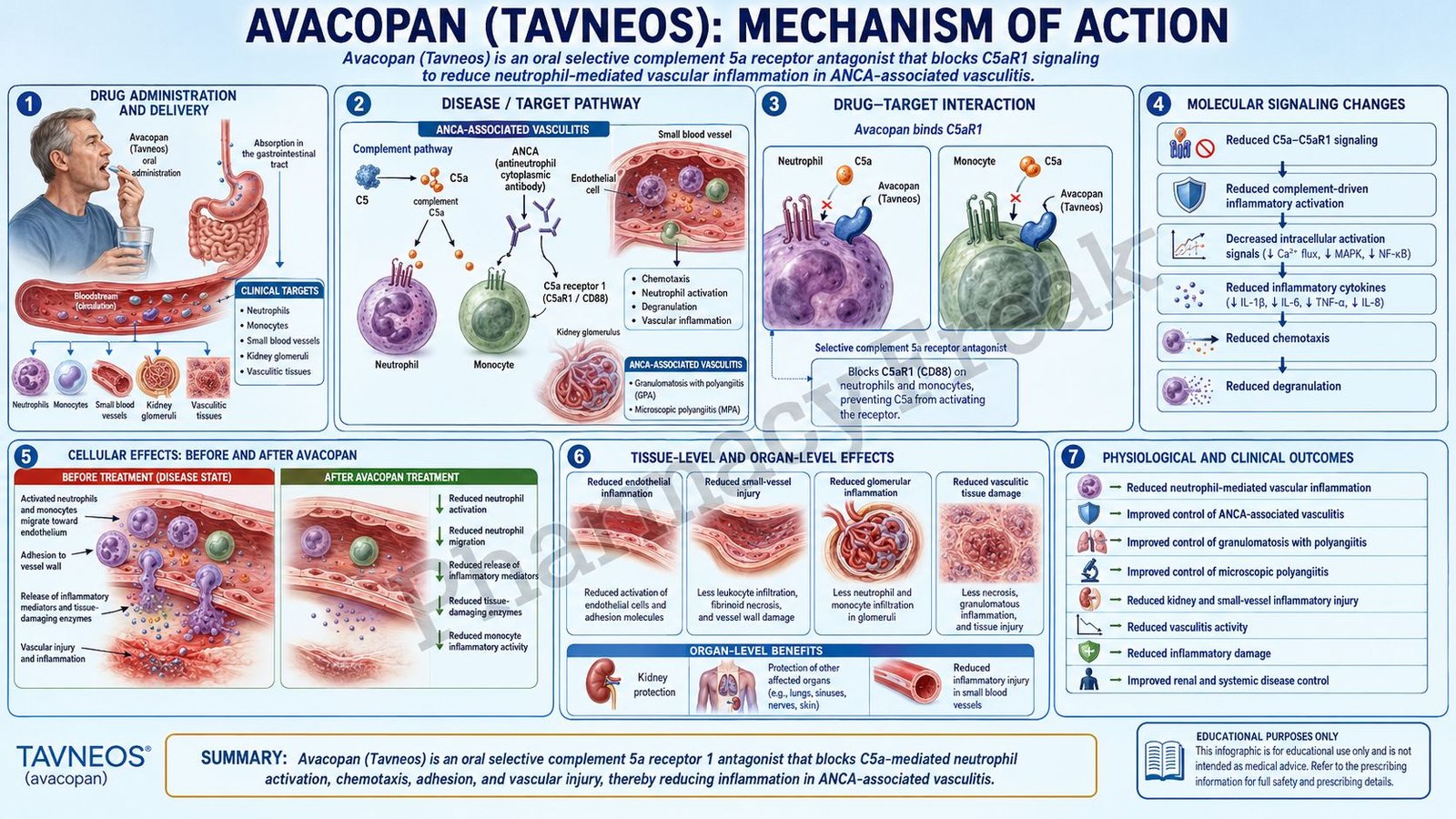
Avacopan is an oral immunology drug marketed under the brand name Tavneos. Pharmacologically, avacopan is a complement 5a receptor antagonist, commonly written as a C5aR antagonist.
Anti-neutrophil cytoplasmic autoantibody-associated vasculitis, or ANCA-associated vasculitis, is an autoimmune small-vessel vasculitis. It includes granulomatosis with polyangiitis, also called GPA, and microscopic polyangiitis, also called MPA. In these diseases, immune dysregulation activates neutrophils and causes inflammation of small blood vessels. This can damage the kidneys, lungs, skin, nerves, upper airways, and other organs.
The complement system plays an important role in inflammatory amplification in ANCA-associated vasculitis. One of the key complement mediators is C5a, a powerful anaphylatoxin. C5a binds to the C5a receptor on neutrophils and promotes neutrophil activation, migration, adhesion, oxidative burst, degranulation, and vascular inflammation.
Avacopan works by blocking the interaction between C5a and the C5a receptor. The official label states that avacopan is a C5aR antagonist that inhibits the interaction between C5aR and the anaphylatoxin C5a, blocking C5a-mediated neutrophil activation and migration. The precise mechanism by which avacopan produces therapeutic benefit in ANCA-associated vasculitis has not been definitively established.
Tavneos is indicated as an adjunctive treatment of adults with severe active ANCA-associated vasculitis, specifically GPA and MPA, in combination with standard therapy including glucocorticoids. The label also states that Tavneos does not eliminate glucocorticoid use.
For exam purposes, avacopan should be remembered as an oral C5a receptor antagonist that reduces C5a-mediated neutrophil activation and migration in severe active ANCA-associated vasculitis.
Mechanism of Action (Step-wise)
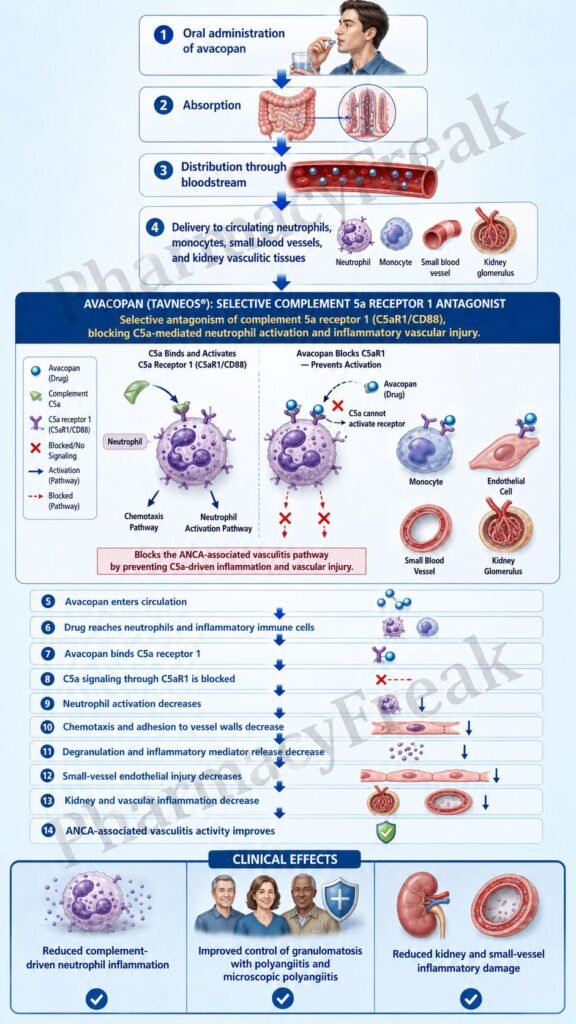
Step 1: ANCA-associated vasculitis is an autoimmune small-vessel vasculitis
ANCA-associated vasculitis involves inflammation and injury of small blood vessels. The main clinical types are granulomatosis with polyangiitis and microscopic polyangiitis.
Step 2: ANCAs activate neutrophil-mediated inflammation
Anti-neutrophil cytoplasmic autoantibodies can interact with primed neutrophils and contribute to abnormal neutrophil activation. Activated neutrophils can adhere to endothelial surfaces and release inflammatory mediators.
Step 3: Complement activation amplifies vascular inflammation
Complement activation can amplify ANCA-associated inflammation. The alternative complement pathway is especially important in maintaining inflammatory feedback loops in ANCA-associated vasculitis.
Step 4: C5 is cleaved to form C5a and C5b
During complement activation, complement protein C5 is cleaved into C5a and C5b. C5a is a potent inflammatory anaphylatoxin, while C5b contributes to terminal complement complex formation.
Step 5: C5a binds to C5a receptors on neutrophils
C5a binds to C5a receptors, especially on neutrophils and other immune cells. C5a-C5aR binding promotes neutrophil chemotaxis, activation, adhesion, and inflammatory mediator release.
Step 6: C5a promotes neutrophil migration
C5a acts as a chemotactic signal, attracting neutrophils toward inflammatory sites. In vasculitis, this can increase neutrophil accumulation around small blood vessels.
Step 7: C5a promotes neutrophil activation
After C5a binds C5aR, neutrophils become more activated. Activated neutrophils can release reactive oxygen species, proteolytic enzymes, cytokines, and inflammatory granule contents.
Step 8: Neutrophils injure vascular endothelium
Activated neutrophils can damage endothelial cells lining small blood vessels. This leads to vessel wall inflammation, necrosis, leakage, thrombosis, and tissue injury.
Step 9: Organ damage develops
Small-vessel inflammation can damage multiple organs. Kidney involvement can cause glomerulonephritis, hematuria, proteinuria, and renal dysfunction. Lung involvement may cause pulmonary inflammation, bleeding, or respiratory symptoms.
Step 10: Avacopan blocks C5a receptor signaling
Avacopan binds to and antagonizes the complement C5a receptor. This prevents C5a from effectively activating C5aR-mediated inflammatory signaling. The official label identifies avacopan as a C5aR antagonist.
Step 11: C5a-mediated neutrophil activation decreases
By blocking C5aR, avacopan reduces C5a-mediated neutrophil activation. This helps reduce the inflammatory behavior of neutrophils in ANCA-associated vasculitis.
Step 12: C5a-mediated neutrophil migration decreases
Avacopan also blocks C5a-mediated neutrophil migration. The label specifically states that avacopan blocks C5a-mediated neutrophil activation and migration.
Step 13: Vascular inflammation decreases
With reduced neutrophil activation and migration, inflammatory injury to small blood vessels decreases. This can help reduce disease activity in GPA and MPA.
Step 14: Avacopan does not directly block C5 cleavage
Avacopan blocks the C5a receptor. It does not work in the same way as C5 inhibitors such as eculizumab or ravulizumab, which bind C5 and prevent C5 cleavage. Avacopan acts downstream by preventing C5a from activating its receptor.
Step 15: Final therapeutic outcome
The final therapeutic effect is reduced C5a-C5aR-driven neutrophilic inflammation in severe active ANCA-associated vasculitis. This helps support disease control when used with standard therapy including glucocorticoids.
Pharmacokinetics
Avacopan is administered orally as Tavneos capsules. The recommended dose is 30 mg, given as three 10 mg capsules, twice daily with food. Capsules should not be crushed, chewed, or opened. If a dose is missed, the patient should take the next regular scheduled dose and should not double the next dose.
Tavneos is available as 10 mg capsules. The label describes the capsules as opaque yellow and light orange capsules with “CCX168” printed on them.
Before starting Tavneos, liver function tests should be obtained, including ALT, AST, alkaline phosphatase, and total bilirubin. Hepatitis B serology should also be checked because hepatitis B reactivation has been reported with Tavneos.
Food increases avacopan exposure. The label reports that administration of 30 mg with a high-fat, high-calorie meal increases avacopan AUC by about 72% and Cmax by about 8%, while delaying Tmax from about 2 hours to 6 hours. This supports the instruction to take Tavneos with food.
Avacopan and its metabolite M1 are highly protein bound, more than 99.9%. The apparent volume of distribution is estimated at approximately 345 L.
Avacopan has a long half-life. After a single 30 mg dose with food, mean elimination half-lives of avacopan and metabolite M1 were approximately 97.6 hours and 55.6 hours, respectively, in healthy subjects.
The main route of clearance is metabolism followed by biliary excretion of metabolites into feces. After radiolabeled avacopan, about 77% of radioactivity was recovered in feces and about 10% in urine. Very little unchanged avacopan was recovered in urine.
Drug interactions are important. When Tavneos is used with strong CYP3A4 inhibitors, the dose should be reduced to 30 mg once daily. Strong CYP3A4 inducers may reduce avacopan exposure and can reduce effectiveness. Avacopan is also a moderate CYP3A4 inhibitor and may increase exposure to some CYP3A4 substrates, including simvastatin.
No dose adjustment is required in mild, moderate, or severe renal impairment, but Tavneos has not been studied in patients with ANCA-associated vasculitis who are on dialysis. No dose adjustment is recommended for mild or moderate hepatic impairment, but Tavneos has not been studied in severe hepatic impairment and is not recommended in patients with cirrhosis, especially severe hepatic impairment.
Clinical Uses
Avacopan is used as Tavneos for adult patients with severe active ANCA-associated vasculitis. The approved disease types are granulomatosis with polyangiitis and microscopic polyangiitis.
It is used as adjunctive treatment, meaning it is added to standard therapy rather than replacing all other therapy. The current label states that Tavneos is used in combination with standard therapy including glucocorticoids and does not eliminate glucocorticoid use.
In GPA, avacopan helps reduce complement-mediated neutrophil activation that contributes to granulomatous inflammation and small-vessel vasculitis. GPA may involve the upper airway, lungs, kidneys, skin, eyes, nerves, and other organs.
In MPA, avacopan helps reduce C5a-C5aR-mediated neutrophilic inflammation that contributes to necrotizing small-vessel vasculitis and organ damage, especially kidney and lung involvement.
Avacopan is not a corticosteroid, cytotoxic immunosuppressant, anti-CD20 antibody, TNF inhibitor, JAK inhibitor, or C5 monoclonal antibody. It is a selective oral C5a receptor antagonist.
Avacopan is not used as emergency monotherapy for life-threatening vasculitis complications. Severe organ-threatening disease still requires specialist-directed induction therapy, monitoring, and supportive care.
Tavneos is not approved for pediatric patients. The label states that safety and effectiveness in pediatric patients have not been established.
Adverse Effects
The most important safety issue with avacopan is hepatotoxicity. Serious cases of hepatic injury have been observed in patients taking Tavneos. The label was updated in May 2026 for hepatotoxicity, and it reports postmarketing cases of vanishing bile duct syndrome, including fatal cases, predominantly in Japan in patients aged 65 years and older, although it may affect patients of any age or ethnicity receiving Tavneos.
Liver function tests should be obtained before starting therapy, every 4 weeks after starting treatment for the first 6 months, and as clinically indicated thereafter. Patients should report symptoms such as jaundice, dark urine, pruritus, right upper abdominal pain, fatigue, loss of appetite, easy bruising, or bleeding.
Serious hypersensitivity reactions can occur. Tavneos is contraindicated in patients with serious hypersensitivity to avacopan or any excipient. Angioedema has occurred in clinical trials. Symptoms may include swelling of the face, lips, tongue, throat, difficulty swallowing, or difficulty breathing.
Hepatitis B virus reactivation is another important warning. Patients should be screened for HBV before starting therapy. In patients with current or previous HBV infection, specialist consultation is recommended for monitoring and possible antiviral therapy.
Serious infections have been reported in patients receiving Tavneos. Because patients with ANCA-associated vasculitis often receive additional immunosuppressive therapy, infection monitoring is important. Patients should report fever, chills, cough, painful urination, skin infection, weakness, or other signs of infection.
Common adverse reactions include nausea, headache, hypertension, diarrhea, vomiting, rash, fatigue, upper abdominal pain, dizziness, increased blood creatinine, paresthesia, cough, and upper respiratory tract infection. These adverse effects are important for exam and clinical counseling.
Hypertension can occur in patients treated with avacopan. Blood pressure should be monitored, especially because ANCA-associated vasculitis patients may already have renal involvement or steroid-related blood pressure elevation.
Gastrointestinal adverse effects such as nausea, vomiting, diarrhea, and abdominal pain may occur. These can affect adherence and hydration status.
Pregnancy data are limited. There are no adequate and well-controlled studies in pregnant women. Animal studies did not show structural fetal harm at studied exposures, but increased abortions were observed in rabbits at certain exposures.
It is unknown whether avacopan is secreted in human milk. Animal data suggest secretion into milk in hamsters. The benefits of breastfeeding and the mother’s need for treatment should be considered along with potential infant risk.
Comparative Analysis
Avacopan is commonly compared with glucocorticoids, rituximab, cyclophosphamide, azathioprine, methotrexate, mycophenolate mofetil, eculizumab, ravulizumab, and other complement-targeting therapies.
Compared with glucocorticoids, avacopan is more targeted. Glucocorticoids broadly suppress inflammation and immunity by altering gene transcription. Avacopan specifically blocks C5a receptor signaling. However, Tavneos does not eliminate glucocorticoid use according to the official label.
Compared with rituximab, avacopan has a different target. Rituximab depletes CD20-positive B cells and reduces autoantibody-producing immune pathways. Avacopan blocks C5a-mediated neutrophil activation and migration.
Compared with cyclophosphamide, avacopan is not cytotoxic chemotherapy. Cyclophosphamide suppresses rapidly dividing immune cells through DNA alkylation, while avacopan targets complement-driven inflammatory signaling.
Compared with azathioprine or methotrexate, avacopan is more specifically focused on the complement-neutrophil axis. Azathioprine and methotrexate are broader immunomodulators used in maintenance or steroid-sparing strategies in autoimmune disease.
Compared with eculizumab and ravulizumab, avacopan acts at the receptor level rather than blocking C5 cleavage. Eculizumab and ravulizumab bind C5 and prevent formation of C5a and C5b. Avacopan blocks C5a from activating C5aR.
Compared with C5 inhibitors, avacopan may theoretically preserve some terminal complement functions because it does not directly block C5b formation. However, clinical use depends on approved indication, disease biology, safety, and specialist judgment.
Compared with TNF inhibitors, avacopan does not neutralize TNF-alpha. It targets complement C5a receptor signaling rather than cytokine TNF signaling.
Compared with JAK inhibitors, avacopan does not broadly block intracellular cytokine signaling. JAK inhibitors affect multiple cytokine pathways through JAK-STAT signaling, while avacopan blocks one complement receptor pathway.
MCQs
- Avacopan is marketed under which brand name?
a) Soliris
b) Tavneos
c) Ultomiris
d) Rituxan
Answer: b) Tavneos
- Avacopan belongs to which pharmacological class?
a) Complement 5a receptor antagonist
b) C5 monoclonal antibody inhibitor
c) TNF-alpha inhibitor
d) JAK inhibitor
Answer: a) Complement 5a receptor antagonist
- Avacopan blocks the interaction between:
a) C5a and C5a receptor
b) C5 and C5 convertase
c) TNF-alpha and TNF receptor
d) IL-6 and IL-6 receptor
Answer: a) C5a and C5a receptor
- C5a is best described as:
a) An anaphylatoxin
b) A platelet growth factor
c) A dopamine metabolite
d) A steroid hormone
Answer: a) An anaphylatoxin
- Avacopan mainly reduces:
a) C5a-mediated neutrophil activation and migration
b) Dopamine release in basal ganglia
c) Androgen receptor transcription
d) VEGFR signaling
Answer: a) C5a-mediated neutrophil activation and migration
- Tavneos is indicated for adults with severe active:
a) ANCA-associated vasculitis
b) Rheumatoid arthritis only
c) Multiple sclerosis
d) Plaque psoriasis
Answer: a) ANCA-associated vasculitis
- The ANCA-associated vasculitis types included in the Tavneos indication are:
a) GPA and MPA
b) Crohn’s disease and ulcerative colitis
c) SLE and Sjögren syndrome
d) Asthma and COPD
Answer: a) GPA and MPA
- Tavneos should be used:
a) As adjunctive treatment with standard therapy including glucocorticoids
b) As complete replacement for all glucocorticoids in every patient
c) As monotherapy for all vasculitis emergencies
d) As an antibiotic for bacterial vasculitis
Answer: a) As adjunctive treatment with standard therapy including glucocorticoids
- The recommended Tavneos dose is:
a) 30 mg twice daily with food
b) 5 mg once nightly
c) 300 mg IV every 4 weeks
d) 150 mg once daily without food
Answer: a) 30 mg twice daily with food
- Tavneos capsules should be:
a) Swallowed whole
b) Crushed and mixed in water
c) Chewed before swallowing
d) Opened and sprinkled on food
Answer: a) Swallowed whole
- With strong CYP3A4 inhibitors, the Tavneos dose should be reduced to:
a) 30 mg once daily
b) 60 mg three times daily
c) 5 mg once weekly
d) 300 mg IV monthly
Answer: a) 30 mg once daily
- Which major warning is associated with Tavneos?
a) Hepatotoxicity
b) Severe hypoglycemia in every patient
c) Ototoxicity
d) Thyroid C-cell tumors
Answer: a) Hepatotoxicity
- Which postmarketing liver injury has been reported with Tavneos?
a) Vanishing bile duct syndrome
b) Reye syndrome in every patient
c) Viral hepatitis A in every patient
d) Gallstone dissolution
Answer: a) Vanishing bile duct syndrome
- Before starting Tavneos, patients should be evaluated with:
a) Liver function tests and hepatitis B serology
b) Only hearing test
c) Only skin biopsy
d) Only serum lithium level
Answer: a) Liver function tests and hepatitis B serology
- Which statement best describes avacopan?
a) It blocks C5aR and reduces C5a-mediated neutrophil activation and migration in ANCA-associated vasculitis
b) It binds C5 and prevents formation of both C5a and C5b
c) It depletes CD20-positive B cells
d) It inhibits androgen receptor nuclear translocation
Answer: a) It blocks C5aR and reduces C5a-mediated neutrophil activation and migration in ANCA-associated vasculitis
FAQs
What is the mechanism of action of avacopan?
Avacopan blocks the complement C5a receptor. By preventing C5a from activating C5aR, it reduces C5a-mediated neutrophil activation and migration, which helps reduce inflammatory vascular injury in ANCA-associated vasculitis.
What is the brand name of avacopan?
The brand name of avacopan is Tavneos.
What is avacopan used for?
Avacopan is used as adjunctive treatment in adults with severe active ANCA-associated vasculitis, specifically granulomatosis with polyangiitis and microscopic polyangiitis, in combination with standard therapy including glucocorticoids.
Does avacopan eliminate steroid use?
No. The official label states that Tavneos does not eliminate glucocorticoid use. It is used with standard therapy, including glucocorticoids.
Is avacopan a C5 inhibitor?
No. Avacopan is not a C5 inhibitor like eculizumab or ravulizumab. Avacopan blocks the C5a receptor, while C5 inhibitors bind C5 and prevent cleavage into C5a and C5b.
Why is avacopan useful in ANCA-associated vasculitis?
C5a promotes neutrophil activation and migration. Since activated neutrophils contribute to small-vessel inflammation and tissue damage in ANCA-associated vasculitis, blocking C5aR can reduce inflammatory injury.
What monitoring is needed with avacopan?
Liver function tests should be checked before treatment and during therapy. Hepatitis B screening should be done before starting treatment. Patients should also be monitored for hypersensitivity reactions, infections, and blood pressure changes.
What are important adverse effects of avacopan?
Important adverse effects include hepatotoxicity, vanishing bile duct syndrome, serious hypersensitivity reactions including angioedema, hepatitis B reactivation, serious infections, nausea, headache, hypertension, diarrhea, vomiting, rash, fatigue, dizziness, and upper respiratory tract infection.
References
Goodman & Gilman’s The Pharmacological Basis of Therapeutics
Katzung Basic & Clinical Pharmacology
K.D. Tripathi Essentials of Medical Pharmacology
Harrison’s Principles of Internal Medicine