Table of Contents
Introduction
Deucravacitinib is an oral immunomodulatory drug marketed under the brand name Sotyktu. Pharmacologically, deucravacitinib is a selective tyrosine kinase 2 inhibitor, commonly called a TYK2 inhibitor.
Psoriasis and psoriatic arthritis are immune-mediated inflammatory diseases involving abnormal cytokine signaling, T-cell activation, keratinocyte inflammation, synovial inflammation, enthesitis, and systemic immune dysregulation. Important inflammatory pathways include interleukin-23, interleukin-12, type I interferons, interleukin-17, interleukin-19, TNF-alpha, and other cytokine networks.
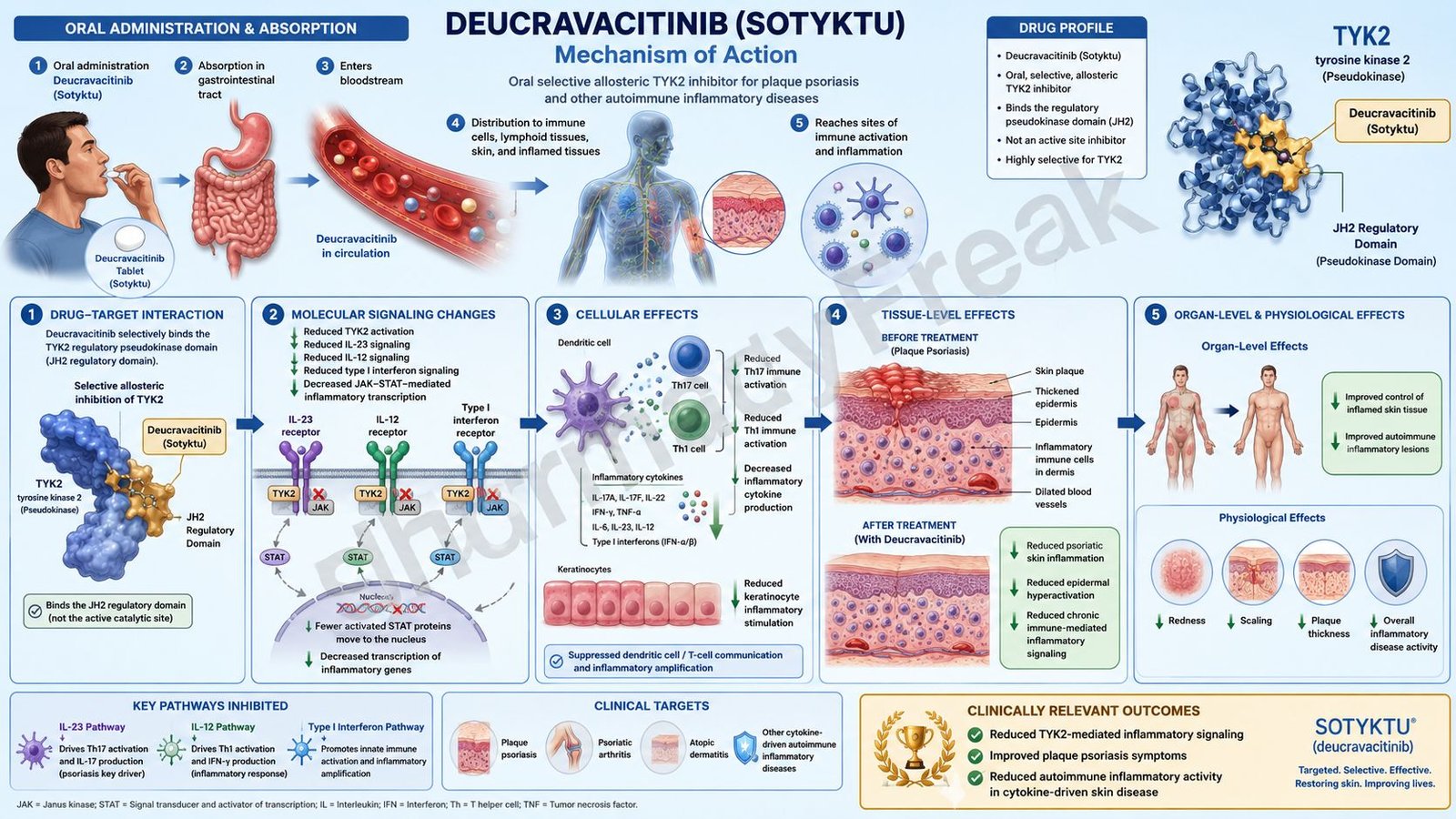
Deucravacitinib works by inhibiting TYK2, a member of the Janus kinase family. However, it is different from many traditional JAK inhibitors because it binds to the regulatory domain of TYK2 rather than directly blocking the conserved ATP-binding catalytic site. This produces allosteric inhibition of TYK2-mediated signaling.
The official Sotyktu label states that deucravacitinib binds to the regulatory domain of TYK2 and stabilizes an inhibitory interaction between the regulatory and catalytic domains of the enzyme. This results in allosteric inhibition of receptor-mediated TYK2 activation and downstream STAT activation. The precise mechanism linking TYK2 inhibition to treatment of plaque psoriasis or active psoriatic arthritis is not currently known.
Sotyktu is indicated for adults with moderate-to-severe plaque psoriasis who are candidates for systemic therapy or phototherapy. It is also indicated for adults with active psoriatic arthritis. It is not recommended for use in combination with other potent immunosuppressants.
For exam purposes, deucravacitinib should be remembered as an oral selective allosteric TYK2 inhibitor used in plaque psoriasis and psoriatic arthritis. Its key mechanism is blockade of TYK2-mediated cytokine signaling, reducing inflammatory pathways involved in psoriatic disease.
Mechanism of Action (Step-wise)
Step 1: Psoriasis is an immune-mediated inflammatory skin disease
Plaque psoriasis involves chronic activation of immune pathways in the skin. Dendritic cells, T lymphocytes, cytokines, and keratinocytes interact to produce erythematous, scaly plaques.
Step 2: Psoriatic arthritis extends inflammation to joints and entheses
Psoriatic arthritis is an inflammatory musculoskeletal disease associated with psoriasis. It can affect peripheral joints, axial skeleton, entheses, tendons, digits, and skin. Cytokine-driven immune activation contributes to pain, swelling, stiffness, enthesitis, dactylitis, and joint damage.
Step 3: Cytokines transmit signals through intracellular kinase pathways
Many inflammatory cytokines act through cell-surface receptors. After cytokine binding, intracellular kinases activate transcription factors that change gene expression and amplify inflammation.
Step 4: TYK2 is part of the Janus kinase family
TYK2 is a member of the Janus kinase family. Janus kinases participate in JAK-STAT signaling, where activated kinases phosphorylate STAT proteins. STAT proteins then regulate transcription of immune and inflammatory genes.
Step 5: TYK2 participates in cytokine signaling
TYK2 pairs with other JAK family members to transmit cytokine signals. The Sotyktu label notes that TYK2 pairs with JAK1 to mediate multiple cytokine pathways and pairs with JAK2 to transmit signals in cell-based assays.
Step 6: Cytokine signaling drives psoriatic inflammation
In plaque psoriasis, cytokine pathways such as IL-23, type I interferon, IL-17-related signaling, and keratinocyte-derived inflammatory mediators contribute to skin inflammation and plaque formation.
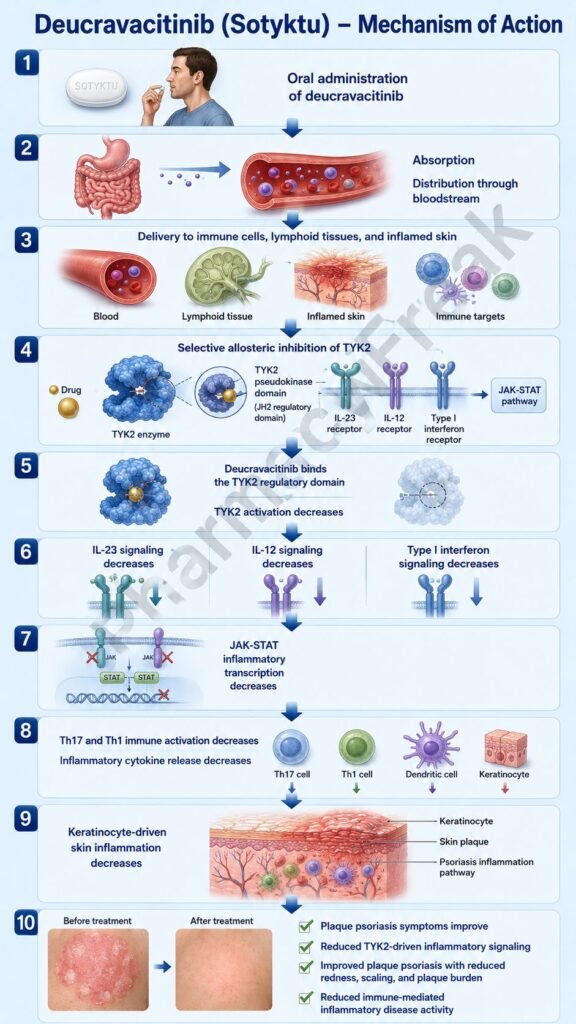
Step 7: Deucravacitinib binds the regulatory domain of TYK2
Deucravacitinib binds to the regulatory domain of TYK2. This is the central molecular mechanism of the drug. This binding site is different from the conserved catalytic ATP-binding site targeted by many JAK inhibitors.
Step 8: TYK2 is inhibited allosterically
Allosteric inhibition means the drug binds to a regulatory site and changes enzyme activity indirectly. Deucravacitinib stabilizes an inhibitory interaction between the regulatory and catalytic domains of TYK2, reducing TYK2 activation.
Step 9: Receptor-mediated TYK2 activation decreases
When TYK2 is allosterically inhibited, cytokine receptor signaling through TYK2 decreases. This reduces the ability of inflammatory cytokines to activate downstream intracellular pathways.
Step 10: STAT activation decreases
TYK2 normally contributes to downstream activation of signal transducers and activators of transcription, called STATs. Deucravacitinib reduces receptor-mediated TYK2 activation and downstream STAT activation in cell-based assays.
Step 11: Psoriasis-associated gene expression decreases
In patients with moderate-to-severe plaque psoriasis, deucravacitinib reduced psoriasis-associated gene expression in psoriatic skin in a dose-dependent manner, including reductions in IL-23 pathway and type I interferon pathway-regulated genes.
Step 12: Circulating inflammatory biomarkers decrease
In patients with moderate-to-severe plaque psoriasis and active psoriatic arthritis, deucravacitinib reduced circulating IL-17A, IL-19, and beta-defensin after 16 weeks of once-daily treatment. In active psoriatic arthritis, reductions in biomarkers such as CRP, MMP3, MMP1, C1M, and TNF-alpha were also observed, although the relationship between these markers and clinical effect is not fully known.
Step 13: Skin inflammation decreases
By reducing TYK2-mediated cytokine signaling, inflammatory communication between immune cells and keratinocytes decreases. This helps reduce plaque thickness, redness, scaling, and skin lesion activity in responsive patients.
Step 14: Joint and enthesis inflammation may decrease
In psoriatic arthritis, decreased cytokine signaling can reduce inflammatory activity in joints and entheses. This may improve joint pain, swelling, stiffness, function, and inflammatory biomarkers in responsive patients.
Step 15: Final therapeutic outcome
The final therapeutic effect of deucravacitinib is reduction of immune-mediated inflammatory signaling in plaque psoriasis and active psoriatic arthritis. It improves psoriatic disease activity by selectively inhibiting TYK2-dependent cytokine pathways, but it does not cure psoriasis or psoriatic arthritis.
Pharmacokinetics
Deucravacitinib is administered orally as Sotyktu tablets. The recommended dosage is 6 mg orally once daily, with or without food. Tablets should not be crushed, cut, or chewed. Sotyktu is available as 6 mg film-coated tablets.
Before starting Sotyktu, patients should be evaluated for active and latent tuberculosis. Active TB is a reason not to administer treatment, and latent TB should be treated before starting therapy. Age-appropriate immunizations should also be completed according to current immunization guidelines.
Deucravacitinib has high oral bioavailability. The absolute oral bioavailability is approximately 99%, and the median time to maximum concentration is about 2 to 3 hours in healthy subjects.
Food does not produce a clinically significant effect on exposure. A high-fat, high-calorie meal decreased deucravacitinib Cmax by approximately 24% and AUC by approximately 11%, while delaying Tmax by about 1 hour. This supports administration with or without food.
The volume of distribution at steady state is approximately 140 L. Protein binding ranges from 82% to 90%, and the blood-to-plasma concentration ratio is about 1.26.
The terminal half-life of deucravacitinib is approximately 10 hours. Accumulation after once-daily dosing is less than 1.4-fold in healthy subjects.
Deucravacitinib is metabolized mainly by CYP1A2 to form the major metabolite BMT-153261. It is also metabolized by CYP2B6, CYP2D6, carboxylesterase 2, and UGT1A9. The active metabolite BMT-153261 has comparable potency to the parent drug, but its circulating exposure accounts for about 20% of total drug-related systemic exposure.
After radiolabeled dosing, approximately 13% of the dose was recovered unchanged in urine and 26% unchanged in feces. BMT-153261 was also recovered in urine and feces.
No dosage adjustment is recommended in mild or moderate hepatic impairment, but Sotyktu is not recommended in severe hepatic impairment, specifically Child-Pugh class C.
No clinically significant pharmacokinetic differences were observed with several commonly evaluated interacting drugs, including cyclosporine, fluvoxamine, ritonavir, diflunisal, pyrimethamine, famotidine, and rabeprazole. Deucravacitinib also did not produce clinically significant pharmacokinetic differences with rosuvastatin, methotrexate, mycophenolate mofetil, metformin, or oral contraceptives in interaction studies.
Clinical Uses
Deucravacitinib is used for adults with moderate-to-severe plaque psoriasis who are candidates for systemic therapy or phototherapy. This means it is used when topical therapy alone is not enough or when disease severity requires systemic treatment.
Deucravacitinib is also used for adults with active psoriatic arthritis. This is an important updated indication because it extends Sotyktu beyond skin-only psoriasis into inflammatory joint disease.
In plaque psoriasis, deucravacitinib helps reduce inflammatory skin plaques by targeting TYK2-mediated cytokine pathways involved in psoriatic inflammation.
In psoriatic arthritis, deucravacitinib helps reduce immune-mediated inflammation affecting joints, entheses, skin, and systemic inflammatory pathways.
Deucravacitinib is not recommended for use in combination with other potent immunosuppressants. This is important because combining strong immunosuppressive drugs can increase infection and safety risks.
Deucravacitinib is not a biologic monoclonal antibody, not a TNF-alpha inhibitor, not an IL-17 inhibitor, not an IL-23 inhibitor, and not a corticosteroid. It is an oral small-molecule TYK2 inhibitor.
Sotyktu is not approved for rheumatoid arthritis. The label specifically notes that Sotyktu is not approved for use in RA, which is important because warnings related to JAK inhibition are discussed in the label.
Sotyktu is not approved for pediatric patients. The label states that safety and effectiveness in pediatric patients have not been established.
Adverse Effects
The adverse effects of deucravacitinib are mainly related to immune modulation, infection risk, viral reactivation, laboratory abnormalities, muscle toxicity, malignancy concern, and potential class-related concerns connected to JAK pathway biology.
Hypersensitivity reactions can occur. Angioedema has been reported in subjects receiving Sotyktu. If a clinically significant hypersensitivity reaction occurs, Sotyktu should be discontinued and appropriate therapy should be given.
Infections are important. Sotyktu may increase the risk of infections, and serious infections have been reported. The most common serious infections reported with Sotyktu included pneumonia and COVID-19. Use should be avoided in patients with active or serious infection. If serious infection develops, treatment should be interrupted until the infection resolves or is adequately treated.
Viral reactivation can occur. Herpes virus reactivation, including herpes simplex and herpes zoster, was reported in clinical trials. The label also notes that the clinical implications of Sotyktu on viral hepatitis reactivation are unknown and recommends considering hepatitis screening and monitoring according to clinical guidelines.
Tuberculosis screening is required before treatment. Patients should be evaluated for latent and active TB before starting Sotyktu. Active TB should not be treated with Sotyktu, and latent TB should be treated before therapy begins.
Malignancies, including lymphomas, were observed in clinical trials with Sotyktu. The benefits and risks should be considered before starting or continuing therapy, especially in patients with known malignancy or those who develop malignancy during treatment.
Rhabdomyolysis and elevated creatine phosphokinase are important warnings. Sotyktu was associated with increased incidence of asymptomatic CPK elevation and rhabdomyolysis compared with placebo. Treatment should be discontinued if markedly elevated CPK occurs or if myopathy is diagnosed or suspected.
Laboratory abnormalities may occur. Triglyceride elevations have been reported, and serum triglycerides should be periodically evaluated according to clinical guidelines. Liver enzyme elevations can occur, and liver enzymes should be evaluated at baseline and during treatment in patients with known or suspected liver disease.
Live vaccines should be avoided during Sotyktu treatment. Immunizations should be completed before treatment according to current guidelines, including prophylactic herpes zoster vaccination when appropriate.
The label discusses potential risks related to JAK inhibition. It states that it is not known whether TYK2 inhibition may be associated with observed or potential adverse reactions of JAK inhibition. In a postmarketing safety trial of a JAK inhibitor in rheumatoid arthritis, higher rates of all-cause mortality, sudden cardiovascular death, major adverse cardiovascular events, thrombosis, deep venous thrombosis, pulmonary embolism, and malignancies were observed compared with TNF blockers. Sotyktu is not approved for RA.
The most common adverse reactions reported in at least 1% of patients include upper respiratory infections, increased blood creatine phosphokinase, herpes simplex, mouth ulcers, folliculitis, and acne.
Pregnancy data are limited. Available case reports are insufficient to evaluate a drug-associated risk of major birth defects, miscarriage, or adverse maternal or fetal outcomes. Deucravacitinib is present in rat milk, and there are no adequate data on its presence in human milk.
Comparative Analysis
Deucravacitinib is commonly compared with apremilast, methotrexate, cyclosporine, TNF inhibitors, IL-17 inhibitors, IL-23 inhibitors, IL-12/23 inhibitors, and traditional JAK inhibitors.
Compared with apremilast, deucravacitinib has a different intracellular target. Apremilast inhibits phosphodiesterase-4 and increases intracellular cAMP, while deucravacitinib inhibits TYK2-mediated cytokine signaling.
Compared with methotrexate, deucravacitinib is more targeted toward TYK2 signaling. Methotrexate has broader immunomodulatory and antiproliferative effects and is used in several autoimmune diseases, including psoriasis and psoriatic arthritis.
Compared with cyclosporine, deucravacitinib does not inhibit calcineurin. Cyclosporine reduces T-cell activation by blocking calcineurin-dependent IL-2 transcription, while deucravacitinib reduces TYK2-mediated cytokine signaling.
Compared with TNF inhibitors such as adalimumab, etanercept, and infliximab, deucravacitinib is oral and intracellular. TNF inhibitors are biologics that neutralize TNF-alpha or block TNF receptor signaling, while deucravacitinib inhibits TYK2.
Compared with IL-17 inhibitors such as secukinumab and ixekizumab, deucravacitinib acts upstream on intracellular cytokine signaling rather than directly neutralizing IL-17A. Both approaches can reduce psoriatic inflammation, but the targets are different.
Compared with IL-23 inhibitors such as guselkumab, risankizumab, and tildrakizumab, deucravacitinib is a small molecule rather than a monoclonal antibody. IL-23 inhibitors directly target IL-23 pathway cytokine biology, while deucravacitinib inhibits TYK2-mediated signaling involved in IL-23 and related inflammatory pathways.
Compared with ustekinumab, deucravacitinib differs by drug class and target. Ustekinumab is a monoclonal antibody against the p40 subunit shared by IL-12 and IL-23. Deucravacitinib is an oral TYK2 inhibitor.
Compared with traditional JAK inhibitors such as tofacitinib, baricitinib, and upadacitinib, deucravacitinib is designed for selective allosteric TYK2 inhibition. Many traditional JAK inhibitors bind catalytic domains of JAK enzymes, while deucravacitinib binds the regulatory domain of TYK2. The Sotyktu label still notes that it is unknown whether TYK2 inhibition may share some observed or potential adverse reactions of JAK inhibition.
Compared with topical corticosteroids, deucravacitinib is systemic therapy. Topical corticosteroids are useful for localized inflammatory skin lesions, while deucravacitinib is used when adult disease is moderate-to-severe or when active psoriatic arthritis requires systemic treatment.
MCQs
- Deucravacitinib is marketed under which brand name?
a) Otezla
b) Sotyktu
c) Cosentyx
d) Tremfya
Answer: b) Sotyktu
- Deucravacitinib belongs to which pharmacological class?
a) TYK2 inhibitor
b) TNF-alpha inhibitor
c) PDE4 inhibitor
d) IL-17A monoclonal antibody
Answer: a) TYK2 inhibitor
- TYK2 belongs to which kinase family?
a) Janus kinase family
b) Cyclin-dependent kinase family
c) Receptor tyrosine kinase family only
d) RAF kinase family
Answer: a) Janus kinase family
- Deucravacitinib inhibits TYK2 mainly by binding to the:
a) Regulatory domain
b) Ribosomal subunit
c) Dopamine receptor pocket
d) Fc receptor
Answer: a) Regulatory domain
- Deucravacitinib produces which type of TYK2 inhibition?
a) Allosteric inhibition
b) Direct DNA alkylation
c) Irreversible beta blockade
d) Competitive GABA activation
Answer: a) Allosteric inhibition
- TYK2 signaling activates which downstream transcription factors?
a) STAT proteins
b) Histamine H1 receptors
c) GABA-A receptors
d) Dopamine transporters
Answer: a) STAT proteins
- Deucravacitinib is indicated for adults with:
a) Moderate-to-severe plaque psoriasis candidates for systemic therapy or phototherapy
b) Acute bacterial meningitis
c) Parkinson’s disease
d) Chronic insomnia only
Answer: a) Moderate-to-severe plaque psoriasis candidates for systemic therapy or phototherapy
- Deucravacitinib is also indicated for adults with:
a) Active psoriatic arthritis
b) Rheumatoid arthritis
c) Multiple sclerosis
d) Ulcerative colitis only
Answer: a) Active psoriatic arthritis
- The recommended Sotyktu dose is:
a) 6 mg orally once daily
b) 80 mg orally twice daily
c) 300 mg IV every 4 weeks
d) 5 mg once nightly
Answer: a) 6 mg orally once daily
- Sotyktu can be taken:
a) With or without food
b) Only with a high-fat meal
c) Only on an empty stomach
d) Only after crushing the tablet
Answer: a) With or without food
- Before starting Sotyktu, patients should be evaluated for:
a) Active and latent tuberculosis
b) Only blood glucose every hour
c) Only hearing loss
d) Only serum calcium
Answer: a) Active and latent tuberculosis
- Which vaccine type should generally be avoided during Sotyktu therapy?
a) Live vaccines
b) Inactivated influenza vaccines only
c) Recombinant vaccines only
d) Toxoid vaccines only
Answer: a) Live vaccines
- Which adverse effect is associated with Sotyktu?
a) Elevated creatine phosphokinase and rhabdomyolysis
b) Mandatory hypoglycemia in every patient
c) Severe ototoxicity
d) Thyroid C-cell tumor warning
Answer: a) Elevated creatine phosphokinase and rhabdomyolysis
- Which infection-related event was reported with Sotyktu?
a) Herpes simplex and herpes zoster reactivation
b) Rabies infection in every patient
c) Mandatory tuberculosis in every patient
d) Malaria cure
Answer: a) Herpes simplex and herpes zoster reactivation
- Which statement best describes deucravacitinib?
a) It selectively inhibits TYK2 allosterically and reduces cytokine-mediated inflammatory signaling in psoriatic disease
b) It neutralizes TNF-alpha extracellularly
c) It blocks IL-17A directly as a monoclonal antibody
d) It inhibits PDE4 and increases cAMP
Answer: a) It selectively inhibits TYK2 allosterically and reduces cytokine-mediated inflammatory signaling in psoriatic disease
FAQs
What is the mechanism of action of deucravacitinib?
Deucravacitinib inhibits TYK2 by binding to its regulatory domain. This stabilizes an inhibitory interaction between the regulatory and catalytic domains, causing allosteric inhibition of TYK2 activation and downstream STAT signaling.
What is the brand name of deucravacitinib?
The brand name of deucravacitinib is Sotyktu.
What is deucravacitinib used for?
Deucravacitinib is used in adults with moderate-to-severe plaque psoriasis who are candidates for systemic therapy or phototherapy. It is also used in adults with active psoriatic arthritis.
Is deucravacitinib a JAK inhibitor?
Deucravacitinib inhibits TYK2, which belongs to the Janus kinase family. However, it is designed as a selective allosteric TYK2 inhibitor and binds the regulatory domain of TYK2, unlike many traditional JAK inhibitors that target catalytic domains.
Is deucravacitinib a biologic?
No. Deucravacitinib is not a biologic monoclonal antibody. It is an oral small-molecule TYK2 inhibitor.
Is Sotyktu used for rheumatoid arthritis?
No. Sotyktu is not approved for rheumatoid arthritis. The label specifically notes that it is not approved for RA.
What monitoring is important with deucravacitinib?
Patients should be evaluated for TB before treatment. Clinicians should monitor for infections, viral reactivation, malignancy, muscle symptoms, CPK elevation, triglycerides, and liver enzymes in patients with known or suspected liver disease.
What are common adverse effects of deucravacitinib?
Common adverse effects include upper respiratory infections, increased blood creatine phosphokinase, herpes simplex, mouth ulcers, folliculitis, and acne.
References
Goodman & Gilman’s The Pharmacological Basis of Therapeutics
Katzung Basic & Clinical Pharmacology
K.D. Tripathi Essentials of Medical Pharmacology
Harrison’s Principles of Internal Medicine